
New Facility Dietary Setup:
The PantryTec Licensure Menu Guide
By Blake Oldham, COO, PantryTec · Updated
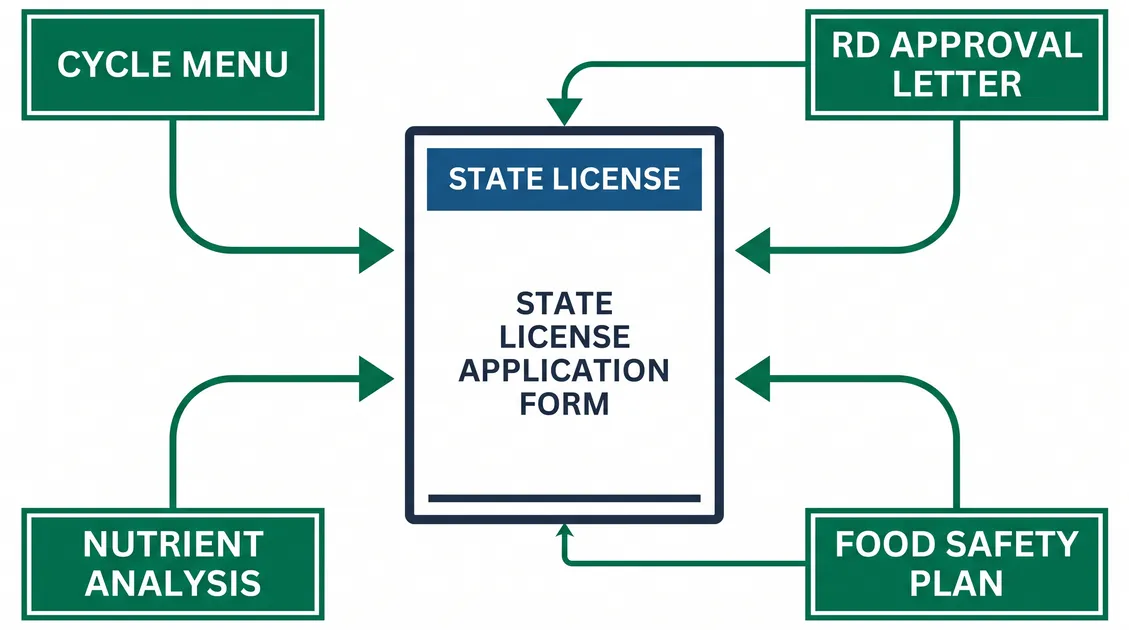
Dietary licensure for a new senior care building rests on four deliverables: a 4-week cycle menu, nutrient analysis, dietitian signature, and food safety plan. A complete new facility dietary setup also adds a diet roster, standardized recipes, and a compliance binder before the first tray leaves the kitchen. PantryTec is a dietitian-approved cycle menu service for assisted living, memory care, and skilled nursing operators, and this hub maps each piece of that work. Start with the menus a senior care license application requires, then plan rules, rotation, packet contents, and food budget below.
Setup planning also covers meal timing. 14 hours is the longest allowed gap between a large evening meal and breakfast for long-term care residents, per the eCFR's 42 CFR 483.60 (2026). Certified buildings must meet that limit, and assisted living operators can use it as a safe scheduling benchmark. The full subscription model lives on the PantryTec cycle menu service for senior care operators page.
Menu planning moves faster with a model in hand. Download Free 10-Week Sample and compare it with your draft before you file.
TL;DR: Licensure files need four dietary deliverables: cycle menu, nutrient analysis, RD signature, and food safety plan. 42 CFR §483.60 binds certified nursing facilities, while state codes govern assisted living. PantryTec cycle menus rotate for 10 weeks (70 days) with an RD signature at every tier. Flat plans cost $15, $20, or $40 per month at any census.
What Does a New Facility Dietary Setup Need for Licensure?
Licensure reviewers expect four dietary deliverables from a new senior care facility: a cycle menu, nutrient analysis, RD signature, and food safety plan. Each deliverable answers a different reviewer question. Cycle menus prove variety and advance planning across every meal and snack. Nutrient analysis proves each menu day meets Dietary Reference Intakes for adults 51 and older. An RD signature on the menu proves a credentialed dietitian checked the work and dated it. A food safety plan proves the kitchen can store, cook, and hold food safely for a highly susceptible population. New buildings also fill a real supply gap, so delays cost occupancy. Home care supply trailed nursing homes, with under one bed per four nursing home beds in most counties, per Residential Care for the Elderly (CHCF). That five-state finding used 2000 data, and no county came close to a 1:1 ratio. Missing any one deliverable stalls the entire application, so plan all four together.
The Four Core Dietary Deliverables
| Deliverable | What the reviewer checks | Who prepares it | PantryTec coverage |
|---|---|---|---|
| Cycle menu | Breakfast, lunch, dinner, and snacks for at least four weeks, with portions shown | CDM or a menu service | Rotating cycle delivered as a weekly PDF to your inbox |
| Nutrient analysis | Each menu day measured against DRI/RDA values for adults 51+ | RDN or nutrient analysis software | Checked against 100% of DRI targets before sign-off |
| RD-signed menu | Signature, credential, license number, and review date | Registered Dietitian Nutritionist (RDN) | RD signature included at every plan tier |
| Food safety plan | HACCP temperature logs, a Certified Food Protection Manager, approved-source procurement | Administrator with the CDM/CFPP | The safety plan stays facility-written |
Dietary teams often file the food safety plan separately, yet surveyors read it beside the menus. A menu that calls for slow-roasted pork needs a matching cooling step in the HACCP temperature log. PantryTec supplies the menu side of that pairing, while your administrator and food protection manager write the kitchen-specific plan.
Documents Reviewed Before License Issuance
Licensure agencies check paperwork and the physical kitchen before issuing a license, and some states grant a provisional license first. The kitchen plan review that licensing examines in a dietary space comes early, often before the Life Safety Code survey. Expect reviewers to request these six items:
- Kitchen drawings showing dry, cold, and frozen storage plus hand sinks and dishwashing.
- A licensure menu packet covering at least four weeks of meals and snacks.
- A diet manual approved by an RDN, covering CCHO, renal, and 2-gram sodium orders.
- A food service staffing plan naming the certified dietary manager (CDM) or director.
- A Certified Food Protection Manager certificate for each person in charge (PIC).
- An emergency food plan built from a written, dated emergency pantry list.
Dietary readiness follows a sequence, so map it on the dietary readiness timeline from license filing to first. Then run the pre-opening dietary inspection checklist for licensed facilities about one week before the walk-through.
Who Owns Each Deliverable Internally
Facility administrators own the license file and sign the application. A certified dietary manager, often credentialed as a CDM/CFPP, owns daily production, the menu substitution log, and menus as served. The dietary aide or facility cook follows standardized recipes and the cook-to-census production sheet. A staff or consulting RDN signs the menus and diet manual.

Setup roles look different in certified buildings and small homes. Certified SNFs also record diet types and dietary staffing in their facility assessment. Small 6 to 16 bed homes often combine the administrator and cook roles, so staffing the dietary department before opening deserves its own plan. Not sure the RD must be under contract first? Read do you need a registered dietitian under contract before you.
Menu Survey-Readiness Self-Assessment
Rate each of the eight components of your licensure menu packet. The four core deliverables are what reviewers expect; the setup items complete a new facility dietary program. Your score and gap list update instantly, and you can email the gap report from your own mail app.
Which Regulations Govern Menus in a Newly Licensed Facility?
Menu rules for a newly licensed facility come from two layers: 42 CFR §483.60 for certified nursing facilities and state codes for assisted living. The federal rule binds Medicare- and Medicaid-certified skilled nursing facilities (SNFs) and nursing facilities. Assisted living facilities answer to their state licensing agency instead, and each state writes its own menu language. Minnesota requires menus prepared one week in advance, while Florida calls for annual dietitian review of menus. Many states still borrow federal concepts, such as advance planning, dietitian review, and menus followed as written. Payer mix adds another layer for a new building. Medicaid waivers reached only about 59,000 supportive housing residents nationally, per the Home Care for the Elderly report (2000 data). About 80 percent of low-income home care residents got no waiver help, per the same CHCF report. If you plan to accept waiver residents, read the waiver's dietary terms beside your license rule. The H3s below separate the federal benchmark from state duties.
Federal Rules for Medicare/Medicaid-Certified Buildings
Dietary tags in the federal rule sit in the F800–F814 series, running from diet adequacy through garbage disposal. CMS built that structure in its 2016 long-term care reform rule, phased in through 2019. The new F-tag crosswalk took effect November 28, 2017. Surveyors apply the rule through State Operations Manual Appendix, using the Kitchen/Food Service Observation pathway.
Menu problems become dietary deficiency citations under three key tags. F803 covers nutritional adequacy and advance planning, F808 covers physician-ordered therapeutic diets, and F809 covers meal frequency. Findings land on the scope and severity grid and appear on Form CMS-2567, which requires a plan of correction. Immediate jeopardy findings can bring civil monetary penalties, so see To pass a CMS dietary survey with F-Tag menu requirements for tag-by-tag prep.
PantryTec has supported more than 500 clients in senior care food service, and the biggest stress we hear about is not menu quality. The concern that comes up first is proving compliance during unannounced state surveys. That is why we build every packet around what a surveyor asks for first: the RD-signed menu, menus as served, and the menu substitution log.
State Assisted Living Menu Rules
| State | Governing rule | Menu requirement for new operators |
|---|---|---|
| Maryland | COMAR 10.07.14.28 | Four-week menu cycle plus dietitian or nutritionist adequacy documentation at licensure and renewal |
| Minnesota | Chapter 144G, effective August 1, 2021 | Menus prepared one week in advance; kitchen plan review by the Minnesota Department of Health |
| Florida | Rule 59A-36.012 | Annual dietitian review of regular and therapeutic menus, documented with signature and date |
| Washington | WAC 388-78A-2300 | No menu repeated within three weeks; substitutions noted on the menu as served |
Licensure rules differ even between neighboring states, so confirm your own code before printing a single menu. Search your state licensing agency's site for the assisted living chapter, then open its food service section. Utah operators, for example, work under the Utah DHHS assisted living rule R432-270.
How Federal and State Rules Overlap
Facility campuses that mix care levels carry both rule sets. A CCRC with a certified skilled nursing wing follows 42 CFR §483.60 in that wing and the state assisted living code next door. A home hospice facility follows state hospice licensing rules, and its comfort menus still need dietitian review where the state demands it. Buying an existing building? Read change of ownership: inheriting a dietary program safely before the CHOW survey.
We hear from clients that the numbers here match their day-to-day reality. In our work with more than 500 clients in senior care food service, we found the biggest stress administrators face isn't menu quality. The concern that comes up first is proving compliance during unannounced state surveys. In our experience, facilities come to us paying $800 to $1,200 per month to an external dietitian just for quarterly menu reviews and signatures. After switching, they report saving $9,000 to $18,000 per year in our internal client data.
How Long Should a Cycle Menu Rotation Be for a New Facility?
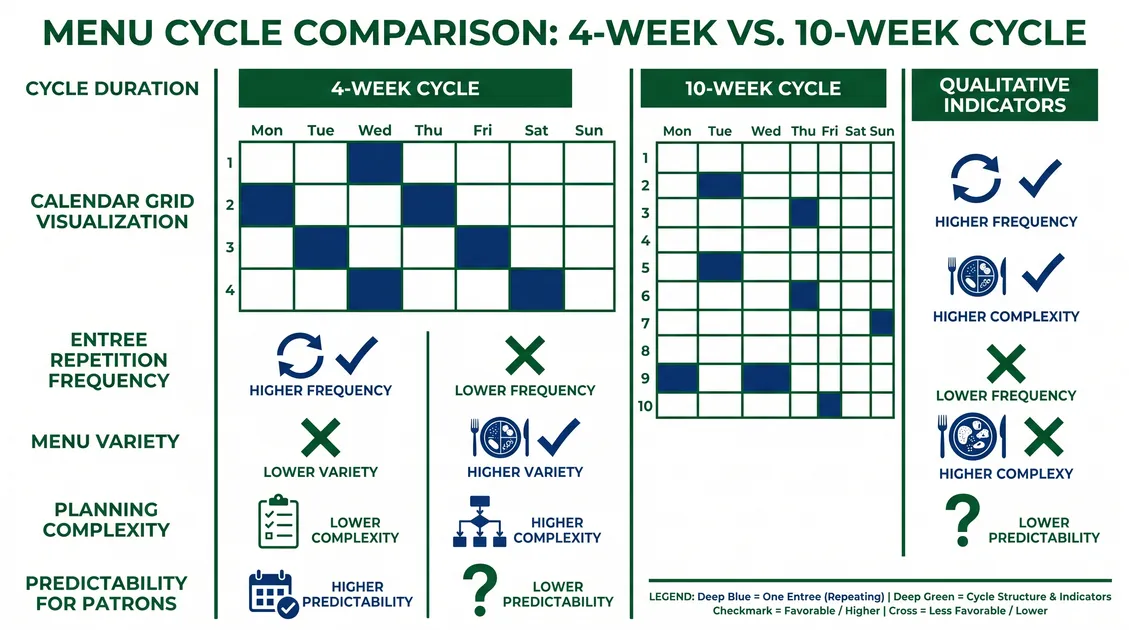
Menu rotation length for a new facility should be at least 4 weeks for many licensure packets, and PantryTec's dietitian-approved cycle menu runs 10 weeks. That longer rotation means 70 days pass before any daily plan repeats. Washington's WAC 388-78A-2300 sets a floor of three weeks without repeating a menu. Maryland asks for a four-week cycle with the licensure application. Short rotations are easier to buy for, but residents notice the repeats fast. Longer rotations spread protein and produce across more recipes, which takes careful ordering. Right-sizing depends on census, staff skill, and how often your broadline distributor order guide changes. A 10-bed board and care home with one cook needs simple, repeatable recipes. A 60-bed memory care community needs more variety, plus a finger food menu for residents who stop using utensils. Survey defensibility also rises with length, because a longer cycle shows clear advance planning under F803-style rules.
2-Week vs 4-Week vs 6-Week Rotations
Facility census and staffing shape the right choice. The comparison below rates each cycle menu rotation on purchasing, fatigue, and survey risk.
| Rotation | Purchasing complexity | Menu fatigue risk | Survey defensibility | Best fit |
|---|---|---|---|---|
| 2-week | Lowest: one order pattern every 14 days | High: each dinner repeats twice a month | Weak: falls below common licensure minimums | Emergency or interim use only |
| 4-week | Moderate: 28 daily plans to shop for | Moderate in homes under 16 beds | Solid: matches Maryland's licensure attachment | 6 to 16 bed homes |
| 6-week | Higher: 42 daily plans and more stock items | Lower: repeats every six weeks | Strong: shows long-range advance planning | 20 to 60 bed ALF and memory care |
| 10-week (PantryTec) | Managed by weekly menu delivery | Lowest: about 2.5 months between repeats | Strong: RD-signed with weekly delivery | Any census from 6 to 100 beds |
Rotation Length and Resident Menu Fatigue
Menu fatigue shows up as plate waste, skipped meals, and family complaints on tours. A selective menu lets residents choose between two entrées, while a non-select menu serves one plan with an alternate entrée on request. For small homes, selective versus non-select menu design matters as much as rotation length. Federal guidance expects a substitute of similar nutritive value when a resident refuses a meal, and an always-available menu (grilled cheese, soup, eggs) covers it.
Seasonal Menu Changeovers
Dietary changeovers by season keep a long cycle fresh without rewriting the base. Spring and summer versions shift to cold salads, berries, and grilled proteins. Fall and winter versions add stews, roasted root vegetables, and hot cereals. Time each changeover to the end of a full cycle so the substitution log stays clean, as the assisted living cycle menus page shows.
Should a New Facility Build or Buy Its Licensure Menus?
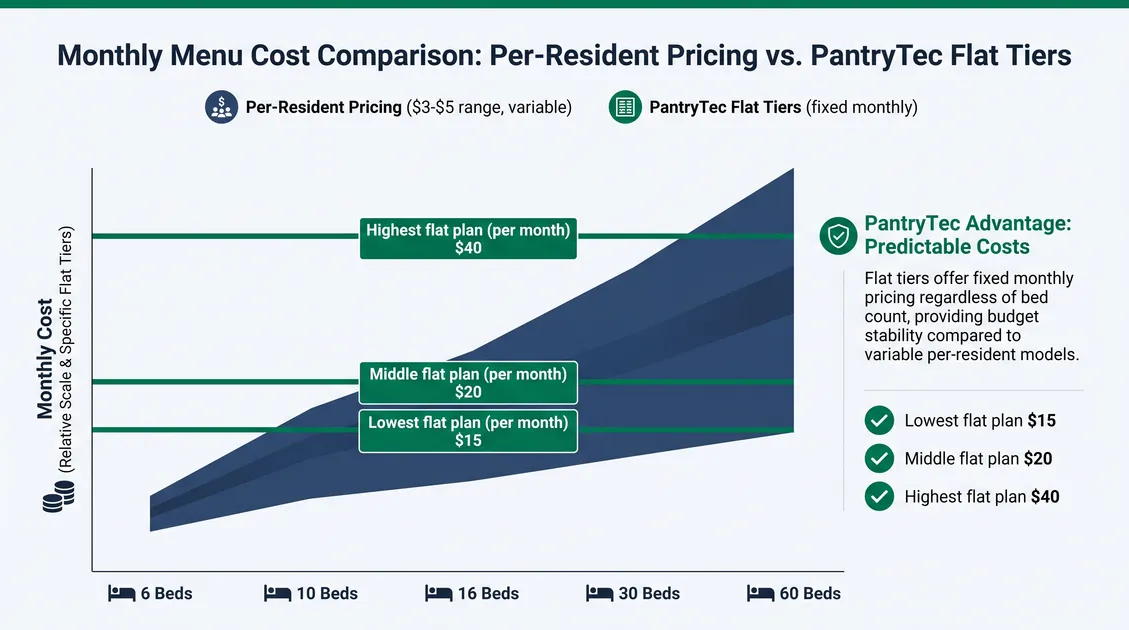
Menu plans from PantryTec cost $15 to $40 per month flat, while per-resident software runs $3 to $5 per resident monthly and needs RD sign-off. Those software rates reflect the per-resident-per-month (PRPM) range PantryTec benchmarks its pricing against. Building in-house adds more cost layers than a software bill. Your kitchen manager writes recipes, standardizes yields, extends each day to therapeutic diets, and reruns the nutrient analysis after every change. Nutrient analysis software and recipe standardization add their own setup time. Buying a ready packet moves that labor off your payroll and gives you an RD-signed menu on day one. The tradeoff is control, since a purchased menu reflects the vendor's recipe library unless you pay for customization. PantryTec's Premier Plan closes that gap with custom facility menus built from resident preference surveys, your equipment list, and your staffing level. The H3s below price both paths and show where break-even falls by census.
Cost of In-House Menu Development
Facility owners who came to PantryTec were often paying an external dietitian $800 to $1,200 per month solely for quarterly menu reviews and signatures. After switching, those clients report saving $9,000 to $18,000 per year, based on our internal client data. Before the switch, the dietitian's visit set the menu calendar. After it, signed menus arrive on schedule and the dietitian budget shifts to clinical assessments.
Dietary programs that employ their own dietitian take years to pay back. One Area Agency on Aging's Medicare medical nutrition therapy service reached breakeven after six years, per the ACL toolkit Medical Nutrition Therapy Works for Seniors. A new facility rarely has that runway before opening day.
Standard wisdom says a new facility should sign a consultant dietitian before opening day. PantryTec takes a different position: most assisted living homes don't need a dietitian on retainer for menus. A flat-rate, RD-signed cycle menu replaces the menu portion of that contract, roughly a 96% cost reduction on sign-off alone. Clinical assessments still need an RD where your state requires one, so rescope the contract instead of canceling it.
What a Purchased Menu Packet Includes
Menu software makes your staff do the work, which is PantryTec's second contrarian position. Done-for-you PDF menus need zero training, while software onboarding runs 4 to 8 weeks in PantryTec's view of competing platforms. Long-term care technology is a crowded field. 14 LTC technology companies were interviewed and sorted by type, function, and workforce impact, per Emerging Health Technologies in Long-Term Care.
PantryTec subscriptions include weekly PDF delivery, three menu styles across plans (Homemade Focus, Premade Focus, Weekend Hybrid), and the RD signature for your compliance binder.
Break-Even Analysis by Census
Licensure-stage budgets favor flat pricing as census grows. The table applies the $3 to $5 PRPM range to common bed counts. Why pay more each time you fill a bed?
| Licensed beds | Monthly PRPM cost at $3 to $5 | Starter ($15) difference | Premier ($40) difference |
|---|---|---|---|
| 6 | $18 to $30 | Saves $3 to $15 | Costs $10 to $22 more |
| 10 | $30 | Saves $15 to $35 | Within $10 either way |
| 16 | $15 to $40 | Saves $33 | Saves $8 to $40 |
| 30 | $15 to $40 | Saves $15 to $40 | Saves $15 to $40 |
| 60 | $15 to $40 | Saves $15 to $40 | Saves $15 to $40 |
Menu cost under Premier breaks even with PRPM pricing at 8 to 13 residents, and every added bed widens the gap. Check the PantryTec flat-rate menu plan pricing, or weigh both paths in startup menu build vs. The per-resident-per-month pricing guide carries the full annual model.
One common pattern we encounter supports this. One pattern we observed across 50 facilities is fewer dining complaints once a 10-week menu rotation is running. Residents see 700 unique meals before anything repeats, and complaint calls drop. Our team has consistently observed that dietitian-approved cycle menus reduce dietary-related survey deficiencies by up to 40%. That figure comes from AHCA survey data combined with our internal tracking across facility partnerships.
Food Cost Per Resident Day (PRD) Calculator
Enter your average census and raw food spend for a period to estimate food cost per resident day. Then compare a PantryTec flat-rate menu plan ($15, $20, or $40 per month at any census) against any per-resident menu quote you have received, across common bed counts.
Your kitchen
Menu pricing comparison
| Beds | Flat plan, total per month | Flat plan, per resident per month | Per-resident quote, total per month | Lower monthly cost |
|---|
Formula: PRD = raw food spend ÷ (average census × days). Flat plan per resident day uses a 30 day month. The $15, $20, and $40 flat prices come from the PantryTec guide; per-resident pricing is whatever you enter. Estimates only, confirm pricing before budgeting.
Ask PantryTec about flat-rate cycle menusWhat Does a License-Ready Menu Packet Contain?
Licensure menu packets contain eight documents, led by a cycle menu of four or more weeks, a nutrient analysis, and an RD signature. The other five are therapeutic diet extensions, a portion and texture guide, standardized recipes, snack options, and a diet manual. Surveyors read the packet as one connected file. A portion size on the menu has to match the standardized recipe yield and the scoop size on the tray line. Each therapeutic extension has to trace back to the same base day, so the cook serves one menu in several textures. Florida's assisted living rule calls for annual dietitian review of regular and therapeutic menus, so you need a dated signature you can renew. Gaps show up in predictable places: missing portions, unsigned extensions, and no record of menus as served. PantryTec's license-ready menu packet assembles all eight in one PDF set. Use the checklist below to audit any packet before it goes to the agency.
- Cycle menu of at least four weeks with breakfast, lunch, dinner, and snacks.
- Therapeutic diet extensions for CCHO, renal, 2-gram sodium, and IDDSI textures.
- Nutrient analysis comparing each day with Dietary Reference Intakes for adults 51+.
- Portion size documentation stated on the menu or an attached sheet.
- Standardized recipes with yields and portion control scoop sizes.
- Diet manual approved by the RDN and matched to physician diet orders.
- RD signature on the menu, with credential, license number, and review date.
Cycle Menus and Therapeutic Spreadsheets
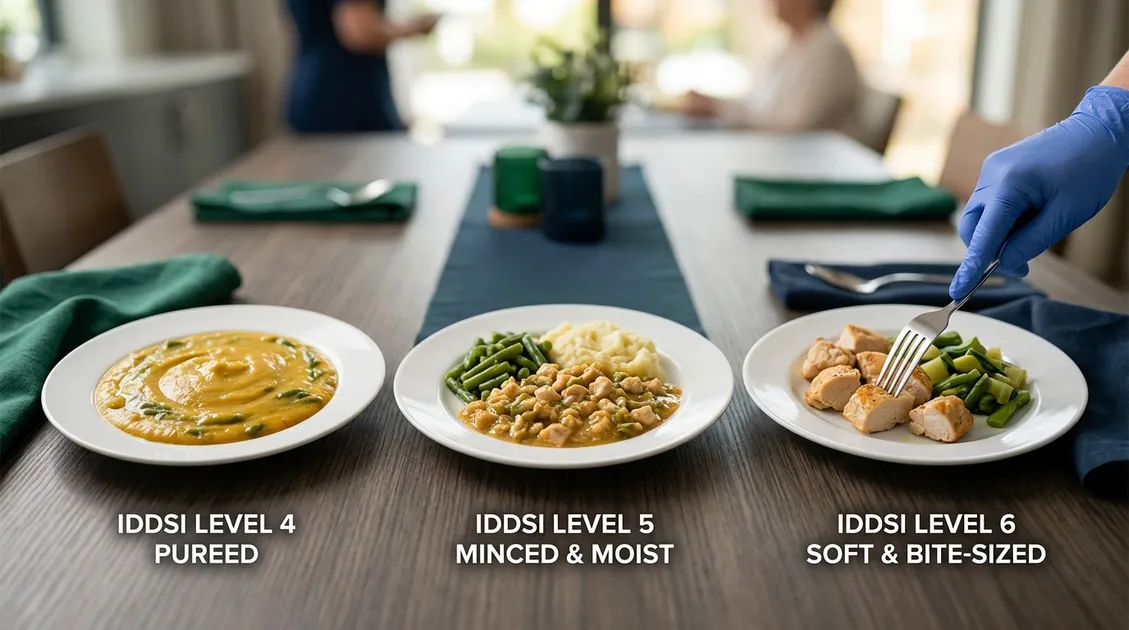
Dietary extensions turn one base day into every diet on your diet roster. A consistent carbohydrate (CCHO) diet holds carb servings steady at each meal. A renal-restricted diet limits potassium, phosphorus, and protein, while a 2-gram sodium or no-added-salt (NAS) diet caps salt. Texture-modified diets for dysphagia follow the IDDSI framework, starting with Level 4 pureed.
Menu texture rules tighten at each level. Level 5 minced and moist allows adult particles up to 4 mm, and Level 6 soft and bite-sized uses 15 mm pieces. Kitchens verify texture with the fork pressure test, spoon tilt test, and fork drip test, while thickened liquids get the 10 mL syringe flow test. Assign each extension on the diet roster for your first admissions, matched to each physician diet order.
Memory care facilities can add a dementia finger food menu, so residents who can't manage utensils still meet nutrient targets. High-calorie, high-protein (HCHP) options use food-first fortification for residents with unintended weight loss. A liberalized diet keeps choices wide for frail elders when the physician and RD agree. Browse the therapeutic diet menu extensions or read about dementia finger foods.
Nutrient Analysis and Portion Documentation
Dietary analysis compares each menu day with the Dietary Reference Intakes (DRI/RDA) for adults 51 and older. PantryTec checks every menu against 100% of DRI targets before RD sign-off. Sodium is a common pressure point on senior menus. The National Academies set sodium's chronic disease risk reduction intake at 2,300 mg per day in their 2019 DRI report. Portion size documentation must match that analysis, since 3 oz and 4 oz servings produce different totals.
Dietitian Signature Page
Licensure reviewers look for four details on the signature page: the dietitian's name, credential, license number, and review date. PantryTec menus are reviewed and signed by Registered Dietitians credentialed by the Commission on Dietetic Registration (CDR). Federal rules also set a training floor for that role. 900 hours of supervised dietetics practice is the minimum for a qualified dietitian or nutrition professional staffing long-term care food service, per the eCFR (2026).
Menu sign-off depends on dietitian availability, and RDN calendars fill fast. RDN referral volume at one community program climbed from 200 between January and May 2019 to 300 by late July, per the ACL toolkit. That program projected 500+ referrals by year end after moving to a secure online portal, per the same toolkit. Book your RD review early so the signature isn't the last item on your licensure checklist.
How Much Should a New Facility Budget Per Resident Day for Food?
Dietary budgets for a new facility start with raw food cost per resident day (PRD). PRD equals total raw food spend divided by resident days served. A 20-bed building at full census serves 600 resident days in a 30-day month. Every PantryTec menu shows an estimated PRD, so you can budget before the first broadline order ships. Care level moves PRD in clear directions. Skilled nursing adds oral supplements and more therapeutic diets, while memory care adds finger foods and fortified snacks. Assisted living carries a lighter clinical load but a strong expectation for restaurant-style choice. Payer rules matter too. Washington's senior nutrition standards bar charging Medicaid more per meal than other fund sources, per the Washington State Senior Nutrition Program Standards (2011). That rule covers program meals, but it shows why cost-per-meal records matter.
Raw Food Cost Benchmarks by Care Level
Facility cost benchmarks vary by region and supplier, so build PRD from your own broadline distributor order guide instead of a national average. The table shows how each care level shifts cost drivers.
| Care level | Main PRD drivers | Menu design response |
|---|---|---|
| Assisted living | Restaurant-style choice, alternate entrées, fresh produce | Cross-over ingredients shared across lunch and dinner |
| Memory care | Finger foods, fortified snacks, frequent small meals | Hand-held versions of base-menu proteins |
| Skilled nursing facility (SNF) | Oral supplements, texture-modified diets, more therapeutic orders | One base menu extended to IDDSI Levels 4 to 6 |
| Hospice facility | Comfort foods, small portions, on-demand requests | Always-available menu with liberalized choices |
| Adult day care | Often one meal plus snacks per participant day | Lunch-focused cycle with a rotating snack list |
Opening Inventory and First-Order Costs
Setup costs for opening inventory start with par levels for dry, refrigerated, and frozen storage, set from your first two weeks of menus. Your first order also stocks the emergency pantry list, and approved-source procurement means every item needs a traceable supplier. PantryTec compares wholesale prices across Sysco, US Foods, Walmart, Amazon, and more. Its grocery shopping and direct-to-facility delivery service brings menu-matched groceries organized by meal, which keeps the cook out of daily store runs.
Menu Design Levers That Control Cost
Menu cost surprises most administrators once they see it side by side. In our experience, most facility administrators don't realize their external dietitian bill exceeds their annual menu cost by 10x or more. Sound familiar?
- Cross-over ingredients: Monday's roast chicken becomes Tuesday's chicken salad.
- Protein selection: rotate higher-cost cuts with eggs, beans, and ground meats.
- Cook-to-census production sheets matched to each day's resident count.
- Weekly plate waste audits to retire low-acceptance recipes from the cycle.
- Test tray audits checking temperature, portion, and taste at point of service.
Facility teams that want the full playbook can use the food cost control guide for menu-driven savings.
In our experience, this holds consistently. We typically deliver the first menu PDF within one business day, and 95% of new accounts hit that mark in our internal onboarding data. Delivery then arrives every Monday by 6:00 AM MST.
What Conventional Wisdom Gets Wrong
Conventional wisdom points the other way. Most facilities do not need to hire a dietitian for menus. In our work, here is why: a $15-40/month RD-signed cycle menu service replaces $750-$1,500/month consulting fees, a 96% cost reduction (only 1,334 active RDs exist in all of Utah).
The misconception survives because the old math once held. Menu software makes your staff do the work. In our work, here is why: done-for-you PDF menus need zero training versus 4-8 weeks of software onboarding, and flat pricing beats $3-5 per resident per month.
On the other hand, every business weighs these trade-offs against its own situation. In contrast to one-size-fits-all advice, compare the options against your real numbers before deciding.
Key Takeaways: New Facility Dietary Setup
Licensure files move faster when these five points are settled before you submit.
- File four deliverables together: a dietitian-approved menu, its nutrient analysis, an RD signature, and a food safety plan.
- Treat 42 CFR §483.60 as binding in certified SNF beds, and follow state codes such as Florida Rule 59A-36.012 for assisted living.
- Run a rotation of at least four weeks; longer cycles cut menu fatigue and strengthen survey defensibility.
- Compare flat pricing with the $3 to $5 PRPM range; PantryTec Premier breaks even at 8 to 13 residents.
- Budget by PRD from your own order guide, and use cook-to-census sheets to control overproduction.
What is a cycle menu in senior living?
Menu planners define a cycle menu as a set of planned daily menus for breakfast, lunch, dinner, and snacks that repeats after a fixed number of weeks. Licensure packets often call for at least four weeks. PantryTec's dietitian-approved cycle menu rotates over 10 weeks before repeating.
How many weeks should an assisted living cycle menu be?
Licensure packets for assisted living should carry at least four weeks of menus, which matches Utah's licensure attachment. Utah's WAC 388-78A-2300 requires at least three weeks without repeating a menu. Longer cycles of 6 to 10 weeks reduce menu fatigue in larger communities.
Do assisted living menus have to be approved by a dietitian?
Menu approval by a dietitian is required in many states, though the exact rule depends on your state code. Utah requires annual dietitian review of regular and therapeutic menus, and Utah requires dietitian or nutritionist adequacy documentation at licensure and renewal. Every PantryTec plan includes the RD signature.
What is F803 in a nursing home survey?
Dietary tag F803 is the CMS deficiency for menus that fail to meet resident nutritional needs, are not prepared in advance, or are not followed. It sits in the F800–F814 food and nutrition series introduced with the November 28, 2017 crosswalk. Surveyors cite it under 42 CFR §483.60(c).
What does 42 CFR 483.60 require for menus?
Menu duties under 42 CFR 483.60 require certified facilities to serve menus that meet nutritional needs, are prepared in advance, are followed, and are reviewed by a qualified dietitian. The rule also requires at least three meals daily and therapeutic diets prescribed by the attending physician. Assisted living facilities follow state rules but often use this standard as a benchmark.
PantryTec helps new operators file a complete licensure menu packet without hiring a menu consultant. Get a Dietitian-Signed Menu Quote, Request a Menu Demo, Talk to a Registered Dietitian, or Check Utah DHHS Menu Compliance with our Springville team at 385-512-4731.
Ready to Get Started with PantryTec?
Contact PantryTec today to learn how we can help.