
Immediate jeopardy dietary citations arise when a food service failure puts a resident at risk of serious harm right now, not eventually. Common dietary paths include wrong texture served to a resident with dysphagia, a therapeutic diet order that never reached the tray, an allergen exposure and foodborne illness. Immediate jeopardy is severity level 4, the top row of the grid explained in our breakdown of dietary scope and severity levels 1 to 4, and it's the worst-case outcome of the survey process covered in our hub on F-tag menu requirements for dietary surveys.
TL;DR: Immediate jeopardy requires three documented elements under CMS Appendix Q. Texture, allergen, foodborne illness and hydration failures are the usual dietary paths to an IJ citation. If the jeopardy is not removed, the provider agreement is terminated within 23 days of the last day of the survey (or temporary management is appointed), under 42 CFR §488.410.
What Is the CMS Definition of Immediate Jeopardy?
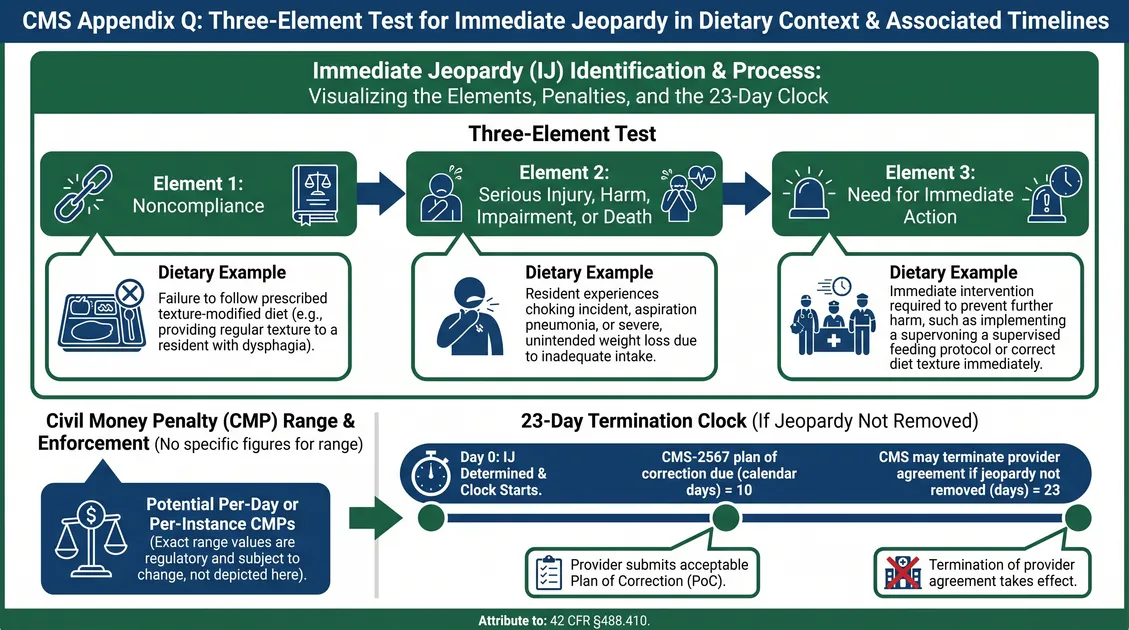
Immediate jeopardy is a situation in which a facility's noncompliance has caused, or is likely to cause, serious injury, harm, impairment or death to a resident. CMS defines it at 42 CFR §488.301 and explains how surveyors apply it in Appendix Q of the State Operations Manual. The survey team must establish three components before citing severity level J, K or L: noncompliance, a serious adverse outcome that occurred or is likely, and the need for immediate action. Harm doesn't have to happen yet. Likelihood alone is enough. Dietary services fall under the food and nutrition services requirement for long-term care facilities at 42 CFR §483.60, so one tray can put a nursing home's Medicare and Medicaid participation at risk.

Menu Survey Readiness Self Assessment: 30 Checkpoints
Check every item your documentation can prove today. Checkpoints marked critical map to the four dietary pathways that drive most immediate jeopardy findings: texture (F805), allergens and substitutions (F806), therapeutic diet orders (F808), foodborne illness, and hydration or weight loss. Scoring weights critical checkpoints three times a standard checkpoint. Nothing is submitted or stored by this tool.
Your readiness snapshot
Top critical gaps to close first:
Reference points used here come from the article: CMS Appendix Q requires a surveyor to document all three elements (noncompliance, serious harm, immediacy) before citing severity level J, K or L; dietary services sit under 42 CFR 483.60; CMS may terminate a provider agreement within 23 days if jeopardy is not removed under 42 CFR 488.410; CMS Appendix PP guidance treats 5 percent weight loss in 30 days as significant, with 7.5 percent at 90 days. This self assessment is an educational planning aid, not a compliance determination or legal advice.
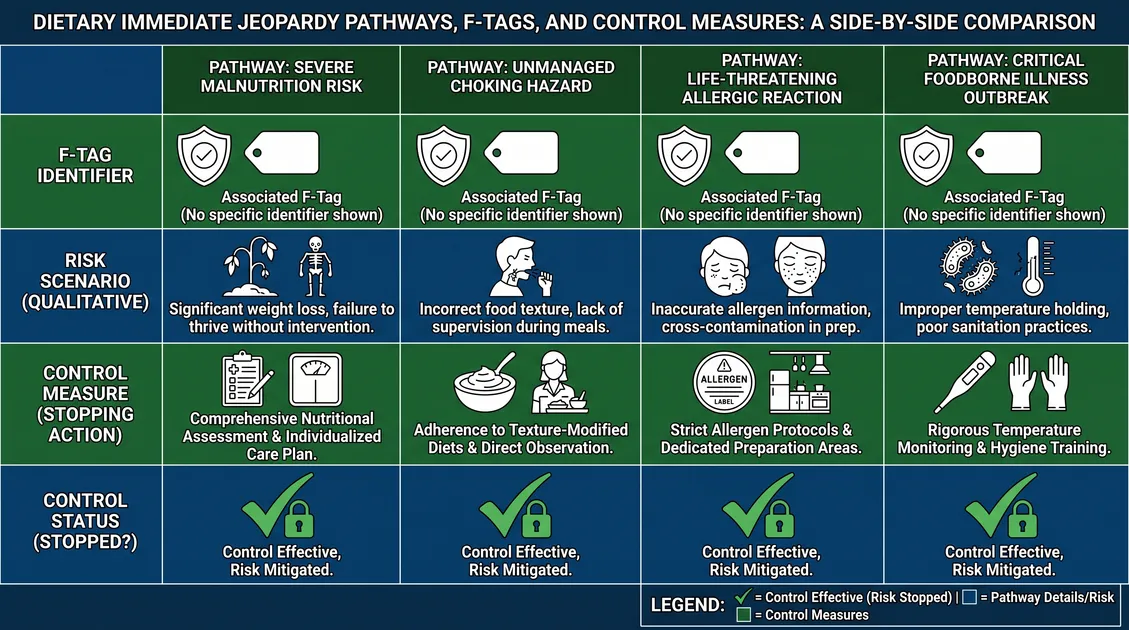
Which Dietary Failures Most Often Trigger Immediate Jeopardy?
Triggers fall into four pathways: wrong texture-modified food, undisclosed allergen exposure, foodborne illness, and untreated dehydration or unintended weight loss. Each maps to a tag. F805 covers food in a form that meets individual needs, the tag behind a regular sandwich handed to a resident with an IDDSI Level 4 puree order. F806 covers allergies and substitutions. F808 covers therapeutic diets ordered by the physician, cited when a renal or consistent carbohydrate order never reaches the tray card. Weight loss and dehydration are usually cited under F692 (nutrition and hydration), where CMS Appendix PP guidance treats 5 percent weight loss in 30 days as significant, with 7.5 percent at 90 days.
| Trigger pathway | F-tag | Typical breakdown | Control that stops it |
|---|---|---|---|
| Wrong texture served | F805 | Regular toast delivered on a puree order | Texture check at the tray line against the diet roster |
| Unordered therapeutic diet | F808 | Renal order never copied to the tray card | Daily roster-to-tray-card match by the CDM |
| Allergen cross-contact | F806 | Allergy undocumented, shared utensils used | Allergen field on every tray card, dedicated utensils |
| Foodborne illness outbreak | F812 | Hot food held below 135°F, expired product served | HACCP temperature log twice per meal period |
| Dehydration or weight loss | F692, F807 | Fluids not offered between meals for days | Weekly hydration and weight review in QAPI |
Cold holding above 41°F and the highly susceptible population rules in the FDA Food Code 2022 drive most sanitation findings, which we unpack in our article on F812 sanitary food service, storage and procurement. Texture errors are prevented by the discipline described in our guide to texture-modified and therapeutic diet menus.
Free 4-Week Sample Menu Packet: Build Your Request
Tell us your facility type, licensed bed count and state. The tool shows which F800 series tags your menu packet needs to document, sizes the tray volume at stake, then hands you a ready to paste request summary for our quote team.
Your packet scope
What the 4 week packet includes for a skilled nursing facility in Texas
This tool runs entirely in your browser. Nothing is sent, stored or emailed when you change a field. To receive the packet, use the request button above or email your summary to us. Figures cited: CMS Appendix PP treats 5 percent weight loss in 30 days as significant and 7.5 percent at 90 days; CMS may terminate a provider agreement within 23 days if immediate jeopardy is not removed, under 42 CFR section 488.410. Tray counts assume full census and are planning estimates, not a nutrition or compliance determination.
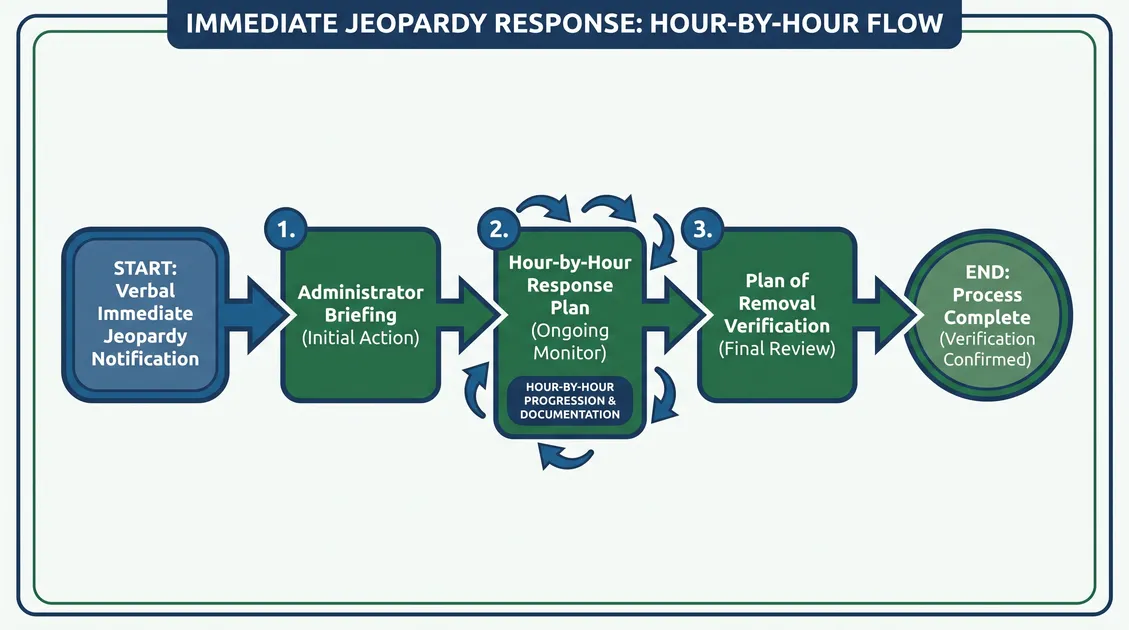
What Happens in the First 24 Hours After an IJ Is Called?
Immediate jeopardy notification reaches the administrator as soon as the survey team identifies it, along with the IJ template describing the noncompliance. The facility then writes a removal plan that stops the threat now, and the survey team verifies it onsite. Removing jeopardy is not the same as correcting the deficiency: the full corrective action arrives later as the plan of correction for the CMS-2567, due within 10 calendar days of receiving it. If jeopardy is not removed, the provider agreement is terminated within 23 days of the last day of the survey or temporary management is appointed, under 42 CFR §488.410. Per-day civil money penalties in the upper range used for immediate jeopardy run $8,351 to $27,378 in CMS's 2025 inflation-adjusted figures under 42 CFR §488.438.
- Administrator and director of nursing (DON) brief the team on safeguards within the first hour.
- Kitchen halts the implicated process, whether a tray line, a held item, or a contractor-supplied product under contractor oversight.
- Dietary and nursing re-verify every physician diet order against the roster and tray cards, resident by resident.
- Infection control practices tighten when foodborne illness is suspected: standard precautions, symptom logs, nosocomial infection surveillance.
- Staff in-service training is delivered and signed that day, then written into care plan setup.
- Document each removal step with times, names and evidence so the survey team can verify removal before exit.
Removing jeopardy before exit does not erase the citation: the CMS-2567 still records the immediate jeopardy, and any remaining noncompliance stays cited at a lower severity until corrected, so the paperwork trail matters as much as the fix.
Key Takeaways: How Do You Prevent Dietary Immediate Jeopardy?
Dietary prevention runs on four controls, one per trigger pathway: a texture verification step at the tray line, an allergen field on every tray card, temperature logs at both ends of the danger zone, and a weekly hydration review. A certified dietary manager (CDM) owns the daily checks, while a registered dietitian owns menu approval and the diet manual. The 30-checkpoint self-assessment above turns those controls into a written gap list you can work before a surveyor does. Menus should carry a nutrient analysis against the Dietary Reference Intakes for adults 51 and older, including the protein RDA of 0.8 g per kilogram of body weight, reviewed per menu day rather than per recipe.
- Immediate jeopardy needs three documented elements under Appendix Q, and likely harm counts as much as actual harm.
- Wrong texture, unordered diet and aspiration events are common dietary triggers, tied to F805 and F808.
- A removal plan stops the threat; the CMS-2567 plan of correction is due within 10 calendar days.
- Unremoved jeopardy can end a provider agreement in 23 days, with penalties accruing daily.
- A self-audit against these checkpoints plus an RD-signed cycle menu closes the documentation gaps surveyors look for first.
Immediate jeopardy prevention starts with menus you can hand a surveyor. You can download a free 4-week sample, review our dietitian-approved menu documentation, or compare flat-rate plan pricing at $15, $20 and $40 per month before your next survey window.