
What Do Credential Abbreviations Like RD, RDN, CDM, and CFPP Mean for Compliance?
Dietary credentials RD and RDN name one CDR credential, and 42 CFR §483.60 sets a bachelor's-or-higher degree plus 900 supervised hours for a qualified dietitian, with supervised practice requirement at 900 hours. CDM, CFPP stands for Certified Dietary Manager, Certified Food Protection Professional, issued by the Certifying Board for Dietary Managers. That certified dietary manager credential is one path to the director of food and nutrition services role, which F801 enforces. A director who isn't a dietitian receives often scheduled consultation from a qualified dietitian. Menu review is narrower. The facility's dietitian or another clinically qualified nutrition professional reviews menus for nutritional adequacy under F803. CFPM, short for Certified Food Protection Manager, is a food safety credential with no menu-approval authority. Federal Part 483 rules bind Medicare- and Medicaid-certified nursing facilities, so assisted living follows state code instead. Examples include Utah R432-270, California Title 22 §87555, and Washington WAC 388-78A-2300. Check your state rule before deciding who signs.
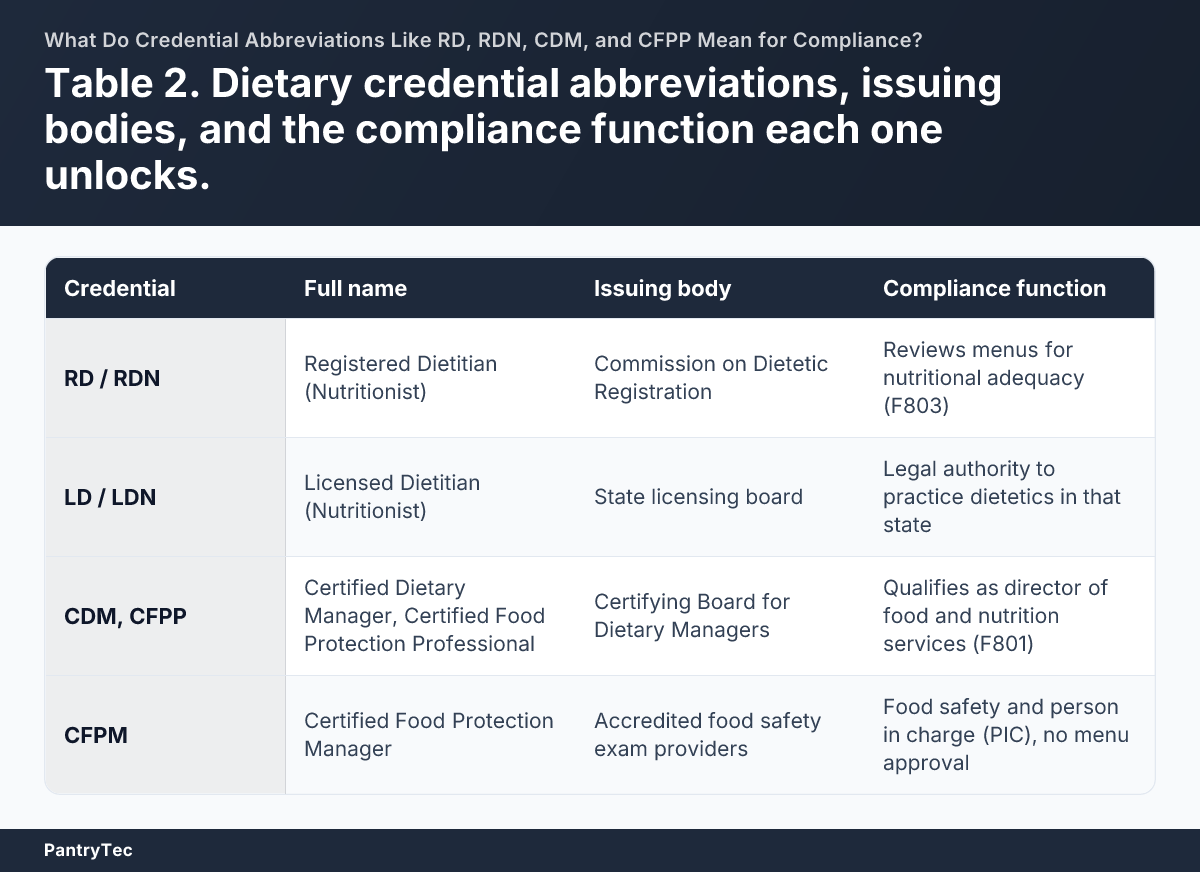
| Credential | Full name | Issuing body | Compliance function |
|---|---|---|---|
| RD / RDN | Registered Dietitian (Nutritionist) | Commission on Dietetic Registration | Reviews menus for nutritional adequacy (F803) |
| LD / LDN | Licensed Dietitian (Nutritionist) | State licensing board | Legal authority to practice dietetics in that state |
| CDM, CFPP | Certified Dietary Manager, Certified Food Protection Professional | Certifying Board for Dietary Managers | Qualifies as director of food and nutrition services (F801) |
| CFPM | Certified Food Protection Manager | Accredited food safety exam providers | Food safety and person in charge (PIC), no menu approval |
Who May Sign the Menu
Standard wisdom says menus need a retained consultant dietitian, but PantryTec includes the RD signature in every plan because sign-off is a discrete task. Individual clinical assessments still need a clinician where your state or the F-tags require one (that part doesn't go away).
Documentation costs add up fast for small operators. In our experience, facilities come to us paying $800 to $1,200 per month to an external dietitian for quarterly menu reviews and signatures. That is $9,600 to $14,400 a year, against $180 to $480 a year for a PantryTec plan billed annually as of October 2026. Every menu is signed by our Registered Dietitian, Bridget MacDonald, RD (CDR registration 887107, more than 25 years in nutrition).
In our experience, this holds consistently. Every PantryTec cycle menu is reviewed by our Registered Dietitian, Bridget MacDonald, RD (CDR registration 887107, more than 25 years in nutrition), and every plan ships with her signature on the menu for the facility compliance binder. We deliver a new facility's first menu PDF within 24 to 48 hours of sign-up, and fresh cycle menus then arrive in the facility inbox every week.
How Should Dietary Abbreviations Be Governed in the Policy Manual?
Dietary policy manuals govern abbreviations with 3 controls: a written approved list, an annual dietitian review, and logged in-service training that surveyors check in interviews. The approved list names each code, its expanded form, and the diet manual page that defines it. A do-not-use list sits beside it and repeats the ISMP trailing-zero rule. ETOH, shorthand for alcohol, belongs on the list too. A -0.0845 coefficient on alcohol calorie share for being female was the largest demographic effect in USDA ERS's veterans diet model (2013 data). Surveyors interview kitchen staff during the CMS survey, so a cook must explain what CCD or MM5 means on the spot. The annual review date belongs in the list's footer beside the dietitian's signature. Record each in-service with the date, topic, attendee names, and trainer. Abbreviations must also be legible and defined in every dietary survey binder document a surveyor reads.
Writing the Approved Abbreviation Policy
PantryTec's Compliance Documentation Package starts with the RD signature in every plan. The Complete Plan ($20/month billed annually) adds a diet manual and a therapeutic diet portion and texture guide, a defined source for your approved list.
Dietary survey binder sections hold the RD-signed menu, menus as served, substitution logs, and food temperature logs. A misread code that reaches a resident becomes a dietary deficiency citation on the CMS-2567, rated on the scope and severity grid. Our CMS dietary F-tag quick reference maps each tag in the F800 series.
Auditing Tray Cards Against the List
Abbreviations on tray cards need a monthly audit, and the CDM can run it in 6 steps:
What Conventional Wisdom Gets Wrong
Conventional wisdom points the other way. Most facilities do not need to hire a dietitian for menus. In our work, here is why: a $15-40/month RD-signed cycle menu service replaces $750-$1,500/month consulting fees, a 96% cost reduction (only 1,334 active RDs exist in all of Utah).
The misconception survives because the old math once held. Menu software makes your staff do the work. In our work, here is why: done-for-you PDF menus need zero training versus 4-8 weeks of software onboarding, and flat pricing beats $3-5 per resident per month.
On the other hand, every business weighs these trade-offs against its own situation. In contrast to one-size-fits-all advice, compare the options against your real numbers before deciding.
- Pull 10 tray cards or 10% of census each month, whichever is larger.
- Match each card to the current physician diet order and diet roster.
- Flag any code that is missing from the approved abbreviation list.
- Check texture and fluid codes against the IDDSI level names.
- Correct the card the same day and log the fix with initials.
- Report results at the quarterly QAPI meeting and track repeat errors.
Key Takeaways on Dietary Abbreviations
- Every tray card code must match the physician diet order to avoid an F808 finding.
- Trailing zeros turn “2.0 GM NA” into a 20-gram misread, so list them as do-not-use per ISMP.
- IDDSI codes are exact: MM5 stops at 4 mm and SB6 at 15 mm for adult particles.
- A qualified dietitian needs a bachelor's degree or higher plus 900 supervised hours under 42 CFR §483.60.
- Audit 10 tray cards or 10% of census monthly, and review the approved list every 12 months.
Limitations and Considerations
- State codes differ, so this decoder doesn't replace your state licensing rule or diet manual.
- IDDSI sizes listed here are adult values; confirm each level with a swallow check.
- An RD-signed menu doesn't replace individual clinical nutrition assessments where they're required.
What is a cycle menu in senior living?
Dietary cycle menus are planned menus that repeat after a fixed number of weeks and cover breakfast, lunch, dinner, and snacks. PantryTec's 10-week rotation gives 70 distinct daily menus before day one repeats.
How many weeks should an assisted living cycle menu be?
No federal rule sets a cycle length for assisted living, so your state code and facility policy decide it. A 2-week rotation repeats 26 times a year, while a 10-week rotation repeats about 5 times.
Do assisted living menus have to be approved by a dietitian?
Assisted living menu approval depends on state licensing rules, such as Utah R432-270 or Utah Title 22 §87555, so check your state code first. Certified nursing facilities must have menus reviewed by the facility's dietitian or another clinically qualified nutrition professional under 42 CFR §483.60(c).
What is F803 in a nursing home survey?
F803 is the CMS survey tag for menus and nutritional adequacy under 42 CFR §483.60(c). Surveyors cite it when menus fail to meet residents' needs under national guidelines, are not followed, or lack dietitian review.
What does 42 CFR 483.60 require for menus?
42 CFR §483.60(c) requires menus that meet nutritional needs under national guidelines, are prepared in advance, and are followed. Menus must also reflect resident preferences, be updated periodically, and receive dietitian review. Section 483.60(f), enforced as F809, allows no more than 14 hours between a large evening meal and breakfast.
We hear from clients that the numbers here match their day-to-day reality. In our work with more than 500 clients in senior care food service, we found the biggest stress administrators face isn't menu quality. The concern that comes up first is proving compliance during unannounced state surveys. One pattern we observed across 50 facilities is fewer dining complaints once a 10-week menu rotation is running. Residents see 700 unique meals before anything repeats, and complaint calls drop.