
About PantryTec. Dietitian-Approved Menus, Made Simple.
About PantryTec in one line: we write dietitian-approved cycle menus for senior care kitchens. We believe a menu should be simple enough for anyone on your team to cook from.
See plans and pricingDownload the free 10-week sample
- Serving facilities across the U.S.
- Reviewed by Registered Dietitians
- Print-ready, RD-signed menus
- One flat rate, no per-resident fees
Why Did We Build PantryTec?
PantryTec exists because a small senior care home answers to surveyors too, yet the common ways to get a reviewed, documented menu can cost $800 to $1,200 a month or charge for every resident.
Small homes rarely have a dietitian on staff. Someone still has to plan weeks of meals and work out diabetic and puree portions by hand. Quantities get guessed and grocery runs multiply. Over-buying turns into spoilage, and planning meetings take time away from cooking.
Two common options stood out, and neither one fit a small kitchen.
An outside dietitian. We've seen the invoices. Facilities bring us bills of $800 to $1,200 a month from consultants who review and sign their menus. That is $9,600 to $14,400 a year, before any clinical work.
Menu software. We've seen those quotes too: $2 to $5 per resident per month, so the bill grows with every admission. Your staff still builds the menus and has to learn the program.
The question behind PantryTec
Administrators tell us their biggest worry is rarely menu quality. It's proving compliance when state surveyors arrive unannounced. Families ask something else on the tour: "Can you handle Dad's dementia diet?"
So we asked a simple question. What if the menu just arrived, finished, reviewed by a dietitian and ready to print? PantryTec is our answer.
We Believe in Simplicity
A printed menu with a dietitian's signature is something anyone can use. That belief shapes every PantryTec decision, from the flat price to the PDF in your inbox.
Simple beats clever
No program to learn and no training. If your newest cook can pin up the menu and follow it, the menu is doing its job.
Price should not punish growth
PantryTec charges one flat rate per facility. A full house costs the same as a half-empty one, whether you run 6 beds or more than 300.
Dietitian review is not an add-on
Every plan includes dietitian review and the RD-signed menu, because that's the page you'll want in hand when a surveyor walks in.
Be honest about scope
PantryTec writes menus and the documents that go with them. We don't assess residents or write care plans, and we say so up front.
Residents come first
Operators should trust the menu they post, and residents should look forward to the meal that follows. That is why our cycle runs 70 days before a day repeats.
Give time back to the kitchen
Every hour not spent on menus or portion math is an hour your staff can spend cooking and caring for residents.
What Does PantryTec Do Every Week?
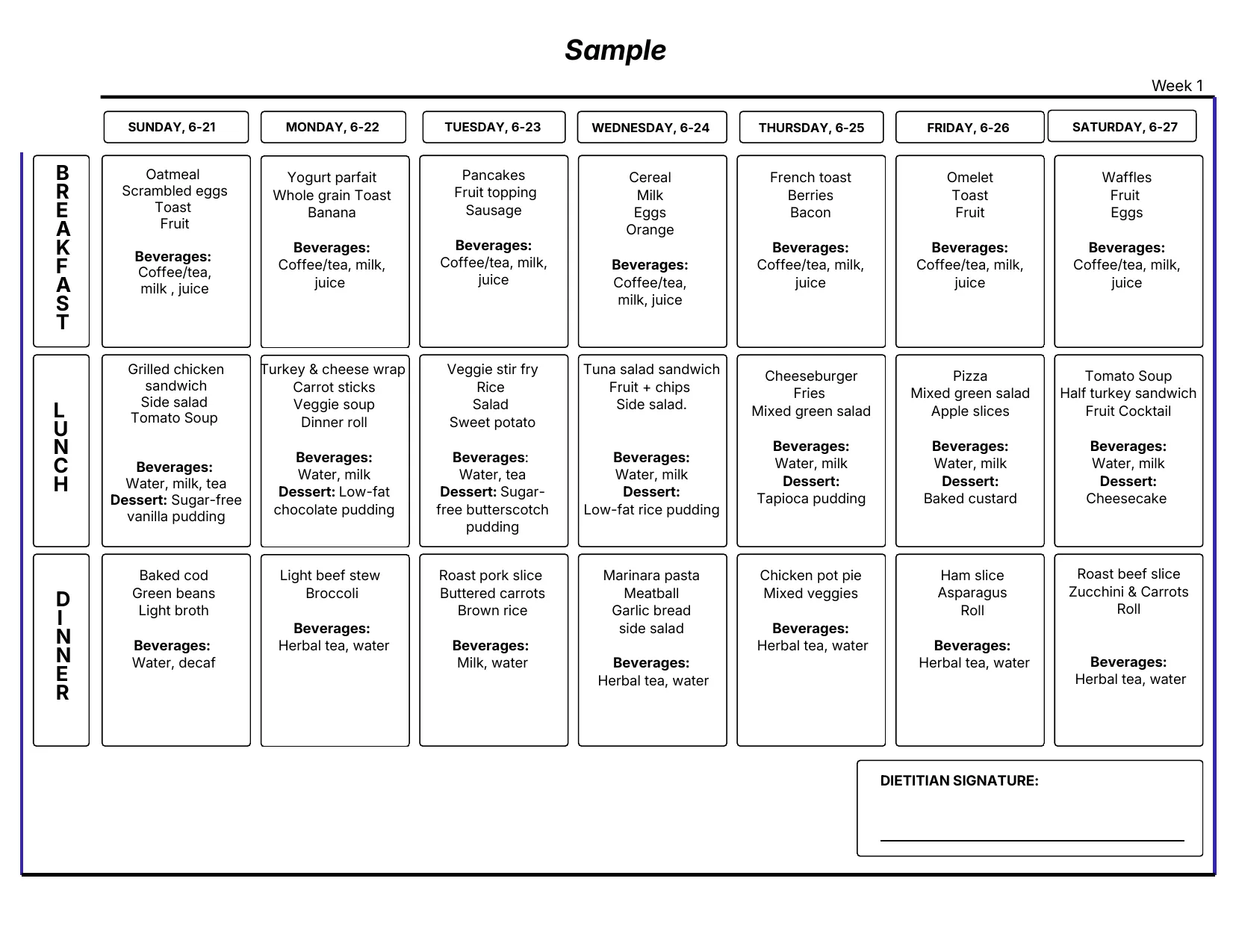
Every week, PantryTec emails your facility the next print-ready PDF of a 10-week cycle menu. The cycle holds 70 daily menus for breakfast, lunch and dinner, reviewed by our Registered Dietitians.
Why 10 weeks? Shorter cycles repeat sooner, and a resident who lives with you for years notices. A 10-week cycle means 210 meals before any day comes around again.
What arrives in your inbox
- The RD-signed menu for your compliance binder, so you can show a surveyor who reviewed your menus.
How a menu gets made
- AssembleWe build a full rotation of breakfasts, lunches and dinners.
- AnalyzeA nutrient analysis checks calories, macronutrients and micronutrients against the Dietary Reference Intakes for older adults.
- ExtendWe build therapeutic diets and textures from the base menu, so on the Complete and Premier plans one cycle serves the whole dining room.
- Review and signA Registered Dietitian reviews and signs the cycle.
- DeliverYour first RD-signed menu arrives within 24 to 48 hours of sign-up, then a new menu every week.
Three plans, one flat price
| Plan | Billed annually | Billed monthly | What it adds, and who it suits |
|---|---|---|---|
| Starter | $15 a month ($180 a year) | $20 a month | Dietitian-approved menus, weekly delivery, the 10-week cycle and the RD signature. For small homes that want low-effort, compliant menus. |
| Complete | $20 a month ($240 a year) | $25 a month | Adds common therapeutic diets, a portion and texture guide, recipes, a diet manual, snack options and a food temperature log. For mid-sized assisted living and memory care. |
| Premier | $40 a month ($480 a year) | $50 a month | Adds menus customized to your facility once each rotation, re-verification as needed and priority support. For diverse or medically complex residents. |
Start with our dietitian-approved cycle menus for senior care, see the full PantryTec price comparison and read how PantryTec works from sign-up to your first weekly menu.
Every Type of Senior Care Facility We Write Menus For, and Why
The same 10-week dietitian-approved cycle adapts to 12 care settings, because a 6-bed group home and a multi-level CCRC campus face different residents, rules and budgets.
The National Center for Health Statistics counted about 30,600 residential care communities and 15,300 nursing homes in its 2020 data. Each one has a kitchen that needs a menu by breakfast.
Each state decides who reviews and posts menus, and many homes have no dietitian on staff.
These menus add texture changes for residents living with dementia.
Federal rule 42 CFR §483.60 sets the menu standard and surveyors check it by F-tag, so the paperwork has to be right.
Active 55+ residents expect restaurant-style dining, so variety matters as much as nutrition.
Comfort comes first, so menus lean on liberalized diets, altered textures and small portions.
These homes answer to both the VA and state health departments, which doubles the scrutiny on the menu.
Small homes carry the same menu duties with far fewer residents to spread the cost across.
California's Title 22 sets the menu rules for residential care facilities for the elderly, so menus are written with it in mind.
A handful of residents and a home-style kitchen need balanced menus that are easy to cook.
One campus runs several levels of care, from independent living to skilled nursing, and each needs its own approach.
Day programs need balanced meals and therapeutic options without a dietitian on staff.
At 6 to 16 beds, consultant retainers rarely make sense, so a flat rate does.
Compare all cycle menus by senior care facility type.
Every Common Therapeutic Diet We Cover, and Why
From the Complete plan up, PantryTec builds common therapeutic diets from the same 10-week cycle. A small kitchen can't write and cook a separate menu for every diet order. Open a diet to see why it matters.
Regular and liberalized
The regular menu, included in every plan, is the base every diet builds on. Many residents do best on a liberalized diet, which eases restrictions when quality of life outweighs clinical risk.
Diabetic (consistent carbohydrate)
Blood sugar control depends on steady carbohydrate from meal to meal. These menus hold each meal to 45 to 60 grams and each snack to 15 to 20 grams.
Cardiac (AHA)
Residents with heart disease or high blood pressure need less sodium and fat. These menus align to American Heart Association guidance.
Low sodium (NAS and 2 g sodium)
Many residents have sodium limits for blood pressure or heart conditions. We build these menus from the same base cycle, so the kitchen isn't planning from scratch.
Renal (kidney)
Chronic kidney disease calls for control of potassium, phosphorus and sodium. Each resident's limits come from their physician's diet order.
Puree (IDDSI Level 4)
Residents who cannot chew safely still deserve a real meal. This texture is smooth and lump-free and holds its shape on a spoon.
Minced and moist (IDDSI Level 5)
For residents who need very little chewing: soft, moist food with pieces no wider than 4 mm and no longer than 15 mm for adults.
Soft and bite-sized (IDDSI Level 6)
Tender pieces no larger than 1.5 cm for adults. Many orders still say mechanical soft, a term the IDDSI framework replaced with tested texture levels.
High calorie and fortified
Unintended weight loss is a real risk in senior care. Calorie-dense meals and fortified foods add calories without adding a separate menu.
Gluten free
Residents with celiac disease or gluten sensitivity need menus with no gluten-containing grains.
How Is PantryTec Different From Other Menu Options?
PantryTec differs from menu software and outside dietitians in three ways: the menus arrive finished, dietitian review comes with every plan, and the price stays flat from 6 beds to more than 300.
| What matters | PantryTec | Per-resident software | Outside dietitian |
|---|---|---|---|
| Monthly cost | $15, $20 or $40, billed annually | $2 to $5 per resident ($40 to $50 at 10 beds, $400 to $1,000 at 200) | $800 to $1,200, from the invoices facilities bring us |
| As you fill beds | Stays the same | Rises with every admission | Set by hours or retainer |
| Who builds the menus | We do | Your staff, inside the software | The dietitian |
| What your kitchen uses | A printed menu | A software account | Whatever the consultant provides |
| Staff training | None | Staff learn the software | None |
| RD-signed menu | In every plan | Varies by vendor | Yes |
| Tray tickets and system integrations | Not part of the plans | Often yes | No |
| Resident assessments and care plans | No | Usually no | Yes |
Why simple wins
Software is powerful, but power isn't what a small kitchen is short of. It's short of time. A printed menu needs no password, no update and no training, and a substitute can follow it the day your cook calls in sick.
Read our comparison of menu software and done-for-you menus, weigh hiring a dietitian against a menu service, or see senior living menu providers side by side.
When PantryTec isn't the right fit
If you run many buildings and need tray tickets and system integrations, software may suit you better. If you need resident assessments or care plans, you need a clinician. Certified nursing homes must still employ or contract a qualified dietitian or other clinically qualified nutrition professional under 42 CFR §483.60. PantryTec handles menus, not resident care.
Who Is Behind PantryTec?
PantryTec serves senior care facilities across the United States from Springville, Utah. Our team of Registered Dietitians and nutritionists reviews every menu, and our product team keeps those menus arriving on time and easy to run.
Our dietitians
A Registered Dietitian signs the menus included in every plan. Meet Bridget MacDonald, RD, one of the Registered Dietitians behind your menus. Our team is growing, and we're adding more Registered Dietitians.
Our product team
Blake Oldham, our Product Manager, owns the product kitchens run every day and turns operator feedback into clearer menus and fewer surprises. Meet the whole team behind your menus.
The rules we write to
In Medicare and Medicaid certified nursing homes, 42 CFR §483.60 requires menus that meet residents' nutritional needs and are prepared in advance and followed. The facility's dietitian or another clinically qualified nutrition professional must review them for nutritional adequacy.
Assisted living is licensed by each state, so who reviews, signs and posts your menus depends on your state's rule. Read about menu requirements by state and how to pass a CMS dietary survey.
Everything You Can Find on PantryTec Today
PantryTec has more than 80 free guides and reference pages live today. A kitchen shouldn't need a subscription to understand its own menu rules.
Passing your survey
CMS menu compliance, the dietary walkthrough, F803, F812 and plans of correction.
Your survey binder
Running the kitchen
Dietary management, kitchen operations, production sheets, recipe scaling, substitutions, food temperatures, tray line and leftovers.
Dining and occupancy
Memory care dining, dining as an occupancy driver and senior care dining data.
Choosing a provider
Provider comparison, best cycle menu providers and PantryTec vs MealSuite.
Reference
Senior care menu glossary, menu abbreviations and all resources.
What We Are Building Next
PantryTec publishes in stages, and these guides are planned but not live yet, so they are not linked here. Open a topic to see what is coming.
Inside the service
- A plan-by-plan comparison
- What the RD-signed menu contains and when you receive it
- Therapeutic diet coverage by plan
- A look inside the 10-week cycle
- The compliance documentation package
- Menu styles: homemade, premade and weekend hybrid
- Custom menus
- How to switch providers
- Reviews and testimonials
- Security and data protection
More therapeutic diets
- Wound-healing and protein-boost adjustments
- Low-fiber and GI-sensitive menus
- Fluid-restricted menus
- Foods that interact with warfarin
- Gluten-free cross-contact in shared kitchens
- The path from physician diet order to tray
- Choosing a diet manual
IDDSI and textures
- A guide to all 8 IDDSI levels
- Converting a cycle menu to pureed
- Fork drip, spoon tilt and flow tests in your own kitchen
- Dysphagia basics for dietary staff
- Thickened liquids
- Purees with plate appeal
- Staff training and tray card color coding
- How speech therapists and dietitians work together on texture orders
Food cost control
- Food cost per resident day and how to calculate it
- Per-resident pricing math
- Dietary budgets for 6 to 16 bed homes
- Plate waste
- What a consultant dietitian really costs
- What in-house menu planning costs in staff time
Planning a cycle menu
- Building a cycle menu from scratch
- Comparing 4, 6 and 10 week cycles
- Nutrient targets for older adults
- Breakfast patterns and bedtime snacks
- Hydration in the cycle
- Holidays and seasonal rotation
- Proving the one-third RDA per meal standard
Person-centered dining
- Food preference surveys and menu committees
- Cultural, ethnic and religious accommodation
- Selective menus in small facilities
- Always-available menu lists
- A resident's right to refuse a diet
- Handling food complaints
- Dehydration and weight loss
- What a liberalized diet is
- Planning treat meals safely
Memory care dining
- Finger food menus by stage of dementia
- Evening menus for sundowning
- Small-group dining
- Adaptive utensils
- Keeping residents hydrated
- Menu-side fixes for mealtime agitation
Survey-ready documents
- An RD signature block sample
- Substitution logs that pass survey
- Production sheets as evidence
- Policies and procedures manuals
- A 30-point mock dietary audit
- Where to post menus, and in what format
- What 42 CFR §483.60 requires
State-by-state menu rules
- Who can legally sign a menu
- Whether remote signatures are accepted
- Re-approval timing
- Guides for California, Texas, Florida, Washington, Maryland, Oregon, Arizona, Colorado, Pennsylvania, New York, Ohio, Michigan, North Carolina and Georgia
Opening a new facility
- What menus a license application requires
- A dietary readiness timeline
- Pre-opening inspection and kitchen plan review
- Staffing and the first diet roster
- Change of ownership
- Whether you need a dietitian under contract before you open
Purchasing and pantry
- Vendor order guides
- Pantry par levels
- Sourcing specialty items for therapeutic diets
- Receiving and storage practices
- Emergency food supply
- Buying groups, distributors and wholesale clubs compared
Comparing your options
- How to choose a menu provider: 9 criteria
- Comparisons with other menu services, software and consultants
- Menu services vs spreadsheet menus
- Menu services vs outsourced contract dining
Families, data and templates
- What to hand families on a tour
- Dining satisfaction surveys
- Responding to reviews about food
- Published research on malnutrition and dysphagia in long-term care
- A downloadable template library
- An F-tag quick reference and a printable IDDSI cheat sheet
- Menus for ICF/IID and behavioral group homes
Questions About PantryTec
Short answers to the questions people ask us most about the company, who reviews the menus and what we do and do not do.
Where is PantryTec based?
PantryTec is based at 1180 N Mountain Springs Parkway in Springville, Utah. We deliver menus by email to senior care facilities across the country, at the same flat price.
Who reviews PantryTec menus?
Our team of Registered Dietitians and nutritionists reviews every 10-week cycle, and a Registered Dietitian signs the menus included in every plan.
Is PantryTec a software company?
No. PantryTec is a done-for-you menu service. You receive finished, dietitian-approved menus as print-ready PDFs, so there is no software to learn and no staff training.
Does PantryTec replace our dietitian?
Not for resident care. PantryTec handles the menus. Resident assessments and care plans still need a clinician, and certified nursing homes must still employ or contract a qualified dietitian, who also reviews menus, under 42 CFR §483.60.
Why does PantryTec cost less than a consultant?
PantryTec builds each cycle once and delivers it by email, so the price can stay flat. A consultant dietitian bills by the hour or on a retainer.
See What Simple Looks Like
Dietitian-approved cycle menus for your facility start at $15 a month billed annually, or $20 billed monthly, with no setup fees and no long-term contract. Questions first? Call (385) 512-4731.