
Senior Living Cycle Menu Planning:
How to Build a Dietitian-Approved Rotation
Cycle menu planning is the practice of writing a fixed rotation of daily menus, then repeating that rotation on a set schedule of 28, 42, or 70 days.
Cycle menu planning is the practice of writing a fixed rotation of daily menus, then repeating that rotation on a set schedule of 28, 42, or 70 days. Senior living operators plan the whole rotation in advance because state licensing reviewers and surveyors ask to see every day of the cycle, not this week's page. PantryTec builds dietitian-approved cycle menus from Springville, Utah for assisted living facilities, memory care communities, and skilled nursing facilities. This guide follows the same order our Registered Dietitian (RD) review uses. If you want definitions before process, start with What Is.
TL;DR: Cycle menu planning sets rotation length first, then recipes, then the nutrient analysis a Registered Dietitian signs and dates. Senior living menus are judged on the whole rotation, not one week. Menus cover breakfast, lunch, dinner, and snacks for every day in the cycle, drawn in our workflow from a database of 40,000+ recipes. Flat-rate billing, monthly or annual, replaces census-driven per-resident pricing.
Senior care operators who want paper in hand first can download a free sample menu packet and read the rest of this guide against a real rotation.
What Is a Cycle Menu, and Where Does Cycle Menu Planning Begin?
Cycle menu planning begins with the rotation: a fixed set of 28, 42, or 70 daily menus, written ahead of service, served in order, then repeated from day one. Each day names breakfast, lunch, dinner, and snacks. A daily written menu answers what happens tomorrow. A cycle answers it for weeks, which is why a licensure menu packet is built around the full rotation. Almost 800,000 people in the United States lived in licensed supportive housing as of the 2000 data year, with a roughly equal number believed to live in unlicensed boarding homes, per PDF Rcfefullreport. Menu expectations follow the license type. Federal needs at 42 CFR §483.60 bind certified skilled nursing facilities, while assisted living facilities answer to state rules that usually mirror that language.
Cycle Menu vs Daily Written Menu
Menu writing done one day at a time can't prove a nutrient average, because each page stands alone. A rotation can, since the identical sequence repeats and one analysis covers every service day. That single difference is why dietitian-approved menus are written as cycles rather than as weekly guesses.
Why Reviewers Ask for the Rotation First
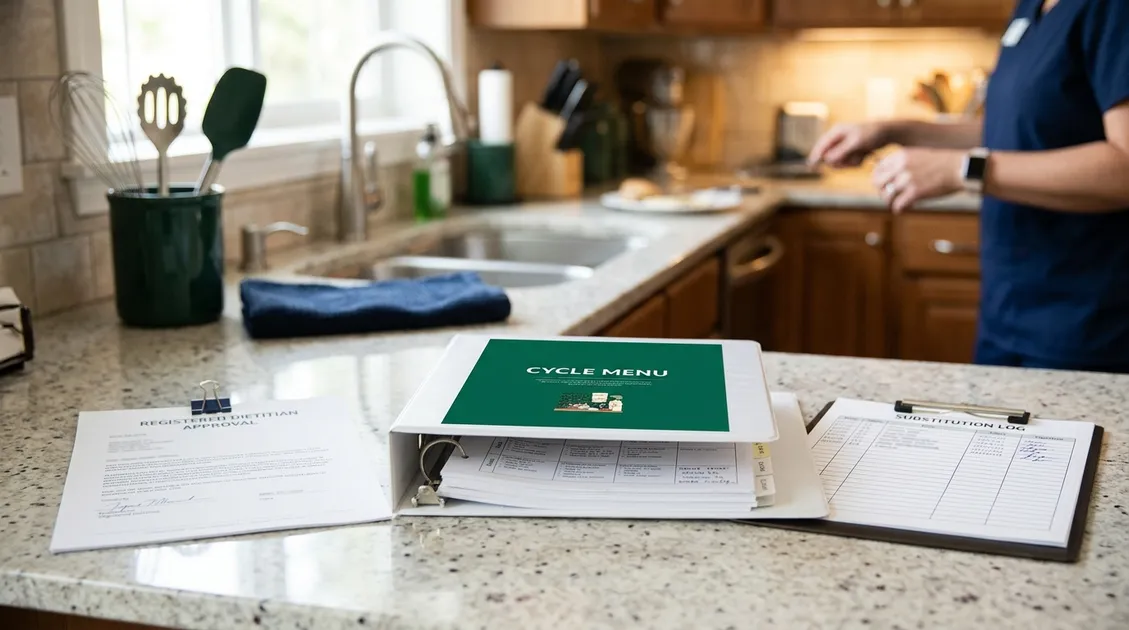
Cycle documents travel together. A reviewer working the Kitchen/Food Service Observation pathway asks for the rotation, the menus as served, the menu substitution log, and the dated RD approval letter. Miss one of the four and a paperwork gap becomes a dietary deficiency citation. Cook-to-census instructions and the safety-net alternative menu belong in the same packet.
Food Cost Per Resident Day Calculator
Enter your current raw food spend and average census to see what one resident day actually costs you today. Then set your rotation length to see how many menu days and meal services a cycle has to cover. Overproduction is optional and starts at zero, so nothing is assumed about your kitchen.
How this is figured: resident days equal average daily census multiplied by days in the period. Cost per resident day equals raw food spend divided by resident days. Meal service cost splits that across the four daily services a cycle menu names. Nothing about savings is assumed: the overproduction line appears only when you turn it on and enter your own percentage. Menu service pricing is not included here, PantryTec bills flat monthly instead of census driven per resident pricing.
How Long Should a Senior Living Cycle Menu Run?
Cycle menu rotation length should outlast the average resident stay: 4 weeks suits short-stay rehab, 6 weeks fits long-stay assisted living, and PantryTec runs a 10-week rotating cycle menu with 70 unique daily plans. Short stays forgive repetition. Long stays do not, and fatigue shows up as plate waste and complaints during family tours. Cycle length also tracks local bed supply. Where home options are thin, residents stay put longer and need more variety. Utah Administrative Code requires assisted living menus be planned in advance, and some state chapters set a three-week floor.
| Rotation | Unique daily plans | Best fit | Repeat interval | Trade-off |
|---|---|---|---|---|
| 4-week | 28 days | Short-stay rehab, adult day care | Every 28 days | Cheapest to build, fastest menu fatigue |
| 6-week | 42 days | Long-stay assisted living | Every 42 days | Industry norm, moderate recipe workload |
| 10-week | 70 days | Memory care, skilled nursing | Every 70 days | 70 recipes to standardize, lowest fatigue |
Menu fatigue drops before food cost does. For variety and cost math side by side, see our cycle menu length comparison.
What Are the Steps to Build a Dietitian-Approved Cycle Menu?
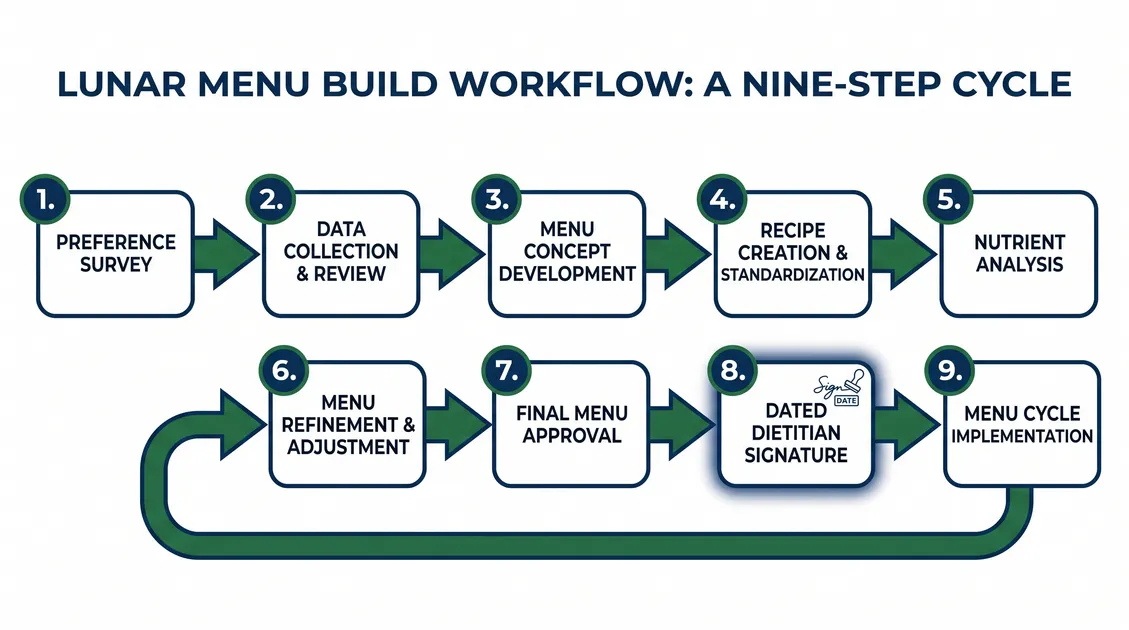
Cycle menu planning runs nine sequential steps, from a resident preference survey to the dated signature of a Registered Dietitian credentialed by the Commission on Dietetic Registration. Step order matters. Preference data comes before recipe selection, because a menu residents refuse wastes food and fails the preference standard at the same time. Menu drafting then assigns standardized recipes with yield, portion size, and method, so a new cook plates the same tray as the last one. Menu planning also respects dining help limits. Residents who reach the dining room late need held plates and a finger food menu for dementia residents, both planned inside the cycle.
- Survey resident preferences, allergies, and cultural or religious restrictions.
- Count licensed beds and average daily census for production scaling.
- Set rotation length and the seasonal editions you plan to run.
- Draft meal patterns: three meals plus a nightly HS bedtime snack.
- Assign standardized recipes with yield, portion scoop size, and method.
- Extend each day into therapeutic diet add-ons: consistent carbohydrate, renal, cardiac, IDDSI textures.
- Run nutrient analysis against DRI targets for adults 51 and older.
- Build the always-available menu and the menu substitution log.
- Obtain the RD approval letter with signature, credential, and review date.
Step nine is the one small homes skip, and it's the step reviewers check first. An approval letter carries the signature, the credential line, and the review date; an undated letter reads as no review at all. The Association of Nutrition and Foodservice Professionals (ANFP) trains the certified dietary manager (CDM) who runs production, while menu approval stays with the dietitian, a division the Academy of Nutrition and Dietetics describes the same way. For each output in sequence, our 9-step workflow for building a cycle menu from scratch documents the full build.
How Does a Cycle Menu Meet F806, F807, and F809 Requirements?
Cycle menu planning satisfies F809 by keeping no more than 14 hours between the evening meal and breakfast, unless a nourishing bedtime snack is offered nightly. F806 covers preferences and substitutes of similar nutritive value. F807 covers enough fluids between meals. Menus meet all three through artifacts, not intentions. An always-available menu of 6 to 10 standing alternates proves a substitute was offered when a resident declines the entrée, which is the practical difference between a selective and a non-select menu. CMS F-tags F800 through F809 apply to Medicare and Medicaid certified nursing facilities, with interpretive guidance in Appendix PP of the State Operations Manual. Assisted living answers to state chapters instead, such as Washington's WAC or Utah's assisted living rule.
| F-Tag | Requirement in plain terms | Menu artifact that proves it |
|---|---|---|
| F803 | Menus meet resident needs, prepared in advance, followed | Full rotation, nutrient analysis, RD approval letter |
| F806 | Preferences honored, equal-value substitutes offered | Always-available alternate list, substitution log |
| F807 | Sufficient fluids to maintain hydration | Hydration pass schedule printed with the menu |
| F809 | Three meals daily, 14-hour span limit | Posted meal times plus nightly HS snack line |
Plan of Correction work starts when a CMS-2567 statement of deficiencies arrives. The facility submits its plan of correction within 10 calendar days, naming the fix, the monitoring method, and the completion date. Menu tags are among the easier deficiencies to correct on paper and the hardest to sustain, since the correction has to survive staff turnover.
Menu citations rarely come from bad cooking. The first worry raised is proving compliance during an unannounced survey. For tag-level detail, read F803 explained: menus must meet resident needs and be followed.
Cycle menu rules reach a market wider than the licensed one. Small homes that do license face a kitchen plan review and a licensure menu packet as their first two dietary hurdles.
How Do You Analyze a Cycle Menu Against DRI Targets and Refresh It Each Season?
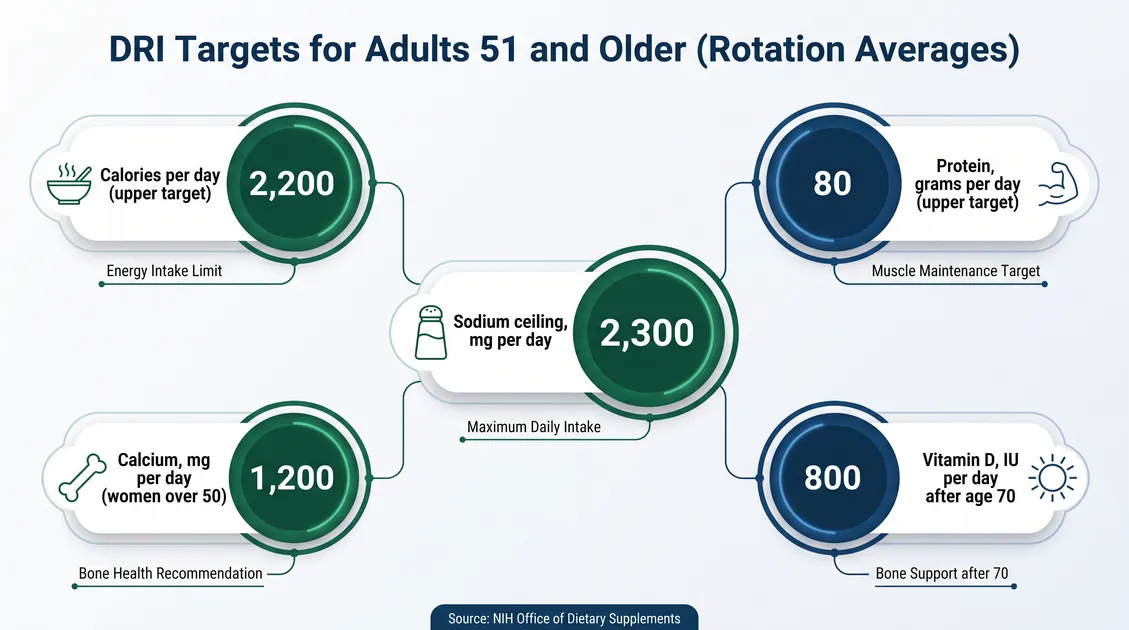
Cycle menu nutrient analysis averages the whole rotation against Dietary Reference Intakes for adults 51 and older, where women over 50 need 1,200 mg of calcium daily, according to the NIH Office of Dietary Supplements. Averaging matters. One salty day inside a long rotation does not fail a menu. A rotation averaging above 2,300 mg of sodium per day does, and that ceiling comes from the USDA Dietary Guidelines for Americans 2020-2025. Senior menus in our workflow target roughly 1,800 to 2,200 calories and 60 to 80 grams of protein a day before sign-off. Vitamin D reaches 800 IU daily after age 70. Reviewers also check the one-third RDA per meal standard, so each meal carries its share.
Priority Nutrients for Older Adults
Menu gaps cluster in five nutrients: calcium, vitamin D, vitamin B12, dietary fiber, and potassium. Food-first fortification closes most of them without supplements, and a high-calorie high-protein day supports residents flagged for significant weight change under MDS 3.0 Section K. Our complete DRI targets for older adults resource lists the full target table.
Quarterly Produce Swaps and Annual Rewrite Triggers
Cycle menus get refreshed four times a year at the quarter marks, with two seasonal editions covering spring/summer and fall/winter plus holiday overlay days. Produce prices move with season, and the USDA Economic Research Service publishes per-pound cost data you can use to time swaps. Swap rules stay short: equal nutritive value, same texture class, similar yield.
Menu rewrites differ from refreshes. Three events trigger a rewrite: a shift in resident population, a dietary citation, or a distributor dropping items from the broadline distributor order guide. Resident council minutes and plate waste audits supply the evidence either way.
What Does Cycle Menu Planning Cost In-House Versus an RD-Signed Subscription?
Cycle menu planning costs $800 to $1,200 a month when a consulting dietitian handles quarterly reviews and signatures, based on invoices facilities bring us. Per-resident pricing is the other model, quoted around $3 to $5 per resident per month by menu software vendors, so the bill climbs with every admission. Flat-rate pricing holds still. PantryTec plan tiers bill a flat rate rather than per resident: the Starter Plan at $15/month, the Complete Plan at $20 and the Premier Plan at $40 when billed annually ($20, $25 and $50 billed monthly), with therapeutic diets included from the Complete plan. Menu budgets also depend on who pays for care.
| Plan | Billed annually | Billed monthly | Diet support | Best fit |
|---|---|---|---|---|
| Starter | $15/mo ($180/year) | $20/mo | Regular senior menus, RD signed | Small assisted living homes, group homes, adult day care |
| Complete | $20/mo ($240/year) | $25/mo | Regular + common therapeutic diets, portion and texture guide | Mid-size assisted living, memory care |
| Premier | $40/mo ($480/year) | $50/mo | Everything in Complete, customized to resident specifics | Diverse or medically complex residents |
The math is narrower: a retainer of $800 to $1,200 a month costs $9,600 to $14,400 a year, and it pays for a review and a signature the subscription already includes. Clinical work stays with your RD. Menu sign-off moves.
Menu delivery speed decides whether a provider switch leaves a documentation gap. We deliver the first menu PDF within 24 to 48 hours of sign-up, with fresh menus every week after that. Compare flat-rate menu plan pricing before your current notice window closes.
Raw food cost per resident day (PRD) stays the number owners watch. Event catering software such as Caterease or Total Party Planner prices banquets well, though neither runs a nutrient analysis for a 51-plus population.
Limitations and Considerations
- Menu subscriptions do not replace physician diet orders, and diet order currency stays a facility duty.
- Clinical assessments, MDS coding, and weight-loss care plans still need your own RD or clinician.
- Texture downgrades follow a speech-language pathologist check, not a menu edit. IDDSI Level 5 requires 4 mm particles and Level 6 pieces no larger than 15 mm, per the IDDSI framework.
- State rules differ, so a menu accepted in Utah may need edits in California or Washington.
- Substitution logging and menus-as-served retention remain kitchen tasks no subscription performs for you.
Senior living administrators comparing options usually want a rotation in hand first. Request a menu demo or call PantryTec at 385-512-4731, or Contact our team about to talk with a Registered Dietitian about your census.
Key Takeaways for Senior Living Cycle Menu Planning
Senior living operators who get three decisions right rarely get cited on menus, with F809 Meal Frequency Rule's evening-to-breakfast span limit at 14 hours maximum.
- Rotation length should outlast average length of stay; longer cycles cut menu fatigue before they cut cost.
- An RD approval letter is worth only the date on it: signature, credential line, and review date, or reviewers treat it as no review.
- Nutrient analysis is averaged across the rotation against DRI targets for adults 51 and older, never judged one day at a time.
- The F809 meal-span rule is met by a bedtime snack line printed on the posted menu, per CMS Appendix PP guidance.
- Flat-rate menu subscriptions replace census-driven per-resident billing, and PantryTec includes the RD signature at every tier.
Menu planning theory becomes a workflow once someone runs it weekly. For the step-by-step video walkthrough and the operator-side sequence, see how PantryTec works: sign-up to your first live cycle.
What is a cycle menu in senior living?
A cycle menu is a fixed rotation of daily menus served in order, then repeated. Each day lists breakfast, lunch, dinner, and snacks, and the whole rotation is written before service begins. Senior living communities use cycles because one nutrient analysis then covers every service day.
How many weeks should an assisted living cycle menu be?
Most assisted living cycle menus run 4 to 6 weeks, while PantryTec builds a 10-week rotation for long-stay populations. Certain state chapters set a three-week minimum. Match the rotation to your average length of stay rather than to what fits on one page.
Do assisted living menus have to be approved by a dietitian?
Many state licensing rules require a registered dietitian to review assisted living menus, and some accept a certified dietary manager working under RD consultation. The review is documented with a signed, dated approval letter kept in the compliance binder. Confirm the exact wording in your state's assisted living chapter, since the standard varies.
What does 42 CFR 483.60 require for menus?
42 CFR §483.60 requires certified nursing facilities to serve menus that meet residents' nutritional needs, are prepared in advance, are followed, and are reviewed by a qualified dietitian. The same section sets three meals daily and limits the evening-to-breakfast interval. It governs Medicare and Medicaid certified facilities, not state-licensed assisted living.
How far in advance must menus be posted in a care facility?
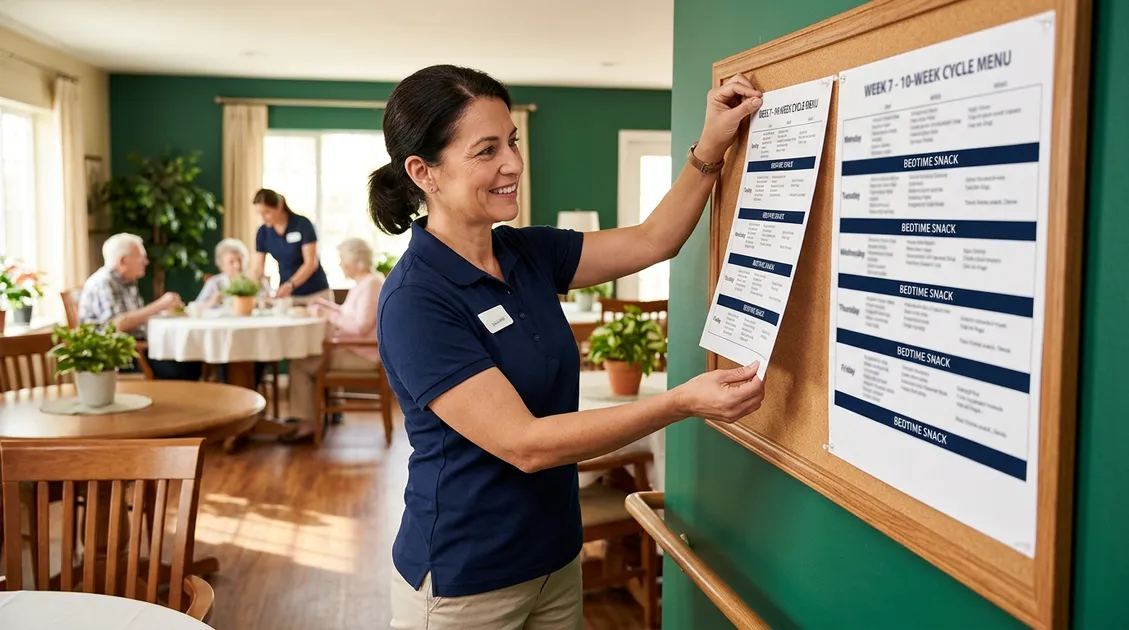
Posting rules come from state licensing, and the common standard is the current week posted where residents and families can read it, with the full rotation on file. Utah's assisted living rule requires menus planned in advance and retained. Substitutions get written on the posted menu the day they occur.
Sample Cycle Menu Packet: Build Your Request
Pick your facility type, licensed bed count, and state. The tool shows the rotation length that fits your average length of stay, estimates the meal volume one full cycle covers, and lists what belongs in a licensure ready packet. Then take your summary to the request page.
Certified skilled nursing is bound by 42 CFR section 483.60. Assisted living answers to state rules that usually mirror that language.
Enter licensed capacity, not current census.
Rotation length should outlast the average resident stay.
Suggested rotation
Six weeks fits long stay assisted living, where residents stay long enough to notice a shorter repeat.
- The full rotation, every day written ahead of service
- Breakfast, lunch, dinner, and snacks named for each day
- Nutrient analysis across the whole rotation
- Dated approval letter signed by a Registered Dietitian
- Menu substitution log and the menus as served
- Cook to census instructions and the alternative safety net menu
Prefer email? Send your details to info@pantrytec.com.
This tool does not submit anything. Nothing you type here is sent, stored, or emailed. Volume figures are arithmetic from the numbers you enter (three meal services per day, plus one snack per resident per day only if you check the snack box) and assume full occupancy, so treat them as a planning ceiling rather than a forecast. Rotation guidance follows the lengths named in this guide: 28, 42, or 70 days. The free sample packet is a 4 week (28 day) rotation. PantryTec builds dietitian approved cycle menus from Springville, Utah.
Explore Topics
8 related pages in this section
What Is a Cycle Menu in Senior Living?
PantryTec vs CaterZen side-by-side: pricing from $15/mo, therapeutic diets, RD approval letters, and CaterTrax alternative analysis for senior care operators.
What Is a Cycle Menu in Senior Living?→4-Week vs 6-Week vs 10-Week Cycle Length: Variety and Cost Comparison
PantryTec vs Caterease comparison for senior living facilities.
4-Week vs 6-Week vs 10-Week Cycle Length: Variety and Cost Comparison→How PantryTec Works: Sign-Up to Your First Live Cycle
PantryTec terms and conditions for dietitian-approved cycle menu subscriptions, cancellation policies, and liability — flat-rate plans from $15/mo with no
How PantryTec Works: Sign-Up to Your First Live Cycle→Inside the PantryTec 10-Week Cycle: 70 Unique Daily Plans
Assisted living cycle menus reviewed and signed by a Registered Dietitian from $15/mo. Pass state surveys and cut costs. Get a free sample menu today.
Inside the PantryTec 10-Week Cycle: 70 Unique Daily Plans→F803 Explained: Menus Must Meet Resident Needs and Be Followed
Board and care home cycle menus from $15/mo. Dietitian-approved, 10-week rotation, 8+ therapeutic diets, weekly PDF delivery. No long-term contracts. Get a free sample.
F803 Explained: Menus Must Meet Resident Needs and Be Followed→Menu Software vs Done-for-You Menu Service: Which Fits Your Facility?
Side-by-side comparison of PantryTec vs MealSuite for senior care facilities. Pricing ($15/mo vs $175/mo+), features, therapeutic diets, and compliance data.
Menu Software vs Done-for-You Menu Service: Which Fits Your Facility?→IDDSI Level 5 Minced and Moist Conversion Guide
Dietary management ALF guide: menu planning, therapeutic diets, costs, and 42 CFR §483.60 compliance for assisted living administrators. Get a free sample menu.
IDDSI Level 5 Minced and Moist Conversion Guide→PantryTec Cycle Menu Service for Senior Care Operators
Download free sample cycle menus for senior care facilities.
PantryTec Cycle Menu Service for Senior Care Operators→