
F812 and Your Menu:
Procurement, Storage and Sanitary Food Service Overlap
Food safety in a certified nursing kitchen runs through a single tag.
Food safety in a certified nursing kitchen runs through a single tag. F812 sanitary food service covers procurement, storage, preparation and service under 42 CFR §483.60(i), and surveyors cite it more often than almost any other dietary requirement. Every element is visible during one kitchen tour, so no chart review is needed to write the deficiency. Your cycle menu sits upstream of all of it. What you plan to cook decides what you buy, how much you store, how long it has to cool, and how many handling steps a thin evening shift must complete. Our guide on Menu Compliance collects the menu F-tags, and sanitation findings are often cited alongside them.
TL;DR: F812 covers food procurement, storage, preparation and sanitary service. Surveyors verify refrigerated storage at 41°F or below, a 7-day date-marking limit on ready-to-eat items, 6 inches of floor clearance in dry food storage, and cooling from 135°F to 70°F within 2 hours. Menu design drives most of it: batch size, puree production and scratch cooking decide how much cooling and handling your staff must control.
Why Is F812 Sanitary Food Service the Most-Cited Dietary Tag?
Sanitary food service covers four observable domains under 42 CFR §483.60(i): procurement, storage, preparation and service. That breadth is why F812 ranks among the most often cited nursing home tags in CMS Quality, Certification and Oversight Reports data. A surveyor doesn't need records to write it. One walk through the kitchen produces a thermometer reading, an undated container and a case on the floor, and each becomes a separate finding under the same tag. Record-based tags such as F803 require menu files, nutrient analysis and an RD approval letter before a problem is provable. Nursing home residents are a highly susceptible population under the FDA Food Code, so foodborne illness escalates fast and pushes scope and severity up the grid.
- Walk-in units reading above 41°F at the internal product probe
- Ready-to-eat items held past the 7-day date-marking window
- Dry food storage stacked below the 6-inch floor clearance line
- Chemical storage shelved beside food or nonfood supply storage
- Steam table hot holding below 135°F during tray line service
- Temperature monitoring logs with blank cells across whole shifts
Sanitation breakdowns also carry the steepest ceiling in dietary. A contaminated batch served to 40 residents is the classic route to immediate jeopardy in dietary services, where the facility faces same-day correction rather than a routine plan of correction.
Weekly F812 Self-Audit Checklist
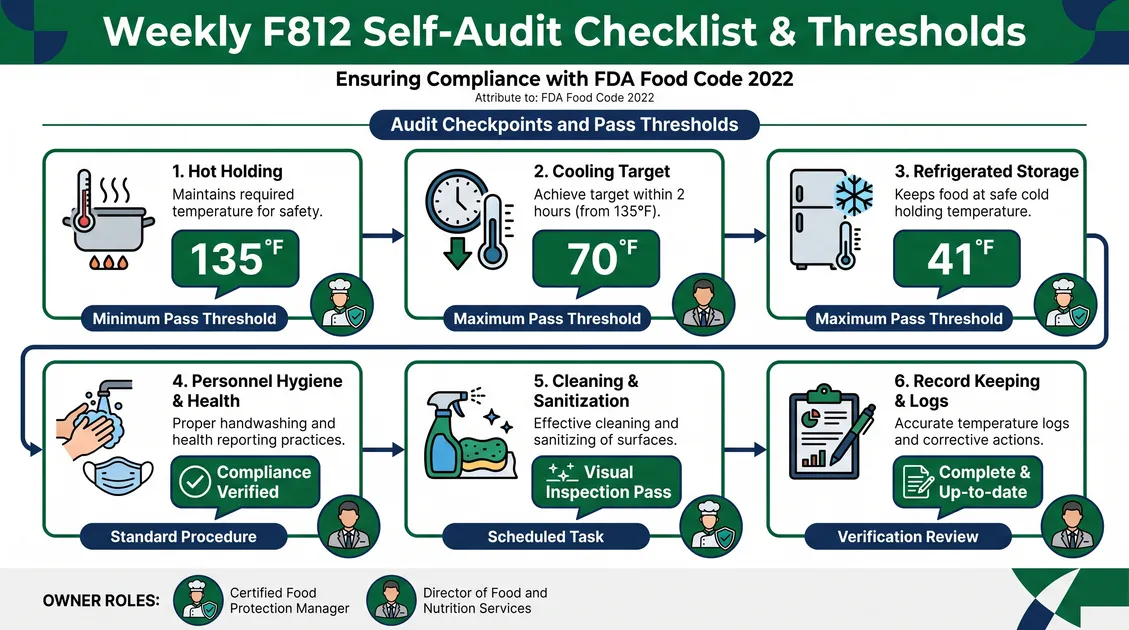
Score each checkpoint against the thresholds surveyors verify under 42 CFR §483.60(i): 41°F refrigerated storage, 135°F hot holding, the 7-day date-marking limit, 6 inches of floor clearance and cooling from 135°F to 70°F within 2 hours.
Enter this week's observed readings. Results update as you type, then copy the gap report for your dietary manager.
Nothing is submitted or stored by this tool. The button above opens your own email client with the report pre-filled, or use the copy button and paste it into your weekly QA file. Thresholds shown reflect the F812 checkpoints described in this article and are a self-audit aid, not a substitute for your state agency guidance or the CMS State Operations Manual.
What Procurement Sources Does F812 Allow?
Procurement under F812 is limited to approved sources: food from suppliers approved or considered satisfactory by federal, state or local authorities, per 42 CFR §483.60(i)(1) and the CMS State Operations Manual Appendix PP guidance. Facilities may also buy directly from local producers when state and local law allow, and may serve produce from a facility garden that is grown and handled safely. Home-canned foods and unpasteurized milk don't belong in the facility's own supply. Food that families bring in for a resident falls under F813, the facility's written policy on food from visitors, not the tray line. Surveyors ask for three things at the receiving door: the distributor's order guide and invoices, the vendor's inspection or license status, and a letter of guarantee.
Procurement records are the part most small homes skip. Keep a rolling year of invoices, receiving temperatures on refrigerated and frozen deliveries, and a dated rejection log, because F812 begins at the loading dock rather than the stove.
What Storage and Dating Rules Do Surveyors Check First?
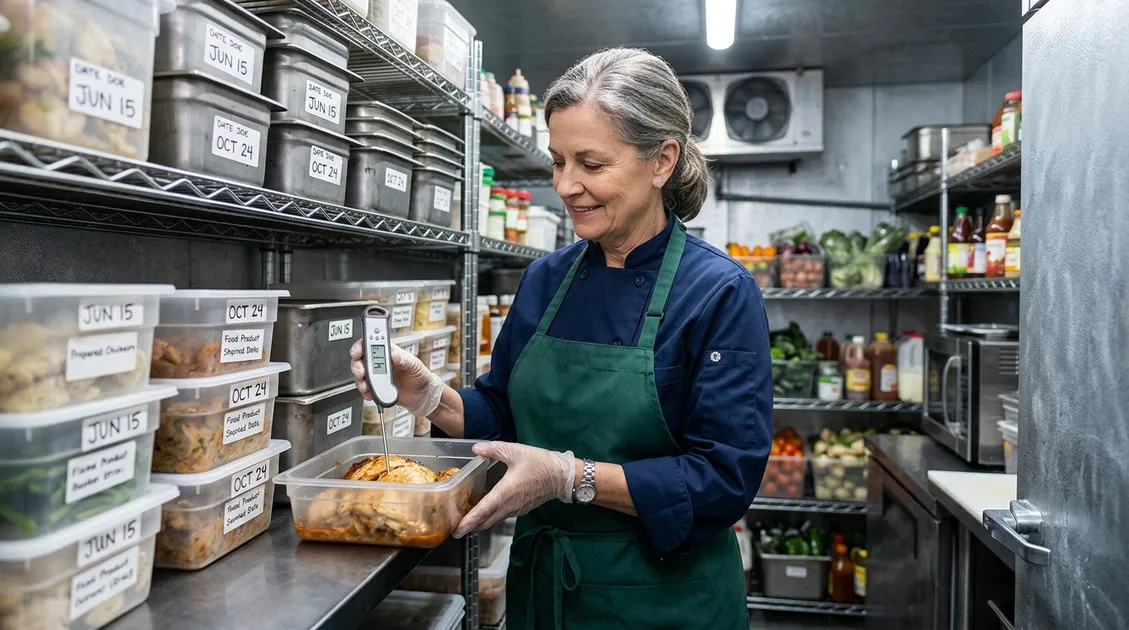
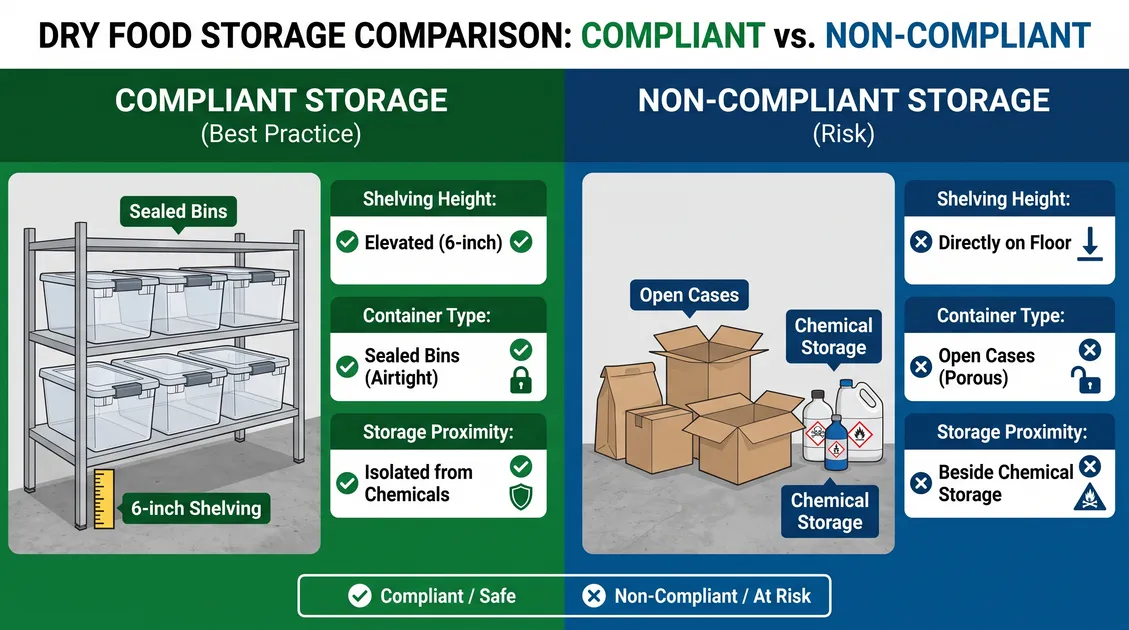
Storage checks open nearly every kitchen tour, and the thresholds are fixed. Refrigerated storage holds at 41°F or below, freezers keep product frozen solid near 0°F, and ready-to-eat items prepared on site carry a maximum 7-day use-by date, with the preparation day counted as Day 1 under the FDA Food Code 2022. Combine two dated ingredients and the earlier date governs the finished dish. Dry food storage needs 6 inches of clearance from the floor, sealed bulk bins and labeled scoops. Chemical storage stays physically separated from both food and nonfood supply storage. State licensing layers on top: Florida's rule 59A-36.012 sets food service standards for assisted living, and Utah applies R432-150-22 to its licensed nursing care facilities. Check your own state agency, since assisted living is licensed by the state rather than certified by CMS.
| Checkpoint | Standard verified | Source |
|---|---|---|
| Refrigerated storage | 41°F or below at the product probe | FDA Food Code 2022 |
| Walk-in freezer units | Near 0°F, product frozen solid | FDA Food Code 2022 |
| Ready-to-eat date marking | 7 days maximum, prep day is Day 1 | FDA Food Code 2022 |
| Dry food storage | 6 inches of floor clearance, sealed containers | CMS Appendix PP, F812 |
| Chemical storage | Separated from food and nonfood supply storage | CMS Appendix PP, F812 |
| Hot holding at service | 135°F or above through tray line | FDA Food Code 2022 |
Storage volume is a menu problem in disguise. Par levels built for a 10-week cycle keep inventory rotation honest, while over-ordering against a repeating 2-week menu produces the expired cases surveyors find behind the shelving.
Cooling Curve Batch Size Calculator for TCS Foods
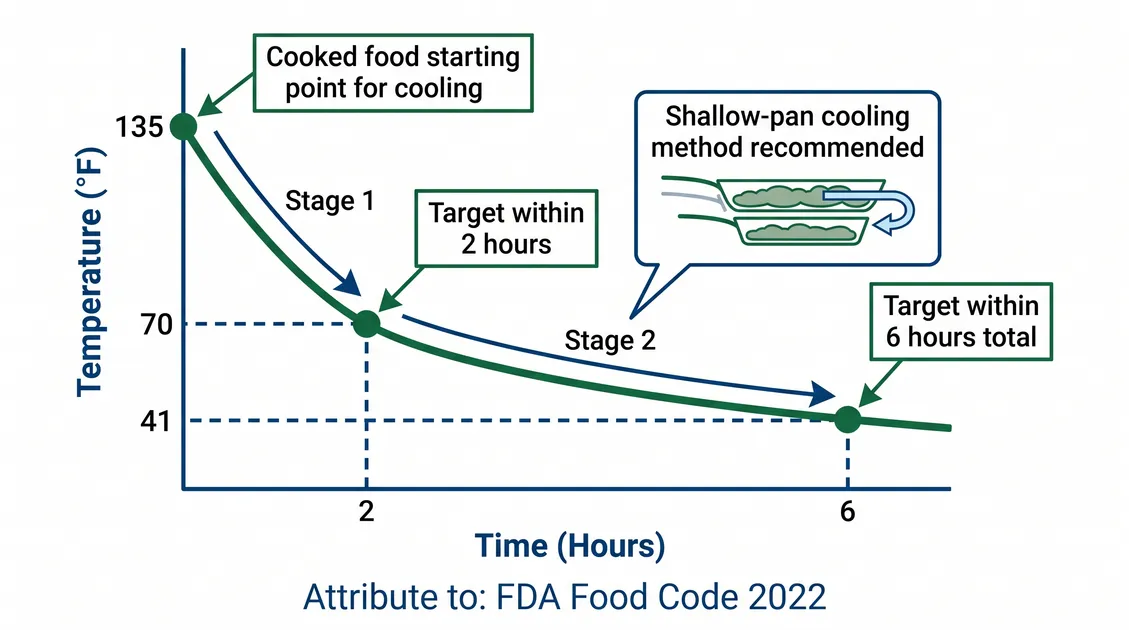
Enter your daily census and the dish you are producing. The tool converts servings into pan count, fill depth and batch splits sized for the F812 cooling curve: 135°F down to 70°F within 2 hours, then into refrigerated storage at 41°F or below.
Batch and pan plan
Stage checkpoints to log
F812 storage rules that apply
Planning aid only. Figures follow the F812 thresholds named in this article: cooling from 135°F to 70°F within 2 hours, refrigerated storage at 41°F or below, a 7 day date marking limit on ready to eat items, 6 inches of floor clearance in dry storage and hot holding at 135°F or above. Verify pan depths, yields and total cooling time against your state code, your HACCP plan and your own validated temperature logs.
How Does Your Cycle Menu Design Create or Prevent F812 Risk?
Menu design decides how much cooling your kitchen must perform, and the FDA Food Code 2022 allows 2 hours to drop cooked food from 135°F to 70°F, then a 6-hour total to reach 41°F. A chili batched for 60 residents when 38 are in the building fails that curve in a deep container. Potentially hazardous foods, now called time/temperature control for safety (TCS) foods, drive most findings: soups, gravies, casseroles, cooked rice, sliced melon and pureed entrees. Cook temperatures matter just as much, with poultry at 165°F, ground meat at 155°F, whole cuts at 145°F and leftovers reheated for hot holding to 165°F within 2 hours.
- Scale batch yields to census, not to licensed bed count
- Shallow pans under 4 inches deep for cooling soups and sauces
- Limit planned leftovers to one reheat cycle inside the 7-day window
- Cook-to-census production sheets steady food cost per resident day (PRD)
- Cross-over ingredients cut raw food cost and shrink stored inventory
- Standardized recipes fix portion scoop size and handling steps per dish
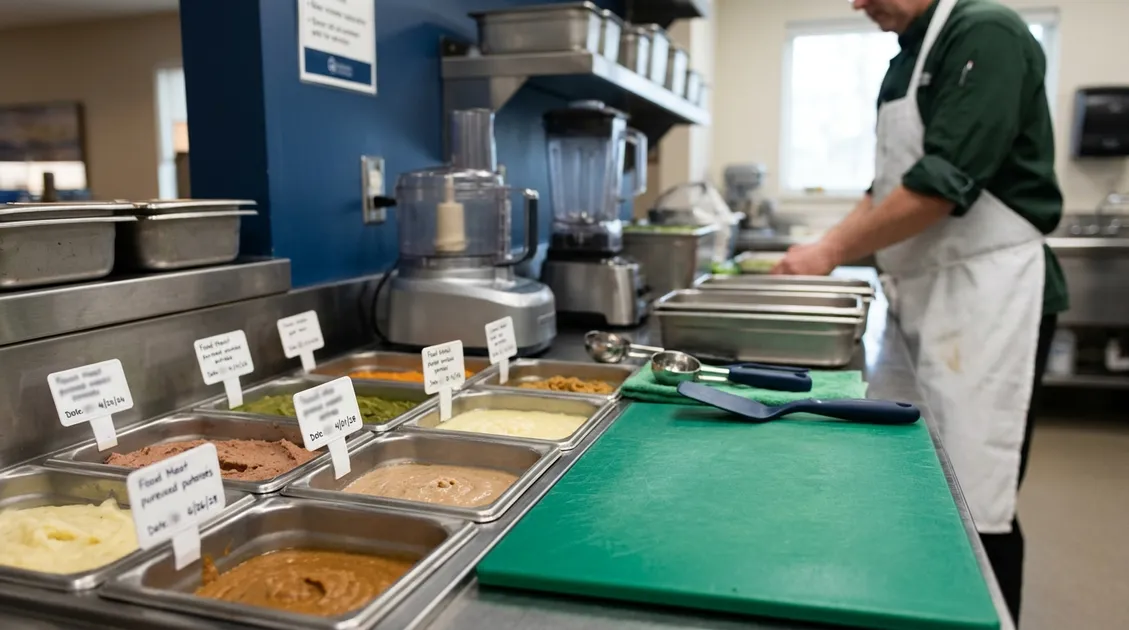
Menu scheduling has to match staffing, and the thinnest coverage usually falls on the evening shift that cools leftovers. Put scratch soups and roasted whole cuts on full-crew days. Holding temperatures are scored under F812 for safety and under F804 food temperature and palatability standards for palatability, so one cold tray can draw two tags. Texture-modified production, including IDDSI Level 4 pureed items and a dementia finger food menu, needs a sanitized prep zone of its own.
What Should a Weekly F812 Self-Audit Include?
Sanitary self-audits work best when they mirror the CMS Kitchen/Food Service Observation pathway (Form CMS-20055), the same task surveyors use, and run weekly instead of once a year before a mock survey. Assign every line to a named owner: the certified food protection manager for temperatures, the director of food and nutrition services for procurement records, the person in charge for tray line service. Set a pass threshold rather than a checkmark, because a walk-in reading of 43°F is a failure that needs a documented corrective action. Training counts as documentation too: keep dated sign-in sheets for every food safety in-service.
- Probe 3 refrigerated storage units and 1 freezer, logging actual readings
- Pull 10 dated ready-to-eat containers and verify the 7-day math
- Walk dry food storage for clearance, pests and chemical separation
- Watch one tray line and record hot holding against the 135°F floor
- Spot-check 2 invoices for approved-source vendors and receiving temps
- Route any repeat finding into QAPI before it becomes a CMS-2567 item
Service failures found twice in a quarter belong in QAPI, not on a clipboard. A plan of correction is due within 10 calendar days of the CMS-2567, and the systemic-change section is far easier to write when your own logs already show the fix.
PantryTec runs flat-rate plans at $15, $20 and $40 a month billed annually, the same at any census. Review the tiers on our flat-rate menu plan pricing page or download a free sample menu first.
Limitations and Considerations
- A signed menu does not fix equipment. Failing gaskets and undersized walk-in units cause repeat 41°F findings.
- Federal F-tags bind Medicare and Medicaid certified nursing facilities; state-licensed assisted living follows state rules that vary widely.
- Menu services cannot supervise your staff. Daily temperature monitoring logs stay a facility duty.
Key Takeaways
- F812 sanitary food service is observable, not record-based, which is why one kitchen tour can produce six separate findings.
- Storage thresholds are fixed: 41°F refrigeration, 7-day ready-to-eat dating and 6 inches of floor clearance, per the FDA Food Code 2022.
- Cooling is a menu decision. Batch size set above census breaks the 135°F to 70°F two-hour rule before staff ever touch it.
- Procurement is only as strong as its paper: invoices, receiving temperatures and vendor letters of guarantee.
- Weekly self-audits mirrored on the Kitchen/Food Service Observation pathway beat one annual mock survey.
What is a cycle menu in senior living?
A cycle menu is a fixed rotation of daily menus that repeats on a set schedule. PantryTec runs a 10-week rotation, which gives residents 70 unique daily plans covering breakfast, lunch, dinner and snacks before anything repeats.
How many weeks should an assisted living cycle menu be?
Three to four weeks is a common state minimum, and longer rotations reduce repetition complaints. A 10-week cycle keeps variety high while holding par levels and raw food cost predictable.
Do assisted living menus have to be approved by a dietitian?
Rules differ by state. Florida's rule 59A-36.012 sets dietary standards for assisted living, Utah's R432-270-22 requires a certified dietitian to approve assisted living menus, and certified nursing facilities need dietitian review under 42 CFR §483.60(c)(6). Confirm the rule with your licensing agency.
What does 42 CFR 483.60 require for menus?
42 CFR §483.60 requires menus that meet residents' nutritional needs under established national guidelines, are prepared in advance, are followed, and are reviewed by the facility's dietitian or other clinically qualified nutrition professional. Tags F800 through F814 split those duties, with F803 covering menus and F812 covering sanitary food service.
How far in advance must menus be posted in a care facility?
Federal rules set no single posting interval, but 42 CFR §483.60 requires menus prepared in advance and followed. State licensing commonly requires the current week's menu posted where residents can read it, plus dated menus-as-served retained as your state requires.