
Georgia Personal Care Home and ALC Menus:
Rules DCH Enforces in 2026
Georgia requires personal care homes and assisted living communities to serve three well-balanced meals a day, seven days a week, so Georgia personal care menus start from that daily pattern.
Georgia requires personal care homes and assisted living communities to serve three well-balanced meals a day, seven days a week, so Georgia personal care menus start from that daily pattern. Personal care homes post menus a day ahead, assisted living communities plan them a week ahead, and both keep menus as served for surveyors. PantryTec, a dietitian-approved cycle menu service for senior care facilities, read both Department of Community Health (DCH) chapters line by line for this guide. Georgia's personal care home rule is one application of the hub's method on To find and read your state's.
TL;DR: PCHs follow Rule 111-8-62-.21 and ALCs follow Rule 111-8-63-.21. Both cap the overnight gap between scheduled evening and morning meals and require a nutritious snack. PCH menus post 24 hours ahead, while ALC menus are dated and planned one week ahead. Both keep menus as served for 30 days. Neither chapter requires a dietitian signature on regular menus, but therapeutic diets need a prescriber's order. Download Free 4-Week Sample
What Does the Georgia Personal Care Home Menu Rule Require?
Georgia Rule 111-8-62-.21 requires personal care homes to serve three well-balanced meals daily, seven days a week, plus a nutritious snack each mid-afternoon and evening. Meals must meet the Recommended Dietary Allowances set by the National Academy of Sciences' Food and Nutrition Board. Portions also need the right quantity, form, consistency and temperature. 14 hours is the longest evening-meal-to-breakfast gap for nursing home residents, per 42 CFR 483.60 on eCFR (2026). Georgia copies that ceiling into both state chapters, measured between the scheduled evening and morning meals. A personal care home, by DCH's definition, is any dwelling giving housing, food service and personal services to two or more unrelated adults. Food service sits inside the license definition, so menus are a licensure item rather than a courtesy. A six-bed board and care home in Macon carries the same meal duties as a 24-bed home in Savannah. The two subsections below separate PCH and ALC duties.
Georgia Menu Survey-Readiness Self-Assessment
Choose your license type, enter your scheduled supper and breakfast times, then answer each item. Your score updates instantly across five areas surveyors check: menu posting, as-served retention, substitution records, diet orders and snacks. Based on Rule 111-8-62-.21 (personal care homes) and Rule 111-8-63-.21 (assisted living communities).
Self-check only, not legal advice or a survey outcome. Confirm requirements against the current text of Ga. Comp. R. & Regs. r. 111-8-62 and 111-8-63 published by the Georgia Department of Community Health. Substitution recording is shown as a practice that keeps your as-served menus accurate.
Rule 111-8-62 Food Service Provisions
Personal care homes need a properly equipped kitchen unless meals come from a permitted food service business. Catered meals must come from a licensed service with a satisfactory food safety record. Emergency food stays in sealed, labeled, dated containers rotated by shelf life, alongside stored drinking water. Special therapeutic diets follow the prescription of the resident's physician, advanced practice registered nurse or physician assistant, as the full text of Ga. Comp. R. & Regs. r. 111-8-62 shows.
Assisted Living Community Rules Under 111-8-63
Georgia assisted living communities follow Ga. Comp. R. & Regs. r. 111-8-63, written as minimum standards for personal care homes licensed as assisted living communities. Rule 111-8-63-.21 adjusts nutrition for age, sex and activity. The nutritious snack requirement here is at least one offering daily beyond regular meals. Hot food leaves the kitchen at 140°F (60°C) or above, and cold food at 41°F (5°C) or below. A 3-day emergency supply of non-perishable food and water stays on hand.
| Requirement | Personal Care Home (111-8-62-.21) | Assisted Living Community (111-8-63-.21) |
|---|---|---|
| Daily meals | Three scheduled, well-balanced meals, seven days | Same, adjusted for age, sex and activity |
| Overnight gap | Capped between scheduled evening and morning meals | Same cap; snacks do not count as meals |
| Snacks | Offered each mid-afternoon and evening | At least one nutritious snack daily |
| Menu timing | Written and posted a day before the meal | Dated and planned a week ahead, regular and therapeutic |
| Substitutions | Noted and treated as part of the original menu | Noted before the meal is served |
| Retention | Menus as served kept one month after use | Regular and therapeutic menus as served kept one month |
| Diet orders | Physician, APRN or physician assistant prescription | As ordered by the resident's healthcare provider |
Care oversight models differ by state, and that shapes who reviews your menus. A few states, Illinois among them, run all-payer long-term care gatekeeping, while most limit it to Medicaid-eligible residents, per the California Health Care Foundation's Residential Care for the Elderly report. Georgia and North Carolina use different license names for comparable small home care settings, as our guide to North Carolina adult care home menu requirements explains.
We hear from clients that the numbers here match their day-to-day reality. In our work, we found the biggest stress administrators face isn't menu quality. The concern that comes up first is proving compliance during unannounced state surveys. One pattern we see is fewer dining complaints once a 10-week menu rotation is running. Residents get 70 days of menus, 210 breakfasts, lunches and dinners, before any day repeats. 75% of 7,094 U.S. norovirus outbreaks studied took place in long-term care and assisted living facilities, per the CDC journal Emerging Infectious Diseases (2020).
Does Georgia Require Dietitian Review of Menus?
Georgia does not require a dietitian to sign menus in personal care homes or assisted living communities, since neither nutrition rule names a menu reviewer. 900 hours of supervised dietetics practice is the minimum for a qualified dietitian reviewing nursing home menus, per 42 CFR 483.60 on eCFR (2026). That federal bar binds certified nursing homes, not state-licensed PCHs or ALCs. DCH's adult day center rules are the exception, requiring adult day health menus approved by a dietitian or registered nurse. For PCHs and ALCs, the test is outcome-based. Surveyors check whether menus meet the Recommended Dietary Allowances, match diet orders and reflect what was served. Dietitian review is optional in Georgia, yet it's the fastest proof of adequacy. Many operators choose a dietitian-approved menu because a signed nutrient analysis answers the adequacy question in writing. The sections below cover diet orders and credential checks.
Dietitian Approval for Special Diets
Menu extensions are where clinical authority enters Georgia kitchens. A consistent carbohydrate (CCHO), 2-gram sodium, renal or IDDSI Level 4 pureed order needs its own written menu version. A sticky note reading 'diabetic, no dessert' doesn't show a surveyor what the resident ate. The ALC rule makes this explicit, because menus are planned for regular and therapeutic diets alike. Our therapeutic diet menu extensions show the format, and our explainer on Therapeutic diets must be physician-ordered covers the federal parallel.

Care plans close the loop. Georgia ALCs complete a resident needs assessment, and the diet order belongs in that individual service plan so aides, cooks and the menu agree. That plan is the person-centered care plan your tray should match. Dietitian-led senior meal service has a long track record. One meals-on-wheels program has provided Medicare nutrition therapy with staff RDNs for about seven years, per ACL's Medical Nutrition Therapy Works for Seniors toolkit.
Georgia Licensed Dietitian Credential Check
Georgia licenses dietitians through the Georgia Board of Examiners of Licensed Dietitians, under the Secretary of State. CDR registration alone does not authorize practice in Georgia, and an out-of-state license doesn't either. All licenses expire on March 31 of even-numbered years, so a signature dated in 2026 should come from a renewed license. Run the signer through the Secretary of State lookup to confirm status and discipline history, and file the printout beside the approval letter. The Georgia licensed dietitians explains the rules.
How Long Must Georgia Menus Be Posted and Retained?
Georgia personal care homes post menus 24 hours before each meal, while assisted living communities date and plan menus one week ahead. Both license types keep menus as served for 30 days. PCH rules treat every change or substitution as part of the original menu. ALC rules add timing: substitutions are noted before the meal is served. ALC menus must be conspicuously posted or easily available, and residents are encouraged to help plan them. A dining room board plus a binder at the front desk covers both readings of that rule. PCH menus must offer options for individual preferences. A selective menu with an always-available alternate entrée is the practical design. Short retention still demands daily discipline in the kitchen. Georgia's posting and retention duties are benchmarked against other states in our guide to States differ on menu signature.
How Far Ahead Should You Post Menus?
Home dining rooms should display the date, each meal, the snack and the alternate entrée. A non-select menu with no listed alternate leaves you claiming choices existed without proof. Selective versus non-select menu design is a documentation decision as much as a dining one. Posting a full week ahead satisfies both chapters, which helps operators holding PCH and ALC licenses on one campus. Multi-state operators should check each state's rule separately, since posting windows differ by state.
Keeping Menus as Served
Menu records as served are the posted menu plus every change. Our team recommends a menu substitution log with these fields, initialed before the tray line starts:
- Date and meal: breakfast, lunch, dinner or one of the snacks
- Planned item and the substitute actually plated for residents
- Reason, such as a short delivery or a resident request
- Matching changes for IDDSI Level 6 soft and bite-sized versions
- Initials of the cook or person in charge (PIC)
Personal care homes and ALCs can archive menus on paper or as PDFs. Long-term care suppliers now sell online portals, mobile apps, sensors, wearables, robots, machine learning, virtual reality and AI tools, per the PMC study Emerging Health Technologies in Long-Term. A dated monthly folder still answers a surveyor's request fastest.
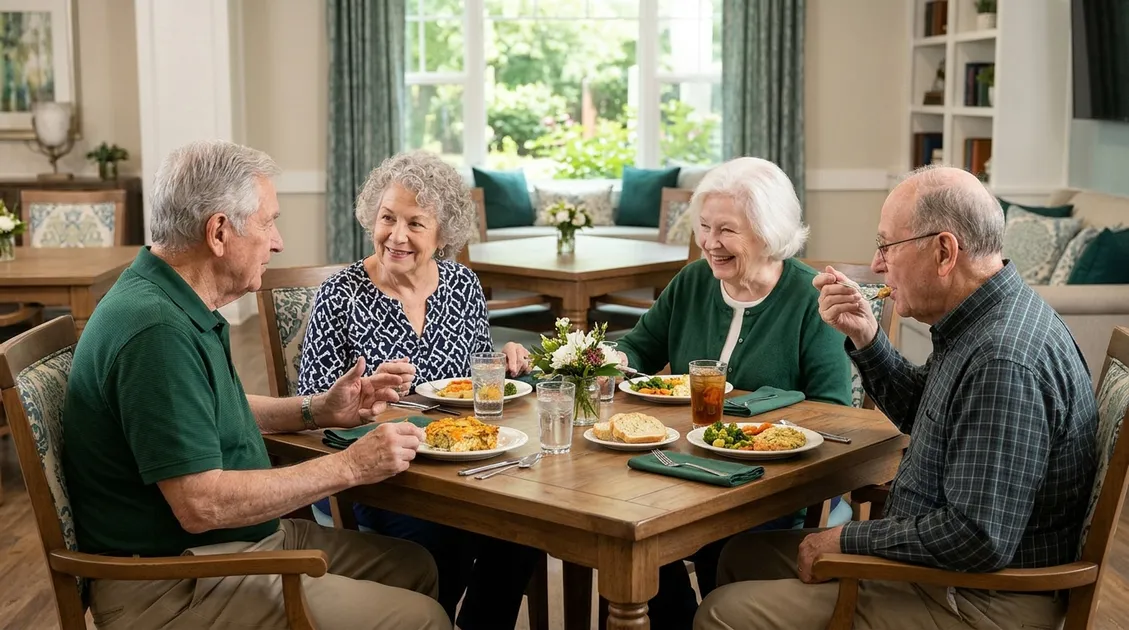
PantryTec's team has found that the biggest stress administrators face isn't menu quality. The concern that comes up first is proving compliance during unannounced state surveys. A complete as-served file, with substitutions noted, ends that conversation quickly.
In our experience, most facility administrators don't realize their external dietitian bill exceeds their annual menu cost by 10x or more. For Georgia PCH Rule 111-8-62-.21, menu posting lead time typically runs about 24 hours before the meal in day-to-day operations. Georgia ALC Rule 111-8-63-.21 shows menu planning lead time of 1 week in advance, regular and therapeutic diets.
How Should Georgia Operators Prepare for a DCH Inspection?
Georgia DCH inspections now follow House Bill 987, the 2020 senior care law whose staffing and memory care rules took effect July 1, 2021. DCH adopted the final PCH and ALC rules on August 12, 2021. PCHs licensed for 25 or more beds and ALCs must average one awake direct care staff person per 15 residents during waking hours. The non-waking staff-to-resident ratio is one per 20 residents. Administrators of those homes need a license from the State Board of Long-Term Care Facility Administrators within 60 days of hire. Average monthly minimum staffing levels are documented on DCH forms. None of these rules mentions menus directly, yet surveyors walk through the kitchen during the same visit. A complete food service file shortens that part of the inspection and keeps attention on care. The checklist below reconciles posted menus, diet orders and dietitian approvals before DCH arrives at your door.
Menu Binder Checklist
- Post the current week's dated menu, including therapeutic versions, in the dining area.
- File one month of menus as served, with substitutions initialed.
- Match the diet roster to each signed physician, APRN or PA diet order.
- Attach texture versions for IDDSI Levels 4, 5 and 6 where ordered.
- Log meal service times that prove the overnight cap between scheduled meals.
- Record mid-afternoon and evening snack offerings on a daily snack log.
- Date and rotate the emergency food and water stock.
- Keep the RD approval letter, nutrient analysis and Georgia license printout together.
Menu files deserve a reconciliation pass a week before your expected survey window. Pull three random days, then compare the posted menu, the substitution log and the diet roster. Fix any mismatch at its source rather than on the copy.
Memory Care Centers and Dining Under HB 987
Georgia requires memory care center certification for any PCH or ALC unit that markets specialized memory care or charges a higher rate for it. Staffing is tighter there: one dementia-trained direct care worker per 12 residents while awake, and two direct care staff on site at all times. Precautions for residents at risk of elopement mean secured memory care units, so snacks and alternates must be reachable inside the unit. A finger food menu for dementia residents keeps residents who refuse utensils eating.
Medication roles affect meal timing too. PCH memory care centers may employ certified medication aides, and proxy caregivers work under Chapter 111-8-100. Personal services include supervising self-administration of medications, and many doses are timed to meals. ALCs also schedule registered professional nurse or licensed practical nurse on-site hours, from 8 hours weekly for 1 to 30 residents up to 40 hours above 90. Menu software is one slice of a crowded market: 14 long-term care technology companies were interviewed for the PMC study on emerging LTC technologies.
What Conventional Wisdom Gets Wrong
Conventional wisdom points the other way. Most facilities do not need to hire a dietitian for menus. In our work, here is why: a $15-40/month RD-signed cycle menu service replaces the $800-$1,200/month consulting fees on the invoices facilities bring us, a 95% to 99% cost reduction.
The misconception survives because the old math once held. Menu software makes your staff do the work. In our work, here is why: done-for-you PDF menus need zero training versus 4-8 weeks of software onboarding, and flat pricing beats $2-5 per resident per month.
On the other hand, every business weighs these trade-offs against its own situation. In contrast to one-size-fits-all advice, compare the options against your real numbers before deciding.
Key Takeaways for Georgia Personal Care Home Menus
- Build to the stricter ALC standard, a full week of dated menus, if you run both license types.
- Note every substitution before service and keep one month of menus as served.
- Pair each physician, APRN or PA diet order with a written therapeutic menu version.
- Treat dietitian sign-off as optional but strongest proof of RDA adequacy, and verify the Georgia license.
- Expect HB 987 staffing and memory care checks during the same DCH visit that reviews your kitchen.
Menu compliance in Georgia doesn't require a consultant on retainer. Standard wisdom says you need a consultant, but PantryTec ships RD-signed menus because Georgia tests adequacy and records. In our experience, facilities come to us paying $800 to $1,200 per month to an external dietitian solely for quarterly menu reviews and signatures. That is $9,600 to $14,400 a year, against $180 to $480 a year for a PantryTec plan billed annually with the RD Approval Letter included.
PantryTec menus run on a 10-week rotation delivered weekly as PDFs, in three styles: Homemade Focus, Premade Focus and Weekend Hybrid. Bridget MacDonald, RD, holds a Georgia dietitian license and signs every approval letter. Plans start at $15 per month billed annually, as listed on our flat-rate menu plan pricing page. Premier customizes menus once per rotation, which works as a seasonal menu refresh. Are you opening a new home or completing a change of ownership (CHOW)? A signed cycle menu set makes a clean licensure menu packet. Request a Menu Demo or talk to a Registered Dietitian.
What is a cycle menu in senior living?
A cycle menu is a set of planned breakfast, lunch, dinner and snack menus that repeats after a fixed number of weeks. A 4-week cycle repeats each day about 13 times a year, while a 10-week cycle repeats about 5 times.
How many weeks should an assisted living cycle menu be?
Georgia sets no minimum menu rotation length for personal care homes or assisted living communities. Rule 111-8-63-.21 only requires ALC menus to be dated and planned a week ahead, so a 4-week, 5-week or 10-week cycle menu rotation all comply.
Do assisted living menus have to be approved by a dietitian?
Georgia does not require dietitian approval of regular PCH or ALC menus. Georgia adult day health centers need menus approved by a dietitian or RN, and any dietitian signing Georgia menus must hold a Georgia license that renews every 2 years.
What is F803 in a nursing home survey?
F803 is the CMS deficiency tag for menus and nutritional adequacy in certified nursing homes, tied to 42 CFR §483.60(c). It checks that menus meet residents' needs, are prepared in advance, are followed and are dietitian-reviewed; our F803 explainer covers survey detail.
What does 42 CFR 483.60 require for menus?
42 CFR §483.60(c) requires certified nursing homes to serve menus that meet nutritional needs under national guidelines, are prepared in advance and are followed. Menus must reflect religious, cultural and ethnic needs, be updated periodically and be dietitian-reviewed, while Georgia PCHs and ALCs follow state Rules 111-8-62 and 111-8-63 instead.
In our experience, this holds consistently. Every PantryTec cycle menu is reviewed by our Registered Dietitian, Bridget MacDonald, RD (more than 25 years in nutrition), and every plan ships with the RD Approval Letter she signs for the facility compliance binder. We deliver a new facility's first menu PDF within 24 to 48 hours of sign-up, and fresh cycle menus then arrive in the facility inbox every week.
Get the Free Georgia 4-Week Sample Menu Packet
Tell us your facility type, licensed bed count and Georgia county. We will show the menu rules that apply to you, then send you to our request page with your details filled in.
Rule 111-8-62-.21 (Personal Care Homes)
Volumes assume full occupancy: 3 meals a day, 7 days a week, per resident. Snack minimums use the rule text: PCH serves a mid-afternoon and an evening snack; ALC serves at least one nutritious snack offering daily.
Nothing is sent from this widget. The button opens our request page with your selections in the link so you can review and submit them there. This summary is general guidance, not legal advice; confirm requirements with DCH.