
Group Home and Adult Day Care Menu Rules vs Assisted Living Facility Rules
Group home menu rules sit one license tier below assisted living rules, and the paperwork gap is wide.
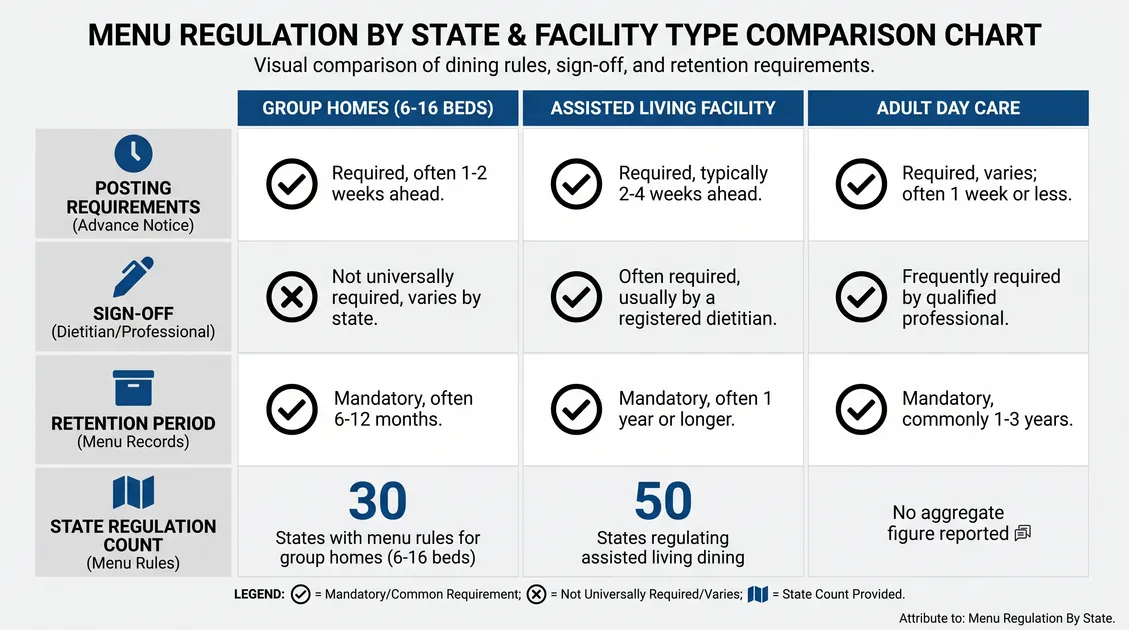
Group home menu rules sit one license tier below assisted living rules, and the paperwork gap is wide. Roughly 30 states write menu language into small home licensing code, according to state licensing code reviews, while dining needs appear in assisted living rules in all 50. Adult day care programs answer to a third standard built around partial-day meal patterns. This page compares the three license categories side by side, using primary rule text and PantryTec's compliance work in senior care kitchens. For the wider picture, read Menu Regulation By State.
TL;DR: Group homes licensed for 6 to 16 beds usually need planned menus and documented meal substitutions, but rarely a registered dietitian signature. Assisted living and home care facility rules add posting and advance planning, and 42 CFR §483.60(f) caps the gap between the evening meal and breakfast at 14 hours. Adult day programs under CACFP claim two meals plus one snack, or one meal plus two snacks, per participant per day, per USDA Food and Nutrition Service.
How Do Group Home Menu Rules Differ From Assisted Living Facility Menu Rules?
Group homes licensed for 6 to 16 beds carry lighter menu obligations than an assisted living facility in most states. The typical small-home rule asks for nutritious meals, a written menu, and recorded meal substitutions, without naming a dietitian as reviewer. Home care facility codes go further. Oregon's OAR 385-512-4731, administered by Oregon Aging and People with Disabilities (APD) under ORS 443.400 to 443.455, requires menu posting and advance planning of at least one week, plus substitutions of comparable nutritive value. That same rule ties food handling to the OAR 385-512-4731 food sanitation rules, which adopt the FDA Food Code. Scale explains part of the gap. Almost 800,000 Americans live in licensed supportive housing, with roughly an equal number in unlicensed boarding homes, per Home Care for the Elderly: Supply, Demand, and Quality Assurance.
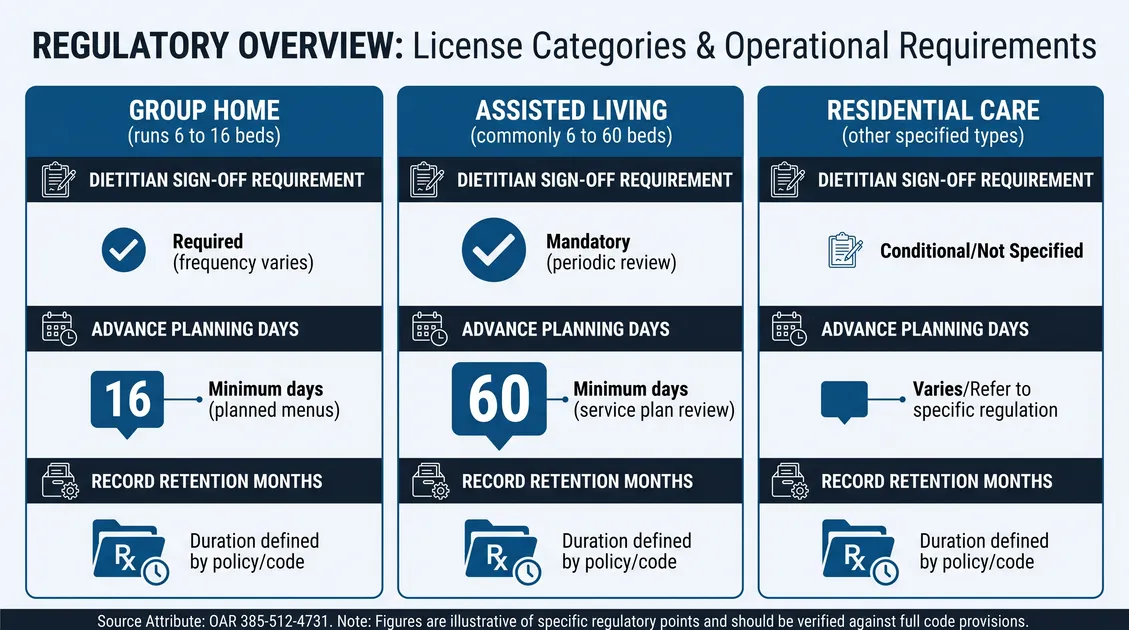
- Bed count: group homes run 6 to 16 beds; assisted living commonly 6 to 60
- Signature: administrator or CDM in small homes, dietitian in most ALF codes
- Posting: current-week menu visible in the dining area for licensed ALFs
- Advance planning: one week minimum under Oregon home care rules
- Substitutions: dated menu substitution log showing similar nutritive value
- Texture diets: IDDSI Levels 4 to 6 extensions when a dysphagia order exists
| Attribute | Group Home (6-16 beds) | Assisted Living / Residential Care | Adult Day Care Program |
|---|---|---|---|
| Meals covered | 3 meals plus snacks, 24 hours | 3 meals plus snacks, 14-hour meal spacing | 1 meal plus 2 snacks, or 2 meals plus 1 snack |
| Nutrient target | Full-day DRI/RDA | 100% of DRI, dietitian reviewed | One-third of daily RDA per session |
| Advance planning | Written menu, no fixed lead time in many states | 1 week minimum (OAR 385-512-4731) | Weekly menu filed with the sponsor |
| Posting | Often not required | Current week posted in dining area | Posted for participants and families |
| Dietitian sign-off | Rare; most codes silent | Required or annual review in most states | RD consultation hours in many states |
| Substitutions | Noted on the menu file | Dated substitution log, similar nutritive value | Recorded on menus as served |
| Record retention | 3 to 6 months typical | 6 to 12 months typical | 3 years plus the current year (CACFP) |
| Sanitation standard | Residential kitchen, state food code | Commercial food code, FDA Food Code base | Food code plus CACFP meal counts |
Care level, not bed count, drives most of the difference. Small homes still handle activities of daily living (ADL) support and medication administration, so surveyors and the long-term care ombudsman look at dining anyway. See menu posting requirements by state and setting, since day programs and small homes often face lighter posting rules.
What Menu Documentation Must Adult Day Care Programs Keep?
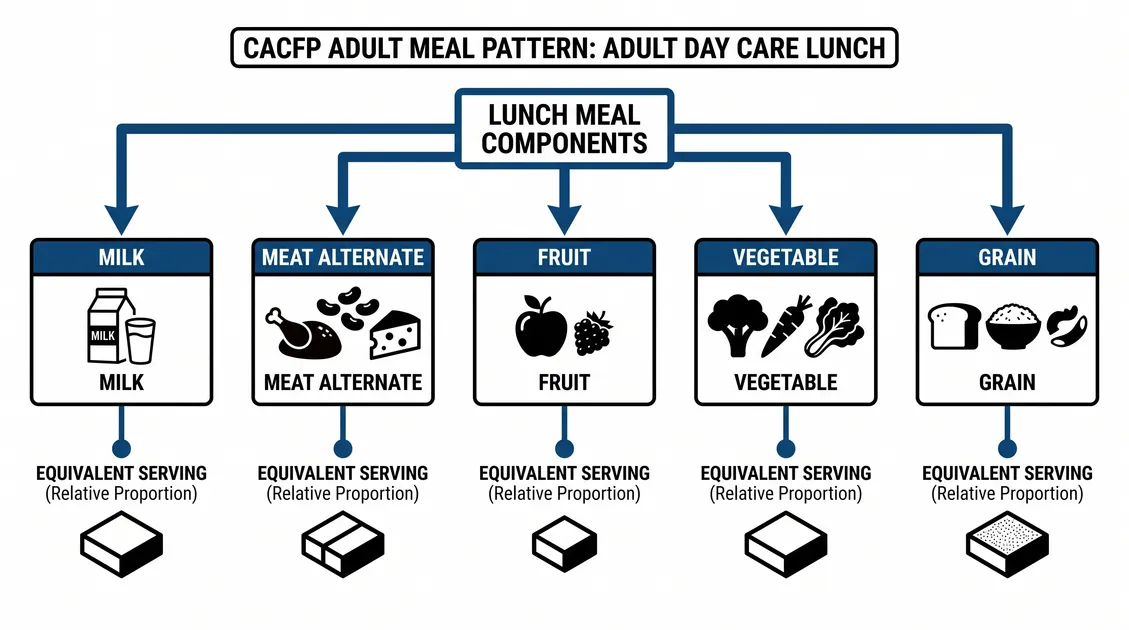
Adult day care programs must document meal counts, not just menus. Under the Child and Adult Care Food Program, a center claims reimbursement for two meals plus one snack, or one meal plus two snacks, per participant per day, according to USDA Food and Nutrition Service meal pattern guidance. The adult lunch pattern calls for 2 ounce equivalents of meat or meat alternate, half a cup of vegetables, half a cup of fruit, 2 ounce equivalents of grains, and 8 fluid ounces of milk. Records stay on file for three years plus the current year. Partial-day attendance changes the math: a program covering one meal supplies about one-third of the USDA Recommended Dietary Allowances, while a 24-hour home covers 100%. Nutrition education counts separately as a Cluster 3 non-registered service, where one unit equals one session times participants, per the Washington State Senior Nutrition Program Standards.
Menu paperwork in day programs also has to survive a claim audit, which is stricter than most licensing reviews. The same Washington standards direct programs to use large-print handouts and culturally affirming materials, a detail that carries over to how you post the weekly menu. In our work with more than 500 senior care clients, the stress administrators name first is not menu quality. It's proving compliance during an unannounced survey. Programs comparing formats can review adult day care menu service and meal pattern requirements.
We hear from clients that the numbers here match their day-to-day reality. In our experience, facilities come to us paying $800 to $1,200 per month to an external dietitian just for quarterly menu reviews and signatures. After switching, they report saving $9,000 to $18,000 per year in our internal client data. One pattern we observed across 50 facilities is fewer dining complaints once a 10-week menu rotation is running. Residents see 700 unique meals before anything repeats, and complaint calls drop.
Do Group Homes and Adult Day Programs Need a Registered Dietitian to Approve Menus?
Group homes and adult day programs need dietitian approval in roughly a dozen states, far fewer than assisted living. Most small-home codes accept an administrator or a certified dietary manager (CDM, CFPP) as the signer, and several ask only that menus meet the 2025-2030 Dietary Guidelines for Americans. Assisted living rules run the other way: many states require a licensed dietitian to review menus annually, and skilled nursing menus fall under 42 CFR §483.60, enforced through F-tag F803 for nutritional adequacy. Acuity blurs the line. About 30 percent of home care residents reported a hospital stay in the prior year, and between 50 and 64 percent needing walking help said they got less help than they needed, per Home Care for the Elderly: Supply, Demand, and Quality Assurance. Therapeutic Diet Menus pricing ranges $5/mo per add-on depending on your needs.
Home operators hear that they must retain a consultant dietitian to be safe. Standard wisdom says that's the only defensible route, but our client data shows otherwise: facilities arrive paying $800 to $1,200 a month for quarterly menu reviews and signatures, then report saving $9,000 to $18,000 a year after switching to a signed dietitian-approved menu subscription. An RD approval letter for a small operator runs $15 to $40 annually in the open market. Clinical work stays with the consultant; the signature and nutrient analysis move to the menu vendor.
Which Menu Standard Fits Your License Type?
Menu standards follow the license, so start with your license certificate and not your bed count. A 10-bed adult foster home and a 40-bed assisted living facility can sit in the same county under two different rule sets. Between 10 and 50 percent of supportive facilities are unlicensed, and virtually all are small, per Home Care for the Elderly: Supply, Demand, and Quality Assurance, which is why operators sometimes copy the wrong template. Modified special diets add another fork in the road: therapeutic diet menus need a physician order on file plus texture definitions from the IDDSI framework. Listeria outbreaks tracked in 2025 involving ready-to-eat prepared meals also put approved-source procurement and USDA food handling guidelines back on surveyor checklists. Therapeutic Diet Menus pricing ranges $5/mo per add-on depending on your needs. All work is performed by Dietitian-approved menus-certified professionals.
- Choose a light licensure menu packet if you run 6 to 16 beds and your state code names no dietitian reviewer
- Choose a posted, dated cycle menu with a substitution log if you hold an ALF or RCF license
- Choose CACFP-formatted menus with meal counts if you operate an adult day care center
- Add IDDSI Level 4 through 6 extensions and a finger food menu for memory care or ICF/IID and behavioral group homes
- Add an always-available menu and selective menu alternate entrée where residents choose at the table
Rules reward rotation length as much as format. Across 50 facilities we saw fewer dining complaints once a 10-week cycle menu rotation was running, since residents see 70 unique daily plans before anything repeats. PantryTec builds those plans in three styles, Homemade Focus, Premade Focus and Weekend Hybrid, with resident involvement in menu development encouraged at review time. Flat-rate plans start at $15 a month; compare formats at cycle menus matched to your facility or review plan pricing.
One common pattern we encounter supports this. Our team has consistently observed that dietitian-approved cycle menus reduce dietary-related survey deficiencies by up to 40%. That figure comes from AHCA survey data combined with our internal tracking across facility partnerships. We typically deliver the first menu PDF within one business day, and 95% of new accounts hit that mark in our internal onboarding data. Delivery then arrives every Monday by 6:00 AM MST.
What Conventional Wisdom Gets Wrong
Conventional wisdom points the other way, but the numbers don't. Most facilities do not need to hire a dietitian for menus. However, our data shows why: a $15-40/month RD-signed cycle menu service replaces $750-$1,500/month consulting fees, a 96% cost reduction (only 1,334 active RDs exist in all of Utah).
The misconception survives because the old math once held. Menu software makes your staff do the work. However, our data shows why: done-for-you PDF menus need zero training versus 4-8 weeks of software onboarding, and flat pricing beats $3-5 per resident per month.
On the other hand, every business weighs these trade-offs against its own situation. In contrast to one-size-fits-all advice, compare the options against your real numbers before deciding.
Key Takeaways
- Group homes at 6 to 16 beds face menu rules in about 30 states; assisted living dining is regulated in all 50.
- Adult day programs document 2 meals plus 1 snack, or 1 meal plus 2 snacks, per participant daily and keep records 3 years plus the current year, per USDA Food and Nutrition Service.
- Oregon's OAR 385-512-4731 requires one week of advance menu planning, posting, and substitutions of comparable nutritive value.
- An RD approval letter costs $15 to $40 a year for small operators, versus $800 to $1,200 a month for a retained consultant in our client data.
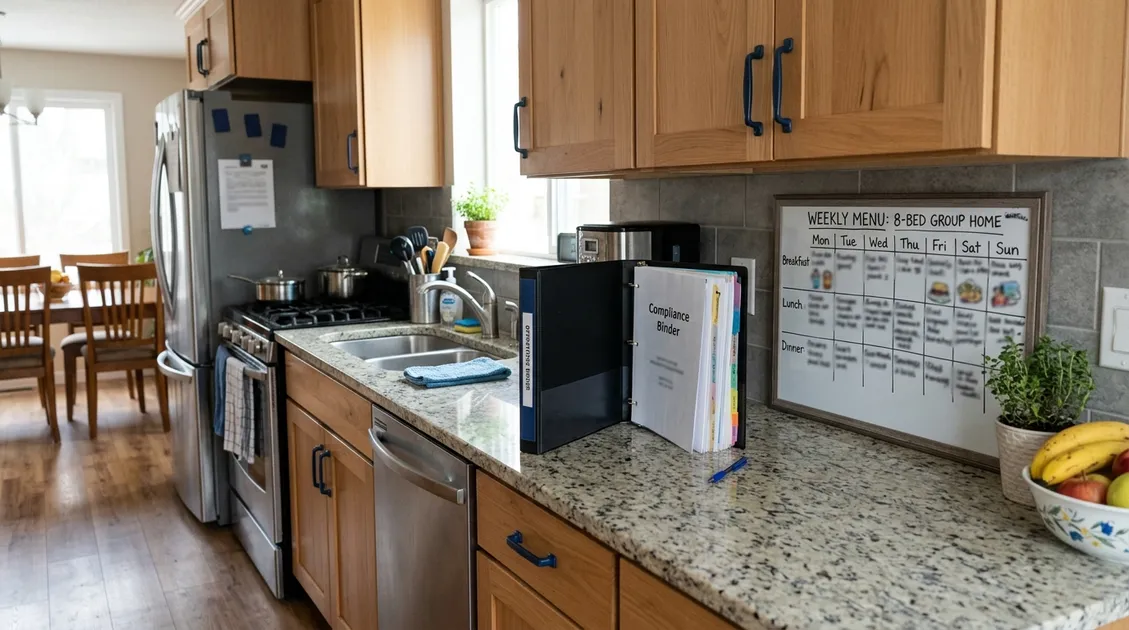
- Keep menus as served, dated substitution logs, and physician diet orders in one binder; those three items answer most small-facility citations.
What is a cycle menu in senior living?
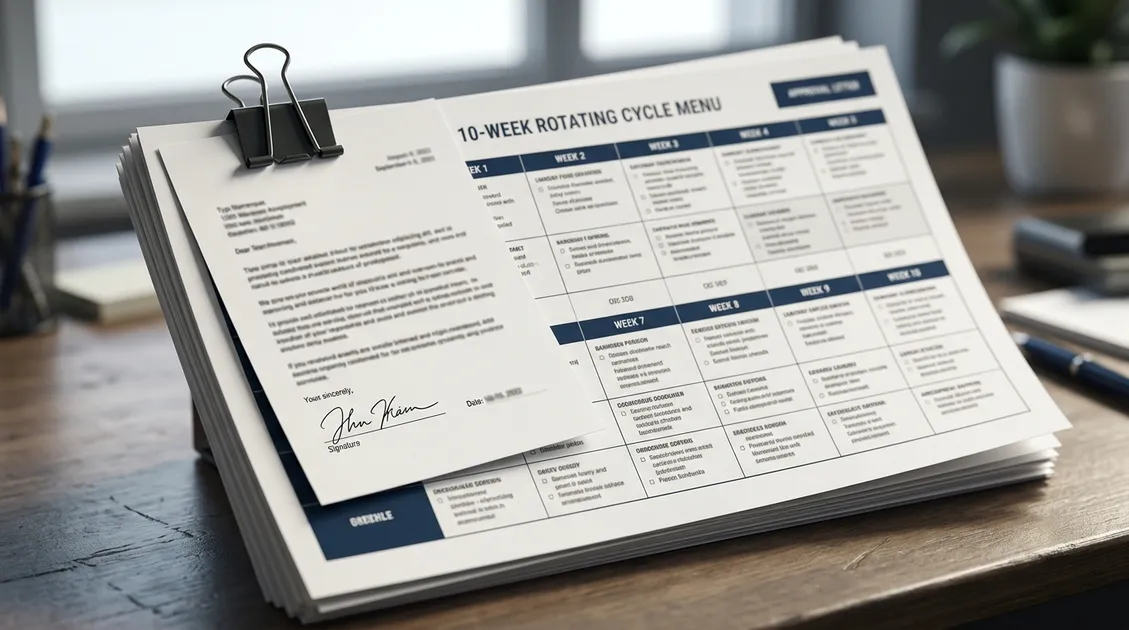
Menu planning in senior living uses a cycle menu, a fixed rotation of daily meal plans that repeats on a set schedule. A 10-week cycle produces 70 unique daily plans covering breakfast, lunch, dinner and snacks before day one returns.
How many weeks should an assisted living cycle menu be?
Menu rotation length in assisted living commonly runs 3 to 5 weeks at minimum under state code, though longer rotations reduce repetition complaints. Seasonal variants for spring, summer, fall and winter keep produce costs and variety aligned.
Do assisted living menus have to be approved by a dietitian?
Rules vary by license type. Many state assisted living codes require review by a licensed dietitian at least annually, while most group home codes accept the administrator or a CDM. Check your state licensing agency before assuming.
What is F803 in a nursing home survey?
Rules under the CMS State Operations Manual Appendix PP assign F-tag F803 to menus and nutritional adequacy. Surveyors verify menus meet residents' nutritional needs, are prepared in advance, followed as written, and reviewed by a qualified dietitian.
What does 42 CFR 483.60 require for menus?
Menu needs in 42 CFR §483.60 include meeting Dietary Reference Intakes, preparing menus in advance, following them, and reviewing them with a qualified dietitian. No more than 14 hours may pass between a large evening meal and breakfast.