
Michigan AFC Menu Rules:
Adult Foster Care and Home for the Aged Guide (2026)
Michigan licenses adult foster care homes and homes for the aged under separate rule sets, and each one sets its own meal, menu, and diet-order duties. Under the Michigan AFC menu rules adopted November 3, 2025, every adult foster care home serves at least three nutritious meals daily from menus written a week ahead. PantryTec builds dietitian-approved cycle menus for senior care facilities, so this guide reads both rule sets the way a LARA licensing consultant does.
Menu duties depend on license type first, which is the core step in our guide on To find and read your state's menu. AFC license numbers start with AF, AS, or AL, so check yours before you read any rule. If you want a working example while you read, download a free 4-week sample.
TL;DR: AFC homes follow R 400.663, which covers daily meals, a capped overnight gap, menus posted a week ahead, and documented substitutions. Homes for the aged follow R 325.1951 to R 325.1954, which cover weekly posted regular and therapeutic menus, as-served copies, and meal census records. Neither rule set requires a dietitian signature. Both require prescribed diets to be served exactly as ordered.
Menu rules last updated:
What Are Michigan's Menu Requirements for AFC Homes and Homes for the Aged?
Michigan requires adult foster care homes to follow R 400.663 and homes for the aged to follow R 325.1951 through R 325.1954, enforced by LARA. Adult foster care (AFC) means 24-hour room, board, and supervised personal care for aged, mentally ill, or disabled adults. Homes for the aged (HFA) serve 21 or more unrelated residents aged 55 or older. Smaller HFAs of 20 or fewer exist only as a distinct part of a licensed nursing home, per the AHCA/NCAL Michigan regulatory summary. LARA's Bureau of Community and Health Systems licenses and inspects both. The AFC rule ties meals to the Dietary Guidelines for Americans, 2020-2025. The HFA rule ties them to Food and Nutrition Board dietary allowances. Michigan does not license assisted living by that name, so read the license on your wall first. California's closest match is the RCFE, or Home Care Facility for the Elderly. The table below shows where Michigan's two rule sets split.
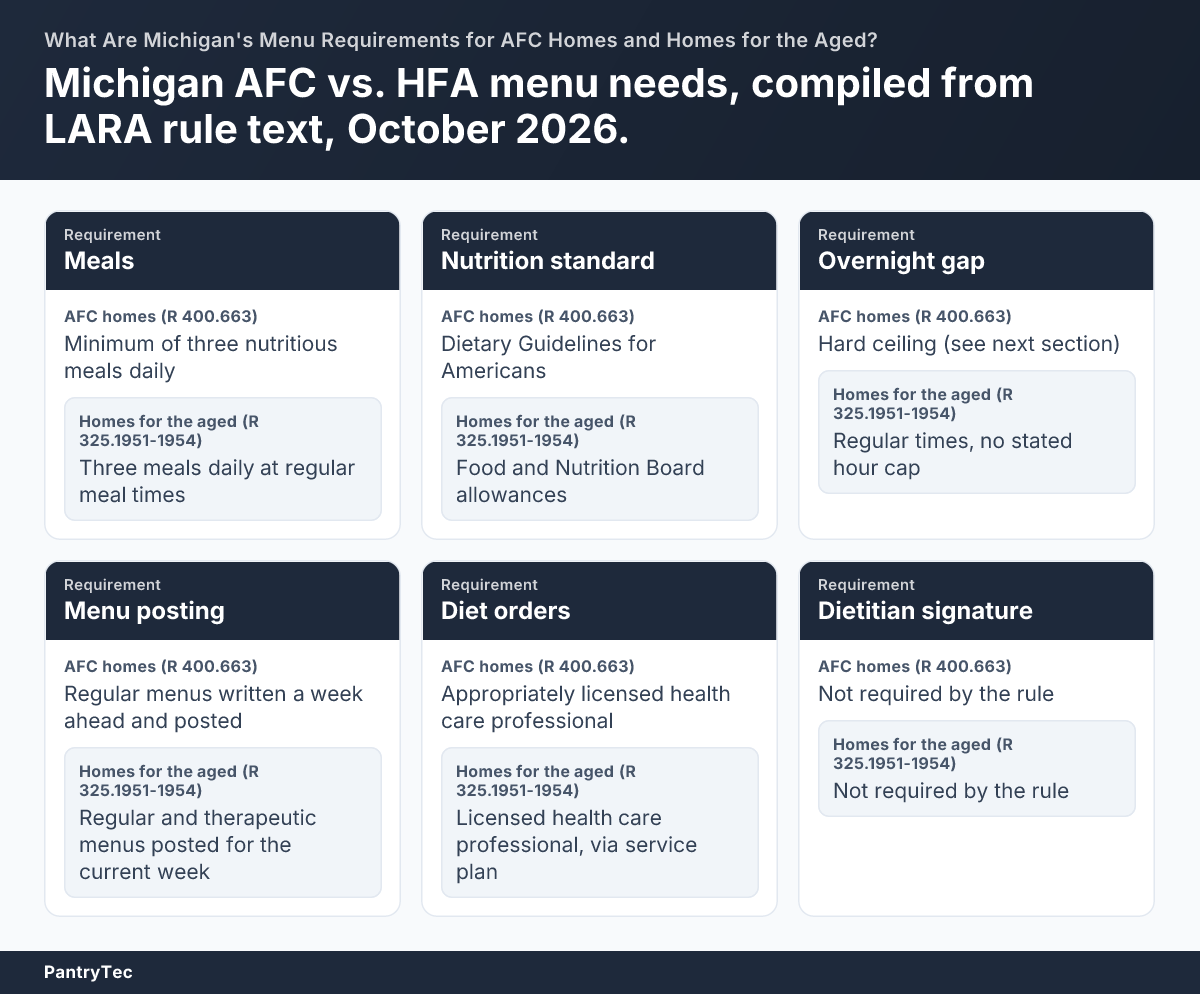
| Requirement | AFC homes (R 400.663) | Homes for the aged (R 325.1951-1954) |
|---|---|---|
| Meals | Minimum of three nutritious meals daily | Three meals daily at regular meal times |
| Nutrition standard | Dietary Guidelines for Americans | Food and Nutrition Board allowances |
| Overnight gap | Hard ceiling (see next section) | Regular times, no stated hour cap |
| Menu posting | Regular menus written a week ahead and posted | Regular and therapeutic menus posted for the current week |
| Diet orders | Appropriately licensed health care professional | Licensed health care professional, via service plan |
| Dietitian signature | Not required by the rule | Not required by the rule |
Adult Foster Care Food Service Rules
Adult foster care rules changed shape in late 2025. LARA's single AFC ruleset, R 400.601 to R 400.745, replaced separate rules for family homes (up to 6 residents), small group homes (up to 12), and large group homes (13 to 20). Family homes once wrote menus only if LARA demanded them after large noncompliance. Now every AFC home writes them, and homes licensed for 7 or more residents need one staff member qualified to run food preparation. Older handbooks from the Bureau of Children and Adult Licensing (BCAL), once part of the Department of Human Services, cite the retired rule numbers.
Michigan AFC food budgets often rest on SSI plus the MDHHS Medicaid personal care supplement payment. Homes bill it after licensure through SIGMA vendor registration, Bridges eligibility, and MiAIMS. Home care homes like Michigan's AFCs saw Medicaid waivers reach only about 59,000 supportive housing residents nationally, per the California HealthCare Foundation's Residential Care for the Elderly report (2000 data). That left about 80 percent of low-income residents in such homes without waiver help, the same report found. The public health emergency (PHE) unwind added risk when Medicaid renewals resumed in 2023.
Home for the Aged Dietary Standards
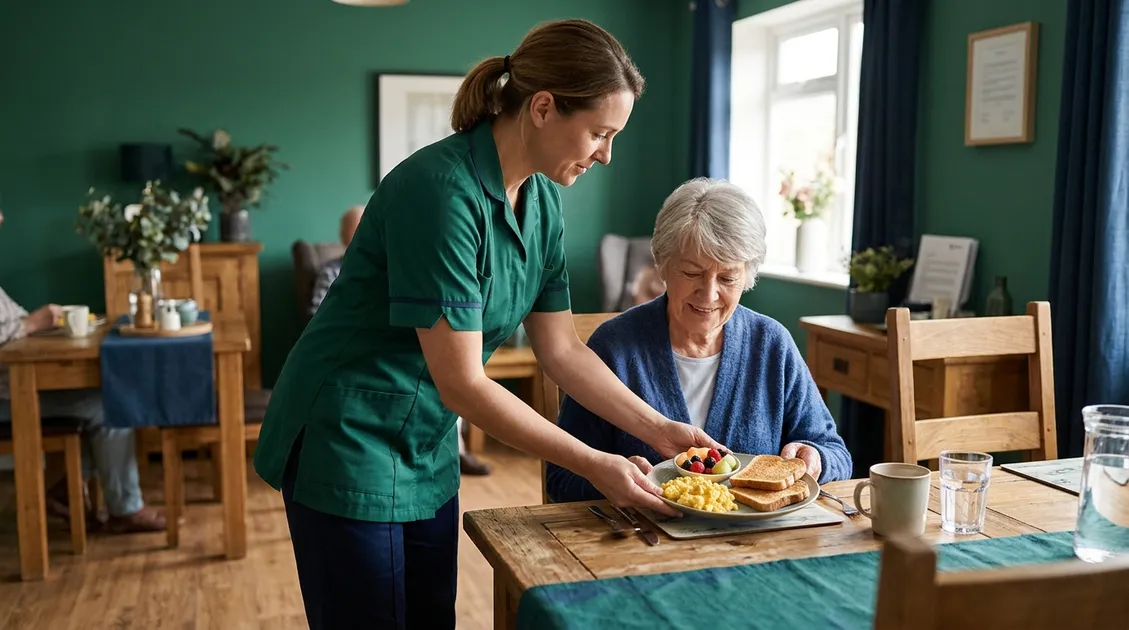
Home for the aged kitchens carry duties the AFC rule lacks, including room tray service and honoring preferences when feasible. Neither Michigan rule set names a dietitian. Federal nursing home law does: 900 hours of supervised dietetics practice is the minimum for a qualified dietitian reviewing nursing home menus, per 42 CFR 483.60 on eCFR (2026). That benchmark doesn't bind an AFC or HFA, but it defines qualified if you hire one.
Michigan Menu Survey-Readiness Self-Assessment
Pick your license type, then rate each item. Your score and a prioritized gap list update instantly, covering menu posting, substitutions, record retention, and diet-order documentation.
Self-check only, not legal advice. Items tagged "Rule" reflect the LARA rule summary on this page (menu rules last updated October 2026). Items tagged "Practice" are documentation habits that help during a survey but whose exact requirement or retention period is not stated here; confirm against the current rule text or with your LARA licensing consultant. Neither rule set requires a dietitian signature on menus.
How Many Hours Can Pass Between Michigan Meals?
Michigan caps the overnight meal gap in every adult foster care home at the same span federal law sets for nursing homes, under R 400.663, with maximum evening-to-breakfast gap at 14 hours. 14 hours is the federal maximum between a large evening meal and next breakfast for nursing home residents, per 42 CFR 483.60 on eCFR (2026). Michigan's AFC rule measures from the evening meal to the morning meal and lists no bedtime-snack exception. Homes for the aged face no stated hour cap. R 325.1952 requires meals at regular meal times instead. Regular still means something to a licensing consultant. A home that serves dinner at 4:30 p.m. to free up evening staff invites questions about hunger and weight loss. The safest HFA practice is to borrow the AFC ceiling anyway. Write real service times on the posted menu so the gap is provable. The examples below show the math on a working schedule.
Overnight Interval Limit
Menu planners in AFC homes should count backward from breakfast:

- Dinner at 5:00 p.m. means breakfast service starts no later than 7:00 a.m.
- A 5:30 p.m. dinner followed by a 7:45 a.m. breakfast is a citable gap.
- Residents who sleep in still get breakfast offered on time, with refusals noted.
- Bedtime snacks are good care, but the AFC rule lists no snack exception.
Snack Requirements Between Meals
Home for the aged rules require snacks and beverages to be available, which an always-available menu of simple items satisfies. AFC rules do not mention snacks, and LARA's family home technical assistance manual says snacks supplement meals but never replace them. Michigan's SSI-funded AFC residents pay board from tight checks. The CHCF report even suggested studying a change letting SSI/SSP recipients redirect food stamps toward monthly home care rent.
Adult day care programs run on a different clock. An Adult Day Care Center serves a partial-day meal pattern of per-session meals and snacks, and its census varies daily. Some states overlap adult day menus with the CACFP adult care component, and posting rules are state-specific. Our comparison of group home and adult day care menu rules vs ALF rules covers those differences.
Who Approves Special Diets in Michigan Licensed Homes?
Michigan AFC homes serve diets prescribed by an appropriately licensed health care professional under R 400.663, while homes for the aged follow service plans. The 2025 AFC ruleset widened that authority. Former rules such as R 400.14313 let only a physician prescribe a special diet. The HFA rules define a licensed health care professional broadly. That list covers medical and osteopathic doctors, nurse practitioners, physician assistants, registered and practical nurses, and podiatrists. Under R 325.1952, that professional prescribes medical nutrition therapy, including therapeutic diets, supplemental nourishments, and fluids. A resident or authorized representative may waive the therapy in writing. That waiver is Michigan's version of a liberalized diet, and it belongs in the record. Neither rule set gives a dietitian independent order authority. Kitchens still need the written order before changing a single tray. Common Michigan orders include no added salt (NAS), consistent carbohydrate (CCHO), renal, and texture-modified diets.
Physician-Ordered Diet Documentation
Menu changes for special diets start in the resident record. LARA's family home manual lists weight reduction, diabetic, low sodium, low carbohydrate, tube feeding, and consistency changes as special diets. Michigan rules never mention IDDSI, yet many dysphagia orders now arrive as IDDSI Level 4 pureed, Level 5 minced and moist, or Level 6 soft and bite-sized.
Medication self-administration records sit in the same chart, so the diet roster and medication list should agree. For AFC residents placed by community mental health (CMH), send diet changes to the CMH case manager too. PantryTec's therapeutic diet menu extensions follow this order-first logic, and our article on why F808 therapeutic diets must be physician-ordered covers the federal parallel.
Dietitian Involvement for Homes for the Aged
Michigan HFAs that can't staff RDN time can look to community nutrition programs. One meals-on-wheels program in the ACL's Medical Nutrition Therapy Works for Seniors toolkit had provided Medicare MNT for about seven years with RDNs on staff. Hospice and home health agency services bring their own clinicians, and their diet advice must reach the service plan.

Menu signatures are where budgets leak, in our experience. Facilities come to us paying $800 to $1,200 per month to an external dietitian solely for quarterly menu reviews and signatures. That is $9,600 to $14,400 a year for a signature Michigan's AFC and HFA rules never require. We have found that reserving consultant hours for clinical assessments keeps that expertise where residents need it most.
One common pattern we encounter supports this. In our experience, most facility administrators don't realize their external dietitian bill exceeds their annual menu cost by 10x or more. In our experience, facilities come to us paying $800 to $1,200 per month to an external dietitian just for quarterly menu reviews and signatures. That is $9,600 to $14,400 a year, against $180 to $480 a year for a PantryTec plan billed annually with the RD Approval Letter included.
How Long Must Michigan Menus Be Kept, and What Does LARA Inspect?
Michigan AFC homes keep menu records, including special diets, for 90 days under R 400.663, while homes for the aged keep as-served menus 3 months. The AFC figure is new. Legacy group home rules demanded 1 calendar year, so older files already exceed the floor. HFAs also keep a meal census of residents, staff, and visitors under R 325.1954. That rule adds a record of the kind and amount of food used over the same window. Posting duties differ as well. AFC homes post regular menus a week ahead, and special diets are excluded from that posting rule. HFAs post regular and therapeutic menus for the current week, with changes written on the planned menu. A practical filing system pairs each posted week with its menu substitution log, diet roster, and census sheet. One dated folder per week keeps every piece of evidence together. LARA consultants open those folders during renewal inspections.
Documents Requested by Consultants
Menu evidence is among the first things a licensing consultant asks to see. Expect requests for:
- The current week's posted menu, dated and visible to residents
- Menus as served, with each substitution and alternate entrée logged
- Diet orders that match the diet roster and tray cards
- HFA meal census and food-use records for the retention window
- Emergency preparedness planning that covers food and water during outages
Home for the aged citations follow fast when posting slips. One LARA HFA inspection report established an R 325.1953 violation because neither the regular menu nor the NAS, consistent carbohydrate, and mechanical soft menus were posted. Consultants also verify criminal history checks under MCL 333.20173a for staff with resident access. Homes advertising dementia care owe the Alzheimer's disclosure in MCL 333.20178, so a finger food menu should match that promise.
Correcting Menu Violations
Michigan citations require a written corrective action plan due 15 days from LARA's letter, per a 2026 LARA renewal inspection report. The plan states how compliance will happen, who is responsible, completion dates, how compliance continues, and a signed date. A clean renewal can earn a 2-year regular AFC license, while serious violations can bring a provisional license. Michigan's inspection reaches every licensed home regardless of payer. The CHCF report found only a few states, such as Illinois, ran all-payer long-term care gatekeeping. Trade groups such as the Michigan Center for Assisted Living track rule changes between renewals.

What Conventional Wisdom Gets Wrong
Conventional wisdom points the other way. Most facilities do not need to hire a dietitian for menus. In our work, here is why: a $15-40/month RD-signed cycle menu service replaces the $800-$1,200/month consulting fees on the invoices facilities bring us, a 95% to 99% cost reduction.
The misconception survives because the old math once held. Menu software makes your staff do the work. In our work, here is why: done-for-you PDF menus need zero training versus 4-8 weeks of software onboarding, and flat pricing beats $2-5 per resident per month.
On the other hand, every business weighs these trade-offs against its own situation. In contrast to one-size-fits-all advice, compare the options against your real numbers before deciding.
Key Takeaways: Michigan AFC and HFA Menu Compliance in 2026
Menu compliance in Michigan rests on written, posted, followed, and retained menus, not on a dietitian's signature. Standard wisdom says a small AFC home must hire a consultant dietitian for menus. PantryTec takes a different approach because neither R 400.663 nor R 325.1953 requires that signature. In our work, the biggest stress administrators describe isn't menu quality. It is proving compliance when a surveyor or licensing consultant walks in.
- AFC homes: R 400.663 now governs every license size, so post regular menus a week ahead and document each substitution.
- HFAs: post regular and therapeutic menus weekly and file as-served copies with meal census records.
- Diet orders: change no tray without a written order from a licensed health care professional.
- Inspections: answer any menu citation with a signed corrective action plan before LARA's deadline.
PantryTec plans start at $15/month billed annually ($180/year) for Starter, with Complete at $20/month ($240/year) and Premier at $40/month ($480/year). Every plan includes an RD Approval Letter signed by Bridget MacDonald, RD, and the first menu arrives within 24-48 hours of sign-up. That letter is useful for a licensure menu packet even where Michigan doesn't demand it. Compare flat-rate menu plan pricing, browse cycle menus matched to your facility, or talk to a Registered Dietitian. Midwest operators can also compare Ohio residential care facility menu rules.
What is a cycle menu in senior living?
Menu cycles are planned rotations of breakfast, lunch, dinner, and snacks that repeat after a set number of weeks. PantryTec's cycle menu runs 10 weeks before any day repeats. Michigan rules do not set a rotation length, only advance writing and posting.

How many weeks should an assisted living cycle menu be?
Michigan sets no minimum menu rotation length for AFC homes or homes for the aged. AFC menus must be written at least 1 week in advance, and HFAs post the current week's menus. Many operators choose longer rotations to limit repetition.
Do assisted living menus have to be approved by a dietitian?
Michigan's AFC and HFA rules don't require dietitian approval of menus. Federal rules at 42 CFR §483.60(a) require a qualified dietitian or clinically qualified nutrition professional only in certified nursing homes. Many Michigan operators still keep a dietitian-approved menu letter in the compliance binder.
What is F803 in a nursing home survey?
F803 is the CMS F-tag for menus and nutritional adequacy under 42 CFR §483.60(c), explained in State Operations Manual Appendix PP. Surveyors check that menus meet needs, are prepared in advance, are followed, and are reviewed by the dietitian. Our F803 explainer covers the details.
What does 42 CFR 483.60 require for menus?
Federal rule 42 CFR 483.60 requires certified nursing homes to serve at least 3 meals daily from menus that meet nutritional needs. It also covers ordered therapeutic diets under F808 and the overnight gap under F809. Michigan's AFC rule mirrors that overnight cap, but HFA rules don't.
We hear from clients that the numbers here match their day-to-day reality. One pattern we see is fewer dining complaints once a 10-week menu rotation is running. Residents get 70 days of menus, 210 breakfasts, lunches and dinners, before any day repeats.
Get the Free 4-Week Sample Menu Packet
Tell us your facility type, bed count, and state. We will show which Michigan menu rules apply to you, then open the request page with your details filled in so the right packet version is sent.
Your menu rules
- Choose a facility type to see the rule set that applies.
Meal counts use the three meals daily required under both Michigan rule sets (beds x 3 meals x 7 days).
Nothing is submitted or stored from this widget. The button opens PantryTec's request page with your selections attached, where you complete the request. Rule summaries reflect LARA rule text as of October 2026 and are not legal advice.