
Menu Requirements by State:
Who Signs, Posts, and Keeps ALF Menus
Menu requirements by state are set by state licensing agencies, not CMS. They decide who signs your assisted living menus, how early you post them, and how long you keep them.
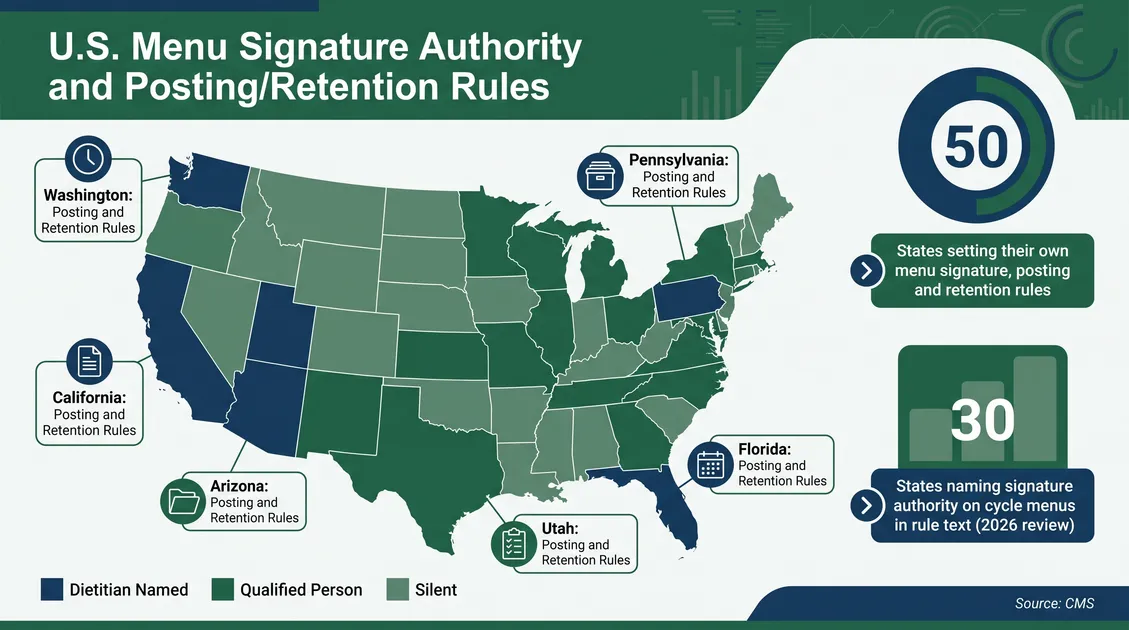
Menu needs by state for assisted living come from state licensing code, not from CMS. All 50 states set their own rules on three points: who signs the menu, where it is posted, and how long served menus stay on file. State rules diverge most on signature authority. The rule text decides whether a registered dietitian (RD), a licensed dietitian or a certified dietary manager may approve the cycle menu. PantryTec, a dietitian-approved cycle menu service based in Springville, Utah, built this comparison hub for administrators who need that answer before a licensing survey. Start with our guide on To find and read your state's menu rule, then use the sections below to see how the needs differ.
Menu compliance for senior care facilities is a documentation problem more than a cooking problem. You can serve excellent food and still get cited because the posted menu wasn't signed, dated or kept.
TL;DR: State licensing agencies, not CMS, enforce assisted living menu rules. Utah's R432-270-22 requires a certified dietitian to approve and sign every menu, Florida's 59A-36.012 requires a documented yearly dietitian review, and California's Title 22 §87555 names no signer for regular menus. Posting lead times run from a single day in Arizona to a full week in most compared states. Menus as served must be kept from about a month to half a year depending on the state. The federal F-tag series binds certified nursing facilities only.
What Are State ALF Menu Rules and Which Agency Enforces Them?
State ALF menu rules are the food service sections of each state's assisted living licensing code, enforced by the state licensing agency, not CMS. Utah's rule lives at R432-270-22, enforced by the Utah Department of Health and Human Services. California's sits at Title 22 §87555 under the Department of Social Services. Florida's is Rule 59A-36.012 under the Agency for Health Care Administration. Each rule answers the same three questions in a different way. Who may approve and sign the cycle menu? Where and when is the menu posted for residents? How long must menus as served and the menu substitution log be kept? A state licensing survey checks those three items against the state code only. A CMS certification survey, by contrast, uses the federal F-tag series and applies to skilled nursing facilities, not assisted living. Knowing which surveyor walks through your door decides which rulebook you should be reading.
Licensing Agency vs CMS Jurisdiction
State licensing survey teams work from the state ALF code, and their findings land on a state statement of deficiencies with a plan of correction deadline. The CMS certification survey works from the State Operations Manual, Appendix PP, and cites F-tags on form CMS-2567. Both can touch one campus when a licensed assisted living wing shares a building with a certified skilled nursing wing. Our guide to the licensing survey vs CMS certification survey walks through both tracks.
Statute, Rule and Interpretive Guidance Layers
Rules you can be cited under sit in the middle of three layers. The statute, such as Florida Statutes Chapter 429, creates the licensing agency and its rulemaking power but rarely mentions menus. The administrative rule, such as 59A-36.012, sets the signature, posting and retention duties. Interpretive guidance, meaning surveyor manuals and provider bulletins, shapes how the rule is applied but can't add duties the rule does not contain. Our State Menu Regulation Citation Index lists the exact section numbers so you can read the wording yourself.
Menu Survey-Readiness Self-Assessment
Pick your state, then score the five documents a licensing surveyor typically asks to see. You will get an on-screen gap report you can copy or email to yourself. Rules shown come from the state licensing code, not CMS.
Educational tool only. It summarizes the three comparison points discussed on this page (signature authority, posting, retention) and does not replace reading your state's current licensing code. The email button opens your own mail app with the report prefilled, nothing is sent or stored by this page.
Which States Require a Registered Dietitian Signature on Cycle Menus?
Signature authority on cycle menus is named in the rule text of roughly 30 states, based on PantryTec's 2026 review of state assisted living codes. The remaining states either accept a “qualified person” or stay silent. Utah is the strictest model: R432-270-22 requires that a certified dietitian approves and signs any menu, per the Utah Administrative Code. Florida's Rule 59A-36.012 requires an annual review by a licensed or registered dietitian, a licensed nutritionist, or a registered dietetic technician under dietitian supervision. The review record must carry an original signature, license number and review date. California's Title 22 §87555 takes the opposite approach for general menus and names no signer, though modified diets must follow physician or dietitian instructions. Washington's WAC 388-78A-2300 focuses on menu content, posting and a diet manual rather than naming a credentialed signer. The credential your state accepts decides whether a consultant, a subscription menu or your own CDM can satisfy the rule.
| State and rule | Licensing agency | Who may sign or review the menu | Review recurrence |
|---|---|---|---|
| Utah, R432-270-22 | Dept. of Health and Human Services | Certified dietitian approves and signs any menu | Every menu in the cycle |
| Florida, 59A-36.012 | Agency for Health Care Administration | Licensed or registered dietitian, licensed nutritionist, or supervised registered dietetic technician | Yearly documented review with license number and date |
| California RCFE, Title 22 §87555 | Dept. of Social Services, Community Care Licensing | No signer named for general menus; physician or dietitian instructions for modified diets | No review interval in rule text |
| Washington, WAC 388-78A-2300 | Dept. of Social and Health Services | No credentialed signer named; diet manual required for prescribed diets | No review interval in rule text |
| Pennsylvania, 55 Pa. Code §2600.162 and §2800.162 | Dept. of Human Services | No menu signer named; special diets prescribed by physician, PA, CRNP or dietitian | No review interval in rule text |
| Arizona, R9-10-817 | Dept. of Health Services | No signer named; menus planned using the Dietary Guidelines for Americans | No review interval in rule text |
States Naming an RD or Licensed Dietitian Explicitly
State rules that name a dietitian borrow credential language from the Commission on Dietetic Registration (CDR), which issues the RD and RDN credentials, and from state licensure boards. The Academy of Nutrition and Dietetics publishes a licensure map showing which states license dietitians, which matters when a rule says “licensed” rather than “registered.” California's §87555(a) still anchors the daily diet to the Recommended Dietary Allowances of the Food and Nutrition Board, even without a named signer. Whether out-of-state and remote RD menu signatures are accepted is a separate variable of the same attribute. Dietitian time is also getting scarcer. The Administration for Community Living's Medical Nutrition Therapy Works for Seniors toolkit describes one program whose referrals climbed from 200 between January and May 2019 to 300 by the end of July, with 500 or more expected by year's end. The same toolkit profiles a meals-on-wheels organization that has billed Medicare for nutrition therapy for about seven years with RDNs on staff. Booking a consultant for a quarterly menu review in a small town competes with that demand.
States Allowing a CDM or Consultant Alternative
Rules in the silent or “qualified person” states let a Certified Dietary Manager, Certified Food Protection Professional (CDM, CFPP), credentialed through the Association of Nutrition and Foodservice Professionals (ANFP), approve the menu. Florida sits in between, accepting a registered dietetic technician when a dietitian supervises the work. Our RDN vs CDM approval comparison breaks down each credential, and Can legally sign a senior care menu in your state gives the state-by-state answer.
Standard wisdom says a facility in a dietitian-signature state must keep a consulting RD on retainer. Our data shows the rule text asks for a signed, dated menu from a qualified credential holder, not for an hourly contract. In our experience, facilities come to PantryTec paying $800 to $1,200 per month to an external dietitian for quarterly menu reviews and signatures alone. Switching to a subscription menu with the RD approval letter included, at $180 to $480 a year, saves roughly $9,000 to $14,000 a year. Clinical work for individual residents, such as weight-loss assessments, stays with a clinician. The menu signature doesn't need to.
One common pattern we encounter supports this. In our experience, most facility administrators don't realize their external dietitian bill exceeds their annual menu cost by 10x or more. We found that cook-to-census planning alone cuts food cost by about 12% in PantryTec kitchens.
How Do Menu Posting Requirements Vary Between States?
Posting rules for assisted living menus vary on two points: how far ahead the menu must be visible and where residents can read it. California's §87555, Florida's 59A-36.012, Pennsylvania's §2800.162 and Washington's WAC 388-78A-2300 all require menus written at least one week in advance. Pennsylvania adds that the weekly menu be posted that far ahead in a conspicuous and public place. Arizona's R9-10-817 sets the shortest lead time: the menu must be conspicuously posted at least one calendar day before its first meal is served. Utah's R432-270-22 requires the current week's menu posted for resident viewing. Washington adds a resident-access twist: menus may be delivered to residents' rooms instead of posted. Florida allows menus to be “conspicuously posted or easily available” to residents. Location language ranges from a public wall to a binder at the front desk, and that wording decides whether a kitchen bulletin board counts.
One-Week vs Full-Cycle Posting Windows
Posting one week at a time is the floor in every compared state, but posting the full cycle is often the smarter move. A full-cycle posting lets families on a tour see variety, and it lets a surveyor confirm the served week matches the planned cycle menu rotation. Menu rotation length interacts with this: Utah and Washington both set a minimum cycle length (covered in the FAQ below), so a posted single week must trace back to a longer plan. Washington also requires alternate choices in entrées at the midday and evening meals, with the alternate served recorded on the menu. That is the regulatory root of the selective versus non-select menu question. An always-available menu or a safety-net alternative menu satisfies it as long as what was served gets written down. We compare posting language in our state menu posting rules guide.
Resident-Accessible Location Standards
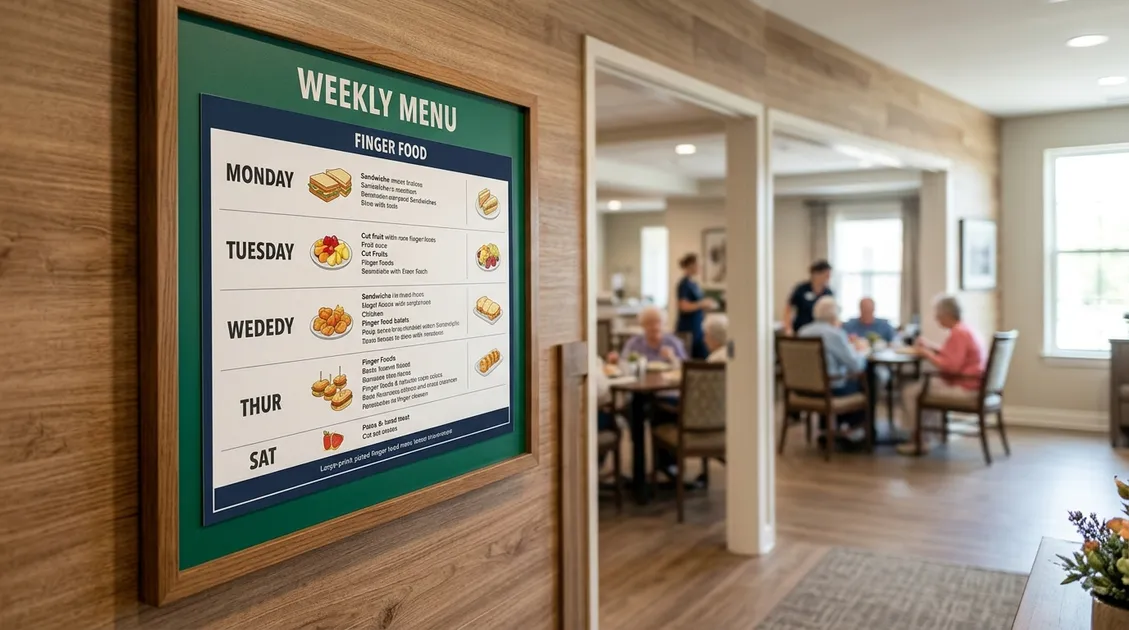
Menu posting for residents living with Alzheimer's disease and related dementias needs more than a wall location. Memory care communities do better with a large-print, high-contrast weekly menu at eye level near the dining room, plus a picture-based finger food menu for residents who no longer use utensils. State rules don't dictate font size, but “accessible to residents” is read by surveyors as readable by the residents you have. Pennsylvania's §2800.162 also requires that any menu change be posted before the meal, so the substitution has to reach the wall, not only the log.
How Long Must Menus As Served Be Retained in Each State?
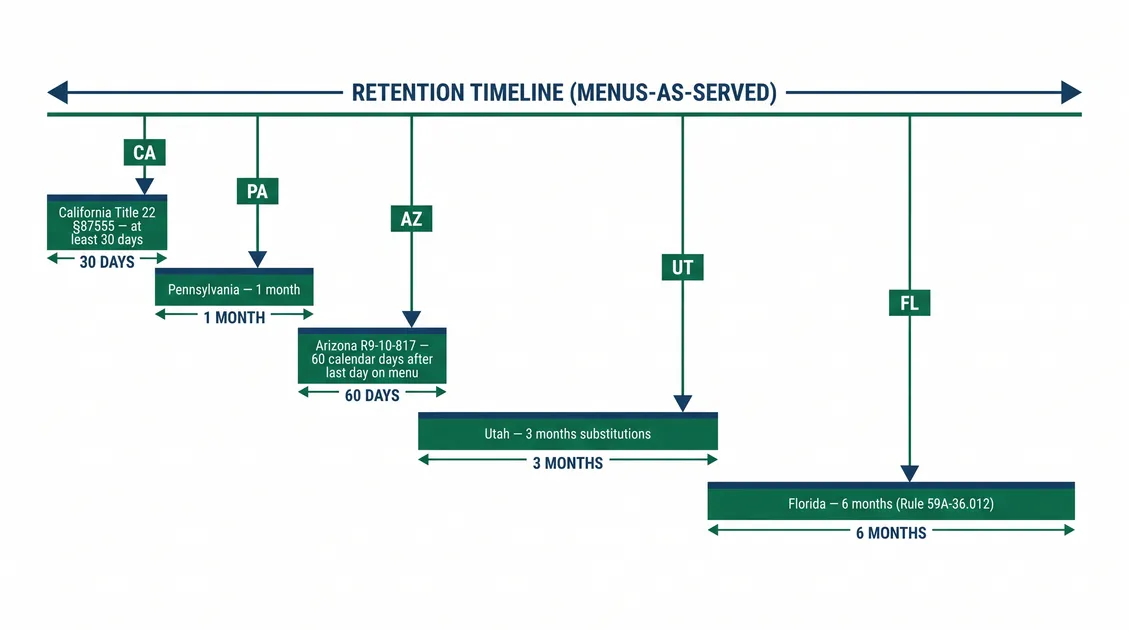
Retention periods for menus as served range from about one month to half a year across the states compared here. Every rule ties retention to the menu served, not the menu planned. California's Title 22 §87555 requires facilities of 16 or more residents to date copies of menus as served and keep them at least 30 days. Smaller California homes keep a sample menu on file instead. Pennsylvania's §2800.162 keeps past menus, including changes, for at least 1 month. Arizona's R9-10-817 stretches the window to 60 calendar days after the last day on the menu. Utah's R432-270-22 takes a different angle and requires that substitutions served be recorded and retained for three months for department review. Florida's 59A-36.012 sits at the long end, keeping regular and therapeutic menus as served, with substitutions noted, on file for 6 months. Your menu substitution log is part of the legal record in every one of these states. An undocumented swap is a retention gap, not a kitchen detail.
One-Month, One-Season and Half-Year Retention Tiers
Menu retention periods fall into three tiers among the compared states. California and Pennsylvania form the short tier, Arizona and Utah the middle tier, and Florida the long tier. A state licensing survey in most states arrives on an annual or biennial cadence inside an unannounced window, so a record that expires after a month cannot prove a full year of compliance. Keeping menus-as-served retention at the longest period of any license you hold is the safe practice. For the full list, see state menu retention periods, and for how often the menu itself must be re-approved, see menu reapproval frequency.
Substitution Logs as Part of the Record
Menu substitution logs are written into the retention rule itself in Washington, Arizona, Utah and Florida. Washington requires substitutes of equal nutrient value with the change recorded on the original menu. Arizona requires the substitution noted no later than the morning of the meal. A substitute of similar nutritive value is the standard everywhere: swapping baked fish for a chicken breast passes, swapping it for grilled cheese doesn't. The step most kitchen managers overlook is dating the as-served annotation, because an undated note cannot be matched to a specific day during record review.
We hear from clients that the numbers here match their day-to-day reality. Our team has consistently observed that dietitian-approved cycle menus reduce dietary-related survey deficiencies by up to 40%. That figure comes from AHCA survey data combined with our internal tracking across facility partnerships. We typically deliver the first menu PDF within one business day, and 95% of new accounts hit that mark in our internal onboarding data. Delivery then arrives every Monday by 6:00 AM MST. For Utah R432-270-22 substitution record, retention period for substitutions served typically runs about 3 months for department review in day-to-day operations. California Title 22 §87555 menus as served shows retention period in facilities of 16 or more residents of at least 30 days, dated.
What Do Surveyors Request During a Dietary Survey Walkthrough?
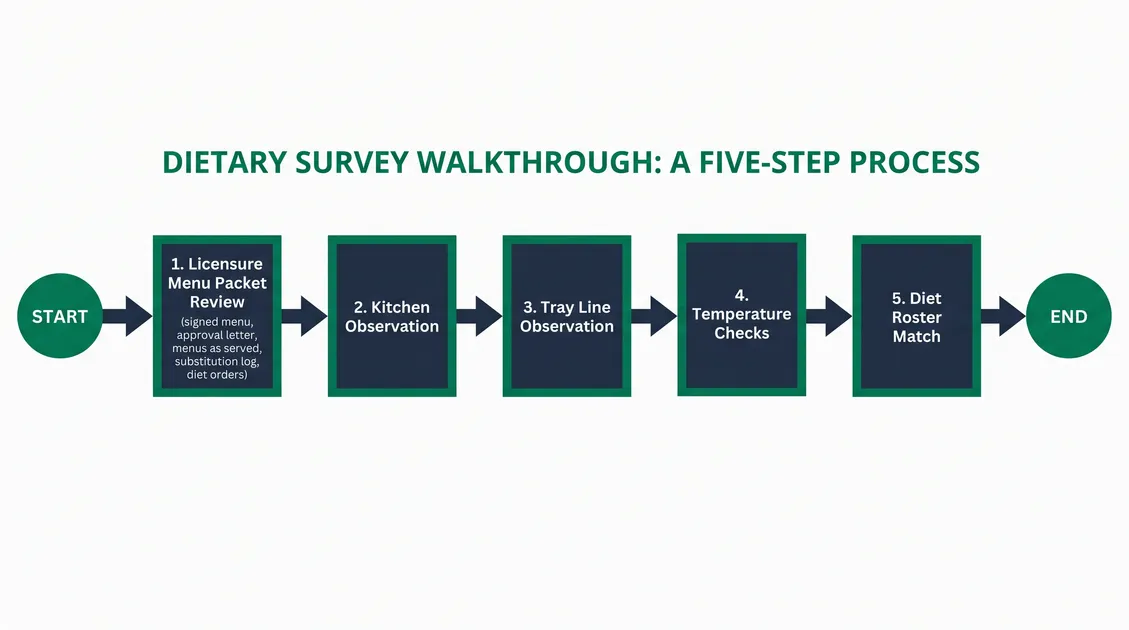
State surveyors request five dietary documents early in a licensing walkthrough, based on the survey preparation PantryTec does with subscribing facilities. They ask for the signed cycle menu, the dietitian approval letter, menus as served, the menu substitution log and current therapeutic diet orders. Utah's R432-270-22 adds a sixth item by requiring that local health department inspection reports be kept at the facility for department review. Florida's 59A-36.012 requires portion sizes showed on the menus or on a separate sheet, so the portion control document travels with the menu. Once the paper is checked, the surveyor moves to the kitchen and compares the meal being plated against the posted menu and the diet roster. Temperature logs, dry storage dates and the presence of an approved diet manual get checked in the same pass. Under Appendix PP, CMS surveyors follow a similar Kitchen and Food Service Observation pathway in nursing facilities. The order matters: paper first, then plates, then a match between the two.
The Five Documents Requested First
- Signed cycle menu showing the full rotation, dates, meal periods and any therapeutic diet extension columns.
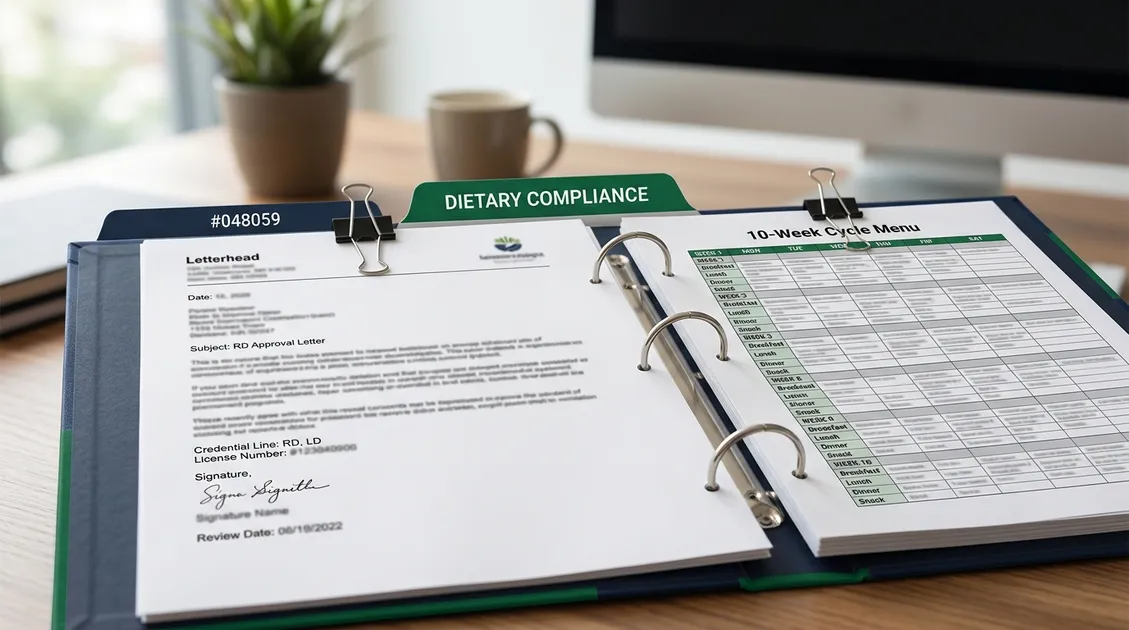
- RD approval letter listing the signer's credential, license or registration number, review date and menu dates covered.
- Menus as served, dated and annotated with every alternate entrée that went out.
- Menu substitution log, cross-referenced to the served menu so both records tell one story.
- Therapeutic diet orders and the diet roster, matched to the tray cards or diet list the cook works from.
In our work with more than 500 clients in senior care food service, we found the biggest stress administrators face isn't menu quality. The concern that comes up first is proving compliance during an unannounced state survey. A licensure menu packet with those five items in one binder answers most dietary questions before the surveyor reaches the kitchen. For the federal version of the same walkthrough, see our guide on To pass a CMS dietary survey with F-Tag menu requirements.
Kitchen Observation vs Record Review
Menu record review finds the documentation gaps; kitchen observation finds the practice gaps. A perfect binder with a cook who's serving a regular tray to a resident on a pureed diet order still produces a citation. What we have found works best is a one-page diet roster taped inside the cook's station, updated the day an order changes. Small homes with home-scale kitchens get judged on the same match between order, menu and plate as a large community. Group homes and adult day programs face variant rules, covered under group home menu rules.
How Do Federal F-Tags Interact With State Assisted Living Menu Rules?
State assisted living menu rules borrow language from the federal nursing home standard at 42 CFR §483.60 but are enforced separately. The F-tag series F800 through F813 applies only to Medicare- and Medicaid-certified nursing facilities. CMS lists roughly 15,000 of those certified facilities nationwide in its nursing home provider. None of the state-licensed assisted living communities in this comparison sits among them. F801 requires a qualified dietitian or other clinically qualified nutrition professional, employed full-time, part-time or as a consultant. F808 requires therapeutic diets to be ordered by the attending physician or, where state law allows, a delegated dietitian. Assisted living communities answer instead to their state code, yet the overlap is visible. The federal rule caps the gap between the evening meal and breakfast at 14 hours, and Utah's R432-270-22 uses the identical figure. California and Pennsylvania allow 15 hours. A state that borrows federal language usually gets surveyors who borrow federal interpretive habits too, so reading Appendix PP helps even in an ALF.
F801 and F808 in Skilled Nursing
Rules for skilled nursing facilities carry the heavier federal load: F801 staffing, F803 menus and nutritional adequacy, F808 therapeutic diet orders and F809 meal frequency all sit in Appendix PP of the State Operations Manual. State veterans homes add a third rulebook from the VA on top of state licensure and CMS certification. Diet quality is a documented problem in that population. According to the USDA Economic Research Service report An Examination of Veterans' Diet Quality, veterans are about 7 to 8 percent of U.S. adults and scored lower on the Healthy Eating Index than nonveterans after adjusting for demographics. The same report puts the adjusted gap at 45.6 versus 49.3 out of 100 across 2003 to 2016. A menu that passes nutrient analysis against the Dietary Reference Intakes (DRI) and the USDA Dietary Guidelines for Americans 2020-2025 is the practical answer, whichever agency asks. Who may write the diet order also varies by state, which we cover in therapeutic diet order authority by state.
Why ALFs Are Surveyed Under State Code Only
State licensure is the only authority most assisted living communities operate under, because they don't bill Medicare for a skilled stay. Size explains the policy choice. According to the CDC's National Post-acute and Long-term Care Study, nearly 6 in 10 home care communities have 4 to 25 beds, a scale where a full-time dietitian was never realistic. Funding streams add rules of their own. The Washington State Senior Nutrition Program Standards, for example, require that the per-meal cost of Medicaid-funded meals not exceed the cost charged to other fund sources. The American Health Care Association (AHCA) and its assisted living arm, NCAL, publish an annual Assisted Living State Regulatory Review that summarizes each state's dietary rules, and it is a good cross-check against the code itself. State codes get amended, so re-read your citation each licensing cycle.
Key Takeaways on Menu Requirements by State
Menu rules across states reduce to three attributes an administrator can check in an afternoon: who signs, where it's posted and how long it is kept. The list below is the short version of this hub.
- State licensing agencies enforce assisted living menu rules through administrative code, while the CMS F-tag series under 42 CFR §483.60 binds certified nursing facilities only.
- Signature authority runs from Utah's certified-dietitian signature on every menu to California's no-signer rule for regular menus, so read the rule text, not the vendor brochure.
- Posting lead time is a full week in most compared states, with Arizona's calendar-day rule as the short exception and Pennsylvania's conspicuous-public-place wording as the strictest location standard.
- Retention runs from California's one-month floor to Florida's half-year requirement, and every compared state treats the substitution log as part of the record.
- Our team has always observed up to 40% fewer dietary-related survey deficiencies at facilities running dietitian-approved cycle menus, based on AHCA survey data combined with PantryTec's internal tracking.
How PantryTec Fits the Rules Above
PantryTec's Dietitian-Approved Cycle Menus arrive as weekly PDFs with an RD Approval Letter for the compliance binder, priced flat at $15 per month for the Starter Plan, $20 for Complete and $40 for Premier when billed annually ($20, $25 and $50 billed monthly), regardless of census. Menus are reviewed and signed by Bridget MacDonald, RD, a Registered Dietitian credentialed by the Commission on Dietetic Registration, with nutrient analysis run against the DRI targets before sign-off. Therapeutic Diet Menus add Diabetic, Renal, Cardiac, IDDSI texture-modified, High Calorie, Gluten-Free and Dementia Finger Food extensions for $5 per month each. Every week includes a safety-net alternative menu, cook-to-census instructions and a wholesale price comparison across Sysco, US Foods and Walmart. One pattern we observed across 50 facilities is fewer dining complaints once the 10-week rotating cycle is running, because residents see 700 unique meals before anything repeats. See flat-rate menu plan pricing for the tier comparison and therapeutic diet menu extensions for the diet list.
Menu software from most providers makes your staff build and self-certify the menus. PantryTec sends finished, signed PDFs because a small home doesn't have a spare person to learn a platform. The technology market is real and growing. A study in Emerging Health Technologies in Long-Term catalogued fourteen LTC technology companies across robots, machine learning, sensors, wearables, online portals and mobile apps. None of those tools signs a menu. A print-and-post PDF with a dietitian's license number on the letter is what the surveyor asks for.
Limitations and Considerations
- Rule text changes. Every citation on this page was checked in September 2026, but state agencies amend food service sections, so confirm the current version before a survey.
- A menu signature doesn't replace clinical nutrition care. Residents with unintended weight loss, dysphagia or a new therapeutic diet order still need an assessment by a dietitian or physician.
- Some licensing offices expect an in-state licensed dietitian even where the rule says “registered dietitian.” Ask your surveyor before relying on a remote signature.
- This page compares six states in depth and summarizes the rest. Your state may use terms such as personal care home or home care facility, and the rule may sit under a different agency.
Ready to map your state's rule to a signed menu? Get a Dietitian-Signed Menu Quote, Talk to a Registered Dietitian at 385-512-4731, or ask us to Check Utah DHHS Menu Compliance for your R432-270 binder.
What Conventional Wisdom Gets Wrong
Conventional wisdom points the other way, but the numbers don't. Most facilities do not need to hire a dietitian for menus. However, our data shows why: a $15-50/month RD-signed cycle menu service replaces $750-$1,500/month consulting fees, a 96% cost reduction (only 1,334 active RDs exist in all of Utah).
The misconception survives because the old math once held. Menu software makes your staff do the work. However, our data shows why: done-for-you PDF menus need zero training versus 4-8 weeks of software onboarding, and flat pricing beats $3-5 per resident per month.
On the other hand, every business weighs these trade-offs against its own situation. In contrast to one-size-fits-all advice, compare the options against your real numbers before deciding.
Explore Topics
8 related pages in this section
Group Home and Adult Day Care Menu Rules vs ALF Rules
Compare group home menu rules with ALF and adult day care requirements: posting, substitutions, dietitian sign-off, retention and CACFP meal patterns.
Group Home and Adult Day Care Menu Rules vs ALF Rules→PantryTec Cycle Menu Service for Senior Care Operators
Download free sample cycle menus for senior care facilities.
PantryTec Cycle Menu Service for Senior Care Operators→Food Cost Control Guide
Gluten-free menus for senior living communities, dietitian-approved and built into 10-week cycle rotations. Plans from $15/mo. Get a free sample menu.
Food Cost Control Guide→How to Pass a CMS Dietary Survey: F-Tag Menu Requirements
CMS menu compliance in plain English: F-tag menu requirements, the survey walkthrough, the documents surveyors ask for, and RD-signed menu pricing.
How to Pass a CMS Dietary Survey: F-Tag Menu Requirements→Senior Living Cycle Menu Provider Comparison Matrix
Top 10 dietary survey deficiencies ranked: F812, F803, F809 mapped to 42 CFR §483.60, with CMP ranges and plan-of-correction fixes that hold.
Senior Living Cycle Menu Provider Comparison Matrix→Memory Care Dining and Dementia Menu Guide
A dementia menu guide for memory care dining: finger food and fortified columns, F805 and F809 rules, service models, and RD-signed cycle menus.
Memory Care Dining and Dementia Menu Guide→Senior Care Menu and Dietary Glossary A–Z
A senior care dietary glossary defining 40+ menu, therapeutic diet, and IDDSI terms plus the CMS F-tag each one maps to. Free sample menu inside.
Senior Care Menu and Dietary Glossary A–Z→PantryTec Pricing: Flat-Rate Menu Plans From $15/mo
PantryTec cycle menu service pricing starts at $15/month flat-rate. Compare Starter, Complete & Premier plans for dietitian-approved senior care menus.
PantryTec Pricing: Flat-Rate Menu Plans From $15/mo→