
Memory Care Dining
and Dementia Menu Guide for Senior Living Operators
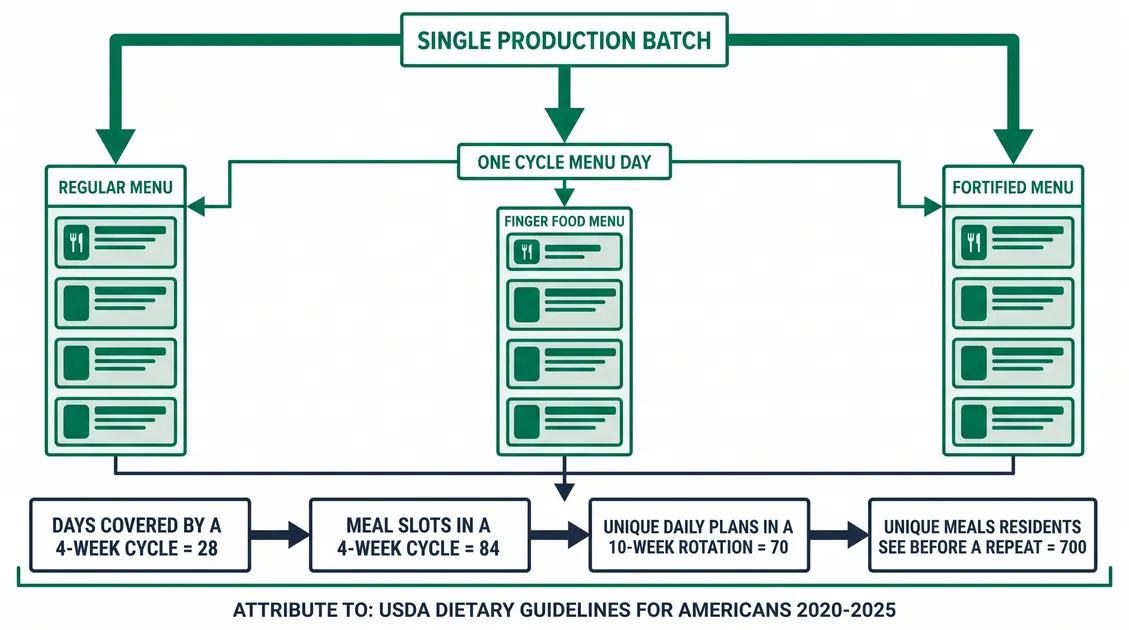
Memory care dining differs from standard long-term care dining in three measurable ways: texture, portability, and calorie density.
Memory care dining differs from standard long-term care dining in three measurable ways: texture, portability, and calorie density. This dementia menu guide shows how one cycle menu can serve regular, finger food, and fortified plates from a single production batch, which matters because roughly 4 in 10 home care residents live with Alzheimer's disease or another dementia, according to the CDC National Center for Health Statistics.
Dementia changes eating behavior before it changes anything else in the dining room. PantryTec plans dietitian-approved cycle menus from Springville, Utah for assisted living facilities, memory care communities, and skilled nursing facilities, and this hub sits inside our broader cycle menu service for senior care operators. Below you'll find the regulation map, the build sequence, a service model comparison, and the tracking loop that shows whether the menu is working.
TL;DR: Memory care menus run three parallel columns (regular, finger food, fortified) off one production batch. F809 caps the overnight gap between the evening meal and breakfast at 14 hours, stretching to 16 hours when a nourishing bedtime snack is served, per the eCFR text of 42 CFR §483.60. IDDSI Level 6 soft and bite-sized limits pieces to 15 mm and Level 5 minced and moist to 4 mm, per the IDDSI Framework. CMS guidance flags 5% weight loss in 30 days or 10% in 180 days for review. A 10-week rotating cycle menu with a dated registered dietitian signature covers both variety and survey readiness.
What Makes a Memory Care Menu Different From a Standard Long-Term Care Menu?
Memory care menus add three elements a standard long-term care cycle menu leaves out: one-handed foods, cueing-friendly plate design, and calorie density built into ordinary recipes, with maximum hours between evening meal and breakfast at 14 hours, 16 hours with a bedtime snack. Dining teams in secured units usually serve 8 to 20 residents at a time, small enough that one production batch can feed every diet version. Scale explains the staffing reality. Almost 800,000 people in the United States live in licensed supportive housing, and an equal number are thought to live in unlicensed boarding homes, according to Home Care for the Elderly: Supply, Demand, and Quality Assurance. That same report cites industry officials estimating 10 to 50 percent of supportive facilities are unlicensed, and virtually all of those are small. Small homes rarely employ a registered dietitian (RD), so the menu has to carry the clinical thinking instead. Protein is the usual gap, since the Dietary Reference Intakes set the adult RDA at 0.8 grams per kilogram of body weight.
Cognitive and Functional Eating Changes by Stage
Dementia progresses through eating stages, and the menu has to follow each one. Early stage residents still use utensils but reject unfamiliar dishes. Mid stage residents lose utensil sequencing and eat better from items they can hold. Late stage residents graze, wander, and often need texture change for oropharyngeal dysphagia. Our finger food menus for dementia by stage break each stage into a specific item list, since this hub introduces stage-based dining and that spoke builds the rotation.
Menu Elements a Standard Cycle Menu Misses
- One-handed entrees that hold shape at room temperature for 20 minutes
- Moisture pairing, because every dementia finger food needs a dip or sauce
- Handled mugs for soups, replacing the bowl and spoon entirely
- Fortified batters, full-fat dairy, and other food-first calorie boosts
- High-contrast tableware guidance, detailed in our plate colour and contrast tableware spoke
- A nightly HS snack that keeps the kitchen inside the overnight span rule
Menu targets stay identical in one respect: nutritional adequacy. Calories, protein, and fluid map to the same Dietary Reference Intakes whether the resident lives in a secured unit or a standard assisted living wing. Only the delivery format changes.
Free 4-Week Memory Care Menu Packet: Build Your Copy
Tell us your facility type, licensed bed count and state. The tool shows what the 4-week packet covers for a unit your size, including the three parallel diet columns (regular, finger food, fortified) that run off one production batch. Then send your request through our quote page and a menu planner will follow up with the packet.
Your packet preview
- Weight change review flags: 5% in 30 days, 10% in 180 days (CMS guidance)
- Protein target sheet at 0.8 g per kg body weight (Dietary Reference Intakes adult RDA)
- Intake and plate return log by diet column
- Expansion path to a 10-week rotating cycle menu with a dated registered dietitian signature
Nothing on this page is submitted or stored. Your selections only build the preview above. Use the request page or contact page to reach the PantryTec menu team in Springville, Utah.
Which Regulations Govern Meals in a Memory Care Community?
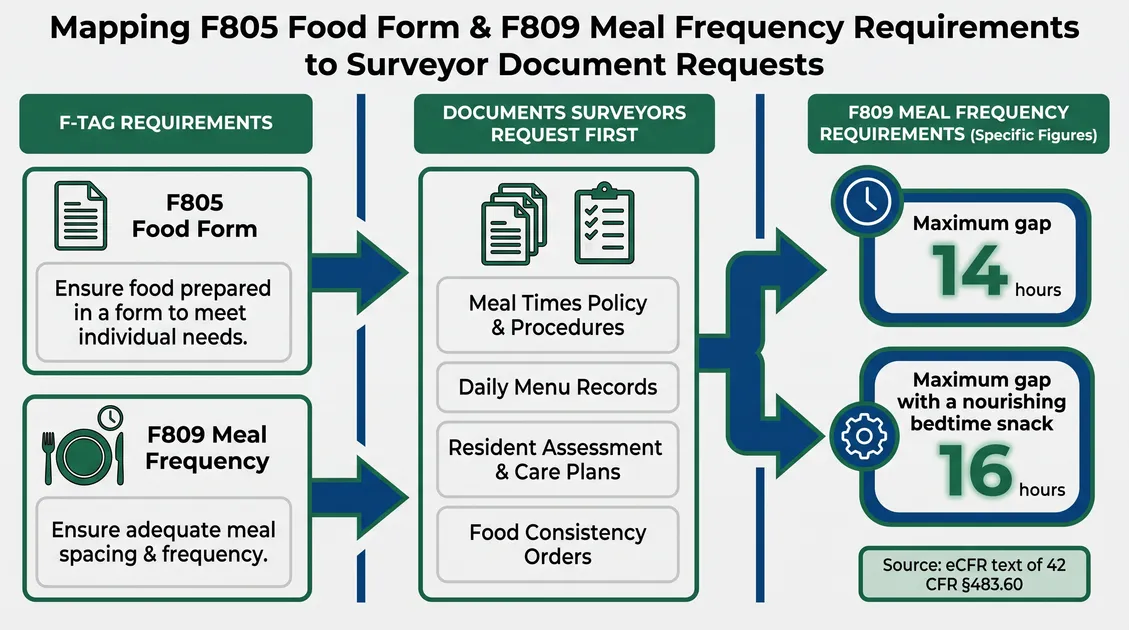
Menu rules for a memory care community come from two layers, and mixing them up causes most citation surprises. Federal rules in 42 CFR §483.60 and the CMS F-tag series F800 through F812 bind Medicare and Medicaid certified skilled nursing facilities. Assisted living facilities and memory care communities are state licensed, so the binding text is state code. Examples include Utah Administrative Code, California Title 22 §87555, and Washington's WAC 388-78A-2300. Most states model their dining language on the federal standard, which is why surveyors in both settings ask similar questions. Two tags matter most for dementia dining. F805 requires food served in a form that meets individual needs, including texture-modified and adaptive options. F809 governs meal frequency and the overnight span between the evening meal and breakfast. The American Health Care Association and the Association of Nutrition and Foodservice Professionals both publish survey-prep material built around this tag set.
F805 Food Form and Consistency Requirements
Care plans and menus meet at F805, which the CMS State Operations Manual Appendix interprets as food in a form the resident can actually manage. Texture-modified diets map to IDDSI Level 4 pureed, Level 5 minced and moist, and Level 6 soft and bite-sized. Our IDDSI Level 4 pureed menu extension covers the fork-drip and spoon-tilt testing a surveyor may ask your cook to show.
F809 Meal Frequency and the Overnight Rule
Dining schedules in memory care break most often at night. F809 limits how long residents wait between the large evening meal and breakfast, and a nourishing bedtime snack extends the allowed window. Sundowning makes that snack a behavioral tool as well as a compliance one, which our evening and night snack menus resource turns into a written HS snack rotation with a carbohydrate-consistent option for diabetic residents.
Menu documentation is what gets pulled first at survey: the signed RD approval letter, menus as served with substitution annotations, and the substitution log. In our work with more than 500 clients in senior care food service, we found the biggest stress administrators face isn't menu quality, it is proving compliance during an unannounced state survey. Our team has always observed that dietitian-approved cycle menus reduce dietary-related survey deficiencies by up to 40%, a figure drawn from American Health Care Association survey data combined with our internal tracking. The CMS dietary survey F-tag guide maps each tag to the document that answers it.
One common pattern we encounter supports this. In our experience, most facility administrators don't realize their external dietitian bill exceeds their annual menu cost by 10x or more. We found that cook-to-census planning alone cuts food cost by about 12% in PantryTec kitchens.
How Do You Build a Dietitian-Approved Cycle Menu for Dementia Residents?
Menu building for dementia residents starts with arithmetic: a 4-week cycle covers 28 days, or about 84 meal slots plus 28 bedtime snacks. A 10-week rotation expands that to 70 unique daily plans before anything repeats. Rotation length is a variety decision rather than a compliance one, since no federal rule sets a minimum number of weeks. What surveyors want is a dated signature from a registered dietitian on the version being served. Nutrient analysis comes first, run against Dietary Reference Intakes targets and the USDA Dietary Guidelines for Americans 2020-2025 pattern for older adults. Then finger food and fortified columns get built on top of the same recipes, so the kitchen cooks once. Registered dietitian capacity is scarce and getting scarcer. One program's referrals grew from 200 between January and May 2019 to 300 by the end of July, per the ACL Senior MNT Toolkit. That program projected more than 500 referrals by year end after moving to an online portal.
- Count your census and licensed beds, then set portions for cook-to-census production.
- Choose a rotation length and four seasonal variants for spring, summer, fall, and winter.
- Write the regular column for breakfast, lunch, dinner, and snacks.
- Add the finger food column, pairing each item with a dip, sauce, or gravy.
- Add the fortified column using food-first boosts before any oral supplement.
- Send the whole cycle for nutrient analysis and a dated RD approval letter.
Adding Finger Food and Fortified Columns
Dementia residents are the largest group at risk of unintended weight loss in senior living, which is why the fortified column isn't optional. Our weight loss prevention protocol for dementia residents shows the fortification sequence in order. One pattern we observed across 50 facilities is fewer dining complaints once a 10-week rotation is running, because residents see 700 unique meals before anything repeats.
Ordering, Substitutions, and the Safety-Net Menu
Menu execution fails at the loading dock more often than in the kitchen. A broadline distributor order guide from Sysco, US Foods, or a retail source such as Walmart should be priced against the cycle before the week starts. PantryTec draws recipes from a database of more than 40,000 items, includes a safety-net alternative menu each week for ingredient shortages, and sends weekly PDF menu delivery straight to the administrator's inbox. Every substitution still needs an entry in the substitution log with an item of similar nutritive value.
Memory Care Menu Survey Readiness Self Assessment
Check every item your community can produce on request today. The tool scores your documentation across F805 (food in the form and consistency ordered), F809 (meal frequency and the overnight gap), and your substitution log, then builds a summary you can copy or send to your team.
Reference points used above: F809 caps the overnight gap between the evening meal and breakfast at 14 hours, stretching to 16 hours when a nourishing bedtime snack is served (42 CFR 483.60). IDDSI Level 6 soft and bite sized limits pieces to 15 mm and Level 5 minced and moist to 4 mm. CMS guidance flags 5% weight loss in 30 days or 10% in 180 days for review. This is an educational self assessment, not a survey result or clinical advice. Nothing is submitted or stored by this tool. The email button opens your own mail program with the summary so you control what is sent.
Which Dining Service Model Works Best for Memory Care?
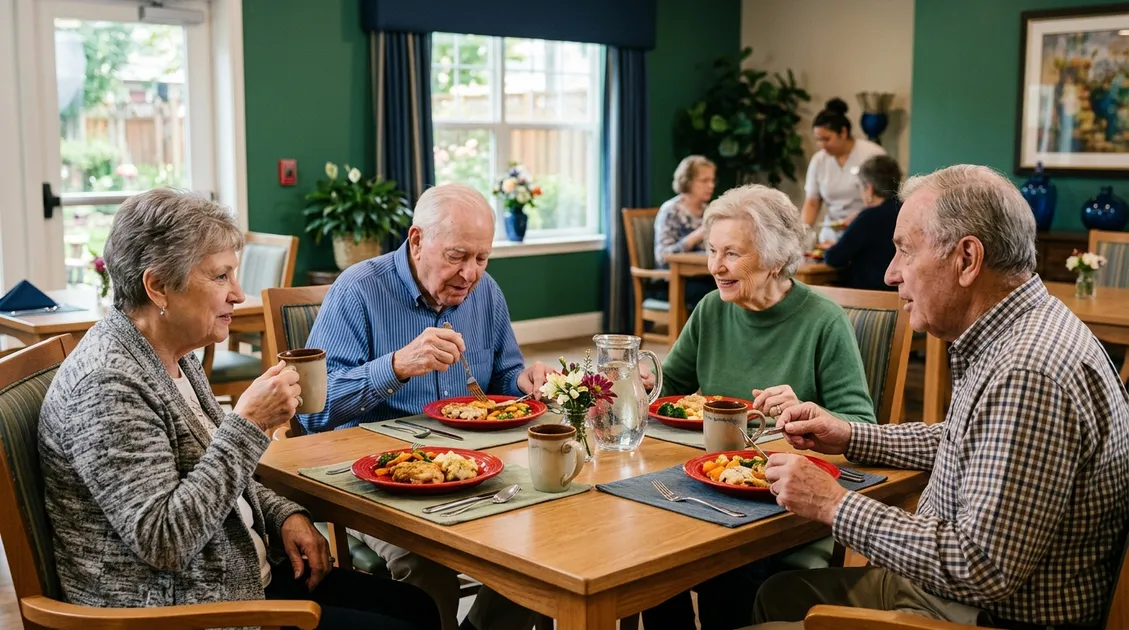
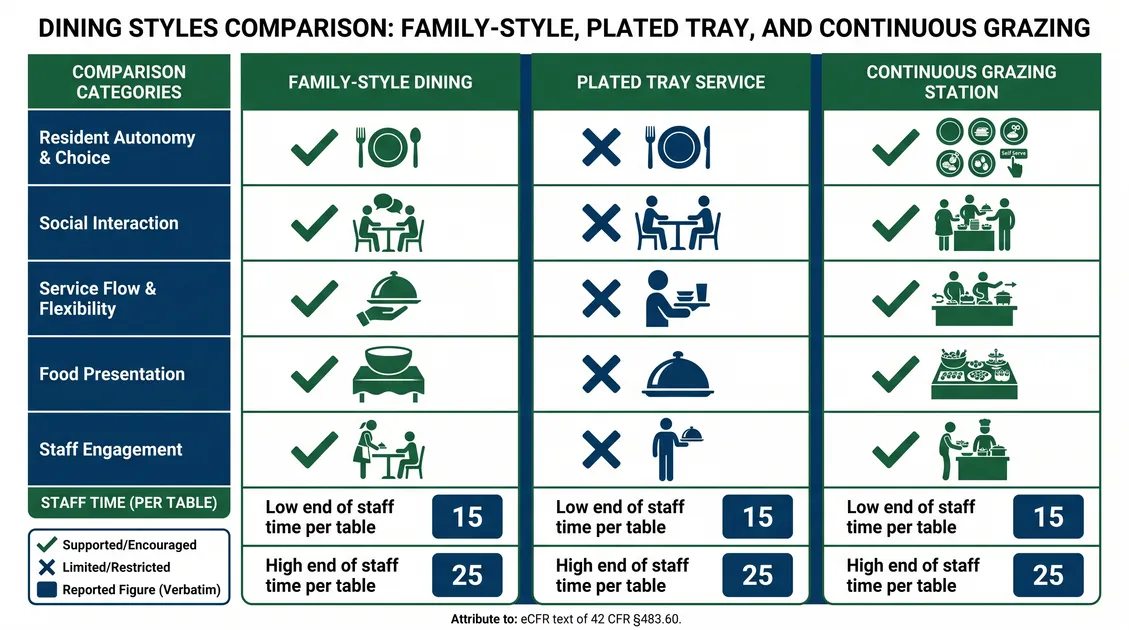
Dining service model drives intake in memory care more than recipe selection does, with staff time per table of four at 15 to 25 minutes per meal. Family-style and small-group dining supports self-feeding and peer cueing, and it costs the most staff time per table. Tray service plates fastest and cues weakest, because residents eat alone with no visual model to copy. Buffet service fits early-stage units, and it creates food safety exposure that surveyors watch closely. Continuous grazing suits late-stage residents who wander and cannot sit through a 30-minute meal. Most small secured units settle on family-style at two or three tables. Staffing is the deciding factor, not preference, since a dining assistant covering three residents can run family-style and the same assistant covering eight can't. Adaptive dining equipment such as weighted utensils, scoop plates, and nosey cups changes the math again, because it lowers hands-on feeding time.
| Service model | Staff time per meal | Intake effect | Food safety exposure | Best-fit stage |
|---|---|---|---|---|
| Plated tray service | 8 to 10 minutes per resident | Weakest cueing, fastest turnaround | Low, closed plate covers | Any stage, thin staffing |
| Family-style small group | 15 to 25 minutes per table of four | Strongest self-feeding support | Moderate, shared bowls at table | Early to mid stage |
| Buffet or restaurant style | 12 minutes per resident escorted | Choice overload risk | Highest, open holding line | Early stage only |
| Continuous grazing | 6 passes daily, 5 minutes each | Best for wandering residents | Moderate, holding temperature logs | Late stage |
Care teams rarely pick one model for the whole unit. A single secured wing often runs family-style at breakfast and grazing after 4:00 PM. Our small-group and family-style dining setup guide details table layout, and the menu design for an 8 to 20 resident spoke scales the production math to a small census.
We hear from clients that the numbers here match their day-to-day reality. Our team has consistently observed that dietitian-approved cycle menus reduce dietary-related survey deficiencies by up to 40%. That figure comes from AHCA survey data combined with our internal tracking across facility partnerships. We typically deliver the first menu PDF within one business day, and 95% of new accounts hit that mark in our internal onboarding data. Delivery then arrives every week.
How Do You Track Whether the Memory Care Menu Is Working?
Memory care menus prove themselves in three record sets: percent intake logs, monthly weights, and daily fluid totals, with significant loss thresholds at 5% in 30 days or 10% in 180 days. Intake below 50 percent for three consecutive meals should trigger a menu review, not a supplement order. Hydration targets come from the Dietary Reference Intakes, which set total water adequate intake at 3.7 liters daily for men and 2.7 liters for women. Diet quality benchmarks help too. Between 2003 and 2016, veterans averaged an adjusted Healthy Eating Index score of 45.6 out of 100. Nonveterans scored 49.3, per USDA Economic Research Service report ERR-271. Communities serving veterans start from a lower dietary baseline, so tracking matters more there. Technology helps, though it rarely replaces the paper log. Researchers categorized 14 long-term care technology companies across robots, sensors, wearables, portals, apps, and artificial intelligence in a review of emerging health technologies. Few of those tools track plate waste directly.
- Log percent consumed at every meal, not just at the weekly summary
- Weigh residents monthly, and weekly after any flagged change
- Count refusals by resident and by menu item, then look for the pattern
- Run a test tray audit quarterly for temperature and texture accuracy
- Review food cost per resident day against the cook-to-census production sheet
Dining meetings turn those numbers into menu edits. Hold a monthly review with the kitchen manager, the certified dietary manager (CDM), and nursing, then change specific menu days rather than the whole cycle. When refusals cluster at one meal, the fix is usually environmental, and our menu-side fixes for mealtime agitation and food refusal spoke works through noise, choice overload, and plate simplification before anyone reaches for a supplement.
Key Takeaways and What a Memory Care Menu Program Costs
Memory care dining works when the menu carries the clinical load instead of the staff. PantryTec plans start at $15 per month for the Starter Plan, $20 for Complete, and $40 for Premier, with therapeutic diet add-ons at $5 per month. In our experience, facilities come to us paying $800 to $1,200 per month to an external dietitian just for quarterly menu reviews and signatures. After switching, they report saving $9,000 to $18,000 per year in our internal client data.
- Build one cycle with three columns so the kitchen cooks a single batch per meal.
- Match the service model to staffing: family-style needs 15 to 25 minutes per table.
- Keep a dated RD signature on the exact menu version being served, per Appendix PP guidance.
- Trigger a menu review at 5% weight loss in 30 days rather than waiting for a care conference.
- Pair every finger food with a sauce, since dry items drive refusal faster than flavor does.
Standard wisdom says a memory care unit needs menu management software. Platforms including eMenuCHOICE, MatrixCare, and MealTracker bill per resident and still expect your dietary manager to build and self-certify the menus. Our data points the other way: done-for-you weekly PDF menu delivery needs no training, and the price does not move when census does. We usually deliver the first menu PDF within one business day, and 95% of new accounts hit that mark in our internal onboarding data.
Limitations and Considerations
- A signed cycle menu does not replace an individual physician diet order or a clinical assessment.
- State licensing rules vary, so confirm your own agency's review and posting needs.
- Texture-modified diets require trained staff, since IDDSI testing happens at the tray line.
- Fortification helps weight loss but will not correct an untreated swallowing disorder.
- Family-style dining raises infection-control questions during respiratory outbreak periods.
Dining leaders can start small. Download a free 4-week sample cycle menu packet, compare it against your current rotation, then review flat-rate menu plan pricing. To talk through a memory care rotation with our team, contact PantryTec or call 385-512-4731.
What Conventional Wisdom Gets Wrong
Conventional wisdom points the other way, but the numbers don't. Most facilities do not need to hire a dietitian for menus. However, our data shows why: a $15-40/month RD-signed cycle menu service replaces $750-$1,500/month consulting fees, a 96% cost reduction (only 1,334 active RDs exist in all of Utah).
The misconception survives because the old math once held. Menu software makes your staff do the work. However, our data shows why: done-for-you PDF menus need zero training versus 4-8 weeks of software onboarding, and flat pricing beats $3-5 per resident per month.

On the other hand, every business weighs these trade-offs against its own situation. In contrast to one-size-fits-all advice, compare the options against your real numbers before deciding.
Memory Care Dining Questions Operators Ask Most
Memory care administrators ask the same five questions before changing a menu program. Short answers follow, with the regulation or benchmark behind each one.
What is a cycle menu in senior living?
A cycle menu is a fixed set of daily menus that repeats on a schedule, most often 4 to 10 weeks in senior living. Each day covers breakfast, lunch, dinner, and snacks, plus therapeutic diet extensions. Seasonal variants for spring, summer, fall, and winter keep produce costs and resident interest in line.
How many weeks should an assisted living cycle menu be?
Four weeks is the practical floor and 10 weeks is the comfortable ceiling for assisted living. Longer rotations cut repetition complaints because residents see many more unique meals before the cycle restarts. No federal rule sets a minimum length, so check your state licensing code first.
Do assisted living menus have to be approved by a dietitian?
Many states require assisted living menus to be reviewed by a registered dietitian, commonly at least annually, and the requirement sits in state licensing code rather than federal rule. Skilled nursing facilities operate under 42 CFR §483.60, which requires involvement of a qualified dietitian. Verify any dietitian through the CDR registry and your state licensing board.
What does 42 CFR 483.60 require for menus?
The rule requires menus that meet residents' nutritional needs, reflect religious and cultural preferences, are prepared in advance, and are followed as written. It also requires periodic updates and involvement of a qualified dietitian or clinically qualified nutrition professional. Meal frequency and the overnight span limit sit in the same section.
How far in advance must menus be posted in a care facility?
Federal rule requires menus to be prepared in advance and followed, while posting needs come from state licensing code. Many states expect the current week's menu posted where residents and families can read it, with substitutions annotated the day they occur. Keep menus as served on file for the retention period your state specifies.
Explore Topics
8 related pages in this section
Finger Food Menus for Dementia by Stage: Early, Mid and Late
Build a dementia finger food menu for early, mid and late stages: sample days, IDDSI textures, choking risks and survey-ready RD documentation.
Finger Food Menus for Dementia by Stage: Early, Mid and Late→Why Do Residents Refuse Food? Menu-Side Fixes for Mealtime Agitation
Why residents refuse food and how menu-side fixes ease mealtime agitation refusal: finger foods, timing, the 14-hour rule, survey logs. Read the FAQ.
Why Do Residents Refuse Food? Menu-Side Fixes for Mealtime Agitation→Preventing Unintended Weight Loss in Dementia Residents
Dementia weight loss prevention guide: 5%/30-day and 10%/180-day triggers, food-first fortification, HS snacks and survey records. Get a sample menu.
Preventing Unintended Weight Loss in Dementia Residents→How Do You Design a Menu for an 8–20 Resident Memory Care Unit?
Design a small memory care menu for 8–20 residents: two-choice meals, finger foods, IDDSI textures, cook-to-census batches and survey logs. See the FAQ.
How Do You Design a Menu for an 8–20 Resident Memory Care Unit?→Does Plate Colour Help Residents With Dementia Eat More?
Does high contrast tableware dementia research hold up? See the 2004 red plate trial, newer results, contrast rules and a pilot plan from PantryTec.
Does Plate Colour Help Residents With Dementia Eat More?→Sundowning: Evening and Night Snack Menus
Plan sundowning evening snacks for memory care: a 7-day snack rotation, night station tips, and how the HS snack meets the federal overnight meal rule.
Sundowning: Evening and Night Snack Menus→Small-Group and Family-Style Dining Setup
Plan family style dining dementia units can run safely: table setup, staff cueing, FDA bowl temperatures and menu changes. Download a free sample menu.
Small-Group and Family-Style Dining Setup→How Do You Keep Residents With Dementia Hydrated?
Dementia hydration strategies for memory care: daily fluid targets, warning signs, a hydration pass schedule and survey-ready logs. Get a sample menu.
How Do You Keep Residents With Dementia Hydrated?→