
Hiring a Dietitian vs Menu Service:
A Complete Comparison for Senior Care Facilities
Compare hiring a dietitian vs menu service for senior care. See 2026 costs, compliance data, and which option fits your facility.
What Does a Registered Dietitian (RD/RDN) Do for Food Service?
And a print-ready compliance binder, facilities with fewer than 50 beds see the largest savings by outsourcing.
What's in This Guide
In our experience, a full-time Registered Dietitian Nutritionist (RDN) in Utah earns $65,000-$101,000 per year, according to Glassdoor's 2025 salary data. Hiring a dietitian vs menu service for senior care facilities is the defining food-service budget decision for operators in 2026. Add 25-35% for benefits overhead and that figure reaches $81,000-$136,000 annually. The U. S. Bureau of Labor Statistics projects 6% job growth for dietitians through 2034, which tightens supply and inflates hiring costs even further. Meanwhile, facilities using senior living menu provider comparisons discover flat-rate subscription services that include RD-approved cycle menus for as little as $15/month. The gap between these two models represents a 96% cost reduction for a 10-bed facility, making the comparison essential before your next budget cycle.
CMS F-Tag F803 requires that menus meet each resident's nutritional needs and be prepared in advance. F-Tag F801 mandates a qualified dietitian on staff or under consulting arrangement. Utah's Department of Health and Human Services enforces these rules during unannounced inspections that can last 3-5 days. Facilities lacking documented RD menu approval face deficiency citations that trigger per-day civil monetary penalties of up to $25,847, per CMS enforcement data.

Managed healthtech operations for 500+ clients.
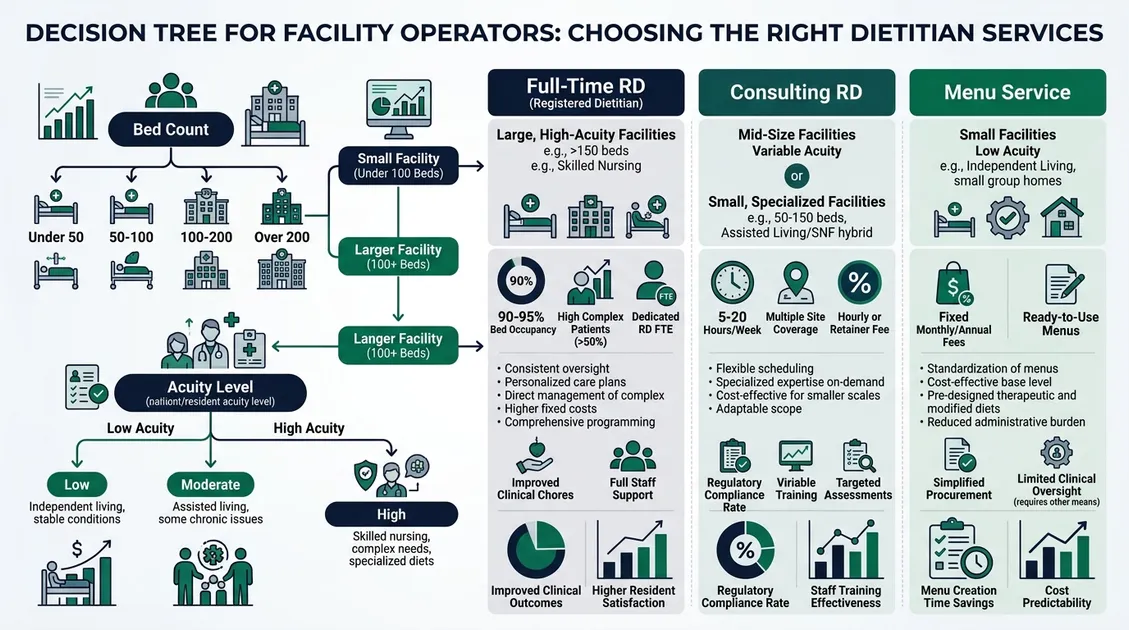
This guide breaks down cost, compliance, therapeutic diet accuracy, and operational risk for three models: full-time RDN hire, part-time consulting dietitian, and outsourced menu service. You'll find specific 2026 pricing, CMS regulatory references, and a decision framework to match the right option to your facility size.
As of , the Commission on Dietetic Registration (CDR) requires all new RDNs to hold a master's degree and complete at least 1,000 hours of supervised practice before credentialing. Registered Dietitian Nutritionists (RDNs) perform clinical oversight, therapeutic diet prescriptions, cycle menu development, nutritional analysis, and compliance binder documentation for senior care facilities. The Academy of Nutrition and Dietetics states that only credentialed RD/RDNs are qualified to prescribe medical nutrition therapy. A single CMS deficiency citation under F-Tag F800 or F803 can trigger per-instance penalties that. According to CMS's FY 2025 final rule, now allow both per-day and per-instance fines concurrently. Facilities must keep RD-approved menus accessible during state surveys, and the compliance binder serves as the primary documentation surveyors review. Understanding this scope helps you evaluate whether a full-time hire or an outsourced service delivers the same regulatory protection at a different price point.
Clinical Responsibilities
RDNs assess each resident's MDS data, develop individualized care plans, and prescribe therapeutic diets including diabetic, renal, cardiac, and IDDSI texture-modified options. They coordinate with the interdisciplinary team on diet orders and monitor unintended weight loss.
Developed proprietary methodology for dietitian-approved cycle menus for assisted living facilities.
Menu Planning and Nutritional Analysis
Cycle menu development involves selecting recipes, building daily meal patterns, constructing multi-week rotations, and running nutrient analysis against Dietary Reference Intakes (DRI). The process takes 5-10 hours per week when done manually. A standardized recipe database with portion control ensures calorie counts, macronutrient ratios, and micronutrient targets meet federal benchmarks.
Compliance Binder and Regulatory Documentation
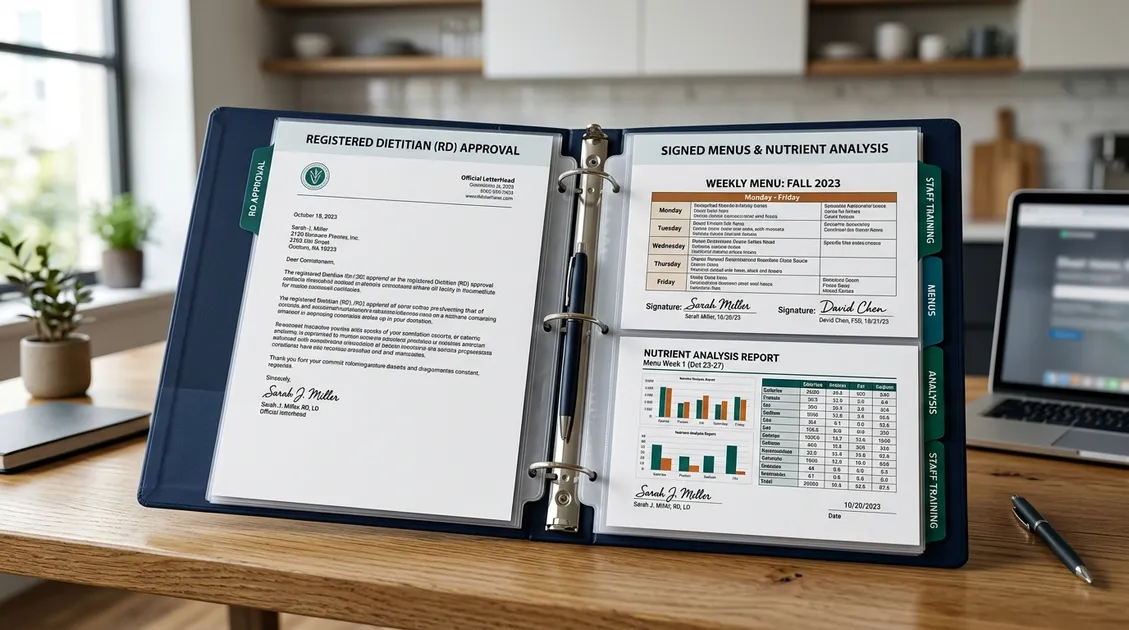
The compliance binder contains RD approval letters, signed cycle menus, nutrient analysis reports, therapeutic diet documentation, and substitution records. Surveyors expect this binder to be current and accessible within minutes. Gaps in documentation are the fastest path to an F-803 or F-800 citation. Learn more about hiring a dietitian versus using a menu service.
💰 Per-Resident Cost Savings Calculator
Compare your current dietitian spend to PantryTec's flat-rate menu service. See how much your facility could save annually.
📊 Your Annual Cost Comparison
What Is a Dietitian-Approved Menu Service and How Does It Work?
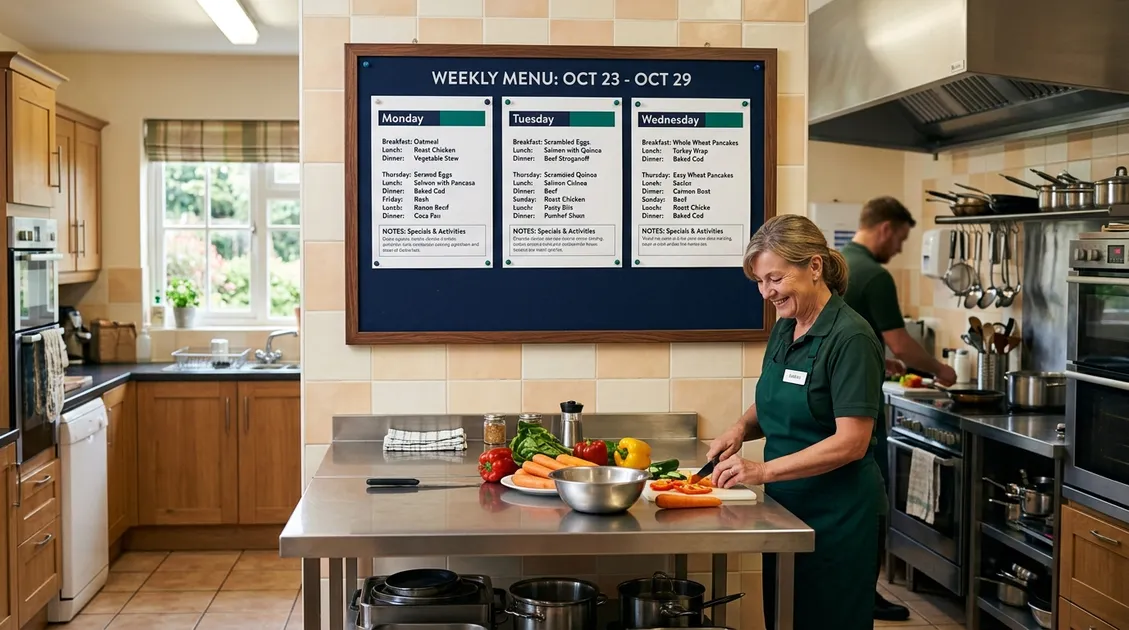
Subscription pricing starts at $15/month for the Starter plan, $20/month for Complete and $40/month for Premier, billed annually ($20, $25 and $50 billed monthly). Dietitian-approved menu services deliver pre-built, RDN-reviewed cycle menus as print-ready PDFs on a weekly or monthly schedule, eliminating in-house menu development labor entirely. PantryTec's cycle menus rotate on a 10-week schedule. Each rotation covers breakfast, lunch, dinner, and snacks, producing 70 unique daily menus before a single repeat. USDA Food and Nutrition Service guidelines require that cycle menus meet specific caloric and nutrient benchmarks, and PantryTec's RDN team verifies compliance before delivery. Compare that to the $750-$1,500/month that facilities spend on external dietitian consulting just for menu sign-off, based on PantryTec data. The decision to hire a dietitian or use a service directly impacts how administrators manage their facility's dietary program.
Cycle Menu Development and Delivery
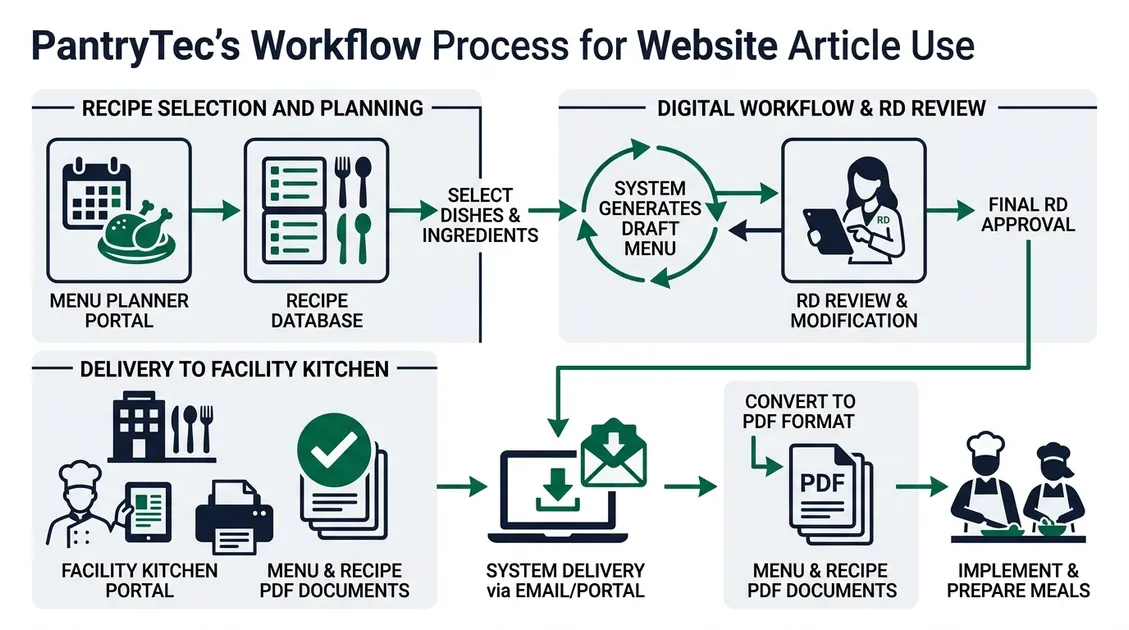
PantryTec's recipe database holds over 40,000 recipes spanning regular, therapeutic, and culturally diverse categories. Fresh weekly PDFs arrive by email. Kitchen staff print and post them with zero software training required.
Consulted with organizations across multiple states.
Therapeutic Diet Menu Packages
Therapeutic diet extensions cover diabetic/consistent carb, renal, cardiac/low-sodium, IDDSI levels 4-6. High-calorie, gluten-free, and dementia finger foods. These menus are included from the Complete plan ($20/mo billed annually). Every therapeutic menu undergoes separate RDN nutrient analysis, aligned with physician diet orders.
The Menu Binder: What's Included?
PantryTec delivers a complete compliance binder package: RD approval letter, signed cycle menus, nutrient analysis reports. Standardized recipes with portion control, and cook-to-census production instructions. You receive everything surveyors need in one organized file. We cover this in detail in our dietary management guide for ALF administrators guide.
How Do the Costs Compare: Hiring a Dietitian vs Menu Service?
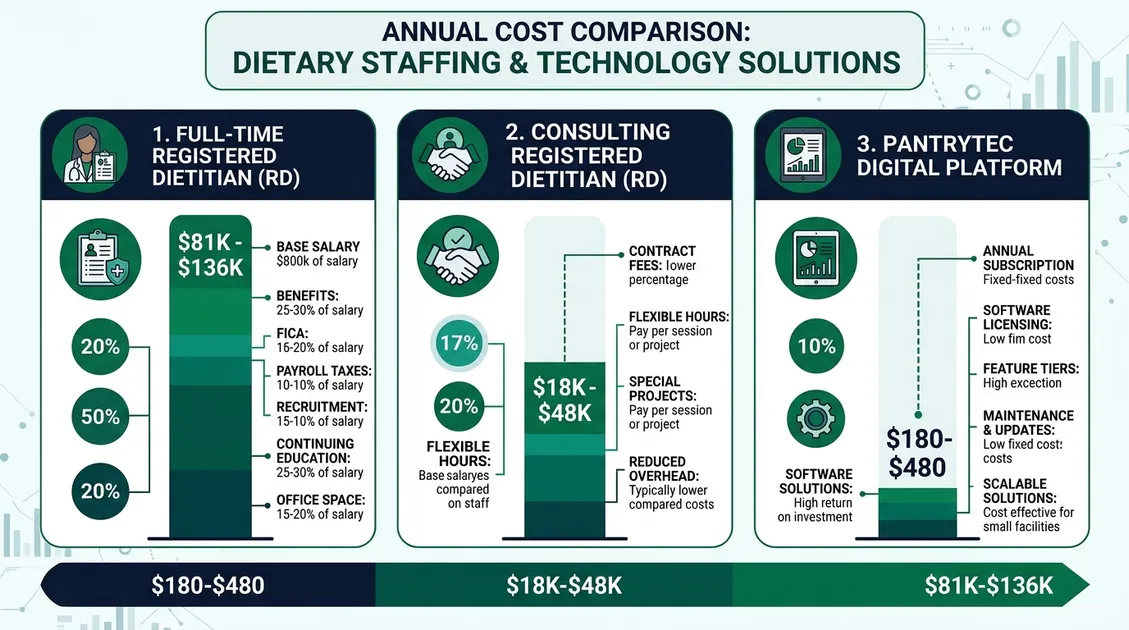
Hiring a full-time RDN in Utah costs $65,000-$101,000 in base salary, according to Glassdoor's 2026 data for the Salt Lake City market. Benefits overhead adds 25-35%, pushing total annual cost to $81,250-$136,350. Recruiting alone costs $9,000-$12,000 per healthcare hire, per SHRM's 2025 benchmarking data. Consulting dietitians charge $75-$150/hour, averaging $1,500-$4,000/month for part-time coverage. PantryTec's flat-rate menu service, by contrast, costs $180-$480/year ($15-$40/month) with no per-resident fees, no long-term contracts, and no setup costs. A 10-bed facility paying $400/month elsewhere pays as little as $15/month with PantryTec. That's a 96% cost reduction for the same regulatory compliance. Cost is a major factor when choosing between an in-house dietitian and an outsourced menu service, and our food cost management guide breaks down additional savings opportunities.
Full-Time RD/RDN Salary, Benefits, and Overhead
The median annual wage for dietitians nationally was $73,850 in , per the Bureau of Labor Statistics.
Utah ranks 50th out of 50 states for RD salaries, according to ZipRecruiter, yet employer demand still drives total compensation above $80,000 when including health insurance, retirement contributions, and paid leave.
Part-Time or Consulting Dietitian Costs
What we see most often is that consulting RDNs provide menu review, quarterly nutritional analysis, and annual care plan updates. At $75-$150/hour and 5-10 hours monthly, facilities spend $375-$1,500 per month for part-time oversight.
Menu Service Subscription Pricing
| PantryTec Plan | Billed Annually | Billed Monthly | Includes |
|---|---|---|---|
| Starter | $15/mo ($180/yr) | $20/mo | RD-approved, state-compliant menus, 10-week rotation |
| Complete | $20/mo ($240/yr) | $25/mo | Regular + common therapeutic diets, portion and texture guide, recipes |
| PremierFeatured | $40/mo ($480/yr) | $50/mo | Menus customized to resident specifics, RD re-verification, priority adjustments |
Dietitian vs Menu Service Cost Estimator
Compare your current spending to PantryTec's flat-rate model. See food cost management for senior care for a deeper breakdown.
Save Up to 96% on Dietitian Compliance Costs
See how PantryTec's RD-approved menu service compares to hiring a full-time Registered Dietitian in Utah.
Schedule a Free Dietitian Consultation (385) 512-4731
Ready to Get Started with PantryTec?
Contact PantryTec today to learn how we can help.