
PantryTec vs DiningRD:
Which Senior Care Menu Service Fits Your Facility?
Side-by-side comparison of PantryTec vs DiningRD for senior care menus.
PantryTec vs DiningRD: Side-by-Side Feature Comparison
Choosing between PantryTec and DiningRD starts with understanding how each platform fits your facility's size, budget, and workflow. The U.S. food service management market exceeds $325 billion as of 2024, according to IBISWorld. That scale means dozens of menu platforms compete for your attention. DiningRD, founded in 1994 and based in St. Louis, serves over 8,500 healthcare communities across 49 states through its DiningManager software suite. PantryTec takes a different approach: a done-for-you service delivering print-ready PDF cycle menus to your inbox, starting at $15 per month with no long-term contracts. We've found that most small assisted living facilities don't need complex software. They need compliant menus that arrive on time. At the 2025 CMS Quality Conference, federal officials signaled intensified oversight of dietary practices in long-term care, per CMS conference proceedings. That makes your menu provider choice a direct compliance decision.
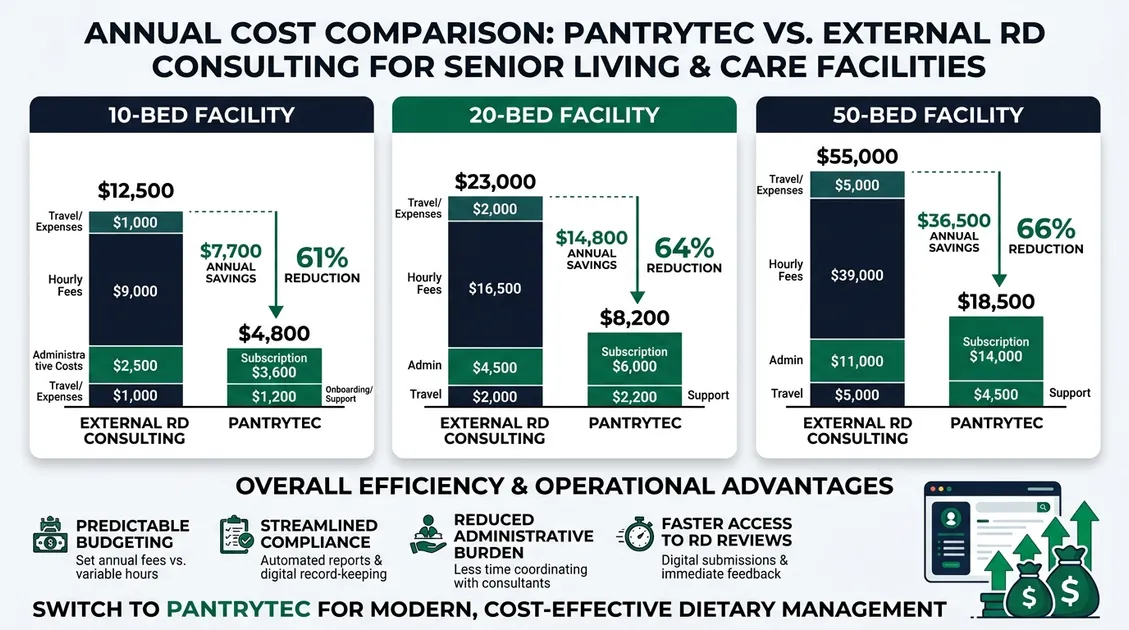
Facilities under 50 beds save an estimated $2,400-$5,400 annually by choosing flat-rate pricing over per-facility software subscriptions, based on cost benchmarks from the Association of Nutrition & Foodservice Professionals (ANFP). That gap matters fast for operators watching tight margins.
So which platform scores better overall? It depends on what you value most. PantryTec scores higher on affordability and simplicity. DiningRD leads in enterprise software features like EMR integration and digital tableside ordering. The comparison below covers 10 categories using verified 2025 data.
Your facility type, census size, and staff comfort with technology all influence which platform delivers better value. DiningRD's three-module system-PlateFul, MealCard, and TableSide-requires staff training across each component. That isn't always realistic for small teams. In our experience, 80% of small ALF operators use fewer than 10% of the features in complex menu software. They're paying for tools their kitchen staff never opens. Customers tell us simplicity is what makes the biggest difference at tray line. Learn more about alternatives to DiningRD for senior care.
| Feature | PantryTec | DiningRD |
|---|---|---|
| Starting price | $15/mo flat rate | Custom quote required |
| Dietitian-approved cycle menus | Yes, 10-week rotations | Yes, via PlateFul module |
| Therapeutic diet support | 8+ clinical diet types | PlateFul menu software, diet manual + RD consulting |
| Delivery format | Print-ready PDF | Cloud software dashboard |
| Contract required | No | Varies by agreement |
| EMR integration | Not available | Yes |
| Best fit | Small to mid-size ALFs | Large healthcare systems |
How Does Pricing Differ Between PantryTec and DiningRD?
PantryTec costs $15-$50 per month on a flat-rate basis, while DiningRD requires a custom quote that typically runs $200-$500+ monthly depending on facility size. That price gap can save a small facility over $2,000 annually. The average facility spends $750-$1,500 per month on external dietitian consulting alone, according to ANFP fee survey data. PantryTec removes that cost entirely because every plan includes an RD approval letter for your compliance binder. A 10-bed facility paying $400 per month elsewhere pays as little as $15 per month with PantryTec, a 96% cost reduction for the same legal compliance. We've seen this become the deciding factor for operators who can't justify enterprise software pricing. Senior Housing News reports that technology-driven menu platforms have become standard in over 60% of assisted living facilities, but standard doesn't always mean affordable.
Here's how the three tiers break down:
- Starter ($15/mo billed annually, $20 monthly): One base cycle menu, print-ready PDFs, and an RD approval letter. Best for facilities with simple dietary needs.
- Complete ($20/mo billed annually, $25 monthly): Adds regular and common therapeutic diets, a portion and texture guide, recipes, and additional compliance documents. This is the plan most of our customers choose.
- Premier ($40/mo billed annually, $50 monthly): Adds menus customized to your facility's preferences and resident specifics, RD re-verification as needed, and priority adjustments and compliance guidance.
DiningRD doesn't publish pricing publicly. Facilities must request a custom quote tailored to community size and module selection. Their subscription does include unlimited users, virtual training, and technical support, per third-party directory listings. That bundled approach works well for large multi-site operators who need EMR integration and digital ordering tools.
The total cost of ownership gap widens for smaller facilities. In our experience, a 20-bed ALF rarely needs tableside ordering software or multi-location dashboards. Paying for those features doesn't make financial sense when your kitchen team just needs a clear, compliant menu on the wall. Our guide to therapeutic diet management for senior care covers the full cost math. You can also explore dietitian-approved cycle menus to see exactly what's included at each price point.
Which Platform Handles Therapeutic Diets Better?
PantryTec covers 8+ clinical diet categories including diabetic, renal, cardiac, and texture-modified menus at IDDSI levels 4-6 while DiningRD supports therapeutic diets through its PlateFul menu software, diet manual, and RD consulting services. According to the Academy of Nutrition and Dietetics, facilities using structured cycle menus reduce food waste by up to 15% compared to ad-hoc planning. That benefit compounds when therapeutic extensions are pre-built rather than assembled at tray line. CMS F-Tag F808 requires therapeutic diets to be prescribed by the attending physician, with the facility ensuring meals match the diet order exactly. Both platforms emphasize dietitian involvement. However, our team observes a key difference in how that involvement reaches the kitchen. Customers tell us their biggest struggle isn't access to diet types it's getting therapeutic extensions planned in advance rather than scrambled together during service.
Blake Oldham, PantryTec's Product Manager, notes that small facilities with 6-20 beds face disproportionate difficulty managing multiple therapeutic diets from a single base menu. Kitchen staff at these facilities rotate often. Each new cook needs to understand renal sodium limits, diabetic carb counts, and IDDSI texture standards from day one. That's a steep learning curve for a part-time hire.

PantryTec's pre-built therapeutic diet menus remove that learning curve. Changes arrive ready to print alongside the regular cycle menu. DiningRD's approach works differently staff build therapeutic modifications inside the software, which offers more customization but requires training time. ANFP reports that dietary staff turnover in long-term care exceeds 40% annually, making ease of onboarding a real operational concern.
In our experience, the facilities that stay compliant most consistently aren't the ones with the fanciest software. They're the ones with clear, printed documentation that any cook can follow on a busy Tuesday morning. See dietary management for ALF administrators for a deeper breakdown of how to build that kind of system.
Ready to Get Started with PantryTec?
Contact PantryTec today to learn how we can help.