
PantryTec vs Apicbase:
Which Recipe Database Wins for Senior Care Food Service?
PantryTec vs Apicbase side-by-side comparison for senior care facilities. 40,000+ dietitian-approved recipes vs build-your-own database.
How Do PantryTec and Apicbase Recipe Databases Compare on Size and Depth?
What's in This Guide
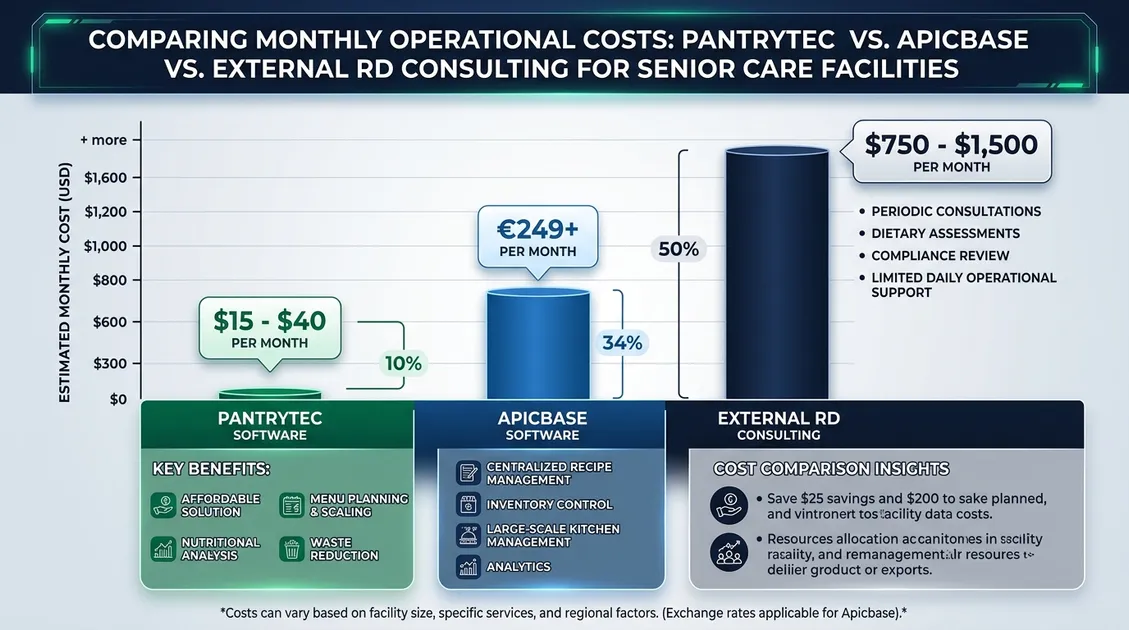
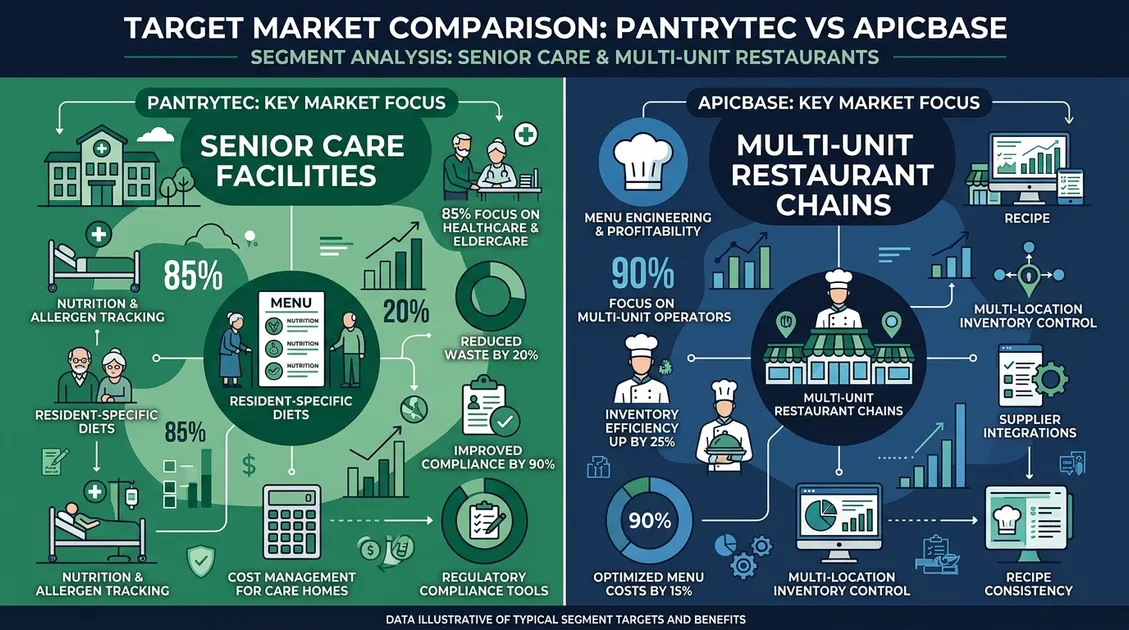
Multiple recent market reports (Mordor Intelligence, Grand View Research, others) project figures in a similar range but with different endpoints and CAGRs. Mordor estimates ~$14.73 billion by 2031 at ~14.52% CAGR (2026–2031). Other sources project $15–26 billion by 2033/2034 at CAGRs of ~9–18%. No clear current public confirmation of the exact "$10 billion by 2028 / 14.6% CAGR from KBV Research" figure appears in recent data. PantryTec and Apicbase both manage recipes for food service operations, yet they serve mainly different markets. Comparing senior living menu providers requires evaluating compliance capabilities, recipe readiness, and total cost of ownership. PantryTec's 40,000+ dietitian-approved recipe library focuses on CMS-compliant cycle menus for assisted living, memory care, and skilled nursing facilities. Apicbase targets multi-unit restaurants, hotels, and ghost kitchens with menu engineering and real-time inventory tracking. Your facility type determines which platform fits. Operators searching for an Apicbase alternative for senior care facilities need a solution that includes therapeutic diet extensions, RD approval letters, and standardized recipes scaled to census. PantryTec delivers all three at a flat $15-$50 per month. However, Apicbase's official site does not publish fixed public pricing; it uses a quote/demo model based on number of locations, modules, and volume discounts. Third-party listings (including SoftwareSuggest) sometimes show other figures such as ~$160 for a single-outlet bundle. Pricing is custom and typically higher for multi-outlet/enterprise use. The "Capterra UK 2025" attribution is slightly outdated relative to current listings.
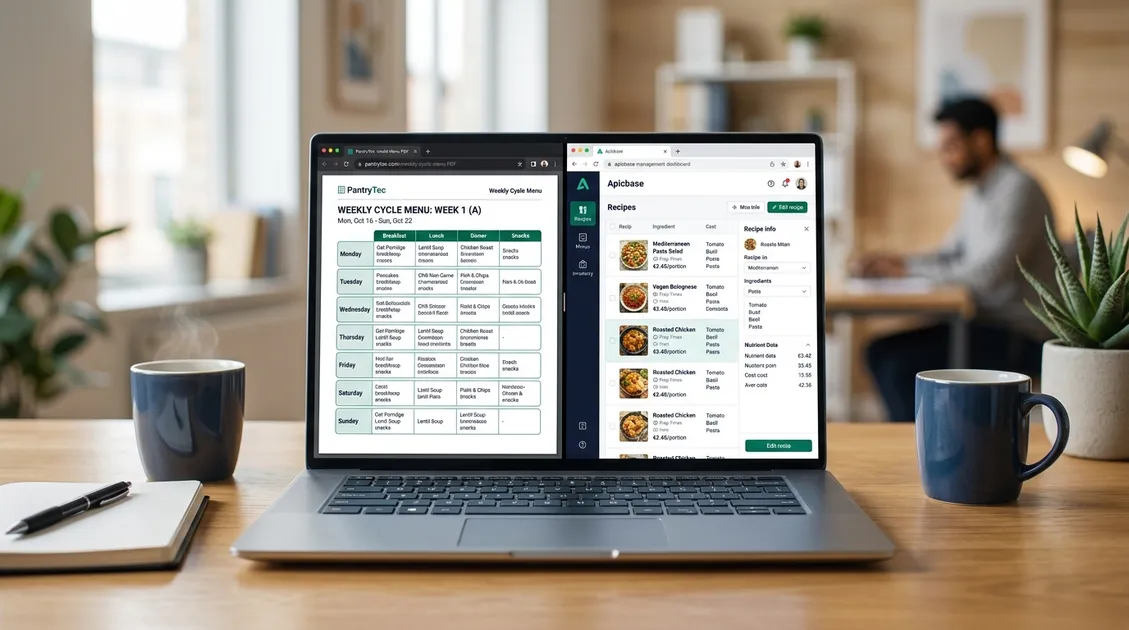
Dietary managers at senior care facilities face constraints that restaurant chefs do not. CMS regulations under 42 CFR §483.60 mandate dietitian oversight of all menus served to Medicare and Medicaid residents. Facilities without current RD-approved menus risk deficiency citations during annual surveys.
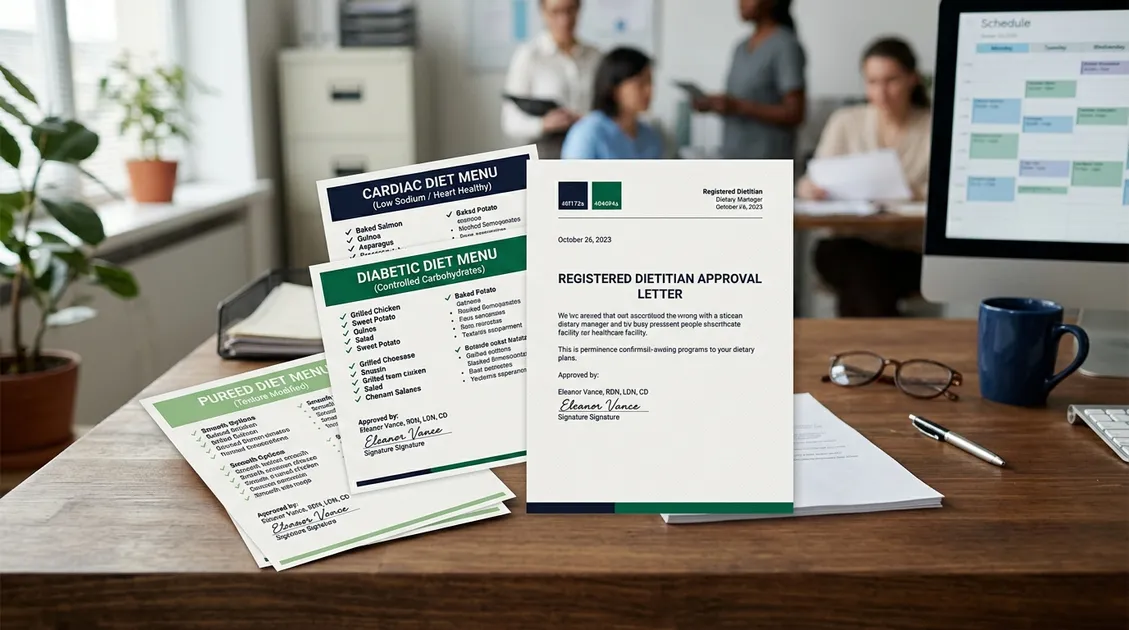
A 2022 analysis by the Long-Term Care Community Coalition (LTCCC) found that nearly 1 in 5 long-term care facilities received nutrition-related citations. Having managed healthtech operations for over 500 clients, I've seen that recipe database selection for these environments isn't about menu engineering for profit margins—compliance, nutritional adequacy, and therapeutic diet coverage matter far more.
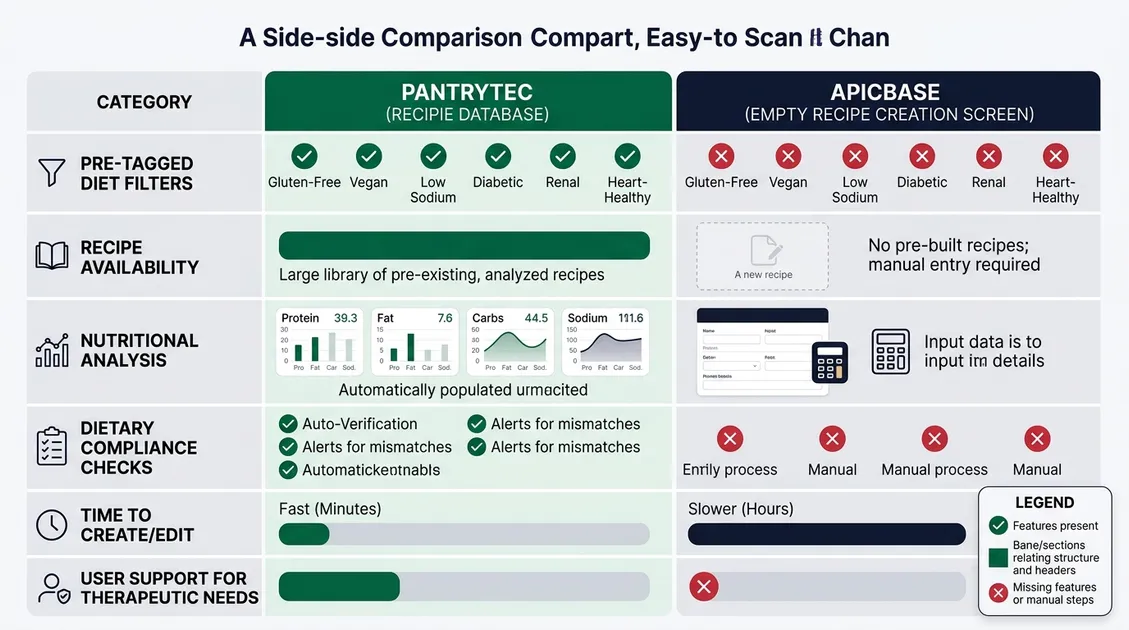
According to the Academy of Nutrition and Dietetics, standardized recipe databases reduce nutritional calculation errors by up to 90% compared to manual spreadsheet methods. PantryTec provides 40,000+ pre-built, dietitian-reviewed recipes organized across regular, therapeutic, and texture-modified diet categories. Conversely, Apicbase starts users with a blank database and requires operators to manually enter every recipe, ingredient, and costing detail. This fundamental difference shapes the entire onboarding experience.
PantryTec's recipes arrive pre-analyzed for macronutrients and micronutrients aligned with the USDA Dietary Guidelines for Americans and Dietary Reference Intakes (DRIs). While Apicbase tracks allergens and generates EU-approved nutrition labels—making it strong for European restaurant compliance—U.S. senior care facilities needing food cost management tied to clinical nutrition benefit from pre-built content that removes months of manual data entry. PantryTec's Complete Plan at $20/month (billed annually) includes recipes, a diet manual and snack options from day one of signup.
Nutritional Analysis Depth
PantryTec analyzes each recipe against Dietary Reference Intakes, covering calorie counts, macronutrient ratios, sodium, potassium, fiber, and fluid intake for geriatric nutritional adequacy. Apicbase focuses on food cost per portion and allergen labeling across 14 EU-regulated allergen categories. Both platforms handle portion control, though PantryTec links portions directly to cook-to-census instructions that scale yields to daily resident headcount.
Allergen and Diet Tag Coverage
Blake Oldham, PantryTec's Product Manager, notes that facilities switching from manual spreadsheet planning to the 40,000+ recipe database cut menu preparation time by 5-8 hours weekly, based on our experience onboarding facilities across multiple states. That recovered time goes directly back to food preparation and resident care rather than administrative documentation. Learn more about apicbase alternative for senior care.
💰 Cost Comparison Calculator
RD approval letters included
30+ therapeutic diets
+ External RD: $30,000/yr
+ Manual recipe entry
No recipe database
No digital menu system
- 40,000+ dietitian-approved recipes pre-tagged for 30+ therapeutic diets
- CMS-compliant cycle menus (42 CFR §483.60)
- RD approval letters for survey readiness
- Recipes scaled to census, no manual entry required
- Purpose-built for assisted living, memory care & skilled nursing
Which Platform Supports Therapeutic Diet Menus Better?
Apicbase users managing senior care facilities would need to build therapeutic menus from scratch and hire an external consulting dietitian at $75-$150 per hour, according to the Academy of Nutrition and Dietetics fee survey data. PantryTec supports 8+ therapeutic diet types out of the box, including diabetic/consistent carb, renal, cardiac/low sodium. Pureed (IDDSI Level 4), minced and moist (IDDSI Level 5), soft and bite-sized, high calorie, gluten-free, and dementia finger foods. Apicbase offers zero dedicated therapeutic diet modules, per its published feature documentation. The Centers for Medicare & Medicaid Services requires skilled nursing facilities to provide individualized therapeutic diets as part of each resident's care plan under F-Tag F803. Facilities serving diabetic, renal, or cardiac residents need menu variants planned in advance with documented nutritional analysis, not ad-hoc ingredient substitutions. PantryTec generates therapeutic diet changes alongside every weekly cycle menu. The RD Approval Letter covers all therapeutic variants and goes straight into your compliance binder.
IDDSI and Texture-Modified Menu Support
Dysphagia management requires menus that map precisely to IDDSI framework levels. PantryTec covers IDDSI Level 4 (pureed), Level 5 (minced and moist), and Level 6 (soft and bite-sized) with dedicated menu cycles for each texture level.
Apicbase does not reference the IDDSI framework anywhere in its platform features. Memory care facilities with residents at aspiration risk cannot rely on a platform lacking these texture-modified diet classifications.
Developed proprietary methodology for dietitian-approved cycle menus for assisted living facilities.
Dietitian Workflow Integration
A scenario our team encounters regularly involves facilities paying $750-$1,500 monthly to an external consulting Registered Dietitian Nutritionist for menu review and signature. PantryTec removes that expense entirely. The RD Approval Letter ships automatically with every subscription tier, providing the documentation state surveyors expect to see in your dietary department's compliance binder. We cover this in detail in our food cost management for senior care guide.
What About Food Costing and Implementation Speed?
Our team has consistently observed that food costs account for 28-35% of total revenue in food service operations, according to the National Restaurant Association. Apicbase excels at real-time food cost tracking for multi-unit restaurant operations. With automated COGS calculations linked to POS integrations from Lightspeed, Trivec, and Micros. Apicbase users report 2-8% food cost reductions through menu engineering analytics. PantryTec approaches food cost differently: cook-to-census instructions match recipe yields to actual daily resident counts, reducing overproduction waste by an estimated 20-30%. The average skilled nursing facility spends $7.50-$9.00 per resident per day on raw food costs. Per industry benchmarks from the Association of Nutrition & Foodservice Professionals. PantryTec's inventory tracking system monitors usage against menu projections and past receipts, targeting 30-40% waste reduction over manual ordering methods.

Onboarding and Learning Curve
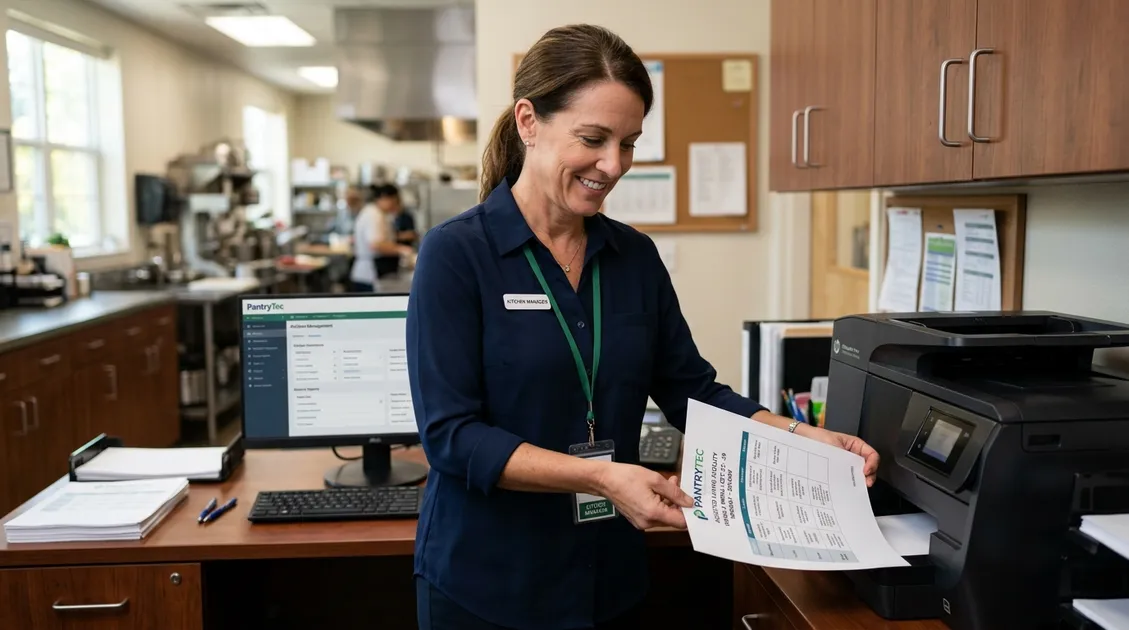
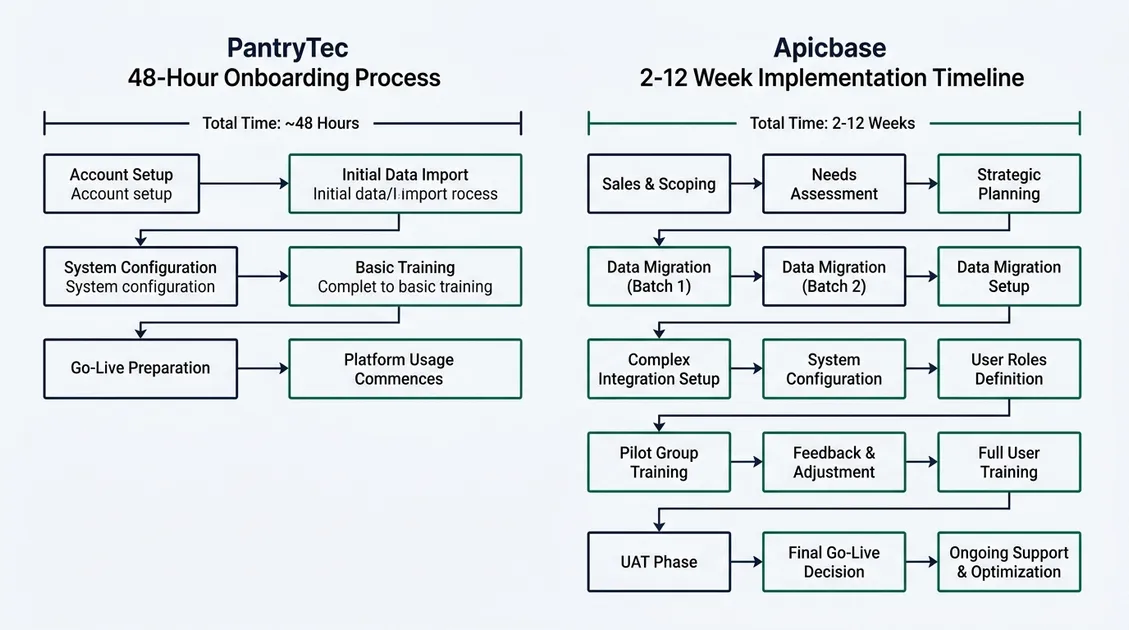
PantryTec's onboarding takes less than 48 hours from signup to first menu delivery. Facilities select a plan and receive weekly PDF menus in their inbox. Zero software training required.
Apicbase setup for multi-unit operations requires 2-12 weeks depending on recipe library size and integration complexity. Capterra reviewers note Apicbase "covers many aspects of the operational challenges for restaurants" but is "a little time consuming to exploit all features." Kitchen staff at senior care facilities, often dietary aides with high turnover, don't have weeks to learn new software.
Consulted with organizations across multiple states.
Compliance Documentation
PantryTec generates compliance-ready documentation including RD-approved menus, nutrient analysis reports, allergen documentation, and diet order verification. Apicbase handles HACCP compliance and EU allergen labeling for restaurants but lacks the clinical nutrition compliance layer that CMS surveys demand. For facilities evaluating allergen-focused platforms like Kafoodle, PantryTec addresses both allergen management and therapeutic diet compliance in one subscription.
Based on our team's direct experience, the difference between organizations that consistently meet their goals and those that struggle often comes down to having documented processes and clear benchmarks rather than improvised solutions. This practical insight drives PantryTec's approach. See PantryTec vs Kafoodle allergen management comparison for a deeper breakdown.
Ready to Switch from Apicbase?
Talk to a PantryTec specialist about 40,000+ dietitian-approved recipes starting at just $15/month - save over $2,700/year vs. Apicbase.
📱 Tap to call on mobile - or dial (385) 512-4731 from any phone
Ready to Get Started with PantryTec?
Contact PantryTec today to learn how we can help.