
Dining is the most visible part of care, so it is the strongest dining occupancy driver a senior living community controls. Family satisfaction with assisted living dining rose 11 points in the 2025 J.D. Power U.S. Senior Living Satisfaction Study, leading that year's gains. Families can see, smell, and taste food on a single tour, which they cannot do with clinical care.
PantryTec is a Springville, Utah provider of dietitian-approved cycle menus for assisted living, memory care, and skilled nursing facilities. This guide connects menu compliance to tours, reviews, and move-ins. It sits under our PantryTec cycle menu service for senior care operators hub, and each section links to a deeper spoke.
Occupancy conversations go better with a real menu in hand. Download Free 4-Week Sample to see the RD-signed format and nutrient layout before you read on.
TL;DR: Dining drove the largest 2025 J.D. Power family satisfaction gain in assisted living. Only 12% of respondents in one 2025 industry report were satisfied with senior living food options. Utah assisted living menus need a certified dietitian's signature and a posted current week. Five monthly metrics, tracked beside census, show whether dining helps occupancy.
How Much Does Dining Quality Affect Senior Living Occupancy?
Dining quality moves occupancy through satisfaction, and one senior living provider profiled by Senior Housing News lifted occupancy more than 5% after overhauling dining services. That figure is one operator's result, not an industry average, but the mechanism behind it is well documented. Researchers at Western Kentucky University found that dining services, along with caregiving and management style, had the greatest impact on assisted living resident satisfaction. Mealtime outweighed apartment and building features in that study, published in the Journal of Housing for the Elderly. Satisfied residents stay longer, and their families refer friends and post positive reviews. Each outcome protects census in a different way. Occupancy rises when move-ins increase, and it also holds when move-outs slow. Dining touches both sides of that equation every day. The subsections below split the effect into satisfaction scores, length of stay, and referrals.
Occupancy Correlation With Dining Scores
Senior living satisfaction studies rarely publish a clean ratio between dining and census, so treat any single number with care. The J.D. Power study scores six factors, including dining, staff, activities, and price paid for services. Its 2025 edition drew 2,917 responses from residents and family decision-makers. No public dataset isolates dining's exact share of occupancy change. Your own data can. Put dining scores and monthly census on one sheet, and you'll see the local pattern within a few survey cycles. Our senior care dining and menu demand page adds national context.
Dining's Effect on Length of Stay
Living on site means eating nearly every meal in the community. Utah's assisted living rule requires three meals a day, seven days a week, plus snacks. That adds up to 21 dining moments each week. Menu fatigue builds fastest in homes that repeat a short rotation, and a bored resident complains to family. Our guide to handling resident and family complaints about covers the response loop.
Referral Volume From Satisfied Families
Occupancy also grows through word of mouth, and review sites now carry that word further. A Place for Mom reports nearly half a million reviews on its platform. Its marketing chief says reviews show what meals and activities are like. One unanswered post about cold dinners stays visible for months, so read our spoke on responding to a negative online review about the.
Food Cost Per Resident Day (PRD) Calculator
Enter your average daily census, days in the month, and raw food spend to calculate food cost per resident day. Add each month to the trend so you can track PRD beside census, one of the monthly metrics that shows whether dining is helping occupancy.
Monthly PRD trend
No months added yet. Calculate a month above and select "Add month to trend."
Formula: PRD = raw food spend ÷ (average daily census × days in month). Trend data stays in this browser tab only and is not saved or sent anywhere. Example figures are illustrative, not industry averages. Compare PRD with your dining satisfaction scores and monthly census on one sheet to see your local pattern.
Why Do Families Judge a Community by Its Menu?
Dining is the one service families can audit on a tour, and only 12% of respondents in a 2025 report were satisfied with food options. The same report, covered by McKnight's Senior Living, put satisfaction with the overall dining experience at 13%. Adult children also named dining quality among the top barriers to choosing a community. That gap explains the scrutiny. A family can't review a care plan, a medication pass, or a night-shift schedule in under an hour. They can read the posted menu, watch lunch service, and taste a test meal. The menu becomes a stand-in for everything they cannot see. Adult children draw conclusions from small details, such as whether the posted entrée matches the plate. Those conclusions shape the move-in decision, which our spoke on Dining ranks among move-in decision factors examines. The subsections below explain the proxy effect and the dignity signals families notice.
Menu as a Proxy for Overall Care Quality
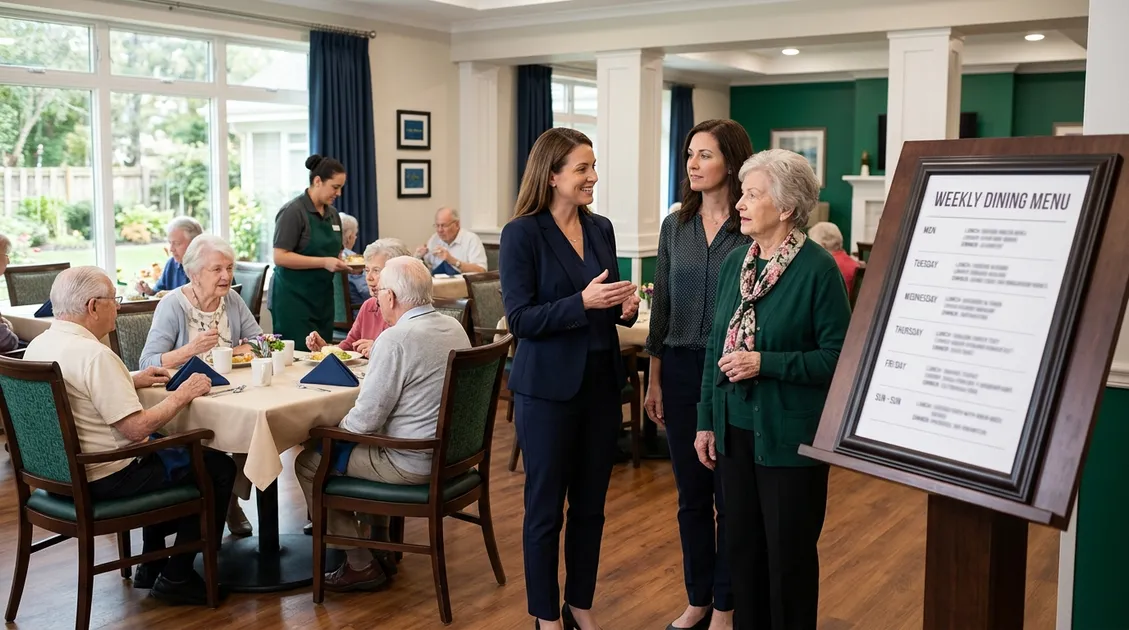
Senior care families read a menu the way patients read a waiting room. A clean, current, accurate menu signals a well-run building. A NursingHome411 food and dietary services fact sheet lists food that is unpalatable, cold, or different from the menu among common resident complaints. A mismatch between the posted menu and the plate tells a family that systems slip when no one is watching. Our guides to displaying menus for residents and families and food questions families ask during a cover both sides of that moment.
Variety, Choice, and Perceived Dignity
Person-centered dining builds meals around each resident's choices, history, and preferences instead of a fixed tray. Its core elements are choice at every meal, regular preference surveys, and liberalized diets that relax restrictions when the clinical benefit is small. Federal rule 42 CFR §483.60(c) tells certified nursing facilities to reflect input from residents and resident groups in menus. It also protects each resident's right to make personal dietary choices. Assisted living is not bound by that federal rule, but it's a sound benchmark for any setting.
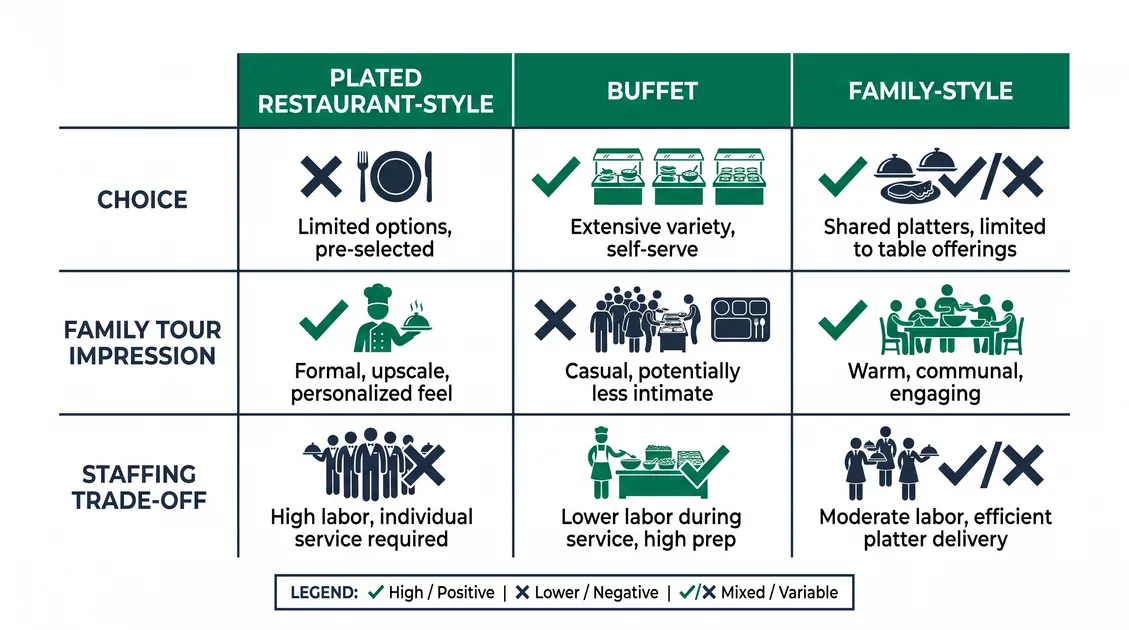
Dining service model shapes how choice feels in practice. Unidine's survey of 119 senior living decision-makers found 59% ranked keeping menus exciting and interesting as a top challenge. The service model you pick is one answer to that problem.
| Dining service model | How choice works | What families notice on a tour | Operational trade-off |
|---|---|---|---|
| Plated, restaurant-style | Selective menu with an alternate entrée at each meal | Servers, printed daily menus, table service | Highest server labor; needs accurate census counts |
| Buffet or steam table | Residents pick items and portions at the line | Visible variety and portion freedom | Needs HACCP temperature logs and portion-control scoops |
| Family-style | Shared bowls passed at each table | Home-like, social meals suited to small homes | Harder to control portions and therapeutic diet orders |
| Always-available menu | Short backup list served any time | Proof that no resident goes hungry | Requires par levels for every backup item |
| Finger-food service (memory care) | Hand-held versions of the main meal | Residents eating independently without utensils | Recipes must be adapted for dysphagia risk |
Memory care communities rely on the last row. Our dementia finger food menus keep residents eating the same meal as their neighbors, in a form they can manage.
What Dining Metrics Should an Executive Director Track Monthly?
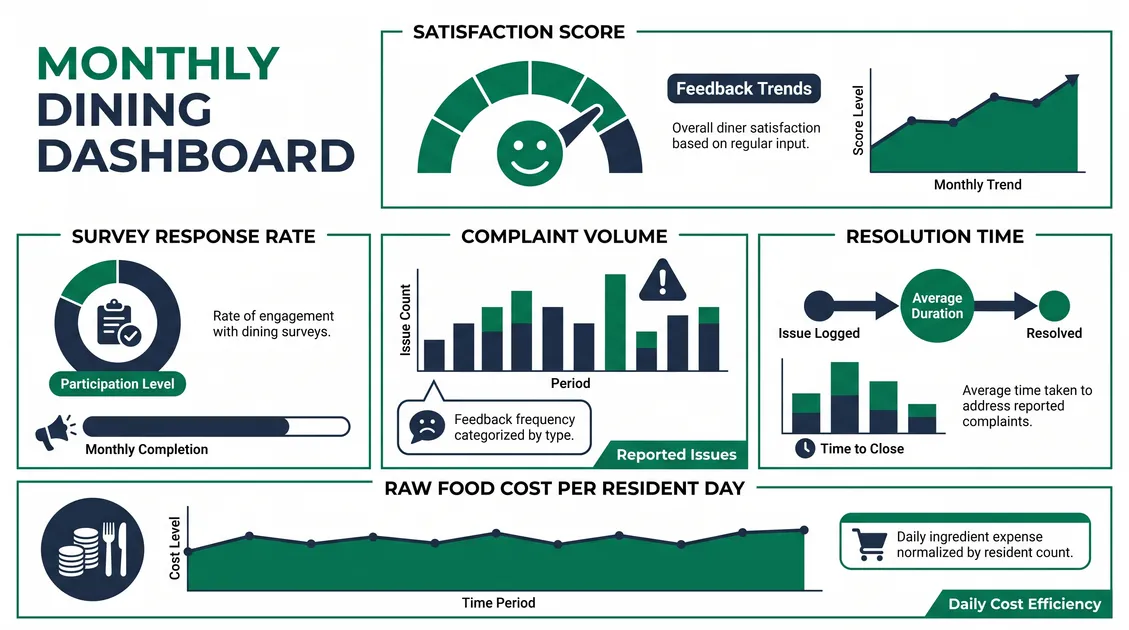
Dining performance fits on a five-metric monthly dashboard: satisfaction score, survey response rate, complaint volume, complaint resolution time, and raw food cost per resident day. Each metric answers a different question for an executive director. Satisfaction shows whether residents like the food. Response rate shows whether that score is trustworthy. Complaint volume and resolution time show how fast the kitchen fixes problems. Food cost per resident day, or PRD, shows whether dining quality is financially sustainable. Together they connect the dining room to census, because each one leads to a tour comment, a review, or a move-out conversation. Review the five numbers at the same monthly meeting where you review occupancy. Patterns appear faster when both sit on the same page. The table below defines each calculation and the lever that moves it, and the subsections explain how to collect clean data.
| Metric | Calculation | Cadence | Lever that moves it |
|---|---|---|---|
| Dining satisfaction score | Average of item-level ratings for food, service, and choice | Quarterly survey plus monthly pulse cards | Menu changes driven by item-level scores |
| Survey response rate | Surveys returned divided by surveys distributed | Every survey cycle | Large-print forms, family email links, menu committee reminders |
| Food complaint volume | Logged complaints from grievance forms, menu committee, and family calls | Monthly count | Recipe fixes, temperature checks, test tray audits |
| Complaint resolution time | Days from complaint log date to documented response | Monthly average | A named owner and written reply for each complaint |
| Raw food cost per resident day | Raw food spend divided by resident days in the period | Monthly | Cook-to-census production, par levels, plate waste audits |
Satisfaction Score and Response Rate
Senior living survey scores are only as good as the people who answer them. A score built from four enthusiastic residents will mislead you. Mix channels: large-print paper forms, a QR code on the posted menu, and an email link for families. Our spoke on running a resident and family dining satisfaction survey covers wording, and resident food preference surveys and menu committees turns scores into menu changes.
Food Complaint Volume and Resolution Time
Occupancy risk shows up first in the complaint log. Residents move through 70 unique daily plans before anything repeats, and complaint calls drop. In our experience, the fix is less about gourmet recipes and more about ending the two-week loop many small homes have run for years.
Resolution time matters as much as volume. A family that reports cold soup on Monday and gets a written answer by Wednesday feels heard. Log the channel, date, owner, and response for every complaint.
Raw Food Cost Per Resident Day
Senior living food cost is easiest to compare as PRD. Here's a worked example. A 30-resident home spends $9,000 on groceries in a 30-day month, which equals 900 resident days, so PRD is $10. Watch the trend rather than one month, since holidays and census swings move the figure. The food cost control guide goes deeper on par levels and order guides.
How Does a Dietitian-Approved Cycle Menu Support Sales and Compliance at Once?
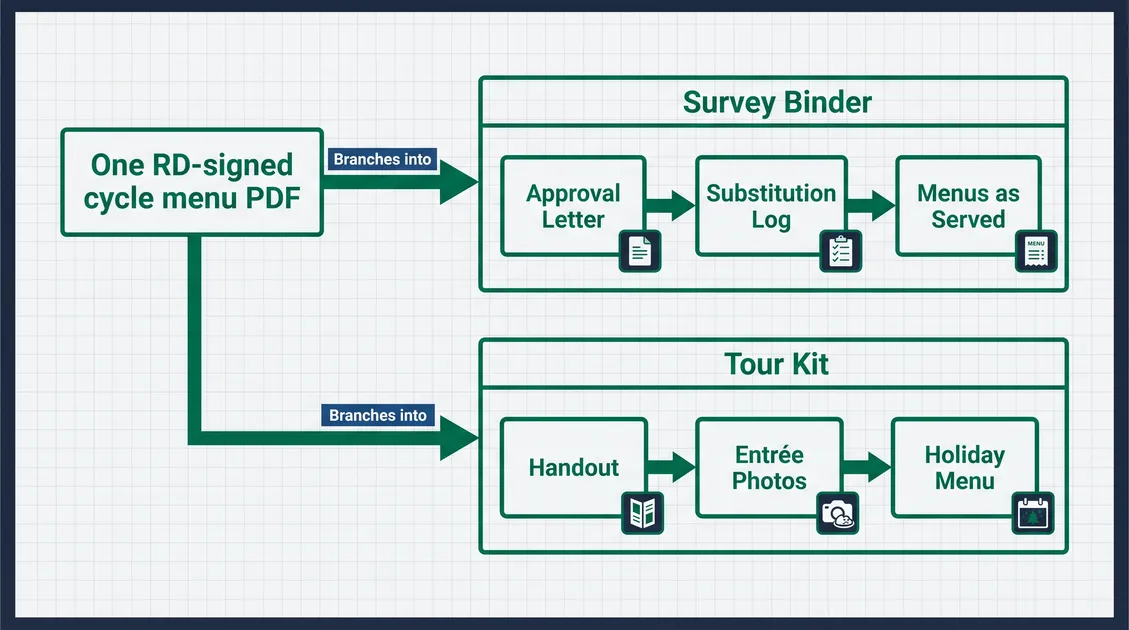
Dining documentation and marketing come from one file, since Utah's assisted living rule, R432-270, requires a certified dietitian's signature and a posted current-week menu. The rule also requires a different menu for each day of the week. That signed, posted menu is among the first documents a surveyor checks and the first page a touring family reads. One file does two jobs. The federal parallel is 42 CFR §483.60, enforced through CMS F-tag F803 at Medicare- and Medicaid-certified skilled nursing facilities. That rule requires menus to meet national guidelines, be prepared in advance, be followed, and be reviewed by a dietitian for nutritional adequacy. It does not govern state-licensed assisted living, but it's a useful benchmark for any setting. Utah's current rule text, effective November 13, 2025, lists food services at R432-270-21, while older copies show R432-270-22. The subsections below show how one menu file fills both the survey binder and the sales kit.
Survey Documentation Value
Senior care surveyors look for a paper trail, not promises. A complete survey binder for a Utah assisted living facility holds these items:
- RD approval letter with signature, credential, license number, and review date
- Current cycle menu plus menus as served, with as-served annotations
- Menu substitution log kept for the period your state requires
- Diet roster matched to each physician diet order and its currency date
- Approved diet manual, required in Utah once a resident needs a therapeutic diet
- Local health department inspection reports, which Utah requires on file
- Nutrient analysis comparing the menu against Dietary Reference Intakes (DRIs)
Therapeutic diets widen the binder. A consistent carbohydrate (CCHO) diabetic diet, a 2-gram sodium cardiac diet, a renal diet, a mechanical soft diet, and a pureed diet each need extensions tied to the base menu. The IDDSI framework runs from Level 0 thin liquids to Level 7 regular foods, and Levels 4 to 6 cover most texture-modified meals. Our therapeutic diet menus hub maps each extension, and our guide on To pass a CMS dietary survey with F-tag menu requirements covers F803 in depth.
Marketing Reuse of the Same Menu File
Dining marketing starts with the week you already signed. Pull one week as a tour handout, photograph three plated entrées, and post the holiday menu online. Our spokes on Menu collateral to hand families on a and turning a cycle menu into photos and marketing collateral show layouts that work. Holiday and special-event days inside a fixed cycle deserve extra care, and seasonal menu updates in spring and fall give prospects a reason to visit again.
Senior living campuses feel these pressures differently. Independent living and 55+ community menu planning works mainly as a leasing lever, while CCRC and multi-level care campus menu programs balance leasing and licensing. Sales teams can follow our planned video walkthrough, Watch: Turning a Cycle Menu Into a Tour Handout, Step by Step. Utah R432-270 assisted living rule shows minimum cycle menu length of 3 weeks.
What Do Dining Software Platforms Add Beyond a Cycle Menu?
Dining software adds ordering, tray cards, and integrations to a menu; DiningRD, founded in St. Louis in 1993, runs its PlateFul drag-and-drop planner inside DiningManager. Business directory listings put DiningRD's founding at 1993 in Saint Louis, and the company was before named Health Technologies, Inc. The company reports serving more than 5,000 senior living and long-term care communities in 47 states. eMenuCHOICE takes a different angle, focusing on resident ordering and digital menu display on tablets. Both tools extend a menu program. Software organizes a menu program, but it does not make an unsound menu compliant. A strong cycle menu becomes easier to serve and track. A weak one becomes a faster way to serve the same complaints. That trade-off matters most for small homes, where every subscription and training hour competes with care staffing. The subsections below compare point-of-service features and the point where software earns its cost.
Point-of-Service Ordering Systems
Occupancy teams like point-of-service (POS) systems because they look modern on a tour. Tableside tablets let servers take orders, check each order against the diet roster, and print a tray card for room service. The payoff is fewer diet-order errors at the tray line. The cost is hardware, dining room Wi-Fi, and training that restarts each time a server leaves.
When Software Is Premature for Small Communities
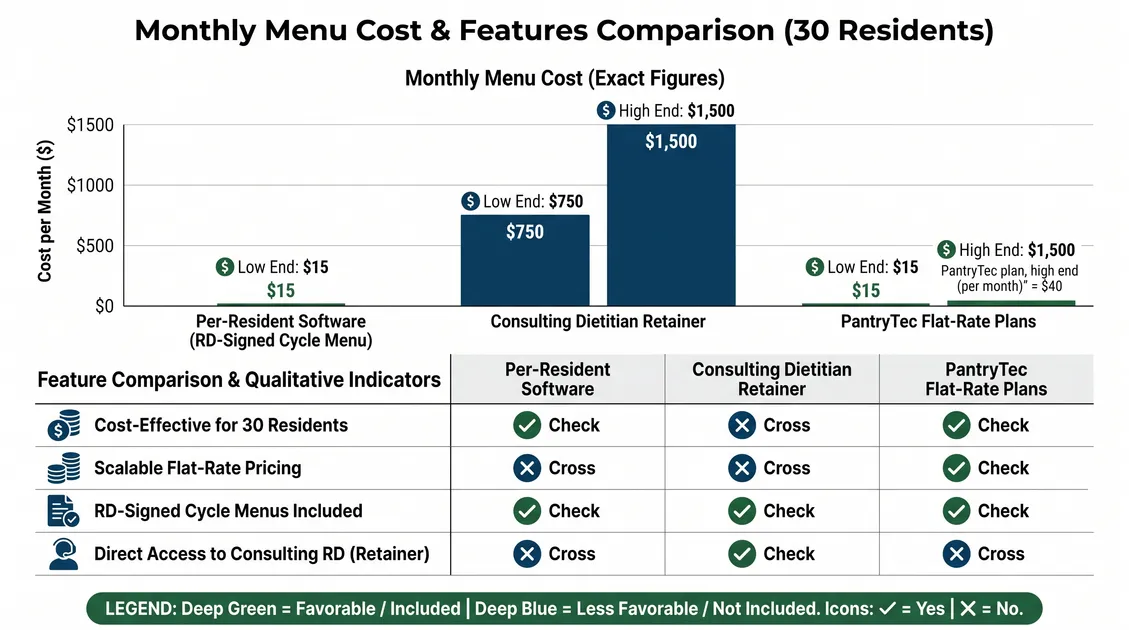
PantryTec takes the opposite position for small homes, because done-for-you PDF menus need zero training, while software onboarding takes 4 to 8 weeks. Per-resident billing also climbs with census, so a marketing win raises your menu bill. The per-resident-per-month pricing guide runs the numbers at several bed counts.
| Menu cost model | How it bills | Monthly cost at 30 residents | Dietitian sign-off |
|---|---|---|---|
| Per-resident software (PRPM) | $3 to $5 per resident per month, per PantryTec market comparisons | $15 to $40 | Often billed as a separate consulting fee |
| External consulting dietitian | Monthly retainer for reviews and signatures | $800 to $1,200, as reported by PantryTec clients | Included in the retainer |
| PantryTec Starter Plan | Flat monthly fee at any census | $15 | RD approval letter included |
| PantryTec Complete Plan | Flat monthly fee at any census | $20 | Adds all 3 menu styles and common therapeutic diets |
| PantryTec Premier Plan | Flat monthly fee at any census | $40 | Adds renal, cardiac, IDDSI Level 4, and dementia finger foods |
Senior care administrators often underestimate that consultant line.
Key Takeaways: Dining as an Occupancy Driver
- Dining led the 2025 J.D. Power family satisfaction gains for assisted living, so menu work belongs in your census plan.
- Families audit food because they can't audit care on a tour; a posted menu that matches the plate is your strongest proof.
- Review five dining metrics monthly beside occupancy, and calculate food cost from resident days, not licensed beds.
- Utah assisted living menus need a certified dietitian's signature, a different menu each day, and a posted current week under R432-270.
- One RD-signed cycle menu file fills the survey binder and the tour kit, and PantryTec plans run from $15 to $40 per month.
Limitations and Considerations
- Public research doesn't isolate dining's exact share of occupancy change, so measure your own trend.
- A signed cycle menu doesn't replace clinical dietitian work where your license requires it; Utah R432-150-22 requires monthly consults at nursing care facilities without a certified dietetic supervisor.
- Therapeutic diets still need a physician order, or a dietitian order where state law allows delegation.
- Large campuses with room service and tray lines gain real value from POS software.
- No menu offsets cold delivery, rushed service, or an understaffed dining room.
Dining upgrades start with a menu your surveyor and your prospects can both read. PantryTec dietitian-approved cycle menus are listed tier by tier on the flat-rate menu plan pricing. We deliver the first menu PDF within 24 to 48 hours of sign-up, then send fresh menus every week. You can Get a Dietitian-Signed Menu Quote, Request a Menu Demo, Talk to a Registered Dietitian, or Check Utah DHHS Menu Compliance. Call 385-512-4731 for help.
What is a cycle menu in senior living?
Senior living cycle menus are sets of planned daily menus that repeat after a fixed number of weeks, covering breakfast, lunch, dinner, and snacks. PantryTec builds 5-week and 10-week rotations, and a registered dietitian reviews and signs each one.
How many weeks should an assisted living cycle menu be?
Assisted living cycle menus in Utah must cover at least three weeks under R432-270. Longer rotations reduce menu fatigue, and a 10-week cycle repeats only about five times a year.
Do assisted living menus have to be approved by a dietitian?
Dining menus in Utah assisted living must be approved and signed by a certified dietitian under R432-270. For certified nursing facilities, 42 CFR §483.60 requires review by a qualified dietitian, and the credential standard includes at least 900 hours of supervised dietetics practice.
What does 42 CFR 483.60 require for menus?
Senior care menus in certified nursing facilities must meet seven conditions under 42 CFR §483.60(c). Menus must meet national guidelines, be prepared in advance, be followed, reflect resident input, be updated periodically, and receive dietitian review. The seventh clause protects each resident's personal dietary choices.
How far in advance must menus be posted in a care facility?
Utah assisted living facilities must post the current week's menu, and Utah nursing care facilities must post menus each day and prepare them in advance. Served substitutions must be recorded and kept for three months, so check your own state's rule for its posting window. For J.D. Power 2025 U.S. Senior Living Satisfaction Study, assisted living family dining satisfaction change typically runs about +11 points on a 1,000-point scale in day-to-day operations.
Get the Free RD-Signed 4-Week Sample Menu Packet
Tell us your facility type, licensed bed count, and state. We will preview what your sample packet covers, then send you to our request page (or open an email) with your details filled in. Nothing is submitted from this box.
Your packet preview
Meal count assumes 3 meals a day at full occupancy for 28 days. Snacks and supplements are not included.
Choose a facility type to see what the sample emphasizes.
Choose a state to see compliance notes.
The request button opens PantryTec's request page with your answers in the link. The email option opens your own mail app with a prefilled draft that you review and send. This widget does not store or transmit your information.
Explore Topics
8 related pages in this section
Senior Care Dining and Menu Demand Data
Senior dining demand data for care facilities: community counts, diet needs, RD access gaps and survey citations. Download a free sample menu.
Senior Care Dining and Menu Demand Data→PantryTec Cycle Menu Service for Senior Care Operators
Download free sample cycle menus for senior care facilities.
PantryTec Cycle Menu Service for Senior Care Operators→Food Cost Control Guide
Gluten-free menus for senior living communities, dietitian-approved and built into 10-week cycle rotations. Plans from $15/mo. Get a free sample menu.
Food Cost Control Guide→How to Pass a CMS Dietary Survey: F-Tag Menu Requirements
CMS menu compliance in plain English: F-tag menu requirements, the survey walkthrough, the documents surveyors ask for, and RD-signed menu pricing.
How to Pass a CMS Dietary Survey: F-Tag Menu Requirements→Senior Living Cycle Menu Provider Comparison Matrix
Top 10 dietary survey deficiencies ranked: F812, F803, F809 mapped to 42 CFR §483.60, with CMP ranges and plan-of-correction fixes that hold.
Senior Living Cycle Menu Provider Comparison Matrix→How to Plan a Senior Living Cycle Menu: Step-by-Step Guide
Cycle menu planning for senior living, step by step: rotation length, recipes, DRI nutrient analysis, and the dated RD signature surveyors ask to see.
How to Plan a Senior Living Cycle Menu: Step-by-Step Guide→IDDSI Framework Guide for Senior Care Kitchens: All 8 Levels
IDDSI framework guide for senior care kitchens: all 8 levels (0-7), fork drip and spoon tilt tests, F805 survey rules, and cycle menu conversion steps.
IDDSI Framework Guide for Senior Care Kitchens: All 8 Levels→How Do You Find and Read Your State's Menu Rule?
Learn to find and read state menu rule citations for assisted living: who signs, review frequency, retention and survey documents. Get a free sample menu.
How Do You Find and Read Your State's Menu Rule?→