
Pennsylvania Personal Care Menus:
Chapter 2600 and 2800 Rules Explained
Pennsylvania requires every licensed personal care home and assisted living residence to offer at least 3 nutritionally well-balanced meals a day. Each meal must include an alternative food and drink item residents can choose instead. The same rules decide how Pennsylvania personal care menus are planned, posted, changed and filed. PantryTec is a dietitian-approved cycle menu service for senior care facilities, and this page is the Pennsylvania chapter of our guide to finding your state's assisted living.
Personal care homes and assisted living residences are two separate license types here, which is the classic lookup pitfall that hub describes. Want a working model to compare? Download Free 4-Week Sample files and hold them against the rule text below.
TL;DR: Chapter 2600 (personal care homes) and Chapter 2800 (assisted living residences) share nearly identical meal and menu text in sections .161 and .162. Menus are written and posted in advance, followed, and kept after service with every substitution noted. Special diets follow a written order from a physician, physician assistant, CRNP or dietitian. Only ALRs must keep a dietitian on staff or under contract.
What Does the Pennsylvania Personal Care Home Menu Rule Require?
Pennsylvania spreads personal care home menu rules across 4 sections of 55 Pa. Code Chapter 2600, and Chapter 2800 mirrors them for assisted living residences. Section 2600.161 sets nutritional adequacy, requiring meals that meet USDA recommended dietary allowances. Residents must be able to get extra portions and beverages at mealtimes, and drinking water at all times. Section 2600.162 covers meal spacing, menu preparation, posting and record keeping. The last two sections address food service worker hygiene and ban withholding or forcing food. The Department of Human Services licenses both settings through its Bureau of Human Services Licensing. Either chapter applies once a home serves 4 or more unrelated adults who need help or supervision with daily activities. That makes your license certificate the first document to check before you plan a cycle menu. Special-diet and dietitian staffing duties differ between the two license types, as the official 55 Pa. Code Chapter 2600 table of contents and its Chapter 2800 counterpart show.
Where Does Chapter 2800 Differ for Assisted Living Residences?
Rules for assisted living residences add a few nutrition duties on top of the shared text, as the comparison below shows.
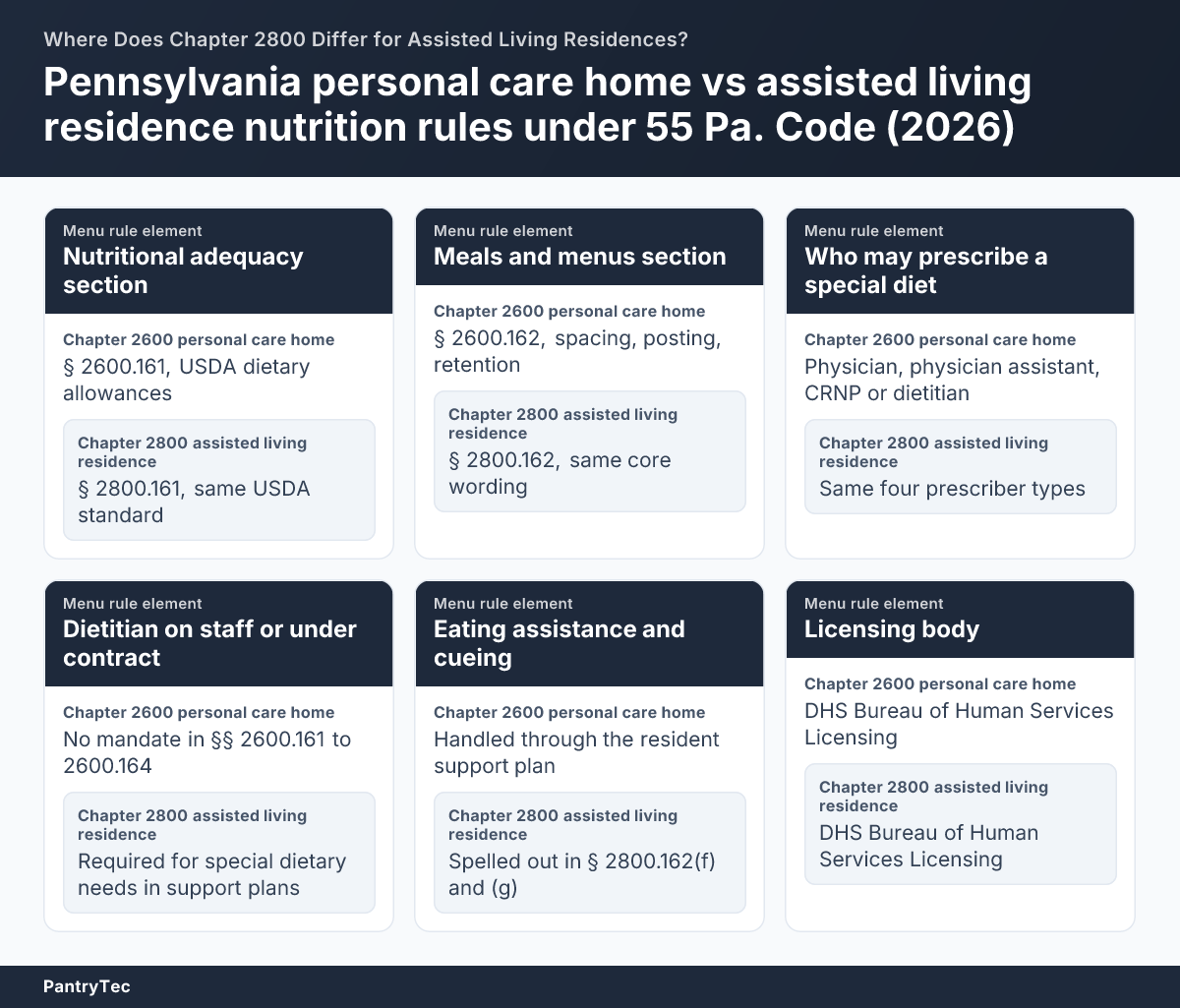
| Menu rule element | Chapter 2600 personal care home | Chapter 2800 assisted living residence |
|---|---|---|
| Nutritional adequacy section | § 2600.161, USDA dietary allowances | § 2800.161, same USDA standard |
| Meals and menus section | § 2600.162, spacing, posting, retention | § 2800.162, same core wording |
| Who may prescribe a special diet | Physician, physician assistant, CRNP or dietitian | Same four prescriber types |
| Dietitian on staff or under contract | No mandate in §§ 2600.161 to 2600.164 | Required for special dietary needs in support plans |
| Eating assistance and cueing | Handled through the resident support plan | Spelled out in § 2800.162(f) and (g) |
| Licensing body | DHS Bureau of Human Services Licensing | DHS Bureau of Human Services Licensing |
Personal care home owners sometimes assume a federal dietitian standard applies to them. 900 hours of supervised dietetics practice is the minimum for a qualified dietitian reviewing nursing home menus, per 42 CFR 483.60 on eCFR (2026). That rule binds certified nursing facilities, not Pennsylvania PCHs or ALRs. Treat it as a quality benchmark, not a licensing requirement.
Who Pays for the Food on a Pennsylvania Menu?
Care funding for meals sits in room and board, which 42 CFR 441.310 excludes from Medicaid HCBS waiver payments. Community HealthChoices (CHC), run by the Office of Long-Term Living, and the LIFE program pay for care services rather than food. Residents who meet nursing facility clinical eligibility can receive those services, but their meals still come from their own income.
Personal Care Home Supplement payments add $180 to $480 a month on top of Supplemental Security Income (SSI) to help offset room and board, per the DHS supplement guide. SSI residents also keep an $15 to $40 personal needs allowance, and it cannot be used for room or board, under § 2600.25a. Domiciliary care homes receive a combined federal and state payment of their own. Waivers covered about 59,000 supportive housing residents in 2000, leaving 80 percent of low-income RCF residents unassisted, per CHCF's Residential Care for the Elderly report.
Pennsylvania Meal Spacing Checker (§ 2600.162(a) and § 2800.162(a))
Enter your evening meal (supper) time and the next morning's breakfast time. The checker measures the overnight gap and flags schedules that exceed the spacing limit in your license chapter.
Both chapters share the same core meal spacing wording in section .162.
Default reflects the 15 hour limit commonly cited for section .162(a). Confirm against the current Pa. Code text and adjust if needed.
Reminder: Pennsylvania requires at least 3 nutritionally well balanced meals a day, each with an alternative food and drink choice, plus drinking water at all times. This tool is a planning aid only and is not legal advice. Verify your schedule against the official 55 Pa. Code text for your license type.
Get Free 4-Week Sample MenusHow Many Hours Can Pass Between Meals in a Pennsylvania Home?
Pennsylvania allows no more than 15 hours between the evening meal and the first meal of the next day, under § 2600.162(a) and § 2800.162(a). Daytime gaps are tighter, with no more than 6 hours between breakfast and lunch or between lunch and supper. A resident's physician can prescribe a different schedule. Keep that order in the resident's record so an inspector sees why one tray runs on its own clock. Federal nursing home rules draw the overnight line an hour earlier. 14 hours is the longest gap between a large evening meal and breakfast in nursing homes, per 42 CFR 483.60 (2026). Pennsylvania's extra hour still leaves little slack once breakfast slides late. Inspectors compare the meal times you post against the times you serve. Weekend schedules are where the gap stretches quietly, so lock service times into the cycle menu itself and check them against the text of 55 Pa. Code § 2600.162.

Modeling Compliant Weekday and Weekend Meal Times
| Schedule | Last meal | Next meal | Gap | Result |
|---|---|---|---|---|
| Weekday | Supper 5:00 pm | Breakfast 7:30 am | 14.5 hours | Within § 2600.162(a) |
| Late weekend breakfast | Supper 5:00 pm | Breakfast 8:30 am | 15.5 hours | Exceeds the overnight limit |
| Brunch-only Sunday | Brunch 10:00 am | Supper 5:00 pm | 7 hours | Exceeds the daytime limit |
Menu planners can fix the weekend by moving supper to 5:30 pm, which puts an 8:30 am breakfast exactly at the limit. Holiday menus deserve the same check, since a late Thanksgiving dinner shifts the next morning too.
Snack Availability and Memory Care Grazing
Care teams in a secured dementia care unit face a different problem: residents who won't sit through a full meal. Chapter 2800 requires between-meal snacks and beverages at all times unless a support plan documents a medical reason against them, under § 2800.161(g). A dementia finger food and grazing stations let residents eat while they walk. Staff cueing to encourage and remind residents to eat and drink is also required where the support plan calls for it.
Home staffing makes or breaks this in a memory care unit of 8 to 20 residents, where the same aides cue at meals and serve the early breakfast. Workforce retention twice as good as typical home care aides came from workforce matching technology, per a PMC study on emerging long-term care technologies. Stable staff keep posted meal times honest. For Pennsylvania Personal Care Home Menu Rule, maximum evening meal to breakfast gap typically runs about 15 hours under § 2600.162(a) in day-to-day operations.
Who Must Review Pennsylvania Menus and Therapeutic Diets?
Pennsylvania lets 4 practitioner types prescribe a resident's special diet: a physician, physician assistant, certified registered nurse practitioner (CRNP) or dietitian, under § 2600.161(d). The home must meet that prescribed diet and document it in the resident's record. Chapter 2800 repeats the same language for assisted living residences in § 2800.161(d). Assisted living residences carry one more duty: a dietitian on staff or under contract for special dietary needs in support plans. The ASPE Compendium of Residential Care and Assisted Living Regulations flags that same Chapter 2800 requirement. Personal care homes have no matching staffing mandate in their nutrition sections. Neither chapter's nutrition sections require a dietitian's signature on regular menus. Therapeutic menus are different, because the written order drives every texture, sodium or carbohydrate change. A dietitian review is how you show the menu matches that order.
How Does a Diet Order Become a Compliant Menu?
- File the signed order from a permitted prescriber in the resident record.
- Copy the exact diet name, such as 2-gram sodium or IDDSI Level 5 minced and moist, onto the diet roster.
- Match the order to a therapeutic diet extension of your base cycle menu.
- Have a dietitian check portions, textures and nutrient targets against the order.
- Log each as-served substitution so the menu record matches the order.
Standard wisdom says every personal care home needs a consulting dietitian on retainer to sign routine menus. PantryTec disagrees for Chapter 2600 homes, because the regulation does not require that signature. Dietitian hours belong on therapeutic orders and residents losing weight.
Home administrators often come to us paying $800 to $1,200 per month to an external dietitian only for quarterly menu reviews and signatures. That totals $9,600 to $14,400 a year. In our experience, the fix is rescoping that contract to clinical assessments and therapeutic diet orders, where dietitian judgment matters most. For the federal parallel, see Therapeutic diets must be physician-ordered under.

Personal care residents with diabetes or kidney disease can also get dietitian help outside the home. One meals-on-wheels program has delivered Medicare medical nutrition therapy with RDNs on staff for about 7 years, per ACL's Senior MNT Toolkit. Those visits complement, but don't replace, the order and documentation duties in § 2600.161(d).
One common pattern we encounter supports this. In our experience, most facility administrators don't realize their external dietitian bill exceeds their annual menu cost by 10x or more. In our experience, facilities come to us paying $800 to $1,200 per month to an external dietitian just for quarterly menu reviews and signatures. That is $9,600 to $14,400 a year, against $180 to $480 a year for a PantryTec plan billed annually with the RD Approval Letter included.
Pennsylvania Menu Survey-Readiness Self-Assessment
Pick your license type, then check each item your home can show a surveyor today. The checklist follows the meal and menu text in 55 Pa. Code §§ .161 to .164 (Chapter 2600 for personal care homes, Chapter 2800 for assisted living residences). Your score and gap list update as you go.
This self-check summarizes the page's reading of 55 Pa. Code Chapters 2600 and 2800 and is not legal advice. Always confirm requirements against the current official regulation text and your Department of Human Services, Bureau of Human Services Licensing guidance. Nothing you check here is saved or sent anywhere.
How Long Must Pennsylvania Menus Be Posted and Retained?
Pennsylvania requires menus prepared and posted 1 week in advance in a conspicuous public place, with past served menus kept for at least 1 month. Each menu must state the specific food served at each meal, and the home must follow it. Any change must be posted where residents can see it before that meal. Substitutions have to meet the same nutritional adequacy standard as the original item. The retained copy is the menu as served, including every change, not the clean version printed weeks earlier. Bureau of Human Services Licensing inspectors work from the DHS Chapter 2600 Regulatory Compliance Guide, which explains how compliance with each rule is measured. A missing substitution note is the gap that turns a sound menu into a citation. Keeping 90 days on file costs nothing and gives you a cushion above the minimum. Store the posted copy, not a fresh printout, because handwritten changes are the evidence.

Which Documentation Gaps Can Inspectors Cite Under Chapter 2600?
Menu documentation problems an inspector can tie to a specific section include these:
- No weekly menu posted in a conspicuous public place, under § 2600.162(c).
- Food served differs from the posted menu, with no change posted beforehand.
- Past as-served menus missing or discarded before the retention period ends.
- Special diet served without a matching practitioner order, under § 2600.161(d).
- No alternative food and drink item offered at a meal, under § 2600.161(b).
- Supper-to-breakfast gap exceeding the limit on weekends, under § 2600.162(a).
Building a Cycle Menu That Passes Inspection
Rules in both chapters leave cycle menu rotation length open. A rotation of several weeks, posted one week at a time, satisfies the posting rule and keeps the same supper from repeating too often. Pair it with a menu substitution log at the kitchen door and a monthly folder of as-served menus.
Menu records can live on paper or in software, and the vendor market is crowded. Fourteen long-term care technology companies interviewed for that same PMC study spanned robots, sensors, wearables, online portals, mobile apps and artificial intelligence. Whatever tool you pick, the weekly menu still has to be posted visibly in the home. Northeast operators can compare these terms with New York adult care facility menu rules. 75% of 7,094 U.S. norovirus outbreaks studied took place in long-term care and assisted living facilities, per the CDC journal Emerging Infectious Diseases (2020).
What Conventional Wisdom Gets Wrong
Conventional wisdom points the other way. Most facilities do not need to hire a dietitian for menus. In our work, here is why: a $15-40/month RD-signed cycle menu service replaces the $800-$1,200/month consulting fees on the invoices facilities bring us, a 95% to 99% cost reduction.
The misconception survives because the old math once held. Menu software makes your staff do the work. In our work, here is why: done-for-you PDF menus need zero training versus 4-8 weeks of software onboarding, and flat pricing beats $2-5 per resident per month.
On the other hand, every business weighs these trade-offs against its own situation. In contrast to one-size-fits-all advice, compare the options against your real numbers before deciding.

Key Takeaways for Pennsylvania Personal Care Home Menus
Pennsylvania rewards homes that write menus ahead, post them, follow them and keep proof. Families comparing monthly rates with the CareScout Cost of Care Survey cannot see your nutrient analysis, but they'll see the posted menu on a tour.
- Confirm your license first: Chapter 2600 covers personal care homes, Chapter 2800 covers assisted living residences.
- Lock supper and breakfast times inside the § 2600.162(a) limits, including weekends and holidays.
- File every special diet order from a permitted prescriber before the tray changes, per § 2600.161(d).
- Post weekly menus, post changes before the meal, and keep as-served copies with substitutions.
- ALRs need a dietitian on staff or under contract; PCHs can focus dietitian time on therapeutic menus.
PantryTec builds its menus around that documentation burden. In our work, menu quality isn't the biggest stress. The concern that comes up first is proving compliance during unannounced state surveys. Every PantryTec cycle menu is reviewed by our Registered Dietitian, Bridget MacDonald, RD (more than 25 years in nutrition), who is licensed in Pennsylvania and signs the RD Approval Letter for your compliance binder.
Menu plans from PantryTec cost $180 to $480 a year billed annually, with no per-resident or setup fees. Compare personal care home menus for Pennsylvania and Georgia if you also operate under the Georgia personal care home menu rule. You can browse cycle menus by facility and license or check flat-rate menu plan pricing. Preparing for your next inspection? Talk to a Registered Dietitian or Request a Menu Demo.
What is a cycle menu in senior living?
Menu cycles are sets of planned menus that repeat on a fixed rotation, such as PantryTec's 10-week cycle delivered weekly. Under Pennsylvania rules, each week of that cycle still has to be posted in advance and followed as written.
How many weeks should an assisted living cycle menu be?
Pennsylvania sets no minimum rotation length for personal care homes or assisted living residences. Other states do: Maryland's COMAR 10.07.14.30 works from a four-week menu reviewed every 3 years.
Do assisted living menus have to be approved by a dietitian?
Rules in Pennsylvania do not require a dietitian's signature on regular menus under Chapter 2600 or Chapter 2800, though ALRs must keep a dietitian on staff or under contract for special diets. Florida, by contrast, requires an annual review of all regular and therapeutic menus by a licensed or registered dietitian or licensed nutritionist.
What is F803 in a nursing home survey?
F803 is the CMS survey tag for menus and nutritional adequacy in certified nursing homes, tied to 42 CFR 483.60(c). It doesn't bind Pennsylvania PCHs or ALRs, which answer to state licensing inspectors. Our F803 explainer on menus meeting resident needs covers how surveyors apply it.
What does 42 CFR 483.60 require for menus?
Care facilities certified by CMS must serve menus that meet residents' nutritional needs, are prepared in advance and are followed, under 42 CFR 483.60(c). Menus must also reflect residents' religious and cultural needs, be updated periodically, and be reviewed for nutritional adequacy by a dietitian or clinically qualified nutrition professional.
We hear from clients that the numbers here match their day-to-day reality. One pattern we see is fewer dining complaints once a 10-week menu rotation is running. Residents get 70 days of menus, 210 breakfasts, lunches and dinners, before any day repeats.