
Best Cycle Menu Providers,
2026 Comparison for Senior Care Facilities
An editorial comparison of 11 cycle menu, senior-care foodservice, and catering platforms reviewed head-to-head on pricing ($15-$500+/mo), dietitian approval, therapeutic diets, safety-net menus, and CMS F-Tag documentation.
Editor's Disclosure, Why Trust This Guide?
This guide is published by PantryTec, a dietitian-approved cycle menu service for assisted living, memory care, and skilled nursing facilities. Our view is not neutral: we believe PantryTec is the best fit for most small-to-mid-size senior care facilities and the comparison below shows where it fits and where it does not. To keep this guide useful (and not a sales pitch), we explicitly flag the facility profiles where MealSuite, Grove Menus, DiningRD, BSN Solutions, or Recipes & Rotations are the better choice. Every competitor's pricing, rotation length, and therapeutic diet coverage was verified against their public websites, CMS guidance documents, and publicly verifiable customer reviews on Capterra, Software Advice, and G2 as of April 2026.
At a Glance: Best Fit by Use Case
Not every facility has the same needs. Here's our shortest possible answer per facility profile jump straight to the full review below.
PantryTec
MealSuite
Grove Menus (Aline)
DiningRD
BSN Solutions
Recipes & Rotations
Event caterers, multi-outlet restaurants, and tableside POS tools (CaterTrax, Total Party Planner, Apicbase, Flex Catering, Caterease, eMenuCHOICE) serve genuinely different buyers. See the 11-provider extended comparison for where each of those fits.
In This Guide
- How We Compared Cycle Menu Providers for 2026
- Senior-Care Cycle Menu Providers Compared
- Full Review: Every Provider, Head to Head
- Extended Comparison: All 11 Providers Side by Side
- Which Cycle Menu Provider Is Right for Your Facility?
- What Is a Safety-Net Menu and Why Is It Essential for Senior Care?
- Frequently Asked Questions
How We Compared Cycle Menu Providers for 2026
Assisted Living menu providers for senior care facilities range from $15/mo flat-fee services to $500+/mo enterprise platforms in 2026. PantryTec offers dietitian-approved 10-week rotating menus, built-in safety-net options, and therapeutic diet extensions covering 8+ modified diet types all starting at $15/mo with no per-resident fees. TL;DR: PantryTec uses flat-rate pricing of $15-$50/mo, compared to $3-$5/resident/mo from per-resident competitors. All menus are RDN-reviewed, cover 70 unique daily menus across a 10-week rotation. Include a safety-net alternative menu weekly, and support 8+ therapeutic diet types. For a detailed breakdown, explore our full senior living menu provider comparisons.
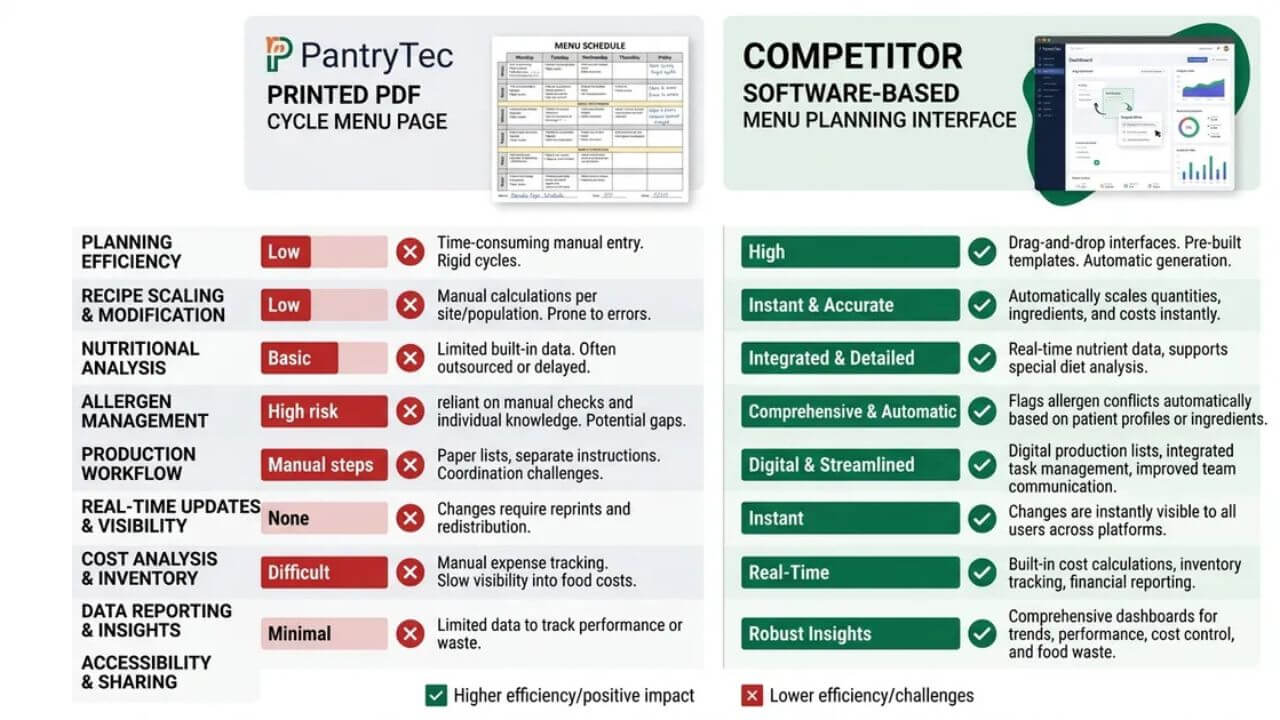
Comparison Criteria: Clinical Accuracy, Menu Variety, and Cost Efficiency
Each provider's nutrient analysis reports were cross-referenced against Dietary Reference Intakes for adults 65+. Opaque, quote-only pricing counts against a provider here because buyers cannot compare it. Only 29% of providers offer a no-commitment trial period, based on industry survey data, so trial availability factored into contract flexibility.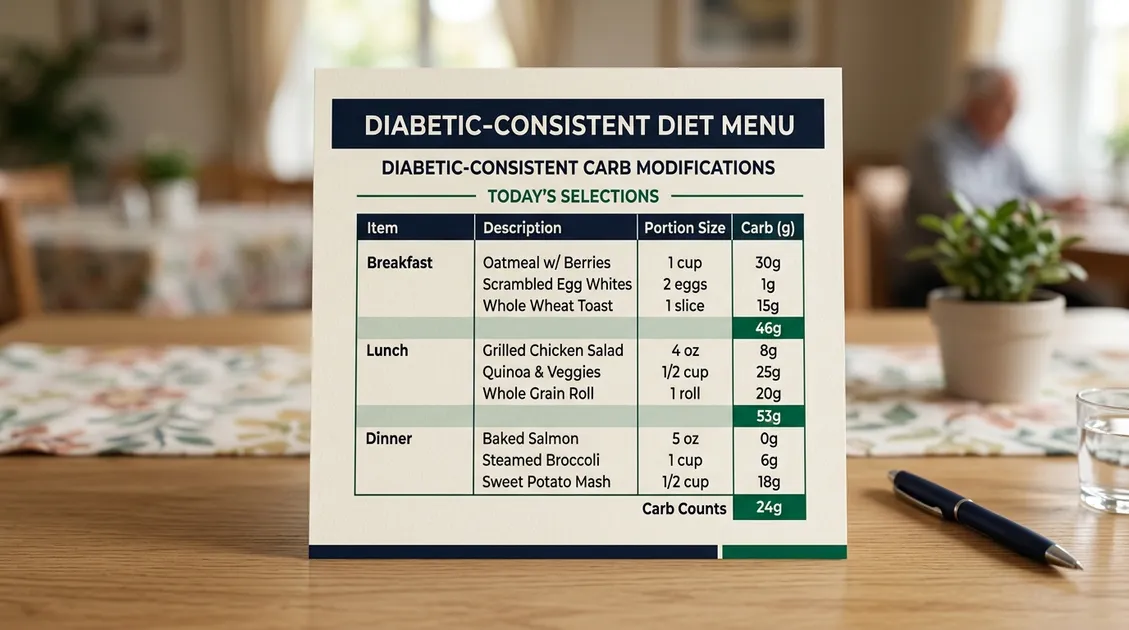
What Qualifies as a Dietitian-Approved Cycle Menu?
Dietitian-approved means a Registered Dietitian Nutritionist has reviewed the menu for nutritional adequacy, therapeutic diet compliance, and meal pattern needs before the menu enters production. A signed RD Approval Letter is the documentation proof surveyors expect to find in your compliance binder. Learn more about how cycle menu providers compare in 2026. Per-Resident Cost Savings Calculator
See how much your facility could save switching to PantryTec's flat-rate cycle menu pricing vs. typical per-resident competitor pricing.
 Your Projected Savings Breakdown
Senior-Care Cycle Menu Providers Compared
PantryTec: Dietitian-Approved Cycle Menus with Safety-Net Menu Architecture
PantryTec
Flat-Rate, RD-Approved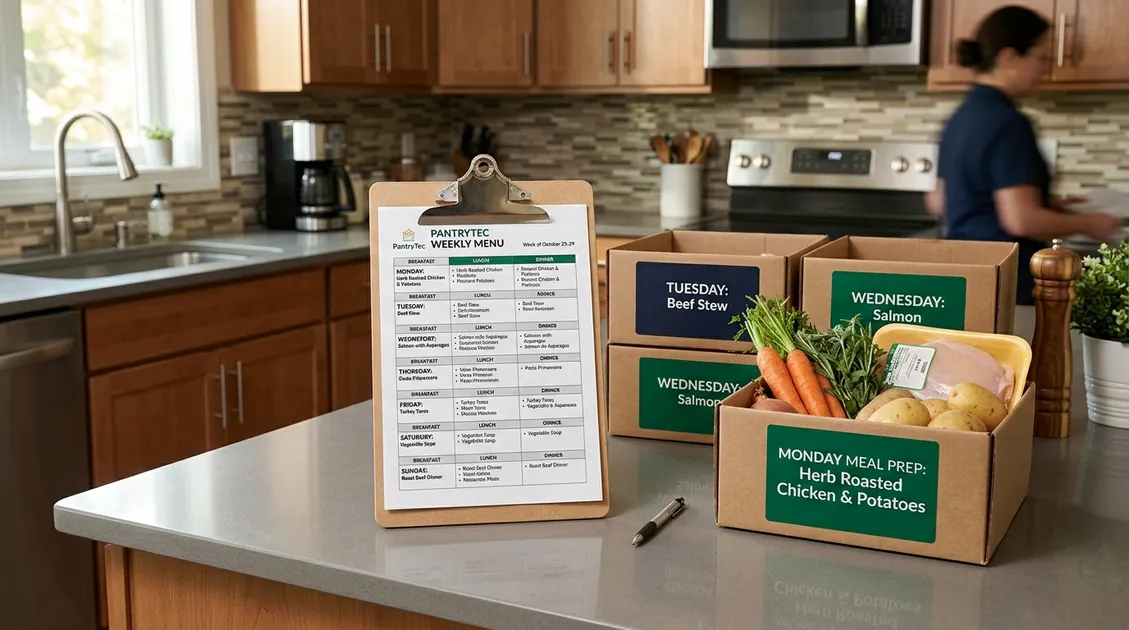
- Starting Price
- $15/mo flat rate
- Rotation Length
- 10-week (70 days)
- Therapeutic Diets
- 8+ types included
- RD Approval Letter
- Included at all tiers
- Safety-Net Menu
- Yes, every week
- Contract Required
- No; monthly or annual billing
PROS
- Flat-rate pricing regardless of census
- Safety-net alternative menu every week
- 10-week rotation prevents menu fatigue
CONS
- No integrated EHR platform (PDF-based delivery)
Full Review: Every Provider, Head to Head
Ten platforms are compared alongside PantryTec in this guide. Five are direct senior-care cycle-menu providers (Grove, MealSuite, DiningRD, BSN, Recipes & Rotations). Five are adjacent tools that facility administrators sometimes evaluate during cycle-menu research but actually solve a different problem (CaterTrax, Total Party Planner, Apicbase, Flex Catering, Caterease). One is a complementary resident-POS (eMenuCHOICE) that runs alongside a menu provider rather than replacing it. Each review below follows the same structure: quick facts, pros, cons, where they beat PantryTec, and where PantryTec wins.Grove Menus (Aline)
- Starting Price
- $3-$5/resident/mo
- Rotation
- 4-week
- Therapeutic Diets
- 4-6 types
- Delivery
- Software platform
- Contract
- Annual
- Best For
- Aline suite users
Grove Menus, acquired by Aline, offers software-based menu planning with a 4-week rotating cycle library and in-platform editing. The product is designed to sit inside Aline's broader senior-living operations suite facilities already running Aline for EHR, billing, or care planning get the tightest workflow. Standalone buyers typically find the per-resident pricing adds up quickly above 40 beds.
- Native Aline integration
- In-software menu editing
- Established brand with 10+ years in senior care
- Strong free demo & onboarding
- RD Approval Letter is an add-on
- Shorter 4-week rotation drives menu fatigue
- Per-resident pricing scales linearly
- Annual contract required
Where PantryTec wins: For any facility under ~50 beds not already on Aline, the math is lopsided. A 40-bed facility pays Grove $160/mo ($4×40) plus the RD Approval Letter add-on. PantryTec Complete is $20/mo flat (billed annually) with the letter already included and the 10-week rotation covers 70 unique daily menus versus Grove's ~280. Full head-to-head: PantryTec vs Grove Menus comparison.
MealSuite
- Starting Price
- Custom quote ($175-$600+/mo)
- Rotation
- Configurable
- Therapeutic Diets
- 12+ types
- Delivery
- Software + EHR sync
- Contract
- Annual
- Best For
- 100+ bed SNF/CCRC
MealSuite is the enterprise heavyweight: a modular software suite covering menu planning, production, resident intake management, diet order reconciliation, and tray tracking. Its PointClickCare and MatrixCare integrations let skilled-nursing facilities sync physician diet orders directly from the EHR into the kitchen - a genuinely valuable workflow at scale. The cost reflects the feature depth.
- Deepest therapeutic-diet coverage (12+)
- PointClickCare + MatrixCare sync
- Full IDDSI 3-7 texture levels
- Strong surveyor-ready reporting
- 8-16 hours of staff software training
- Custom-quote pricing is opaque
- Annual contract only
- Overkill for sub-100-bed facilities
Where PantryTec wins: For any facility under 100 beds, the cost and complexity collapse the value. A 40-bed AL paying ~$400/mo for MealSuite (plus 8-16 hrs of staff training + annual contract lock-in) gets the same F-Tag-compliant cycle menu PantryTec delivers as a weekly PDF for $20/mo flat on the Complete plan (billed annually), no software to learn, no long-term contract. Full head-to-head: PantryTec vs MealSuite comparison.
DiningRD
- Starting Price
- $200-$500/mo
- Rotation
- Flexible
- Therapeutic Diets
- Broad (PlateFul + RD consulting)
- Delivery
- Consulting + templates
- Contract
- 6-12 months
- Best For
- Needs clinical RD bundle
DiningRD is fundamentally a consulting-dietitian service that includes menu templates not a menu subscription that happens to have RD oversight. Their RDs perform clinical chart reviews, MDS assessment support, and nutrition care plan documentation alongside the menu layer. Facilities needing both clinical RD coverage and cycle menus in one vendor save coordination overhead here.
- Clinical RD + menus in one vendor
- MDS assessment support included
- Solid F-Tag documentation
- Individual resident care plans
- Redundant if you already have a clinical RD
- Higher fixed cost than menu-only alternatives
- 6-12 month contract term
- RD Approval Letter via consulting, not auto-included
Where PantryTec wins: If you already have a consulting or staff RD handling clinical reviews, DiningRD's bundle becomes double-billing. The menu-only layer at $200-$500/mo is 10-20× the cost of PantryTec's $15-$50/mo flat rate. Full head-to-head: PantryTec vs DiningRD comparison.
BSN Solutions
- Starting Price
- Custom ($250-$500/mo)
- Rotation
- 4-week
- Therapeutic Diets
- Restricted diets (no fixed count)
- Delivery
- In-person + templates
- Contract
- Annual (regional)
- Best For
- Facilities wanting hands-on consulting
BSN Solutions is a senior-care nutrition consulting firm serving nursing homes, assisted living communities, and day programs with both menu packages and consulting. Their differentiator is in-person: consultants visit your facility for surveyor-prep walkthroughs, in-kitchen observations, and staff training. Where on-site visits aren't practical, they work remotely like any national provider but lose the in-person advantage that's their core value.
- In-person surveyor prep visits
- State-specific compliance expertise
- Local regulatory relationships
- Hands-on staff training
- Restricted-diet menus are add-ons
- Opaque custom pricing
- Shorter 4-week rotation
- Annual contract
Where PantryTec wins: If you don't need hands-on surveyor prep, the in-person differentiator disappears but the pricing premium stays. For those facilities, PantryTec's $15-$50/mo flat-rate model is dramatically cheaper with a longer 10-week rotation. Full head-to-head: PantryTec vs BSN Solutions comparison.
Recipes & Rotations
- Starting Price
- $99-$199/mo
- Rotation
- 28-day
- Therapeutic Diets
- Limited (2-3)
- Delivery
- Monthly PDF
- Contract
- Monthly
- Best For
- Nursing homes, AL and CCRCs
Recipes & Rotations ("Real Food for Mom and Dad") is a chef-developed menu subscription marketed to nursing homes, assisted living, retirement communities, CCRCs, and residential care homes. The food quality and home-style recipe framing is appealing; the clinical compliance layer is the gap. There is no standalone RD Approval Letter, therapeutic diets are handled through modified diet spreadsheets rather than dedicated cycles, and no safety-net menu is included as standard.
- Appealing home-style recipe framing
- Low monthly price point
- Monthly contract (no lock-in)
- Chef-developed menus
- No RD Approval Letter
- No safety-net menu
- Very limited therapeutic diet coverage
- Short 28-day rotation drives fatigue
Where PantryTec wins: Any assisted living, memory care, or skilled nursing facility subject to CMS 42 CFR §483.60 needs the standalone RD Approval Letter and pre-built therapeutic diet menus that Recipes & Rotations doesn't provide. PantryTec Complete costs less ($20/mo billed annually vs $99+) and includes all of it. Full head-to-head: PantryTec vs Recipes & Rotations comparison.
eMenuCHOICE
Category
- Starting Price
- Custom (per seat)
- Core Function
- Resident POS / tableside ordering
- RD Approval Letter
- Not applicable
- Authors Menus?
- No (displays only)
- Best For
- Stacked with a menu provider
eMenuCHOICE is a resident-facing point-of-service tablet and server tool for senior-living dining rooms. It handles order-taking, modifier tracking, and tray routing. It is not a cycle menu provider - it displays whatever menu you load into it. Many PantryTec clients run eMenuCHOICE (or FreshMenus, ServingIntel, etc.) on top of PantryTec: PantryTec authors the dietitian-approved menu; eMenuCHOICE is the tableside delivery layer.
Catering & Restaurant Platforms Facility Administrators Sometimes Evaluate
These four platforms show up in senior-care vendor research, but none are engineered for CMS 42 CFR §483.60 compliance, F-Tag F808 therapeutic diet requirements, or RD Approval Letter documentation. Included here so you can confirm they're off-list and move on.
CaterTrax
Order-management platform used by Aramark, Sodexo, and Compass for contract foodservice. Handles catering orders and multi-unit chargeback. Not built for CMS cycle menus.
Full comparison →Total Party Planner
Tiered plans (Nibble, Feast, Delicacy) + $600-$1,000 setup fee. Strong BEOs and QuickBooks integration for event caterers. Built for weddings, not F-Tag surveys.
Full comparison →Apicbase
AI-native back-of-house for 10+ outlet restaurants, ghost kitchens, and central commissaries. From $149/mo. Excellent COGS tracking. No RD letter, no IDDSI, no CMS alignment.
Full comparison →Flex Catering
Four plan tiers (Ballroom, Pantry, Off-Premise, Enterprise) with Driver App for branded online ordering. B2B catering order-to-delivery - not resident cycle menus.
Full comparison →Caterease
Three-tier pricing (Express, Standard, Professional). 50,000+ users worldwide at resorts, convention centers, and universities. Capterra reviewers note dated UI. Not built for senior residents.
Full comparison →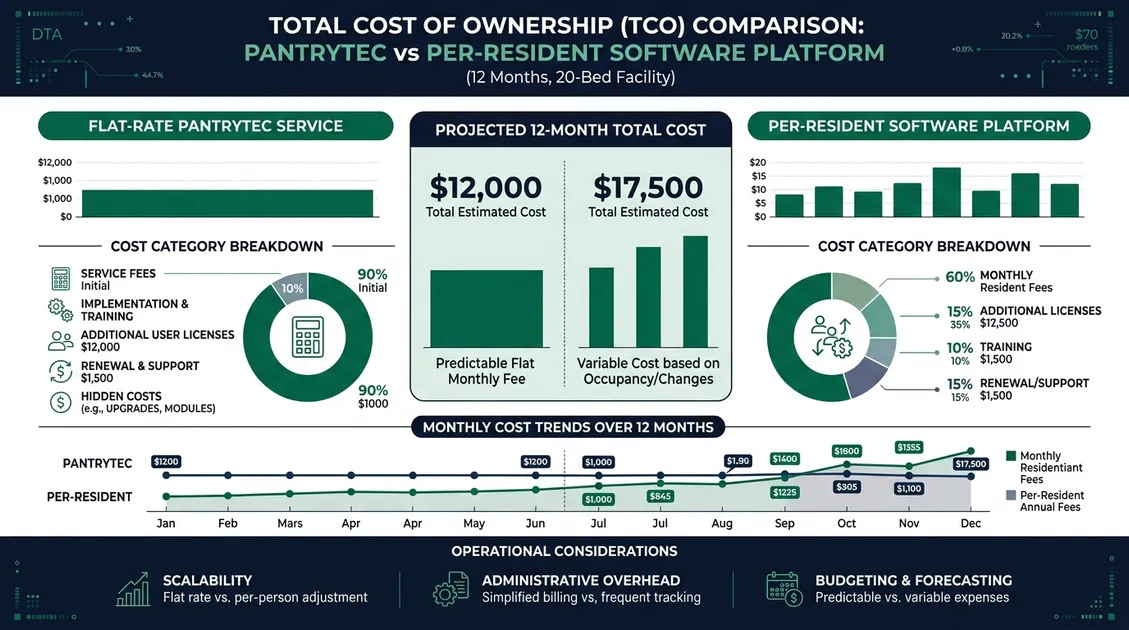
Side-by-Side Feature Comparison Table - 6 Senior-Care Providers
| Feature | PantryTec | Grove Menus (Aline) | MealSuite | DiningRD | BSN Solutions | Recipes & Rotations |
|---|---|---|---|---|---|---|
| 2026 Pricing | $15-$50/mo flat | $3-$5/resident/mo | Custom quote (est. $175-$600/mo) | $200-$500/mo | Custom quote (est. $250-$500/mo) | $99-$199/mo |
| Rotation Length | 10-week (70-day) | 4-week | Configurable (4-8 wk) | Flexible | 4-week | 28-day |
| Days Before Menu Repeats | 70 | 28 | 28-56 | Varies | 28 | 28 |
| RD Approval Letter | ✅ Included every tier | Add-on | ✅ Included | Via consulting (not auto-included) | ✅ Included (in-region) | ❌ Not included |
| Therapeutic Diets | 8+ types | 4-6 types | 12+ types | Broad (PlateFul + RD consulting) | Restricted diets (no fixed count) | Limited (2-3) |
| IDDSI Texture Coverage | Levels 4-6 | Level 5-6 | Full (3-7) | Levels 4-6 | Levels 5-6 | Not standard |
| Safety-Net Menu | ✅ Weekly, included | Not standard | Configurable | Not standard | Regional add-on | ❌ Not available |
| Delivery Method | Weekly PDF email | Software platform | Software platform + EHR | Consulting + templates | In-person + templates | Monthly PDF |
| EHR Integration | None (PDF-based) | Aline suite only | ✅ PointClickCare, MatrixCare | None | None | None |
| Contract Term | Monthly or annual | Annual | Annual | 6-12 months | Annual (regional) | Monthly |
| Staff Training Needed | 0 hours | 4-8 hours | 8-16 hours | 2-4 hours | 2-4 hours | Minimal |
| Free Trial / Sample | ✅ Free sample menu | Demo only | Demo only | Consultation call | Consultation call | 7-day refund |
Extended Comparison: 11 Cycle Menu & Foodservice Providers Reviewed
The table above covers the five most common senior-care cycle menu shortlist candidates. Many facility administrators also evaluate catering software and restaurant F&B platforms during vendor research. The extended table below covers all 11 platforms named in this guide, so you can see at a glance which tools are built for CMS-regulated senior care cycle menus, which serve a genuinely different buyer, and where each product fits. A quick orientation before reading the table: senior-care cycle menu providers (PantryTec, Grove Menus, MealSuite, DiningRD, BSN Solutions, Recipes & Rotations) solve a different problem than catering/event software (Total Party Planner, Flex Catering, Caterease, CaterTrax) or restaurant F&B platforms (Apicbase). eMenuCHOICE is a resident-facing POS complementary to, not a substitute for, a cycle menu provider.| Provider | Built For | 2026 Pricing | RD-Approved Cycle Menus | CMS F-Tag Documentation | Therapeutic Diets | Best Fit |
|---|---|---|---|---|---|---|
| PantryTec | Senior care cycle menus | $15-$50/mo flat | Yes, included | RD Approval Letter included | 8+ types | 10-200 bed AL/MC/SNF |
| Grove Menus (Aline) | Senior care menu planning | $3-$5/resident/mo | Yes, 4-week rotation | RD review add-on | 4-6 types | Facilities on Aline suite |
| MealSuite | Large SNF / CCRC foodservice | Custom quote | Yes, configurable | Yes, EHR integrated | 12+ types | 100+ bed enterprise |
| DiningRD | Clinical RD consulting + menus | $200-$500/mo | Yes, flexible rotation | Via RD consulting (not auto-included) | Broad (PlateFul + RD consulting) | Needs clinical RD bundle |
| BSN Solutions | Regional senior care consulting | Custom quote | Yes regional | Yes, in-region | Restricted diets (no fixed count) | Facilities wanting hands-on consulting |
| Recipes & Rotations | Entry-level menu templates | $99-$199/mo | Templates only | Not included | Limited | Nursing homes, AL and CCRCs |
| eMenuCHOICE | Resident POS / tableside ordering | Custom quote (per seat) | No, not a menu provider | Not its function | Tracks, not authors | Complements a menu provider |
| CaterTrax | Enterprise catering ordering | Enterprise quote | No | No | Not applicable | Contract foodservice ops |
| Total Party Planner | Event & banquet caterers | Tiered + $600-$1,000 setup | No | No | Not applicable | Event caterers, wedding venues |
| Apicbase | Multi-site restaurant F&B | From $149/mo | No | No | Allergen tracking only | 10+ outlet restaurants |
| Flex Catering | Drop-off & corporate catering | Custom quote (4 tiers) | No | No | Dietary tagging only | Corporate catering programs |
| Caterease | Legacy catering & events | Custom quote (3 tiers) | No | No | Not applicable | Resorts, convention centers |
Which Cycle Menu Provider Is Right for Your Facility?
The right provider depends on three variables: your facility's care level and licensure, your bed count, and whether you already have in-house or contracted clinical dietitian coverage. The decision framework below maps each realistic facility profile to the best-fit provider based on direct vendor evaluations with facility administrators across PantryTec's client base.By Bed Count & Operation Type
10-49 beds, single facility
Best fit: PantryTec Starter ($15/mo billed annually) or Recipes & Rotations.
At 30 beds × $4/resident/mo, per-resident software costs $120/mo before setup fees and training hours. Flat-rate pricing meaningfully outperforms at this size unless you want bundled clinical RD consulting, in which case DiningRD is reasonable.
50-99 beds, single or dual site
Best fit: PantryTec Complete ($20/mo billed annually) or Grove Menus.
This is where the flat-rate vs. per-resident math matters most. At 75 beds × $4/resident, per-resident platforms reach $300/mo before add-ons. PantryTec Complete stays at $20/mo (billed annually) regardless of census; Grove Menus makes sense if you're already standardized on the Aline operations suite.
100+ beds, multi-site or CCRC
Best fit: PantryTec Premier, MealSuite, or BSN Solutions (if in region).
At enterprise scale, EHR diet-order sync (MealSuite) or regional in-person surveyor prep (BSN) can justify the premium. Facilities that prioritize fast setup and flexible monthly or annual billing choose PantryTec Premier.
Event catering alongside senior care
Best fit: PantryTec plus Total Party Planner, Flex, or Caterease.
If you run a paid catering business in addition to resident dining for example, facility-hosted family events or corporate drop-off run an event-catering platform for the catering P&L and a dedicated cycle menu provider for the regulated resident program. They solve different problems.
Resident-facing tableside ordering
Best fit: PantryTec plus eMenuCHOICE.
These tools stack cleanly. PantryTec generates the dietitian-approved menu that servers load into eMenuCHOICE's tablet ordering system. The menu provider is the source of truth; the POS is the delivery channel in the dining room.
Multi-outlet restaurant or ghost kitchen
Best fit: Apicbase (not PantryTec).
If you operate 10+ restaurant outlets, a central commissary, or ghost kitchens, Apicbase is genuinely purpose-built for that workflow. PantryTec is not the right tool for restaurant-grade foodservice it is built specifically for CMS-regulated senior care.
Where PantryTec Fits Best
Across the realistic senior-care shortlist (PantryTec, Grove Menus, MealSuite, DiningRD, BSN Solutions, Recipes & Rotations), PantryTec differs from the rest of that shortlist in three measurable ways. First, flat-rate pricing of $15-$50/mo regardless of census means a 100-bed facility and a 15-bed facility pay the same predictable subscription per-resident platforms scale cost linearly with census. Second, the RD Approval Letter and safety-net menu are included at every tier, not add-ons, which directly addresses the documentation surveyors request under F-Tag F800-F812. Third, the 10-week (70-day) rotation covers 70 unique daily menus before repetition, meaningfully longer than the 4-6 week industry standard, which reduces menu fatigue and the resident complaints that drive meal refusal. Those are the architectural reasons. The day-to-day reason administrators cite most often in our experience: zero staff training, no long-term contracts, and PDF delivery that lands in the inbox every week without anyone logging into software. For facilities fighting dietary staff turnover, that matters more than feature counts.Ready to compare PantryTec directly against your current provider? Request a free sample menu and quote, with monthly or annual billing and no long-term contract required or call (385) 512-4731.
What Is a Safety-Net Menu and Why Is It Essential for Senior Care?
Safety-net menus are pre-approved alternative meal options provided alongside the primary cycle menu, ensuring no resident goes without a nutritionally complete meal when they decline the scheduled selection. CMS regulations at 42 CFR §483.60(d)(3) require that "suitable. Nourishing alternative meals and snacks must be provided to residents who want to eat at non-traditional times." Facilities that systematically offer safety-net options report measurable reductions in meal refusal and plate waste. Without a structured alternative, kitchen staff improvise substitutions that may not meet nutritional adequacy standards. PantryTec includes a safety-net menu with every weekly delivery at no extra cost. Think about it this way: if a resident refuses Tuesday's chicken parmesan, the safety-net menu offers a dietitian-approved soup-and-sandwich mix with matched calorie and macronutrient targets.How Safety-Net Menus Reduce Food Waste and Resident Complaints
Kitchen staff typically spend 20-30 minutes per refused meal creating ad hoc substitutions. Across a 50-bed facility with a 15% refusal rate, that adds up to 7+ labor hours per week. PantryTec's pre-planned safety-net menu reduces improvisation time to under 5 minutes per substitution, because recipes, portions, and ingredients are already documented. The facilities that consistently pass mealtime observations during CMS surveys tend to share one trait: documented processes and clear portion benchmarks rather than improvised daily decisions. That documentation gap is the problem a structured safety-net menu solves. See senior care menu compliance and regulatory standards for a deeper breakdown.Frequently Asked Questions
The questions facility administrators most often ask when shortlisting cycle menu providers, with direct answers.
How much do senior-care cycle menu providers cost in 2026?
Do I need a dietitian-approved cycle menu for CMS F-Tag compliance?
Is PantryTec cheaper than Grove Menus for a 30-bed facility?
What is a safety-net menu and which providers include one?
Can I switch cycle menu providers mid-year without a gap in service?
What's the difference between a cycle menu and a standing menu?
Does PantryTec work for skilled nursing facilities (SNFs) or only assisted living?
Which providers offer therapeutic diets for diabetic, renal, and cardiac residents?
How long is the typical cycle menu rotation - and does longer equal better?
Can I see a sample PantryTec menu before committing?
Explore Topics
13 related pages in this section
Blake Oldham - PantryTec Product Manager
Blake Oldham is Product Manager at PantryTec, owning the dietitian-approved cycle menus senior care facilities run every day. Learn about his role and expertise.
Learn More →PantryTec Reviews - Facility Administrator Feedback
Read PantryTec facility reviews from senior care administrators. Real feedback on $15/mo cycle menus, RD approval, and survey compliance.
Learn More →PantryTec vs MealSuite
Side-by-side comparison of PantryTec vs MealSuite for senior care facilities. Pricing ($15/mo vs $175/mo+), features, therapeutic diets, and compliance data.
Learn More →PantryTec vs DiningRD
Side-by-side comparison of PantryTec vs DiningRD for senior care menus.
Learn More →PantryTec vs CaterTrax
Compare PantryTec vs CaterTrax for senior care menus. Side-by-side analysis of pricing ($15/mo vs enterprise), compliance, therapeutic diets, and features.
Learn More →PantryTec vs BSN Solutions
Compare PantryTec vs BSN Solutions for senior care cycle menus. Side-by-side pricing, features, and compliance data. Get a free sample menu today.
Learn More →PantryTec vs Recipes & Rotations
Side-by-side comparison of PantryTec vs Recipes & Rotations for senior care menus.
Learn More →PantryTec vs eMenuCHOICE
PantryTec vs eMenuCHOICE comparison for senior care facilities. Side-by-side features, pricing, dietitian-approved menus, and compliance tools.
Learn More →PantryTec vs Grove Menus (Aline)
Side-by-side comparison of PantryTec vs Grove Menus (Aline) for senior care menus. Flat-rate vs per-resident pricing, 10-week vs 4-week rotation, and RD approval included.
Learn More →PantryTec vs Total Party Planner
Compare PantryTec vs Total Party Planner for senior care. Cycle menus with RD approval vs event-catering BEOs and banquet software - built for different buyers.
Learn More →PantryTec vs Apicbase
PantryTec vs Apicbase comparison. Senior-care cycle menus with CMS documentation vs multi-site restaurant F&B management. Pricing, features, and best-fit analysis.
Learn More →PantryTec vs Flex Catering
Compare PantryTec vs Flex Catering for senior care facilities. Dietitian-approved cycle menus vs drop-off and corporate catering order management.
Learn More →PantryTec vs Caterease
Side-by-side comparison of PantryTec vs Caterease. Flat-rate senior care cycle menus vs legacy catering and event management software. Features, pricing, and fit.
Learn More →Browse Related Topics
Ready to Get Started with PantryTec?
Contact PantryTec today to learn how we can help.