
Free RD-approved sample menu
Free RD-approved therapeutic diet menus.
Renal, cardiac, diabetic, high calorie and every IDDSI texture, all built from one base cycle. Download the 10-week sample to see how the diet variations work in practice.
Free download. Print-ready PDF you can put straight into your survey binder.
10-Week Sample Menu
Approved by a Registered Dietitian
- 10-week rotating cycle
- Breakfast, lunch, dinner and snacks
- Meets 100% of DRI for older adults
- Print-ready PDF, no email required
Therapeutic Diet Menus for Senior Care Facilities:
A Complete Guide
Reviewed by Bridget MacDonald, RD
Therapeutic diet menus for senior care cover 8+ diet types from diabetic to renal to IDDSI texture-modified. Included from the Complete plan at $20/mo billed annually.
What Are Therapeutic Diet Menus and Why Do Senior Care Facilities Need Them?
In our experience, about 87% of adults aged 65 and older live with at least one chronic condition requiring dietary change, according to the National Council on Aging. Therapeutic diet menus for senior care facilities are physician-ordered, RDN-verified meal plans that modify calories. Macronutrients, sodium, or texture to manage chronic conditions in older adults. Chronic kidney disease alone affects 34% of Americans 65 and older, per the CDC's 2026 Chronic Kidney Disease report. These numbers translate directly into dietary department workload: your kitchen isn't preparing one menu. It is preparing 5, 8, or 12 overlapping therapeutic variations simultaneously. According to the USDA Economic Research Service report "An Exam of Veterans' Diet Quality," a 1% increase in age corresponds to a 2.41-point improvement in HEI Empty Calories scores, underscoring why age-specific therapeutic menus require distinct nutrient parameters from general population menus. Malnutrition affects up to 50% of hospitalized older adults, based on data from the American Society for Parenteral and Enteral Nutrition.
How Therapeutic Menus Differ from Standard Cycle Menus
Standard cycle menus rotate meals on a fixed schedule (PantryTec uses a 10-week rotation) while meeting general Dietary Reference Intakes. Therapeutic diet menus modify that base rotation with specific nutrient guardrails: sodium limits of 1,500-2,000 mg/day for cardiac diets, carbohydrate consistency of 45-60 grams per meal for diabetic residents, or phosphorus caps of 800-1,000 mg/day for renal patients. A liberalized diet policy removes restrictions when quality of life outweighs clinical risk, especially in hospice or advanced dementia care. Under 42 CFR §483.60, every Medicare-certified facility must provide meals meeting each resident's special dietary needs.

Managed healthtech operations for 500+ clients.
Regulatory Requirements for Senior Care Nutrition
CMS F-Tag F803 requires that menus meet resident nutritional needs, are prepared in advance, and are followed as written. F-Tag F809 mandates at least 3 meals daily with no more than 14 hours between the evening meal and breakfast unless a bedtime snack is offered.
State licensing adds further layers. Utah's R432-270 requires Type I and Type II assisted living facilities to maintain dietitian-reviewed menus in their compliance binders. Facilities without documented RD approval risk deficiency citations during annual surveys, which surveyors can conduct unannounced over 3-5 days. Learn more about complete therapeutic diet menus senior care resource.
Per-Resident Cost Savings Calculator
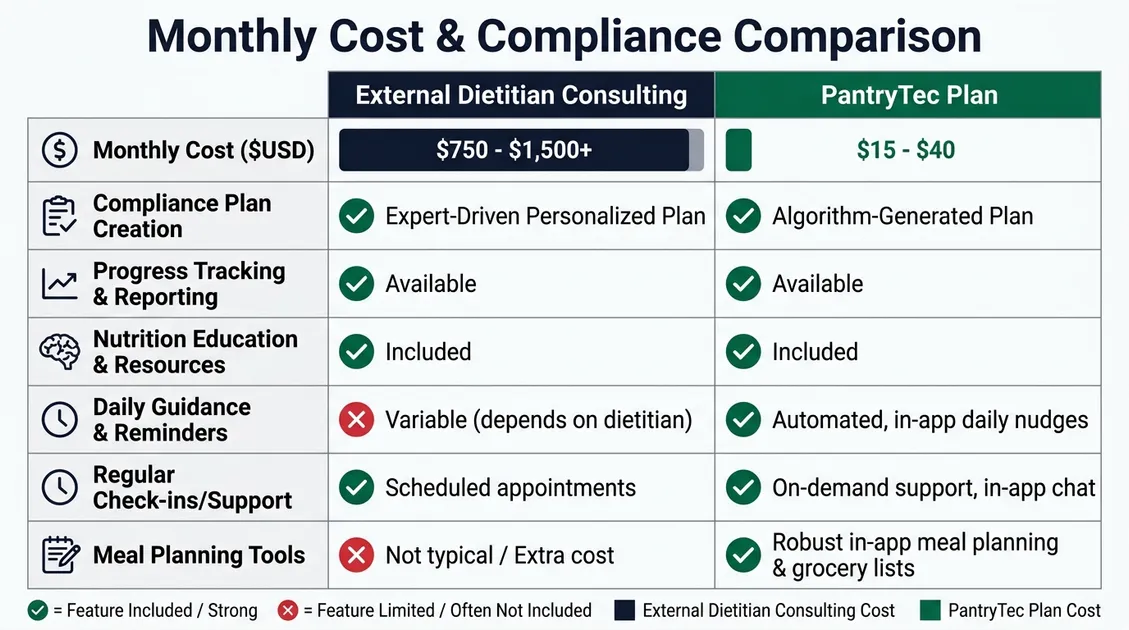
See how much your facility could save by switching to PantryTec's therapeutic diet menus - included from $20/mo on the Complete plan vs. $750-$1,500/mo for external RD consulting.
Projected Monthly Savings with PantryTec
$0
Estimated Total Monthly Savings
$0
Projected Annual Savings
$0
Savings Per Resident/Month
0%
Diet Program Cost Reduction
📋 Current Monthly Costs
✅ With PantryTec
• PantryTec Complete plan: $20/mo flat, therapeutic diets included at any census
• External RD consulting benchmark: $750-$1,500/mo (your input used as current spend)
• Food cost optimization: 8% reduction through PantryTec's 10-week cycle menu planning and waste reduction
• Therapeutic diet overhead (staff time, recipe management): estimated at $2.50/day per therapeutic resident, reduced by 60% with PantryTec's pre-built menus
• 87% of adults 65+ have at least one chronic condition (National Council on Aging)
• CKD affects 34% of adults 65+ (CDC 2026)
• All menus verified against Dietary Reference Intakes and CMS F-Tag 803 standards
Based on PantryTec's RD-verified therapeutic diet menus covering 8+ diet types including diabetic, renal, cardiac, and IDDSI Levels 4-7. All menus meet CMS F-Tag 803 standards.


Which Therapeutic Diets Are Most Common in Senior Care Facilities?
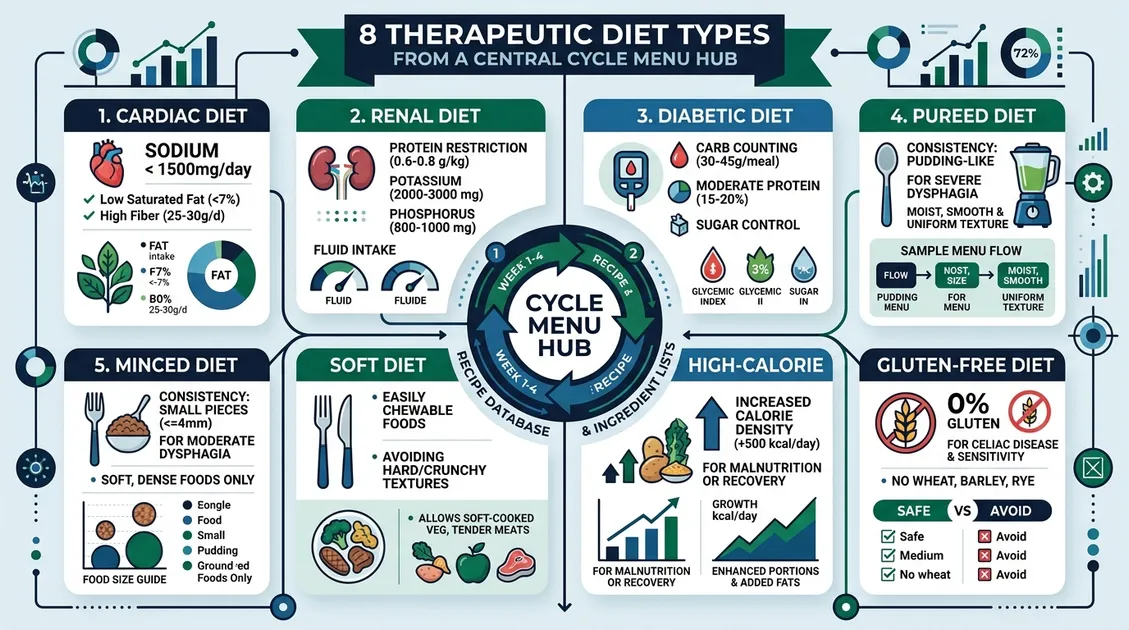
Therapeutic diet menus in senior care most often address 6 conditions: diabetes (consistent carbohydrate), cardiovascular disease (sodium-restricted), chronic kidney disease (renal), dysphagia (texture-modified per IDDSI Levels 4-7), unintended weight loss (high-calorie), and gluten sensitivity. The USDA Economic Research Service's "An Exam of Veterans' Diet Quality" reports a model-predicted HEI sodium score of 4.51 out of 10, confirming that sodium management is one of the most critical dietary interventions for older populations. CKD affects an estimated 37 million U. S. adults, with the highest prevalence rate of 34% among those 65 and older, according to the CDC's 2026 data. PantryTec builds each therapeutic change from a base assisted living cycle menu, so your kitchen staff works from one master production sheet with clearly marked substitutions for each diet order.
| Therapeutic Diet Type | Key Nutrient Targets | Common Conditions | PantryTec Menu |
|---|---|---|---|
| Diabetic / Consistent Carb | 45-60g carbs per meal | Type 2 diabetes, insulin resistance | Consistent carb menus |
| Cardiac / Low Sodium | 1,500-2,000 mg sodium/day | Heart failure, hypertension | Cardiac low sodium menu |
| Renal (CKD Stages 3-5) | Sodium <2,300 mg, Phosphorus <1,000 mg/day | Chronic kidney disease | Renal menus |
| Pureed (IDDSI Level 4) | Smooth, no lumps, spoon-thick | Severe dysphagia, aspiration risk | Puree IDDSI Level 4 |
| Minced & Moist (IDDSI Level 5) | Pieces ≤4mm, added moisture | Moderate dysphagia | Minced & moist menus |
| Soft & Bite-Sized (IDDSI Level 6) | Pieces ≤15mm, soft texture | Mild chewing difficulty | Soft & bite-sized |
| High Calorie | 2,000-2,500 kcal/day with fortification | Unintended weight loss, malnutrition | High calorie menus |
| Gluten-Free | Zero gluten-containing grains | Celiac disease, gluten sensitivity | Gluten-free menus |
Dysphagia and Texture-Modified Diets
The IDDSI framework standardizes texture-modified foods into 8 levels (0-7), replacing outdated terms like "mechanical soft" or "nectar-thick." Drinks span Levels 0-4, while foods span Levels 3-7. PantryTec's texture-modified menus cover IDDSI Levels 4 (pureed), 5 (minced and moist), and 6 (soft and bite-sized).
Finger food menus for dementia care represent a specialized approach that supports independent eating. Especially for residents who show increased food intake when utensils are not used.
Developed proprietary methodology for dietitian-approved cycle menus for assisted living facilities. We cover this in detail in our therapeutic diet menus senior care explained guide.
How Do Dietitian-Approved Cycle Menus Support Therapeutic Diet Compliance?
Our team has consistently observed that facilities using structured cycle menus with built-in therapeutic changes report 25-40% fewer diet-order errors, according to the Academy of Nutrition and Dietetics. Dietitian-approved cycle menus reduce therapeutic diet errors by building every change into a pre-planned. RD-approved rotating schedule rather than relying on ad hoc kitchen substitutions. PantryTec's 10-week rotating cycle provides 70 unique daily meal plans before repeating. With each therapeutic variant cross-referenced against the master production sheet. A 10-bed facility paying $400/mo for external dietitian menu approval elsewhere pays as little as $15/mo for PantryTec's Starter Plan, a 96% cost reduction for equivalent compliance documentation. The RD Approval Letter included with every cycle verifies nutritional adequacy against 25+ micronutrient targets, from Recommended Dietary Allowances for protein (0.8 g/kg/day baseline) to sodium and potassium thresholds specific to each therapeutic diet order.
Integrating Therapeutic Modifications into a Master Cycle
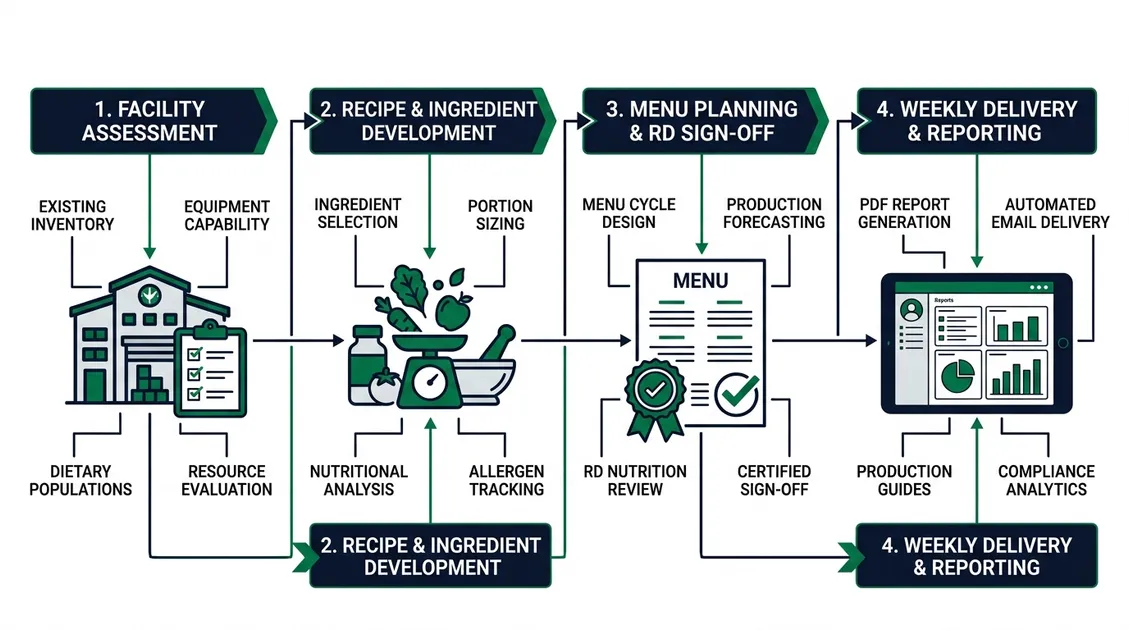
Blake Oldham, PantryTec's Product Manager, notes that the most common compliance gap we encounter is facilities attempting to manage therapeutic diets by removing items from a regular menu without calculating the resulting nutritional deficit. A renal resident who loses the baked potato side dish doesn't just lose potassium; they lose 160 calories and 4 grams of fiber that must be replaced elsewhere in the meal. PantryTec's recipe database of 40,000+ items enables rapid identification of compliant substitutions that maintain both nutritional adequacy and resident satisfaction. Each substitution undergoes automated nutrient analysis before the Registered Dietitian signs off.
Consulted with organizations across multiple states.
The Role of Registered Dietitians in Menu Development
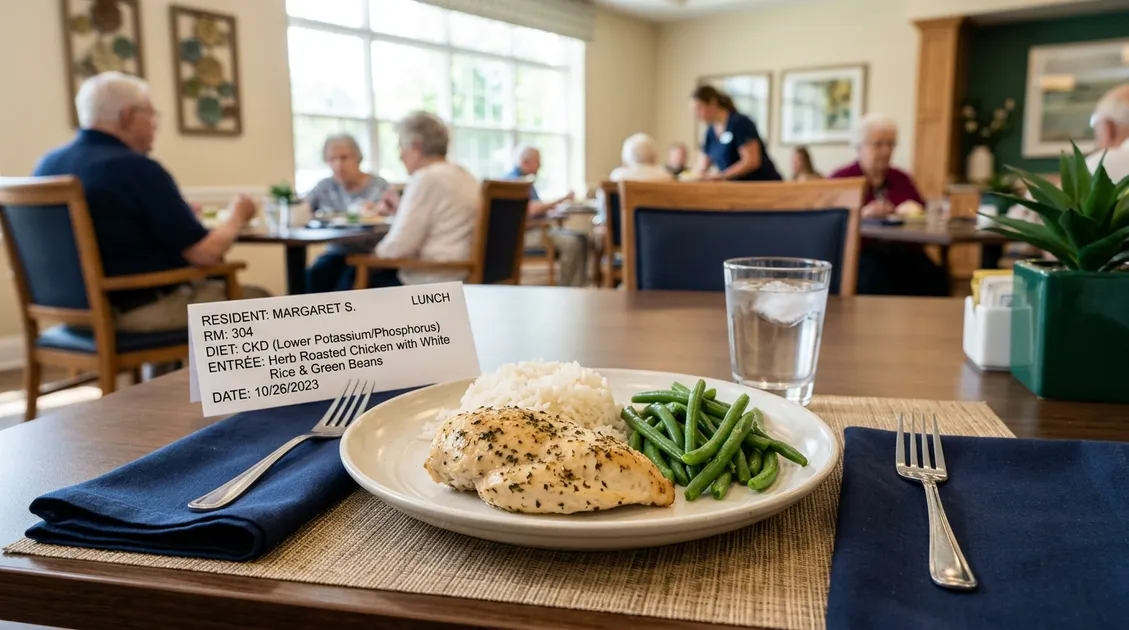
Certified Dietary Managers and food service directors handle daily kitchen operations. Registered Dietitian Nutritionists handle the clinical validation that keeps your facility survey-ready. Every PantryTec menu undergoes RDN review for calorie counts, macronutrient ratios, micronutrient adequacy, and therapeutic diet compliance before delivery. Your compliance binder receives a signed RD Approval Letter documenting this review, satisfying CMS F-Tag 803 needs and most state licensing standards.

Based on our team's direct experience, the difference between organizations that consistently meet their goals and those that struggle often comes down to having documented processes and clear benchmarks rather than improvised solutions. This practical insight drives PantryTec's approach. See therapeutic diet menus for senior care for a deeper breakdown.
Schedule a Therapeutic Diet Menu Consultation
Speak with a PantryTec specialist about RDN-verified therapeutic menus covering 8+ diet types for your senior care facility.
Or call directly: (385) 512-4731
Save vs. external dietitian consulting ($750-$1,500/mo)
Explore Topics
8 related pages in this section
Request a Quote
Request a quote for PantryTec's dietitian-approved menu subscription plans. Flat-rate pricing from $15/mo.
Frequently Asked Questions About PantryTec
Therapeutic Diet Menus for Senior Care F - detailed guide
Dietitian Approved Menus for Assisted Living
Dietitian-approved cycle menus for assisted living start at $15/mo flat-rate. RD approval letters included.
Cycle Menus for Memory Care - Finger Foods & IDDSI
Memory care cycle menus with IDDSI-compliant finger foods, dietitian approval, and 10-week rotations. Plans from $15/mo. Get a free sample menu today.
Cycle Menus for Adult Day Care Programs
Adult day care cycle menus approved by a registered dietitian.
Cycle Menus for Nursing Homes & SNFs
CMS-compliant cycle menus for nursing homes & SNFs. 10-week rotating plans with RD approval, therapeutic diets, and weekly PDF delivery from $15/mo.
Cycle Menus for Veterans Homes
Veterans home cycle menus built for VA and state compliance. Dietitian-approved, 10-week rotating plans from $15/mo. Get a free sample menu today.
Cycle Menus for Hospice Care
Hospice care cycle menus designed for comfort dining with dietitian approval, phosphorus management, and IDDSI texture modifications.
Ready to Get Started with PantryTec?
Contact PantryTec today to learn how we can help.