
Assisted living, RD approved
Assisted living menus,
approved by a Registered Dietitian.
Done-for-you 10-week cycle menus that pass state survey, covering every therapeutic diet and IDDSI texture, with a print-ready PDF and RD Approval Letter within 24 to 48 hours. Plans from $15/mo.
10-Week Sample Menu
Approved by a Registered Dietitian
Free to download, just below.
Download Free Assisted Living Menu Samples
Dietitian-approved, print-ready PDFs. Grab any single week, or the complete 10-week cycle free.
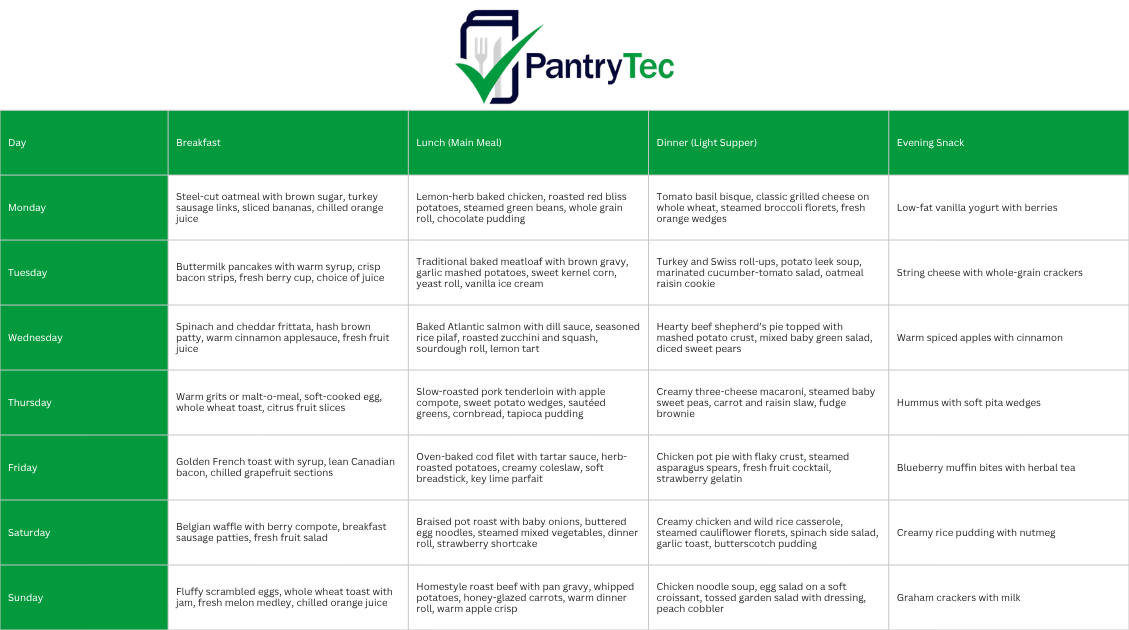
Assisted living cycle menus are pre-planned, rotating meal schedules reviewed and approved by a Registered Dietitian, giving a facility documented proof its meals meet resident nutritional needs. Most states require these menus to meet 100% of the Dietary Reference Intakes for seniors, and a signed RD Approval Letter is the first document surveyors ask to see. You can review a full week free or call PantryTec at 385-512-4731 to see a dietitian-approved cycle in action.
TL;DR: Assisted living cycle menus rotate on a 10-week schedule covering breakfast, lunch, dinner, and snacks. PantryTec plans start at $15/month flat rate, versus $750 to $1,500/month for an external dietitian. Menus meet 100% of the Dietary Reference Intakes, ship as print-ready PDFs, and include an RD Approval Letter for your survey binder. Therapeutic diets are included from the Complete plan ($20/mo billed annually).
This page is a facility-specific application of the broader planning framework in our complete dietitian approved cycle menus resource. As a senior care menu and food service compliance provider, PantryTec builds menus around state survey rules, not generic recipe lists.
Assisted living menus are dietitian-planned meal cycles that assisted living facilities serve to residents each day. A complete assisted living menu covers breakfast, lunch, dinner, and snacks, plus therapeutic diet variations. PantryTec builds these menus and keeps them survey-ready.
Assisted Living Menus at a Glance
At a glance, PantryTec assisted living menus are Registered Dietitian-approved 10-week cycle menus priced at a flat $15 per month, with therapeutic diets included from the Complete plan ($20/mo billed annually). Because every therapeutic and texture-modified version is built from the same core menu, residents on special diets eat alongside everyone else instead of receiving a separate tray, and your kitchen works from one consistent plan. Each menu arrives as a print-ready PDF with a signed RD Approval Letter, within 24 to 48 hours of your request. The calculator below compares that flat rate against a typical external dietitian fee and your staff’s planning hours, so you can see the likely monthly and annual savings for your own bed count before you ever request a free sample.
- PantryTec serves assisted living, memory care, and skilled nursing facilities.
- PantryTec builds every menu on a 10-week rotating cycle.
- PantryTec reviews every menu with a registered dietitian.
- PantryTec supports regular, mechanical soft, pureed, renal, cardiac, and diabetic diets.
- PantryTec charges a flat $15 per month, regardless of census.
- PantryTec delivers the first menu PDF within 24 to 48 hours.
- PantryTec includes a free 10-week sample menu.
- PantryTec covers breakfast, lunch, dinner, and snacks daily.
- PantryTec updates menus seasonally, with spring and fall versions.
- PantryTec keeps menus CMS survey-ready and state-licensing compliant.
Why Do Assisted Living Facilities Need Dietitian-Approved Menus?
Assisted living facilities need dietitian-approved menus because state licensing surveyors require documented proof that resident meals are nutritionally adequate, therapeutically appropriate, and reviewed by a qualified professional. In skilled nursing settings the same expectation is codified in CMS F-Tag F803, which requires menus to be prepared in advance, followed as written, and to account for residents’ allergies, preferences, and prescribed therapeutic diets. A Registered Dietitian’s review is the evidence that satisfies those standards: it confirms each cycle meets 100% of the Dietary Reference Intakes for older adults, offers appropriate portions and textures, and provides safe substitutions. Without it, facilities risk survey deficiencies, resident weight loss and malnutrition, and the expense of a rushed dietitian consult. Dietitian-approved cycle menus also save staff time, because the planning, nutrient analysis, and documentation are already done before the menu ever reaches the kitchen.
Assisted living facilities need dietitian-approved menus to prove compliance at state survey. Every meal must meet residents’ nutritional needs on paper. PantryTec menus are approved by a Registered Dietitian. That gives operators documented evidence, protects the license, and saves staff from building menus alone.
Dietitian-approved menus give assisted living facilities documented proof that meals meet resident nutritional needs, which most state licensing agencies verify at survey. Assisted living is regulated at the state level, not by the federal CMS §483.60 rule that binds skilled nursing facilities, though many states model their dietary standards on it. In Utah, R432-270-22 requires a certified dietitian to approve and sign assisted living menus. California's Title 22 §87555 requires diets that meet the Recommended Dietary Allowances, with regular consultation from a qualified nutrition professional when the food service lead is not one. The RD Approval Letter is the deliverable surveyors request first. Without it, a facility risks a citation for failure to meet residents' nutritional needs. According to the Academy of Nutrition and Dietetics, older adults face elevated malnutrition risk, so documented oversight protects both residents and the license. That single signed letter satisfies the documentation intent behind CMS F-Tag F803, which many state surveyors reference directly when auditing dining programs.
Assisted living surveyors verify three things fast during an unannounced visit:

- A current RD Approval Letter signed within the review period, kept in the compliance binder.
- Nutrient analysis showing menus meet 100% of RDA and DRI targets for seniors.
- Posted weekly menus that match what the kitchen actually serves that day.
Assisted living residents skew older, and diet quality data shows why oversight matters. According to An Examination of Veterans' Diet Quality, veterans scored an average total HEI-2010 of 48.2 in 2003-04, 50.8 in 2009-10, and 49.4 in 2015-16, all far below the 100-point mark. Veterans, who make up 7 to 8 percent of U.S. adults, scored lower than nonveterans even after controlling for demographics, 45.6 versus 49.3. Added sugars and solid fats drove those gaps, not alcohol. Since many assisted living residents are veterans, dietitian-reviewed menus target these documented shortfalls directly.
Per-resident savings calculator
Compare a PantryTec plan (Starter at $15/mo flat, or Complete at $20/mo with therapeutic diets) against an external dietitian at $750 to $1,500/mo plus staff planning time.
Estimate only. Current cost combines any external dietitian fee plus your staff planning time. Plans start at $15/mo flat; therapeutic diets are included from Complete at $20/mo. Actual pricing and results vary by facility.
What Does a Cycle Menu Look Like for Assisted Living?
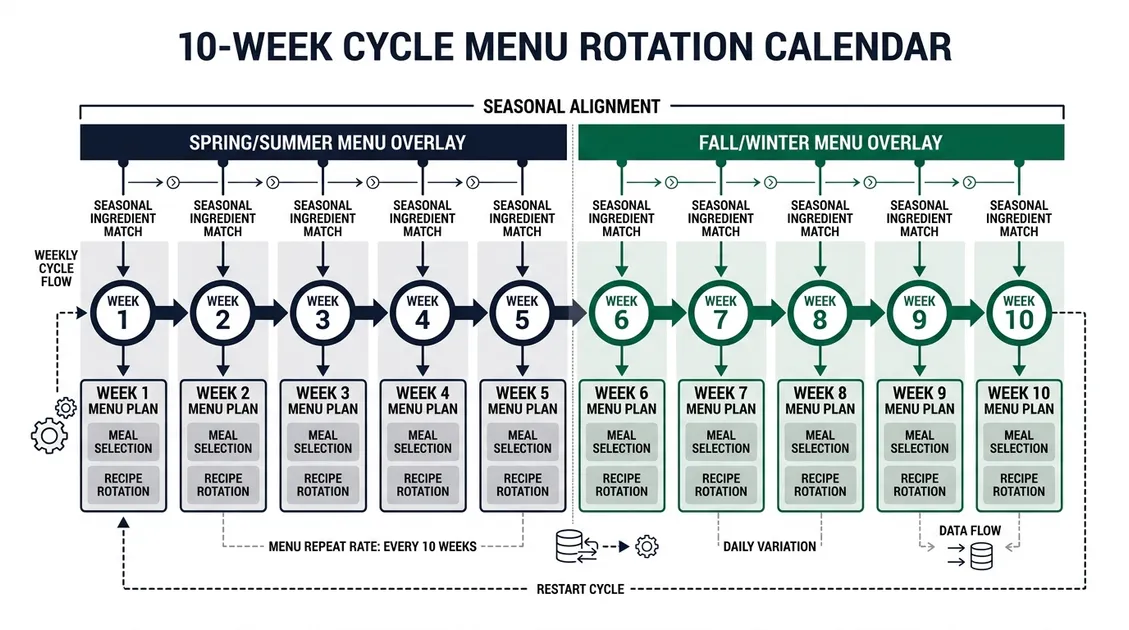
A cycle menu for assisted living is a set of daily menus that repeats on a fixed rotation, so residents enjoy variety without the kitchen planning every meal from scratch. A PantryTec assisted living cycle runs 10 weeks and covers breakfast, lunch, dinner, and snacks for every day, which means residents see roughly 70 different days of meals before anything repeats. Menus also rotate by season, so the spring cycle differs from the fall cycle and ingredients stay fresh and familiar. Each day is portioned and balanced to meet the Dietary Reference Intakes for older adults, with built-in options for texture-modified and therapeutic diets so every resident eats from the same core menu. The result is a predictable, survey-ready dining program that is easy for staff to follow and something residents can look forward to.
An assisted living cycle menu is a plan that rotates on a fixed schedule. PantryTec menus run on a 10-week cycle. They cover breakfast, lunch, dinner, and snacks. Residents see 70 unique daily menus before any repeat. Menus also rotate seasonally, with spring and fall versions.
Assisted living cycle menus follow a 10-week rotating cycle menu covering breakfast, lunch, dinner, and snacks, so residents see 70 unique daily menus before anything repeats. PantryTec builds each cycle from a recipe database of more than 40,000 standardized recipes, scaled to portion size for consistency. Menus rotate seasonally, with Spring/Summer and Fall/Winter versions, plus holiday menus for Thanksgiving, Christmas, Easter, and July 4th. An always-available menu gives active seniors restaurant-style choices at any meal, and a weekly safety-net alternative covers residents who dislike the day's entree. According to the Association of Nutrition & Foodservice Professionals, menu variety supports intake and lowers plate waste in senior dining. Facilities receive each week's menu as a print-ready PDF, so staff print and post with zero software training. That print-and-post workflow is the core of the PantryTec menu subscription, and you can see the steps in our 3-step onboarding process.
Residents cycle through weeks of varied meals before anything repeats, and complaint calls drop noticeably within the first two months. Seasonal produce keeps costs down while holiday and themed meals give families something to see when they tour.
Assisted living operators use dining as an admissions tool that competitors overlook. When a family tours, the menu often decides the sale, so a professional cycle menu doubles as marketing.
How Are Therapeutic Diets Handled in Assisted Living Menus?
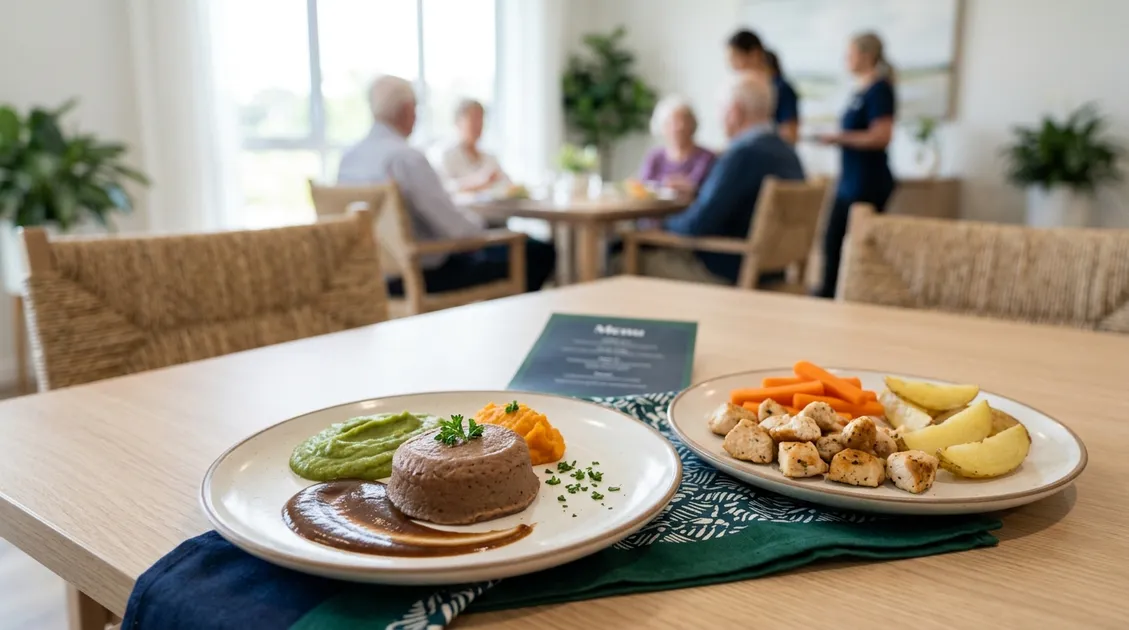
Therapeutic diets in assisted living menus are handled by modifying the standard cycle menu to meet a resident’s medical needs while keeping meals appetizing and consistent with the rest of the dining room. PantryTec builds each therapeutic version from the same RD-approved base menu, so a renal, diabetic (consistent-carbohydrate), cardiac, low-sodium, or high-calorie plan mirrors the daily menu with compliant swaps rather than a separate, isolating tray. Texture-modified diets follow the International Dysphagia Diet Standardisation Initiative (IDDSI) framework, covering pureed (Level 4), minced and moist (Level 5), and soft and bite-sized (Level 6) options for residents with dysphagia. Every therapeutic menu is reviewed by a Registered Dietitian, meets the Dietary Reference Intakes for older adults, and ships with the same print-ready PDF and approval letter. Therapeutic diets are included from the Complete plan ($20/mo billed annually), built on the same base menu.
Assisted living menus handle therapeutic diets by adapting one base cycle. PantryTec menus support regular, mechanical soft, pureed, renal, cardiac, and diabetic diets. Every variation comes from the same recipes. Most facilities favor the liberalized diet. It improves intake and keeps documentation survey-ready.
Assisted living favors the liberalized diet, which the Academy of Nutrition and Dietetics endorses for older adults to cut malnutrition risk and lift intake. PantryTec includes therapeutic diets from the Complete plan ($20/mo billed annually), built on the same base menu. A diabetic diet uses a steady-carb, bigger-midday-meal strategy to prevent accidental carb loading. Renal diet menus limit potassium and phosphorus, while cardiac diet menus cap sodium for heart-healthy service. Dysphagia-safe menus follow the IDDSI framework, covering pureed Level 4, minced and moist Level 5, and soft and bite-sized Level 6. Each therapeutic version stays dietitian-reviewed, so nutritional adequacy holds even when texture or nutrients change. That automation lets a small home manage complex residents without an in-house RD on payroll. Therapeutic diet menus are included from the Complete plan ($20/mo billed annually).
Assisted living kitchens also manage food allergies through tray cards that flag the top-9 allergens per resident profile and specify each diet order. A mechanical soft diet serves fork-mashable foods for residents with chewing difficulty, which is distinct from IDDSI minced textures. For renal, cardiac, and diabetic extensions, explore our therapeutic and liberalized diet menus for senior residents or the specific low-sodium cardiac menu guide.
How Much Do Assisted Living Cycle Menu Plans Cost?
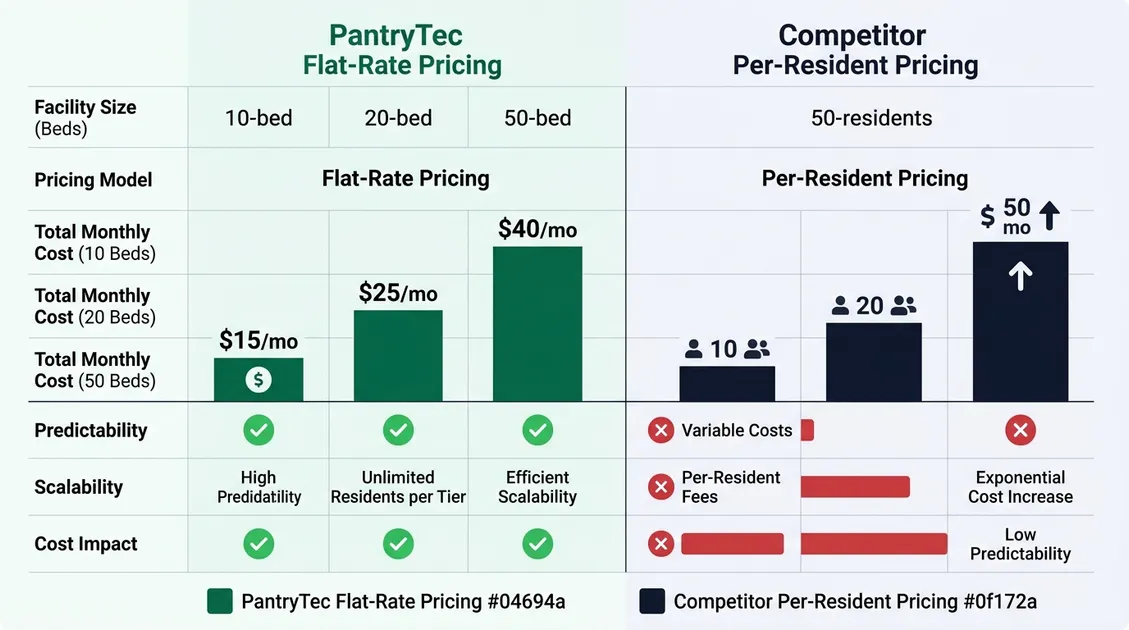
Assisted living cycle menu plans from PantryTec start at a flat $15 per month, with therapeutic diets included from the Complete plan ($20/mo billed annually). That flat rate covers the full 10-week rotating cycle from breakfast through snacks, a nutrient analysis meeting 100% of the Dietary Reference Intakes, a signed RD Approval Letter, and a print-ready PDF sized for posting and kitchen use. Compared with the common alternatives, the savings are substantial: an external consulting dietitian typically bills $750 to $1,500 per month, and staff-built menus consume roughly 12 hours of planning time each month before any professional review. For a 40-bed community paying a mid-range dietitian, that difference works out to about $1,410 per month, or $16,920 per year. Use the savings calculator above to estimate the number for your own bed count and current spend.
Assisted living cycle menu plans from PantryTec start at $15 per month. That is a flat rate, no matter your census. The Complete plan is $20 per month billed annually ($25 billed monthly). A free 10-week sample menu is available too. Flat pricing replaces per-resident dietitian bills that often cost far more.
Assisted living cycle menu plans from PantryTec start at $15 per month flat rate, regardless of census, with a Complete plan at $20 and a customizable Premier plan at $40 (billed annually; $20, $25 and $50 billed monthly). That flat fee replaces the $750 to $1,500 per month many facilities pay an external dietitian just for signatures and quarterly reviews. Against a $750 a month dietitian, a PantryTec plan at $15 to $40 a month is a 95% to 98% cut for the same legal compliance. Therapeutic diets are included from the Complete plan ($20/mo billed annually). Raw food cost lands around $6 to $10 per resident day, shown on every sample menu. According to the Washington State Senior Nutrition Program Standards, the per-meal cost for Medicaid-funded meals must not exceed the cost charged to other fund sources, so transparent per-resident pricing matters for reimbursed facilities. PantryTec charges no long-term contracts and no setup fees.
| Plan | Price | Best For | Key Inclusions |
|---|---|---|---|
| Starter | $15/mo billed annually ($20 monthly) | Small assisted living homes, group homes, adult day care | RD-approved, state-compliant menus, weekly delivery, 10-week cycle |
| Complete | $20/mo billed annually ($25 monthly) | Mid-sized ALF, memory care | Common therapeutic diets, portion and texture guide, compliance documents, recipes |
| Premier | $40/mo billed annually ($50 monthly) | Diverse or medically complex residents | Menus customized to resident specifics, RD re-verification, priority adjustments |
| External RD | $750-$1,500/mo | Traditional consulting | Signatures and quarterly reviews only |
Replacing that with a PantryTec plan at $180 to $480 a year saves roughly $8,500 to $17,800 a year.
Compare full plans on our flat-rate menu pricing page, review broader operations in the complete dietary management ALF guide resource, or request a custom menu quote for your facility.
Key Takeaways
- Assisted living cycle menus must meet 100% of the Dietary Reference Intakes and carry a signed RD Approval Letter, per state licensing rules like Utah R432-270.
- A 10-week rotating cycle gives residents 70 unique daily menus before repeat, built from PantryTec's 40,000-recipe database.
- PantryTec plans run $15 to $50/month flat, replacing $750 to $1,500/month external dietitian fees, a 93% to 99% reduction.
- Therapeutic diets (diabetic, renal, cardiac, IDDSI texture-modified) extend from one base menu and are included from the Complete plan ($20/mo), no software required.
- USDA diet-quality data shows older adults average HEI scores near 45 to 50 of 100, so dietitian oversight directly addresses documented gaps.
What Are Common Questions About Assisted Living Cycle Menus?
These are the questions assisted living operators ask most about menus. Each answer reflects how PantryTec builds, reviews, and delivers assisted living menus. Use them to compare PantryTec against building menus in-house or hiring an outside dietitian. Every plan includes dietitian-signed documentation for survey.
Assisted living operators most often ask whether cycle menus pass state surveys and how diets get customized. Dietitian-approved menus meet 100% of the Dietary Reference Intakes and include an RD Approval Letter for the compliance binder, which satisfies the documentation intent behind CMS F-Tag F803 and F-Tag F804. PantryTec delivers the first menu PDF within 24 to 48 hours of sign-up. Nutrient analysis verifies calories plus 28 or more micronutrients, including potassium, phosphorus, and iron, against RDA targets before a Registered Dietitian Nutritionist signs. Menus arrive in your inbox every week, and facilities can move between plans month to month with no long-term contract. Survey readiness stays covered in our menu compliance and RD approval for survey readiness guide.
How do assisted living facilities plan menus?
Assisted living facilities plan menus using a rotating cycle, usually 5 to 10 weeks, built by a dietary manager or a service like PantryTec. The menu covers breakfast, lunch, dinner, and snacks, then a Registered Dietitian reviews it against DRI targets and signs off before it enters production.
What is a cycle menu in senior living?
A cycle menu is a set of meals that repeats on a fixed interval, commonly 10 weeks in senior living. The rotation delivers 70 unique daily menus before repeating, cuts dietary manager workload, and controls food cost while keeping variety high.
Do assisted living menus need to be approved by a dietitian?
It depends on the state. Utah requires a certified dietitian to approve and sign assisted living menus (R432-270-22), while California requires menus that meet the Recommended Dietary Allowances, with consultation from a qualified nutrition professional when the food service lead is not one. A signed RD Approval Letter in the compliance binder documents that review, and surveyors often ask for it first.
How much does a dietitian cost for assisted living?
A consultant dietitian costs $750 to $1,500 per month for menu signatures and quarterly reviews, or $75 to $150 per hour. PantryTec's RD-approved cycle menus start at $15 per month flat, replacing most of that expense while including the same approval documentation.
What are the dietary requirements for assisted living facilities?
Assisted living dietary needs are set by each state and generally mandate menus meeting 100% of the Dietary Reference Intakes, three meals daily plus snacks, a maximum 14-hour gap between the evening meal and breakfast, and documented therapeutic diet accommodations. Where the state requires it, a Registered Dietitian verifies nutritional adequacy.
Build your free sample menu
Set your preferences, then request a dietitian-approved weekly cycle menu (print-ready PDF) with an RD Approval Letter within 24 to 48 hours.
- Full 10-week rotating cycle: breakfast, lunch, dinner, snacks
- Nutrient analysis meeting 100% of DRIs for seniors
- A signed RD Approval Letter for your survey binder
- Print-ready PDF sized for posting and kitchen use
Prefer to talk? Call PantryTec at 385-512-4731.
Menus built for your facility and your residents’ diets
Assisted living menus are Registered Dietitian-designed cycle menus that rotate on a fixed schedule, so residents receive varied, nutritionally complete meals every day. At PantryTec, every plan is built on the same RD-approved 10-week system, then tuned to your care level and your residents’ therapeutic needs. A memory care community, a skilled nursing facility, and an independent living residence each get menus matched to their acuity, texture requirements, and licensing framework, while sharing one survey-ready foundation. Each menu covers breakfast, lunch, dinner, and snacks, meets 100% of the Dietary Reference Intakes for older adults, and ships as a print-ready PDF with a signed RD Approval Letter for your survey binder. Whether you run a 12-bed group home or a multi-level CCRC, the menus below are organized by facility type and by therapeutic diet so you can find the exact fit for your residents.