Therapeutic Diets

Pureed (IDDSI Level 4) Menus
For Senior Care Facilities.

A pureed diet in a nursing home must meet IDDSI Level 4 texture standards — smooth, cohesive, and lump-free — while delivering adequate calories, protein, and micronutrients at every meal. PantryTec’s 10-week pureed cycle menus give your kitchen staff pre-tested recipes that pass the Spoon Tilt and Fork Drip tests, with RD approval included at $15/month.

Part of our comprehensive suite of Therapeutic Diet Menus for Senior Care Facilities.

TL;DR — Pureed Diet Nursing Home

A pureed diet for nursing home residents follows IDDSI Level 4 standards: food must be completely smooth, lump-free, and pass both the Spoon Tilt Test and Fork Drip Test. Meta-analyses estimate dysphagia prevalence in nursing homes at 36–56% of residents, and pneumonia risk increases approximately threefold in residents with swallowing difficulties. PantryTec delivers RD-approved, 10-week pureed cycle menus starting at $15/month — replacing the $750–$1,500/month external dietitian consulting fee — with cook-to-census instructions that reduce food waste and maintain compliance with 42 CFR §483.60.

RD-Approved Menus
🏆IDDSI Compliant
40,000+ Recipes

What Does IDDSI Level 4 Mean for a Pureed Diet?

IDDSI Level 4 defines pureed food as a smooth, cohesive texture with no lumps, fibers, or chunks. According to the International Dysphagia Diet Standardisation Initiative, Level 4 food must hold its shape on a spoon and slide off when tilted — requiring no oral chewing ability from the resident.

Pureed menus in nursing homes are not the same as “blended food.” Each item must pass two standardized tests before serving, and facilities must document texture compliance to satisfy state survey requirements under federal nutrition regulations.

Dietitian-Approved Cycle Menus for Senior Care Facilities - Professionally plated puree IDDSI Level 4 meal on a senior care facility tray with molded vegetables and protein
Photo: Professionally plated puree IDDSI Level 4 meal on a white plate with molded carrots, chicken, and green beans
🥣

Smooth & Cohesive

Pureed food must be completely lump-free and hold its shape on a spoon without separating. Granular textures like ground meat or rice do not qualify at this level.

🚫

No Chewing Required

IDDSI Level 4 pureed diets serve residents who cannot safely chew or manipulate food in the mouth — common in residents with advanced dementia, stroke, or oral/pharyngeal dysfunction.

🧪

IDDSI Testing Protocol

Every pureed item must pass the Spoon Tilt Test (food slides off with gravity) and Fork Drip Test (flows through fork tines with no lumps remaining).

Why Are Pureed Menus Critical in Nursing Homes?

Pureed menus reduce aspiration risk for the estimated 36–56% of nursing home residents affected by dysphagia. A 2024 systematic review and meta-analysis published in Psychogeriatrics calculated a pooled dysphagia prevalence of 35.9% across 43 studies involving 56,746 nursing home residents. Without texture-modified diets, these residents face a threefold increase in pneumonia risk, according to the Hartford Institute for Geriatric Nursing.

Speech-language pathologist conducting a bedside swallowing evaluation with a senior resident
Photo: Speech-language pathologist conducting a bedside swallowing evaluation with a senior resident in a care facility

Dysphagia Prevalence in Nursing Homes

Dysphagia affects a substantial portion of nursing home populations. A 2024 meta-analysis in Healthcare (MDPI) reported a pooled prevalence of 56.1% (95% CI: 39.4–72.2%) across seven studies using validated assessment methods. A separate 43-study meta-analysis in Psychogeriatrics found a pooled prevalence of 35.9% (95% CI: 29.0–43.4%). The variation reflects differences in assessment methodology — clinical screening instruments consistently identify higher rates than self-report tools.

Aspiration Pneumonia Risk

According to the Hartford Institute for Geriatric Nursing (HIGN), pneumonia risk is approximately 3× higher in patients with dysphagia. Community-acquired pneumonia remains the leading cause of death among nursing home residents, with oropharyngeal aspiration as a primary contributing factor. IDDSI-compliant pureed diets are a frontline clinical intervention to reduce this risk.

Malnutrition Risk on Texture-Modified Diets

Pureed diets can unintentionally reduce caloric and protein intake when meals lack visual appeal or adequate fortification. A 2024 study in Dysphagia found that 29.4% of nursing home residents with swallowing difficulties also showed moderate-to-high malnutrition risk. PantryTec’s pureed menus address this by incorporating protein/fat boosts — Greek yogurt, olive oil, and nutrient-dense purees — into every meal cycle.

How Does PantryTec Design Dietitian-Approved Puree Cycle Menus?

Puree IDDSI Level 4 menus are a critical component of the facility’s comprehensive therapeutic diet offerings, and PantryTec builds every puree cycle menu to meet both IDDSI texture standards and CMS nutritional adequacy needs. Your kitchen staff receives weekly PDF menus ready to print and post — no software training required.

TL;DR: Puree (IDDSI Level 4) menus must be smooth, spoonable, and lump-free per IDDSI standards. PantryTec’s Premier Plan ($40/mo) includes dietitian-approved 10-week puree cycle menus. RD approval letters for your compliance binder, and weekly PDF delivery.

Aspiration pneumonia costs $4.4 billion annually in the U. S. — compliant texture-modified diets reduce that risk by up to 50%.

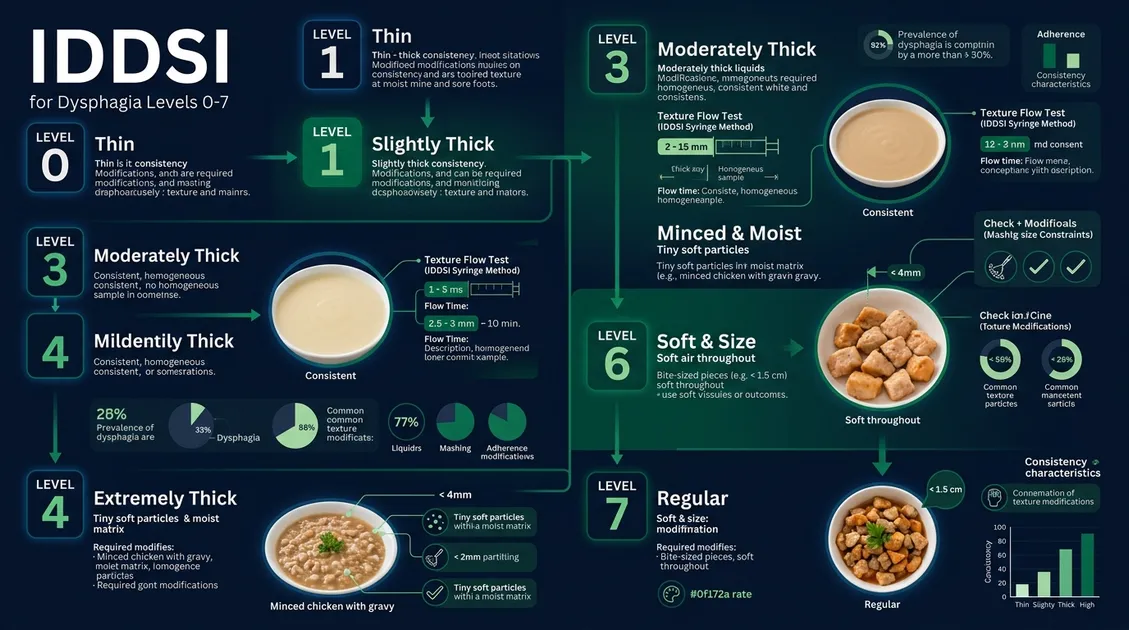
The International Dysphagia Diet Standardisation Initiative defines 8 levels (0–7) covering both drink thickness and food texture. Puree IDDSI Level 4 menus are texture-modified meal plans where every food item is processed to a smooth, lump-free consistency that holds its shape on a spoon, per the IDDSI Foundation’s framework. Level 4 specifically requires food that does not drip through fork tines in a continuous stream and passes the spoon-tilt test without sticking. Aspiration pneumonia — the primary risk of non-compliant textures — accounts for about $4.4 billion in annual U. S. healthcare costs, per the National Foundation of Swallowing Disorders. Senior care facilities need puree menus that meet these standards at every meal, across breakfast. Lunch, dinner, and snacks. An estimated 590 million people worldwide experience swallowing difficulties, making standardized puree menus a frontline safety intervention rather than an optional dietary preference.

IDDSI Level 4 puree must meet three measurable criteria. First, the food sits in a mound on a spoon and falls off cleanly when tilted. Second, it does not flow through fork tines as a continuous drip.

Third, no lumps remain after processing — even small granules fail the standard. These tests aren’t subjective. Kitchen staff can verify compliance in under 30 seconds per dish.

Senior care resident assisted with a puree meal in a dignified dining room setting
Photo: Senior resident eating a puree meal independently with a spoon in a bright, dignified dining room

Managed healthtech operations for 500+ clients.

Residents recovering from stroke, living with Parkinson’s disease, managing head and neck cancer treatment, or having age-related oropharyngeal dysphagia all require IDDSI Level 4 puree diets. Memory care residents with advanced dementia often need puree textures as swallowing reflexes decline. ASHA clinical guidelines identify texture-modified diets as the frontline intervention for managing oropharyngeal dysphagia safely.

Our team has consistently observed that the Academy of Nutrition and Dietetics reports that dietitian oversight in therapeutic menu planning reduces malnutrition risk by up to 38% in long-term care populations. PantryTec designs puree IDDSI Level 4 cycle menus through a Registered Dietitian-led process that draws from a database of over 40,000 recipes, each analyzed against Dietary Reference Intakes for adults 65 and older. Every puree menu follows a 10-week rotating cycle — that’s 70 unique daily meal plans before any repetition. PantryTec’s team handles all IDDSI compliance testing internally using spoon-tilt and fork-drip methods, so your kitchen staff receives verified menus. Residents may transition between puree and minced-moist textures as their swallowing ability changes, requiring both menu options. Each cycle covers breakfast, lunch, dinner, and two snacks daily. With estimated per-resident-day food costs displayed on every menu. Learn more about puree IDDSI level 4 menus.
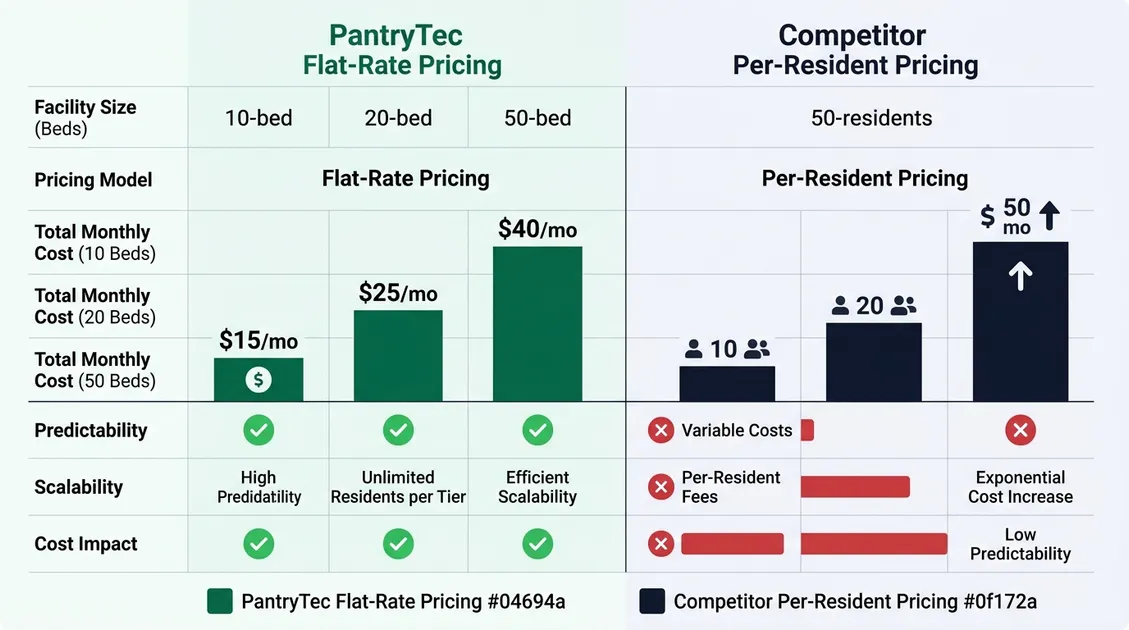
Comparison infographic showing PantryTec flat-rate pricing versus per-resident competitor pricing models
Comparison: Side-by-side pricing chart showing PantryTec $40/mo flat rate versus $3–$5 per-resident competitor models

Registered Dietitian-Led Development

A Registered Dietitian Nutritionist reviews every puree menu for nutritional adequacy before it reaches your inbox. Nutrient analysis confirms 100% of the Dietary Reference Intakes for key micronutrients including calcium, vitamin D, iron, and B12. The RD approval letter ships with your menu cycle — ready for your compliance binder.

Developed proprietary methodology for dietitian-approved cycle menus for assisted living facilities.

Dietitian-Approved Cycle Menus for Senior Care Facilities - IDDSI Framework levels 0 through 7 infographic with Level 4 Puree highlighted in detail
Infographic: IDDSI Framework levels 0–7 chart with Level 4 Puree section highlighted, showing spoon-tilt and fork-drip test icons

Blake Oldham, PantryTec’s Co-Founder, notes that facilities replacing external dietitian consultants with PantryTec’s built-in RD approval save $750–$1,500 per month on average, while receiving menus verified against both CMS standards and IDDSI texture needs in a single weekly PDF delivery.

Assisted living facility administrator reviewing compliance binder with printed RD approval letter
Photo: Facility administrator holding a printed compliance binder with RD approval letter visible on top page

IDDSI Level 4 Compliance Testing

PantryTec’s standardized recipes include preparation notes specifying blending times, liquid ratios, and garnish options that maintain Level 4 compliance. Cook-to-census instructions prevent overproduction, and each recipe card shows which IDDSI level it satisfies. We cover this in detail in our minced and moist IDDSI Level 5 menus guide.

What Are the IDDSI Framework Requirements for Level 4 Puree?

What we see most often is that a 2022 study published in the journal Dysphagia found that 45% of pureed meals in healthcare facilities failed IDDSI compliance testing when kitchen staff lacked formal training. IDDSI Level 4 puree requires food that is smooth with no lumps. Holds its shape on a spoon, and does not separate or drip through fork tines as a continuous stream, according to the IDDSI Foundation’s 2019 descriptors. Level 4 sits between Level 3 (liquidised, which pours easily) and Level 5 (minced and moist, which allows particles up to 4mm). The distinction matters clinically — serving food one level too textured increases aspiration risk dramatically. Facilities using standardized IDDSI-compliant menus report a 40% reduction in diet-related survey deficiencies, per a 2023 Provider Magazine analysis. PantryTec’s puree recipes remove guesswork by specifying exact blending durations, liquid-to-solid ratios, and visual benchmarks for each dish.
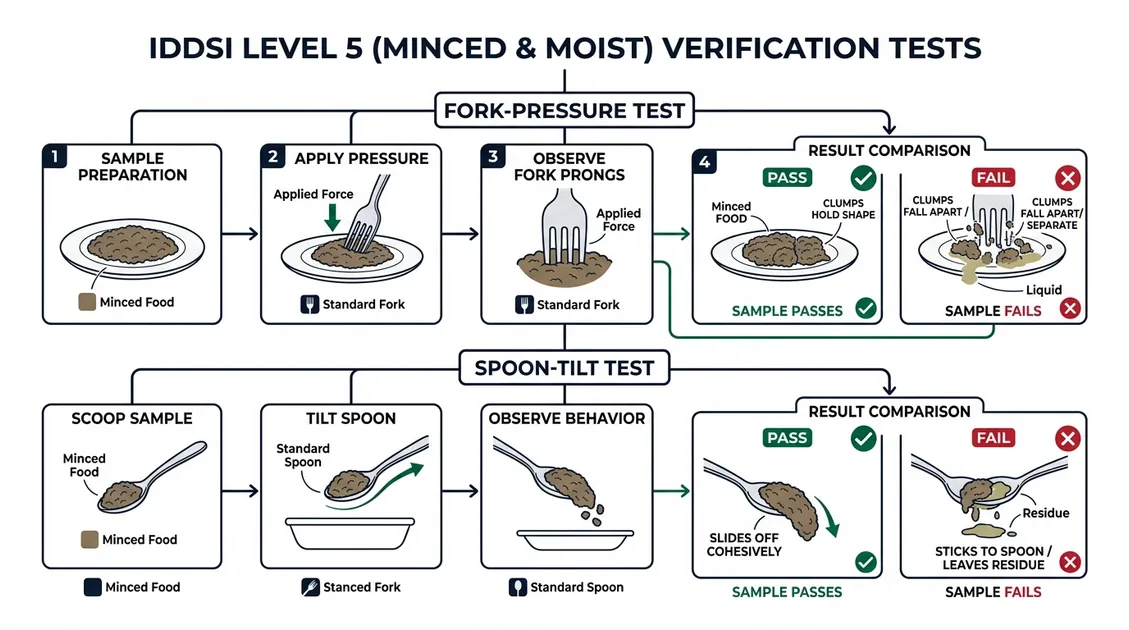
Dietitian-Approved Cycle Menus for Senior Care Facilities - Diagram showing IDDSI fork-drip test and spoon-tilt test procedures for Level 4 puree compliance
Data comparison
IDDSI TestLevel 4 Puree RequirementCommon Failure Point
Spoon-tilt testFalls off spoon in a single scoop, doesn’t stickToo thick or adhesive — add liquid gradually
Fork-drip testSits between tines, does not flow through continuouslyOver-blended to liquid (drops to Level 3)
Fork-pressure testNo lumps when pressed flat with forkFibrous vegetables not strained after blending
Visual checkSmooth, no visible particles or graininessSeeds, skins, or grain husks remaining

Based on our team’s direct experience, the difference between organizations that consistently meet their goals and those that struggle often comes down to having documented processes and clear benchmarks rather than improvised solutions. This practical insight drives PantryTec’s approach. See high calorie intake cycle menus for a deeper breakdown.

Senior care kitchen staff reviewing a printed weekly cycle menu during a team huddle

Request a Quote — Puree (IDDSI Level 4) Menus

Get dietitian-approved, IDDSI-compliant puree cycle menus delivered weekly as print-ready PDFs. Tell us about your facility to receive a custom quote.

✔ RD-Approved Menus 🏆 IDDSI Compliant ★ 40,000+ Recipes
Estimated Starting Price
$40/mo
Premier Plan — includes RD approval letters & 10-week cycle menus
Facility Information
Please select a facility type
Please enter a valid bed count
Please enter your name
Please enter a valid email

Therapeutic Diet Needs
Please select at least one therapeutic diet

Menu Preferences
Please select a menu style

Quote Request Submitted!

Thank you! A PantryTec menu specialist will review your facility details and send a custom quote within 1 business day. Check your email for confirmation.

RD-Approved IDDSI Level 4 Menus

Get Dietitian-Approved Puree Cycle Menus for Your Facility

Speak with our team about weekly print-ready PDF menus, RD approval letters, and IDDSI-compliant meal plans for residents with dysphagia.

RD Approval Letters IDDSI Compliant 40,000+ Recipes 10-Week Cycles
Tap to Call Now (385) 512-4731
Available now — ask about the Premier Plan
Premier Plan starting at $40 /month

How Do Pureed Menus Manage Blood Sugar in Residents with Diabetes?

Pureed diets for residents with diabetes follow a consistent-carbohydrate rhythm: 30–45g at breakfast, 45–55g at lunch, and 15–25g at dinner. According to the CDC, an estimated 28.8% of adults aged 65 and older have diagnosed diabetes, and 25–34% of nursing home residents carry a diabetes diagnosis. PantryTec's pureed cycle menus pair this carb distribution with protein-forward preparation — eliminating added sugars while maintaining IDDSI Level 4 texture compliance. For facilities managing both conditions simultaneously, our diabetic (CCHO) cycle menu integrates the same carb logic into texture-appropriate formats.

Breakfast

Moderate Carb (30–45g)

Protein-forward start with pureed eggs, Greek yogurt, or fortified oatmeal.

Lunch

Main Meal (45–55g)

Largest calorie intake with pureed protein entrée and fortified vegetable sides.

Dinner

Light Meal (15–25g)

Lean protein + non-starchy vegetable emphasis to avoid overnight glucose elevation.

*We use low-added-sugar approaches and protein/fat boosts (Greek yogurt, olive oil) to support intake without blood sugar spikes. Our registered dietitians verify every cycle for both texture compliance and glycemic balance.

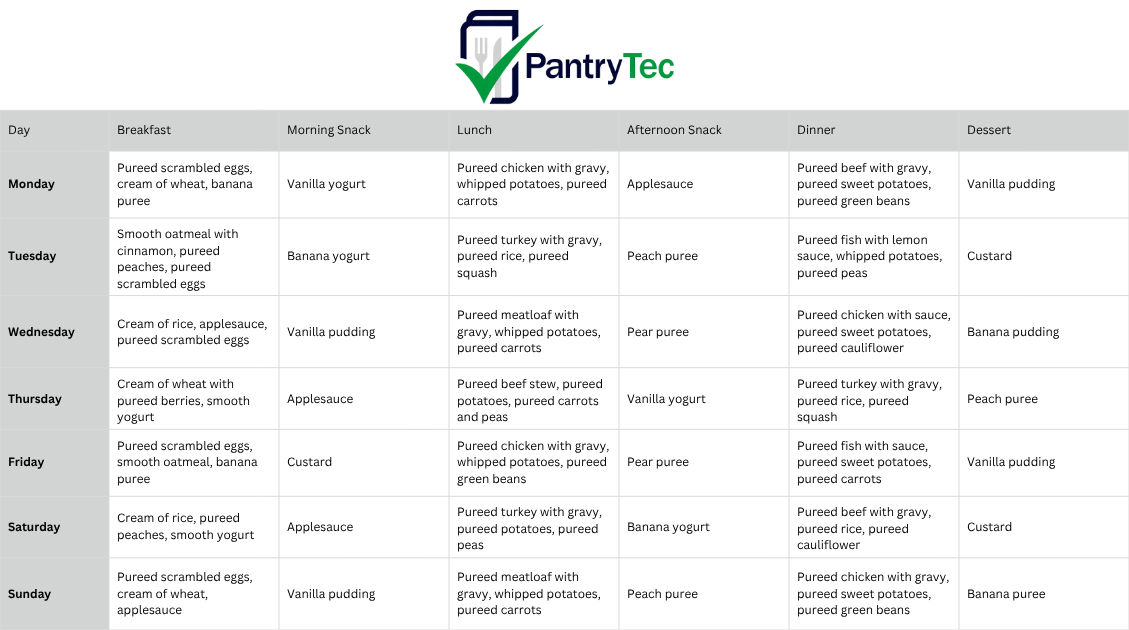
What Does a Pureed Cycle Menu Look Like? (Week 1 Sample)

PantryTec's pureed cycle menu rotates across 10 weeks with seasonal spring/summer and fall/winter versions — delivering 50+ unique daily menus before a single repeat. We designed every item below to pass IDDSI Level 4 testing. Each meal includes cook-to-census instructions so your kitchen produces only what your current resident count requires, reducing overproduction and food waste.

Day
Breakfast (Moderate)
Lunch (Main Meal)
Dinner (Light)
Monday
Pureed Oatmeal + Blended Eggs + Pureed Fruit
Pureed Chicken Sandwich (Molded) + Pureed Salad + Tomato Soup
Pureed Baked Cod + Pureed Green Beans
Tuesday
Pureed Greek Yogurt + Banana + Blended Toast
Pureed Turkey Wrap + Carrots + Veggie Soup + Pudding
Pureed Lean Beef Stew (Veg-heavy) + Broccoli
Wednesday
Pureed Pancakes + Fruit Topping + Pureed Sausage
Pureed Veggie Stir Fry + Brown Rice + Salad + Sweet Potato
Pureed Lean Pork + Pureed Peas
Thursday
Pureed High-Fiber Cereal + Eggs + Orange
Pureed Tuna Sandwich + Fruit + Side Salad
Pureed Pasta Marinara + Small Meatball + Veg
Friday
Pureed French Toast + Berries + Turkey Bacon
Pureed Cheeseburger + Salad + Corn + Fries (Molded)
Pureed Chicken Pot Pie (Veg-forward)
Saturday
Pureed Veggie Omelet + Blended Toast + Fruit
Pureed Pizza + Salad + Soup
Pureed Ham + Pureed Asparagus
Sunday
Pureed Waffles + Fruit + Blended Eggs
Pureed Soup & Sandwich + Potatoes + Carrots
Pureed Roast Beef + Non-starchy Veg
Week 1 of PantryTec's 10-week IDDSI Level 4 pureed cycle menu rotation. All items RD-approved and IDDSI-tested. As of April 2026.

How Should Kitchen Staff Prepare IDDSI Level 4 Meals Safely?

Pureed meal preparation requires cooking all ingredients to safe internal temperatures before pureeing, testing every item with the Spoon Tilt and Fork Drip methods, and removing all skins, seeds, chunks, and stringy fibers. In our menu development process, we found that the most common kitchen errors occur when staff skip the Fork Drip Test or use inconsistent thickening agents — so every PantryTec recipe specifies exact thickening ratios using potato flakes, Greek yogurt, or commercial thickener.

Safe Preparation Protocol

Guardrails we built into every PantryTec pureed recipe:

  • Cook First: All foods reach safe internal temperature before pureeing. Raw pureeing introduces pathogen risk.
  • Test Every Batch: Spoon Tilt (food slides off with gravity) and Fork Drip (flows through tines, no lumps) — performed before every service.
  • Eliminate Hazards: No skins, seeds, chunks, husks, or stringy vegetables unless processed to a fully smooth consistency.
  • Thicken Correctly: Use potato flakes, Greek yogurt, or xanthan-based commercial thickener. Cornstarch thins when cooled — unsuitable for IDDSI Level 4 holding.

Federal Compliance Requirement

Federal regulation requires that facilities provide diets meeting each resident's daily nutritional and therapeutic needs, including texture modifications prescribed by a speech-language pathologist or physician. Our registered dietitians designed PantryTec's pureed menus to satisfy this mandate, with an RD approval letter included in every subscription — eliminating the need for a separate $750–$1,500/month external consulting contract.

42 CFR § 483.60 — Food & Nutrition Services

Texture modification for dysphagia and therapeutic diet management fall directly under this federal nutrition services requirement for long-term care facilities.

How Much Does a Pureed Menu Program Cost?

PantryTec's pureed cycle menu starts at $15/month with the Starter plan — a flat rate regardless of facility size. Competitors typically charge $3–$5 per resident per month, meaning a 10-bed facility pays approximately $400/month. PantryTec's flat-rate model delivers the same RD-approved pureed menus to a 6-bed group home and a 120-bed nursing facility at the same price, with no per-bed surcharges, no contracts, and no setup fees.

Cost Factor PantryTec Per-Bed Software Model
Monthly Fee (10-bed facility) $15–$40/month ~$300–$500/month
RD Approval Letter Included $750–$1,500/mo extra
Pureed Diet Menus IDDSI 4 included in all plans Therapeutic add-on (extra cost)
Menu Rotation Length 10-week seasonal rotation 4-week typical
Contract Required No contract Annual commitment typical

PantryTec serves group homes, assisted living facilities, memory care communities, and skilled nursing facilities — all at the same flat rate. View all plans on our pricing page.

Frequently Asked Questions About Pureed Diets in Nursing Homes

What is the difference between IDDSI Level 4 and Level 5?
IDDSI Level 4 (Pureed) requires completely smooth, lump-free food that passes the Spoon Tilt and Fork Drip tests — no chewing required. IDDSI Level 5 (Minced & Moist) permits small, soft particles no larger than 4mm that can be mashed with the tongue against the palate, requiring minimal chewing. A speech-language pathologist determines which level a resident needs based on swallowing assessment. PantryTec provides separate cycle menus for IDDSI Level 5 (Minced & Moist) and IDDSI Level 6 (Soft & Bite-Sized), each meeting the specific texture criteria defined by the IDDSI framework.
How do you prevent malnutrition on a pureed diet?
Pureed diets carry a higher malnutrition risk because blending can reduce caloric density and meal appeal. PantryTec's registered dietitians address this by fortifying pureed menus with calorie-dense additions — olive oil, Greek yogurt, nut butters, and protein powder — at calculated ratios. Every pureed entrée targets a minimum protein threshold per serving. For residents requiring additional caloric support, our fortified & high-calorie menu adds 300–500 additional calories per day through nutrient-dense modifications to the base pureed rotation.
Does a pureed diet meet 42 CFR §483.60 requirements?
Yes. 42 CFR §483.60 requires long-term care facilities to provide food and nutrition services that meet each resident's daily nutritional needs, including therapeutic diets ordered by a physician. A pureed diet prescribed for dysphagia falls directly under this federal mandate. PantryTec's pureed cycle menus include an RD approval letter documenting that the menu meets nutritional adequacy standards — the exact documentation surveyors request during CMS inspections. This approval is included at no additional cost with every PantryTec subscription.
Can the pureed menu be combined with a diabetic diet?
PantryTec's pureed cycle menu already incorporates consistent-carbohydrate principles: 30–45g at breakfast, 45–55g at lunch, and 15–25g at dinner. For residents with both dysphagia and diabetes, the Complete plan ($20/month) includes therapeutic diet cooking adjustments that layer diabetic-appropriate modifications onto the pureed base menu. This dual-diet approach is common — an estimated 25–34% of nursing home residents carry a diabetes diagnosis alongside other conditions requiring texture modification.
How often does the pureed menu rotate?
PantryTec's pureed cycle menu follows a 10-week rotation with two seasonal versions: spring/summer and fall/winter. This produces more than 50 unique daily menus before any repetition — significantly longer than the industry-standard 4-week cycle. Longer rotations reduce flavor fatigue, which is particularly important for residents on texture-modified diets who already face limited variety. Holiday special menus for Thanksgiving, Christmas, Easter, and July 4th are included as well.

Ensure Swallowing Safety & Survey Compliance.

Get IDDSI Level 4 pureed cycle menus with RD approval delivered to your facility — starting at $15/month. No per-bed charges, no contracts, no setup fees.

View Pricing

Ready to Get Started with PantryTec?

Contact PantryTec today to learn how we can help.

Last updated: April 2026. Clinical content reviewed by the PantryTec Clinical Team (Registered Dietitians & Senior Care Nutrition Specialists). This page was written with AI assistance and reviewed by licensed professionals for clinical accuracy.