
How to Pass a CMS Dietary Survey:
F-Tag Menu Requirements
What surveyors check under 42 CFR §483.60 and the F800 series dietary tags, and the menu documentation to have ready before they arrive.
CMS menu compliance means your menus satisfy 42 CFR §483.60 and hold up under the F800 through F814 dietary tags. Surveyors ask for three artifacts early: a dated nutrient analysis, menus as served, and a registered dietitian's signature. Everything else in the dietary task builds on those three documents.
Survey readiness is a paperwork problem before it is a cooking problem. This guide follows the dietary review in the order surveyors run it, from the kitchen tour through the exit conference. Assisted living operators should note one boundary first. Part 483 binds Medicare and Medicaid certified skilled nursing facilities, while state-licensed assisted living answers to state rules that borrow much of the same language. Start with what 42 CFR §483.60 requires for food and nutrition services, then work through the tags below.
TL;DR: Menu compliance is enforced through the F800 to F814 tag series in Appendix PP. Standard surveys are unannounced and must occur no later than 15 months after the last one, per 42 CFR §488.308. F809 caps the gap between the evening meal and breakfast at 14 hours. A plan of correction is due within 10 calendar days of the CMS-2567. PantryTec's dietitian-approved cycle menus start at $15 per month flat, and you can download a free sample cycle menu packet before you subscribe.
Which F-Tags Govern Food and Nutrition Services in a CMS Survey?
Menu needs in a CMS survey trace to one regulation, 42 CFR §483.60, which surveyors enforce through the F800 to F814 tag series published in Appendix PP of the CMS State Operations Manual, at 14 hours, or 16 hours with a bedtime snack. Five tags carry most of the menu risk. F801 covers qualified dietary staff. F803 covers menus and nutritional adequacy. F804 covers palatability, appearance and food temperature. F808 covers therapeutic diet orders. F812 covers sanitary food service, and it remains among the most often cited dietary tags nationally, according to the CMS Quality, Certification and Oversight Reports database. A tag isn't a separate rule. Each one is a numbered slice of the regulation text, which is why a citation always quotes the paragraph it came from. When you read a statement of deficiencies, match the tag to the subsection first. That tells you which sentence of the rule the facility missed, and which document proves the fix.
The F801 to F812 Dietary Tag Family
| F-Tag | Regulation | What surveyors verify |
|---|---|---|
| F801 | §483.60(a) | Qualified dietitian employed full-time, part-time or on consultation |
| F802 | §483.60(a)(3) | Sufficient dietary staff to meet resident needs |
| F803 | §483.60(c) | Menus meet nutritional needs, are prepared in advance and followed |
| F804 | §483.60(d)(1)-(2) | Nutritive value, palatable appearance, preferred serving temperature |
| F805 | §483.60(d)(3) | Food in a form that meets individual resident needs |
| F808 | §483.60(e) | Therapeutic diets ordered by the attending physician |
| F809 | §483.60(f) | Meal frequency and the 14-hour overnight limit |
| F812 | §483.60(i) | Procurement, storage, preparation and sanitary service |
Needs under F803 sit at the center of every menu argument, because that tag ties nutritional adequacy to evidence that the kitchen actually followed the written cycle. Our deeper walkthrough of F803 menu requirements: menus must meet resident needs and be followed shows what nutrient analysis and menus-as-served look like side by side.
Menu Survey Readiness Self Assessment: 30 Binder Checkpoints by F-Tag
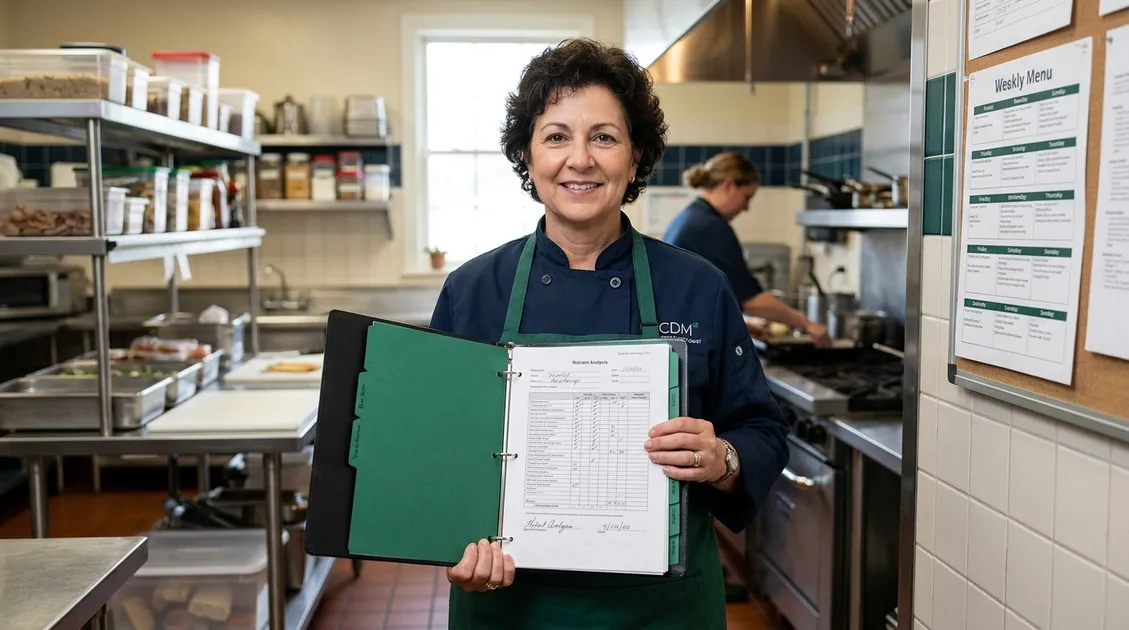
Work through the 30 checkpoints in the order a surveyor runs the dietary task. Mark each one Verified, Partial or Missing, and the panel scores your binder gaps by F-tag. Checkpoints labeled "core artifact" are the three documents surveyors ask for first: a dated nutrient analysis, menus as served, and a registered dietitian signature.
Scoring is a self assessment aid only, not a compliance determination. Standard surveys are unannounced and must occur no later than 15 months after the last one under 42 CFR 488.308. A plan of correction is due within 10 calendar days of the CMS-2567. F809 caps the gap between the evening meal and breakfast at 14 hours, or 16 hours when a nourishing bedtime snack is offered.
How Does the Dietary Portion of a Standard Survey Unfold?
Survey teams arrive unannounced, and a standard recertification survey must occur no later than 15 months after the previous one, with a statewide average interval of 12 months, under 42 CFR §488.308. The dietary task starts with a brief kitchen tour shortly after the entrance conference, per the CMS Long-Term Care Survey Process. Surveyors then watch a full meal service. They check hot holding at 135°F or above and cold holding at 41°F or below, the thresholds set by the FDA Food Code 2022 for time and temperature control foods. A test tray follows the last resident tray so the team can taste and temp the same food a resident received. Resident interviews come next, then record review, then the exit conference where early findings are read aloud.
What the Kitchen Tour and Test Tray Catch
- Posted menu that doesn't match the tray line food
- Undated leftovers or product stored past its use-by date
- Coffee or soup served below the preferred serving temperature, an F804 finding
- Pureed items plated without shape or contrast, common in memory care units
- Diet roster that disagrees with the tray card texture
The concern that comes up first is proving compliance during unannounced state surveys, which is exactly why the binder matters more than the recipe box. The question list on our questions surveyors ask during a dietary walkthrough page mirrors this sequence.
Dietary findings often start in nursing, not the kitchen. F809 limits the span between a large evening meal and breakfast to 14 hours, extended to 16 hours when a nourishing bedtime snack is served, and late trays or missed snacks show up in the nursing record first. Read the detail on F809 meal frequency and the 14-hour overnight.
What Menu Documentation Must Be Ready Before Surveyors Arrive?
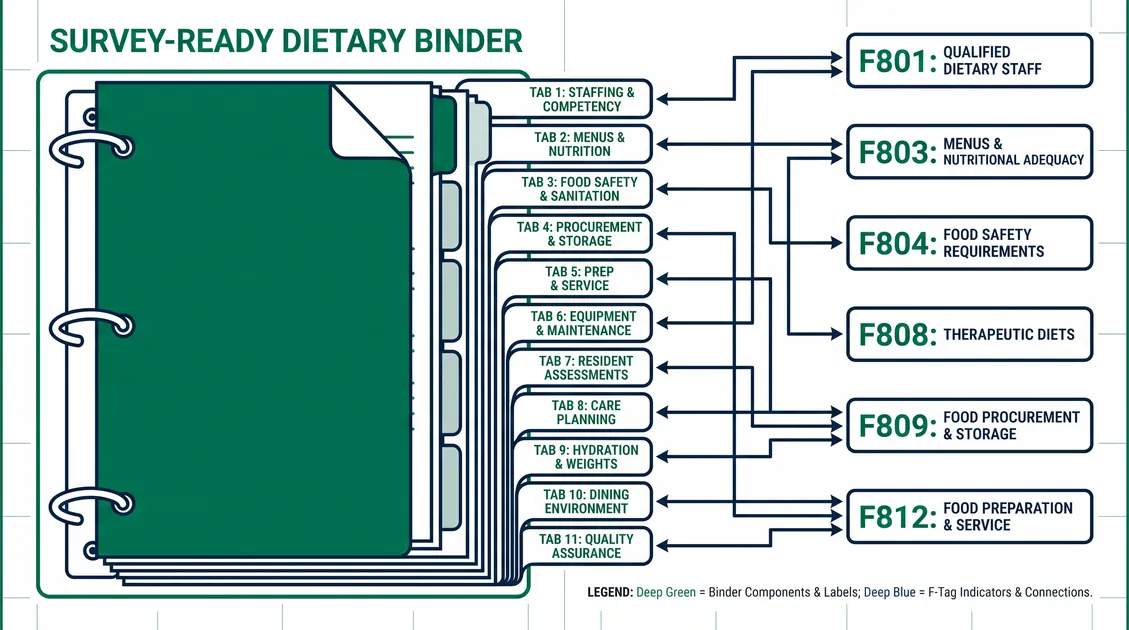
Menu documentation should sit in one binder with 11 tabs, because surveyors ask for the same set every time. Keep the current cycle menu, the signed nutrient analysis, menus as served with as-served annotations, the substitution log, standardized recipes, production sheets scaled to census, tray cards, the diet roster, the current diet manual, temperature logs, and the RD approval letter. Nutrient analysis is the tab that decides most F803 outcomes. An unsigned spreadsheet proves arithmetic. A nutrient analysis signed and dated by a Registered Dietitian Nutritionist proves professional review, which is the language the regulation uses. We keep 12 months of production and substitution records on hand so the survey lookback never runs past the paperwork. Menus benchmarked to Dietary Reference Intakes for adults 51 and older, including the protein RDA of 0.8 grams per kilogram of body weight per day, carry the nutritional adequacy argument.
Why the Signature Line Matters More Than the Spreadsheet
Needs for professional review exist because diet quality in older adults is measurably fragile. According to the USDA Economic Research Service report An Exam of Veterans' Diet Quality, veterans make up roughly 7 to 8 percent of the U.S. adult population, and their adjusted Healthy Eating Index score averaged 45.6 out of 100 compared with 49.3 for nonveterans, a gap of 3.7 points. State veterans homes and small assisted living homes serve that same population. A signed menu is the facility's evidence that someone qualified checked the math against the National Academies' Dietary Reference Intakes.
Substitution and Production Records
Menu substitutions pass or fail on one test: similar nutritive value, documented and dated. A cook who swaps green beans for peas creates a substitution log entry, not a citation. A cook who swaps a protein entree for bread and jam creates both. Production sheets scaled to census close the loop by showing the kitchen cooked for the number of residents present, which also trims waste. Nutrition education, by contrast, is tracked separately in some programs, and the Washington State Senior Nutrition Program Standards count one unit as one session multiplied by the number of participants.
Per-Resident Menu Cost Calculator
Enter your licensed bed count and what you spend today on dietitian review or a menu vendor, then compare it against PantryTec flat-rate cycle menu plans starting at $15 per month. All figures update as you type.
Please enter at least 1 bed and a spend of 0 or more.
Your comparison
How this works: plan pricing is the flat monthly rate ($15, $20 or $40 per month billed annually) for dietitian approved cycle menus, not a per bed charge. Difference figures compare that flat rate against the current spend you entered, so accuracy depends on your own numbers. This tool does not price staffing under F801 or F802, and it is an estimate only, not a compliance determination. Menus must still satisfy 42 CFR 483.60 and the F800 to F814 tags, including the F809 limit of 14 hours between the evening meal and breakfast, or 16 hours with a bedtime snack.
What Scope and Severity Level Turns a Menu Deficiency Into Immediate Jeopardy?
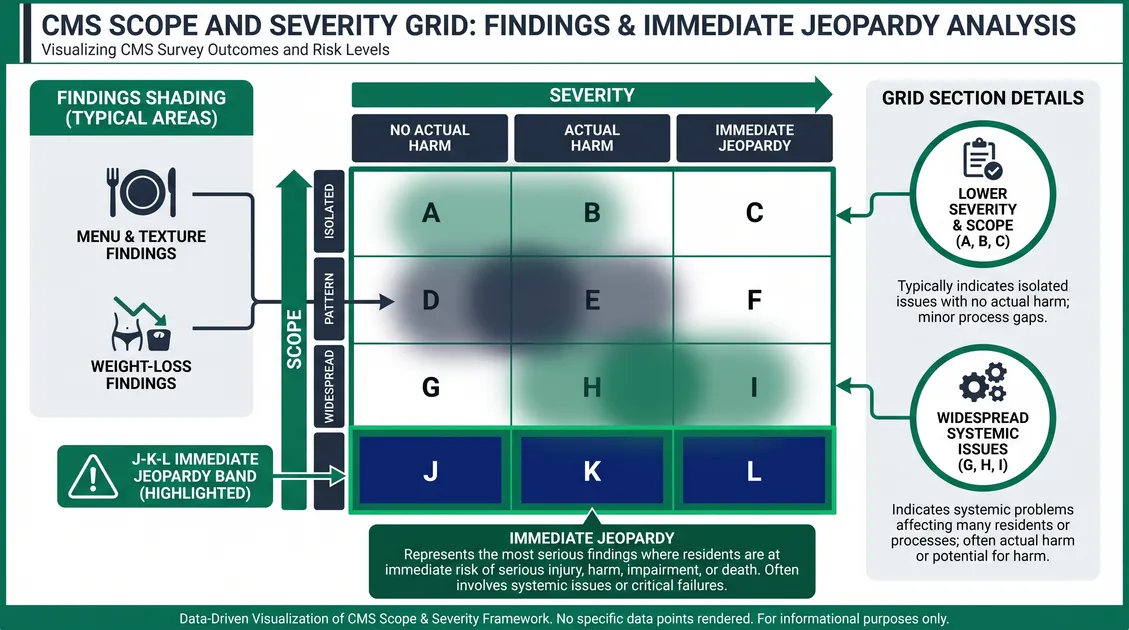
Menu deficiencies scored at level J, K or L on the CMS scope and severity grid constitute immediate jeopardy, the only tier that triggers the upper civil money penalty range of $3,050 to $10,000 per day under 42 CFR §488.438, adjusted annually for inflation. Lower-tier deficiencies fall in the $15 to $40 per day range. The grid runs A through L, combining severity on one axis with scope on the other. Most menu findings land at D or E, meaning no actual harm with a pattern. Texture errors are the exception. Serving a regular tray to a resident with an IDDSI Level 4 pureed order can produce an aspiration event, and that single tray moves a paperwork problem into harm territory fast. A plan of correction is due within 10 calendar days of the CMS-2567.
Texture Orders Are Where Severity Escalates
Dietary teams need the IDDSI framework memorized, not laminated on a wall. Level 5 minced and moist requires particles no larger than 4 millimeters, Level 6 soft and bite-sized allows pieces up to 15 millimeters, and drink thickness is verified with the 10 millilitre syringe flow test. The fork drip test and spoon tilt test confirm pureed consistency at the tray line. Our IDDSI Level 4 pureed diet menus extend from the same base cycle, so a resident on pureed texture eats the same meal as everyone else at the table.
Therapeutic diets add a second failure point. F808 requires the attending physician to order the diet, and some states allow delegation to a qualified dietitian. When nursing transcribes a 2-gram sodium order and the tray card still reads regular, the chain breaks in the record, not the kitchen. See F808 physician-ordered therapeutic diets, and if a citation already landed, our guide to writing a plan of correction for an F803 menu citation covers the CMS-2567 response. For Immediate jeopardy civil money penalty, upper daily range per 42 cfr §488.438 typically runs about $3,050 to $10,000 per day in day-to-day operations.
How Do You Run a Mock Audit, and Who Owns Menu Compliance?
Menu compliance belongs to the administrator on paper, but §483.60(a) requires a qualified dietitian on staff, part-time or on consultation, and most facilities contract that role. A quarterly mock dietary survey audit of 30 checkpoints catches the gaps before a surveyor does. Run it in the survey sequence: kitchen tour, meal observation, test tray, three resident interviews, then binder review. Score each checkpoint pass or fail, and treat any two failures in the same tag as a corrective action trigger. Accountability splits cleanly once you write it down. The administrator owns the outcome and the budget. The certified dietary manager, CDM and CFPP credentialed, owns production sheets and daily logs. The Registered Dietitian Nutritionist owns menu approval and the diet manual. Nursing owns diet order accuracy from physician order to tray card.
Assigning Mock Surveyor Roles
- Administrator reviews the binder and the 12-month record retention
- CDM walks storage, labeling and temperature logs against the FDA Food Code thresholds
- A nurse compares 10 diet orders to 10 tray cards
- A second facility's manager tastes the test tray, since familiarity dulls judgment
- Findings convert to a dated corrective action list with owners
Verifying the Dietitian Who Signs Your Menu
Needs for RD approval vary by state, and this is where assisted living diverges from skilled nursing. Utah Administrative Code R432-270 governs assisted living dietary services, Washington uses WAC 388-78A-2300, and California applies Title 22 §87555. Before you accept an approval letter, verify the dietitian's license through your state board, such as the Utah Division of Professional Licensing. A signature from an unlicensed reviewer is worth nothing in a state licensing survey.
What an RD-Signed Cycle Menu Costs Per Month
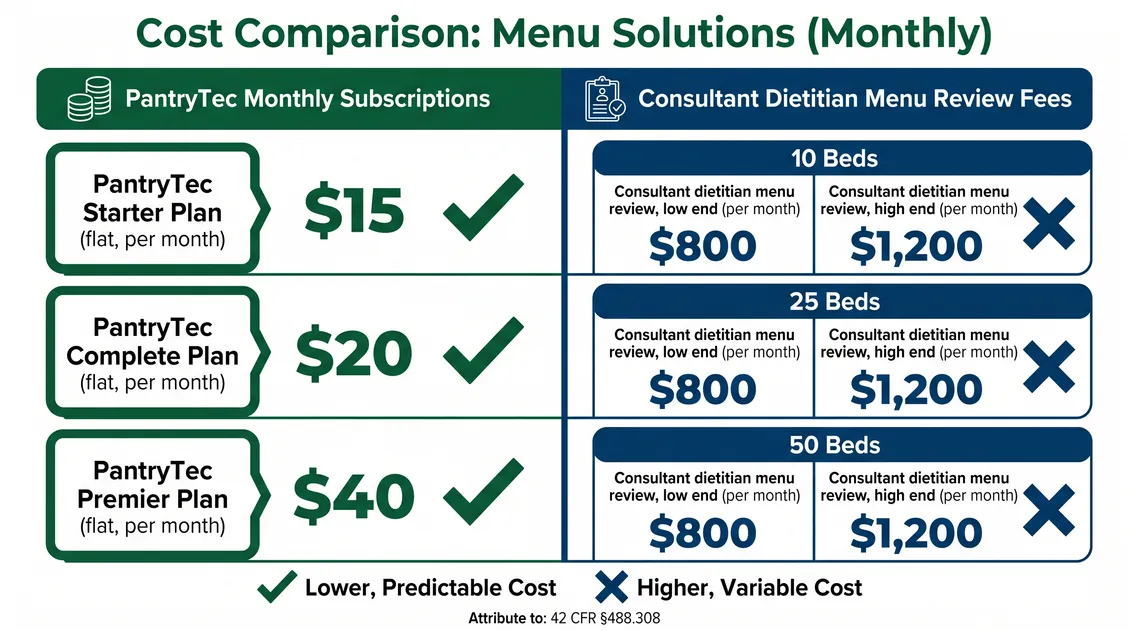
Menu costs split into two models. Replacing that with a PantryTec plan at $180 to $480 a year saves roughly $9,000 to $14,000 a year. PantryTec charges a flat $15 per month for the Starter Plan, $20 for the Complete Plan and $40 for the Premier Plan when billed annually ($20, $25 and $50 billed monthly), with the RD approval letter included at every tier and no per-bed charge. Market intelligence on this sector is priced for enterprises, not 12-bed homes: the assisted living software market report from Future Market Insights lists its Full Research Suite at $5,000, $7,500 or $10,000. Blake Oldham, Product Manager at PantryTec, points out that a 10-week cycle menu delivering 70 unique days of breakfast, lunch, dinner and snacks costs less annually than four hours of consulting RD time. Compare tiers on our flat-rate menu plan pricing or call 385-512-4731 to talk through your bed count.
Reimbursement math supports the outsourcing trend elsewhere in aging services. According to the ACL toolkit Medical Nutrition Therapy Works for Seniors, one Area Agency on Aging reached breakeven on Medicare MNT services only after six years of delivering them, which is why few small operators build clinical nutrition capacity in-house.
Key Takeaways for CMS Menu Compliance
- Menu enforcement runs through the F800 to F814 tags in Appendix PP, with F803, F804, F808 and F812 carrying the most menu exposure.
- Survey timing is unannounced, capped at 15 months between standard surveys per 42 CFR §488.308, so readiness is a standing condition rather than a project.
- Documentation beats intent: a nutrient analysis signed by an RDN, menus as served, and a dated substitution log answer most F803 questions.
- Severity decides the cost, and immediate jeopardy at levels J, K or L opens the $3,050 to $10,000 per day penalty range under §488.438.
- Compliance costs less than most facilities assume, with flat-rate dietitian-approved cycle menus starting at $15 per month versus $800 to $1,200 monthly for consultant menu review in our client data.
Needs terminology across these tags is defined in our senior care menu and dietary glossary, which supplies the vocabulary this compliance hub applies during an actual survey.
What is a cycle menu in senior living?
A cycle menu is a fixed set of daily menus that repeats on a schedule, commonly 4, 5 or 10 weeks. PantryTec's 10-week rotation covers 70 unique days of breakfast, lunch, dinner and snacks before any day repeats.
How many weeks should an assisted living cycle menu be?
Most state licensing rules set a minimum rotation of three to four weeks, and your state agency publishes the exact figure. A 5-week or 10-week cycle exceeds every common minimum and reduces menu fatigue. Longer rotations also spread seasonal produce across spring, summer, fall and winter variants.
Do assisted living menus have to be approved by a dietitian?
Many states require a registered dietitian to review assisted living menus, and skilled nursing is bound federally under §483.60(a). Utah R432-270, Utah WAC 388-78A-2300 and Utah Title 22 §87555 each address dietary service needs differently. Verify your reviewer's license through the state board before accepting the letter.
What does 42 CFR 483.60 require for menus?
The regulation requires menus that meet nutritional needs consistent with national advice, are prepared in advance, followed, updated periodically, and reviewed by the facility's dietitian or clinically qualified nutrition professional. Menus must reflect religious, cultural and ethnic preferences. Subsection (f) adds the 14-hour overnight meal limit.
How far in advance must menus be posted in a care facility?
Federal rule requires menus prepared in advance and followed, without naming a posting deadline; state licensing rules set the posting requirement. Many states require the current week posted where residents can read it. PantryTec emails a print-ready PDF menu weekly, and new accounts receive their first menu within 24 to 48 hours.
Menu survey readiness improves fastest when someone else carries the signature. Request a dietitian-signed menu quote at PantryTec contact or call 385-512-4731 in Springville, Utah.
Explore Topics
8 related pages in this section
About PantryTec: The RDN Review Behind Every Signed Menu
Who is behind PantryTec, and how a registered dietitian reviews and signs every cycle menu.
About PantryTec: The RDN Review Behind Every Signed Menu→PantryTec RD Approval Letter: What You Receive and When
What the RD Approval Letter covers, who signs it and when it arrives for your compliance binder.
PantryTec RD Approval Letter: What You Receive and When→What Is in the PantryTec Compliance Documentation Package?
The menu documents PantryTec provides for your survey binder, listed item by item.
What Is in the PantryTec Compliance Documentation Package?→Cycle Menu FAQ for Administrators
Short answers to the cycle menu questions administrators ask most often.
Cycle Menu FAQ for Administrators→Menu Service vs Hiring a Consultant Dietitian: Coverage Comparison
What a menu service covers compared with a consultant dietitian, and where each one fits.
Menu Service vs Hiring a Consultant Dietitian: Coverage Comparison→What Does 42 CFR §483.60 Require? Food and Nutrition Services Explained
The federal food and nutrition services rule for long-term care facilities, explained section by section.
What Does 42 CFR §483.60 Require? Food and Nutrition Services Explained→F803 Explained: Menus Must Meet Resident Needs and Be Followed
What F803 requires: menus that meet residents’ nutritional needs, are prepared in advance, are followed and are reviewed for nutritional adequacy.
F803 Explained: Menus Must Meet Resident Needs and Be Followed→F808: Why Therapeutic Diets Must Be Physician-Ordered
Why therapeutic diets need a physician’s order under F808, and when state law lets a dietitian write them.
F808: Why Therapeutic Diets Must Be Physician-Ordered→