
Senior Care Dietary Glossary:
Menu, Diet, and IDDSI Terms From A to Z
This senior care dietary glossary defines 40+ menu, therapeutic diet, and IDDSI terms in plain English and maps each one to the CMS F-tag or state rule it comes from.
Senior care dietary glossary terms aren't marketing language, they are the exact words an inspector reads off the rule book. CMS interpretive guidance in Appendix PP carries roughly 40 recurring menu and nutrition terms across tags F801 through F814, and surveyors quote those definitions almost verbatim when writing a dietary finding on Form CMS-2567. This page defines that vocabulary in plain English, maps each word to the tag or state code it comes from, and flags the places where a term means one thing to an inspector and something else to your cook. PantryTec built the reference from 500+ senior-care facility engagements where the same handful of words produced the same avoidable findings. Read it next to our guide on Menu Compliance, which applies this vocabulary during a real inspection.
TL;DR: Menu terminology traces to three sources: 42 CFR §483.60, CMS Appendix PP, and state licensing code such as Utah R432-270. The six terms that drive most dietary citations are cycle menu, menus as served, substitution log, food form, therapeutic diet, and nutritional adequacy. Therapeutic diets need a physician order under tag F808; preference changes don't. IDDSI numbers texture from 0 to 7, with Level 5 minced and moist set at a 4 mm particle size. PantryTec cycle menu plans are flat rate at $15, $20, and $40 per month billed annually ($20, $25, and $50 billed monthly) with the RD approval letter included.
Which Menu and Dietary Terms Do Senior Care Surveyors Use Most Often?
Menu vocabulary in senior care stacks up from three sources: the federal rule at 42 CFR §483.60 Food and Nutrition Services, the interpretive guidance in the CMS State Operations Manual Appendix PP, and your own state licensing code. State agencies borrowed most of the federal wording, so the same six terms surface in nearly every dietary finding: cycle menu, menus as served, substitution log, food form, therapeutic diet, and nutritional adequacy. Each term carries a tag. F803 covers menus and nutritional adequacy, F805 covers food form, F806 covers substitutions and preferences, and F807 covers hydration. A dietary deficiency citation usually names one of those six inside its first sentence. Learning the definitions in advance costs about an hour of staff time, which beats learning them at an exit conference.
Care setting decides which rule binds you. 42 CFR Part 483 and the F-tag series govern Medicare and Medicaid certified skilled nursing facilities. Assisted living and memory care are licensed by the state, so your enforceable text is code such as Utah R432-270, Washington WAC 388-78A-2300, or California Title 22 §87555.
Core Menu Terms A Through M
| Term | Plain definition | Source tag |
|---|---|---|
| Always-available menu | Alternate items offered at every meal with no special order | F806 |
| Cycle menu | A fixed set of daily menus repeated in order, 4 to 10 weeks | F803 |
| CDM, CFPP | Certified Dietary Manager credential accepted for food service direction | F801 |
| Diet manual | The reference a facility formally adopts to define each diet | F808 |
| Dietary deficiency citation | A written dietary finding recorded on Form CMS-2567 | F800 series |
| Food form | Physical texture and shape of food as it reaches the resident | F805 |
| Liberalized diet | Loosened restrictions used to protect intake and body weight | F805, F692 |
Core Menu Terms N Through Z
| Term | Plain definition | Source tag |
|---|---|---|
| Menus as served | Dated record of what actually left the tray line | F803 |
| No added salt (NAS) | No salt at the table or in finishing, not a 2 gram sodium diet | F808 |
| Nutrient analysis | Calorie and nutrient calculation averaged across the full cycle | F803 |
| Plan of correction | The facility's written fix filed after a citation | CMS-2567 |
| Production sheet | Cook-to-census sheet listing portions, yields, and leftovers | F803 |
| Selective menu | A menu offering an alternate entrée, opposite of non-select | F806 |
| Substitution log | Dated record of any swap and its equal nutritive value | F806 |
Terms Surveyors Quote From Appendix PP
Glossary entries that begin with an F number belong to the regulatory subset, and their full guidance text lives in our CMS dietary F-tag quick reference index. One word can carry two meanings at once, which is why we keep a separate breakdown of surveyor versus kitchen staff menu terminology differences.
Senior Care Menu and Dietary Glossary Lookup
Search a term or jump by letter to see its plain English definition and the CMS F-tag, federal rule, or state code it maps to. Select any term for the full entry, including where inspectors and cooks read the same word differently.
Request a cycle menu quote
How Do Therapeutic Diet Terms Differ From Regular Diet Terms?
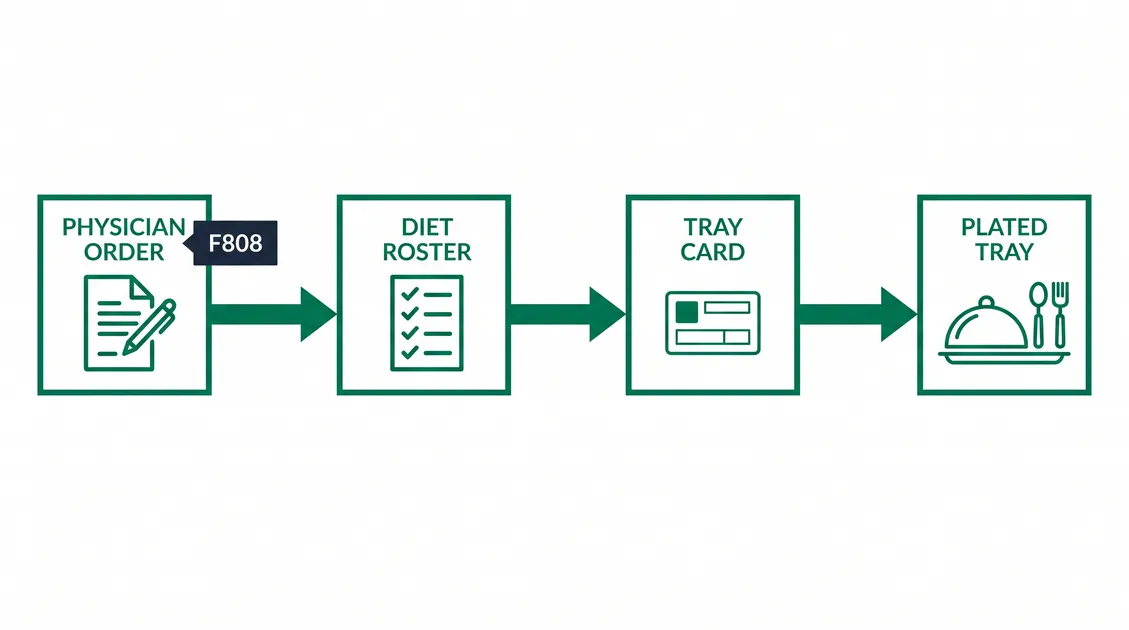
Dietary orders split into two legal categories. A therapeutic diet requires a physician or delegated practitioner order under 42 CFR §483.60(e) and tag F808, while a preference change requires none. That single line separates most tray card errors from clean charts. A therapeutic diet treats a condition, so a renal diet limiting potassium, phosphorus, and protein qualifies. A modified diet changes texture or consistency for swallowing safety. A preference diet reflects what a resident likes and lives under F806 substitutions and preferences. Every therapeutic definition traces back to the diet manual your facility formally adopts, and surveyors ask which manual and which edition. Delegation language matters too: many states let the attending physician delegate diet order authority to a registered dietitian nutritionist (RDN), and the scope varies by state statute.
- Consistent carbohydrate (CCHO): a set carbohydrate allowance per meal, not a sugar-free diet.
- 2 gram sodium diet: a measured daily cap, stricter than a no-added-salt tray.
- Renal-restricted diet: limits potassium and phosphorus, with protein set per physician order.
- High-calorie high-protein (HCHP): food-first fortification added to standard menu items.
- Mechanical soft and pureed diets: texture changes tied to dysphagia, ordered as food form.
Therapeutic diet extensions are where that fear lands, since one base menu has to branch into diabetic, cardiac, and renal versions without contradicting the diet manual. Our therapeutic diet menu extensions handle that branching before the PDF reaches your kitchen.
Medical nutrition therapy (MNT) is the billable clinical counterpart, and demand for it is real. One aging services provider documented 200 referrals between January and May 2019, 300 by the end of July, and projected 500 or more by year end after opening an online referral portal, according to the ACL toolkit Medical Nutrition Therapy Works for Seniors.
What Do Texture, Food Form, and Hydration Terms Mean in Practice?
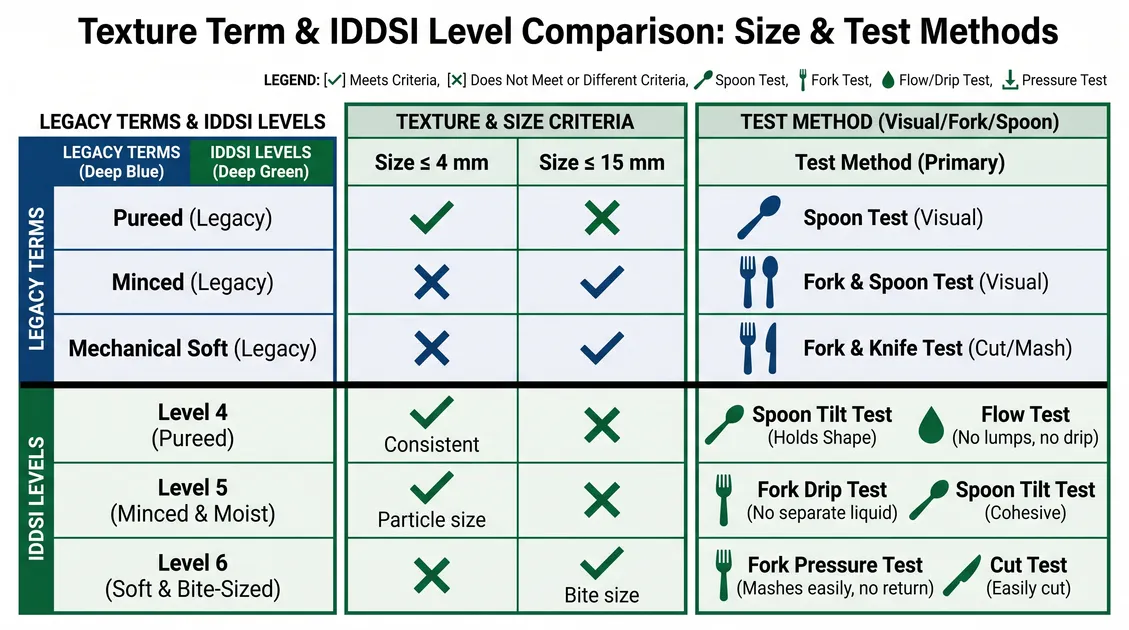
Menu texture language changed when IDDSI replaced legacy names with eight numbered levels from 0 to 7, published by the International Dysphagia Diet Standardisation Initiative. Facilities running both vocabularies must cross-reference them on diet cards to satisfy tag F805 food form. Level 4 is pureed, Level 5 is minced and moist with a 4 mm particle size, and Level 6 is soft and bite-sized at a 15 mm piece size that squashes with fork pressure. Drinks carry their own numbers: mildly thick is Level 2 and moderately thick is Level 3, each verified with the 10 mL syringe flow test. The fork drip test and spoon tilt test check thickness at the tray line in seconds. Getting the number right protects against penetration-aspiration risk and matches what a speech pathologist wrote after a modified barium swallow study.
Care teams in memory care hit a second vocabulary layer. Dementia finger foods are transitional foods shaped to be eaten without utensils, and a finger food menu still has to meet the same nutrient targets as a plated meal. Weight loss coded in MDS 3.0 Section K, item K0300, is often the first clinical signal that texture and food form need review.
| Legacy term | IDDSI level | Test used |
|---|---|---|
| Pureed | Level 4 | Fork drip test |
| Minced and moist | Level 5 | Fork pressure, 4 mm gap |
| Mechanical soft, bite-sized | Level 6 | Fork squash, 15 mm piece |
| Nectar-thick liquid | Level 2, mildly thick | 10 mL syringe flow test |
| Honey-thick liquid | Level 3, moderately thick | 10 mL syringe flow test |
Glossary terms for hydration sit under F807, which requires enough fluid to maintain hydration. A hydration pass is a scheduled between-meal fluid round; a fluid restriction is a physician-ordered daily volume split across meals and med pass. Print the printable IDDSI level cheat sheet for Levels 0 through 7 and post it at the tray line, since texture terms in this glossary map directly to those numbers. A short video walkthrough of the IDDSI levels helps new kitchen hires more than a policy binder does.
Menu Survey-Readiness Self-Assessment
Score your dietary documentation against the terms surveyors quote most: cycle menu, menus as served, substitution log, food form, therapeutic diet, and nutritional adequacy. Answer each line, then review your gap list by tag. Nothing is submitted or stored, results stay in your browser.
Educational self-check only, not a survey result or legal opinion. Definitions follow 42 CFR §483.60, CMS Appendix PP tags F801 through F814, and state licensing code such as Utah R432-270, Washington WAC 388-78A-2300, or California Title 22 §87555. Verify current text with your state agency.
Which Nutrition Standards Terms Appear in Menu Documentation?
Menu documentation borrows its targets from the Dietary Reference Intakes (DRIs) set by the National Academies of Sciences, Engineering, and Medicine, published for adults 51 and older and summarized by the NIH Office of Dietary Supplements. Four abbreviations do the work. RDA is the intake meeting the needs of nearly all healthy people in a group. AI is an adequate intake used where evidence is thinner. UL is the tolerable upper limit. EAR is the median requirement used in research. The measurement that trips facilities up is averaging: nutrient analysis is judged across the whole cycle, not meal by meal, so a light Tuesday lunch isn't a finding if the week balances. PantryTec runs nutrient analysis against 100% of DRI targets before an RDN signs a menu.
Diet quality benchmarks use the Healthy Eating Index. Between 2003 and 2016, veterans reached an adjusted total HEI score of 45.6 out of 100 against 49.3 for nonveterans, a gap of 3.7 points, according to the USDA Economic Research Service report An Examination of Veterans' Diet Quality. State veterans homes use that gap to justify tighter menu review.
Care programs funded through public dollars add reporting vocabulary. Nutrition education is reported as a Cluster 3 non-registered service where one unit equals one session multiplied by the number of participants, and the per meal cost for Medicaid-funded meals must not exceed the cost charged to other fund sources, per the Washington State Senior Nutrition Program Standards. Terms like these get shortened on paperwork, so our dietary documentation abbreviations explained page decodes the shorthand written on tray cards. One caution: searching for menu nutrition standards often surfaces retail programs such as the University of Utah Health cafeteria labeling initiative, which carries no licensing weight for a care facility.
How Should a Facility Use This Glossary During Survey Prep?
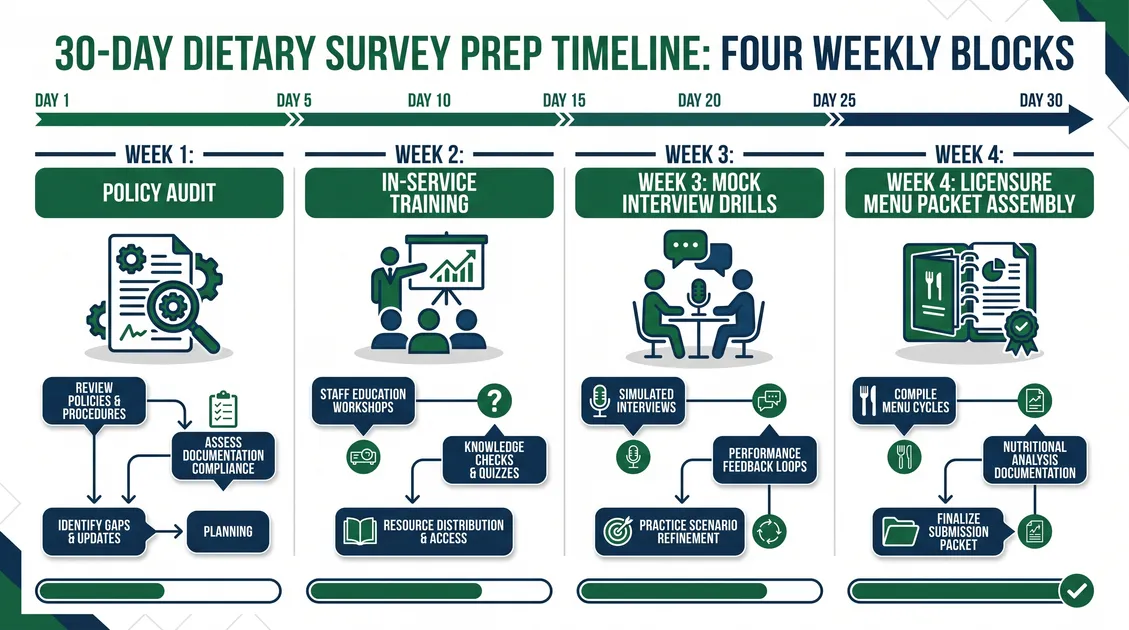
Senior care operators get the most out of this glossary by running a 30-day prep sequence before the recertification survey window opens. Week one, read your dietary policy and procedure manual against the definitions above and rewrite any sentence that uses a word the regulation does not. Week two, run in-service training where staff say the definitions out loud. Week three, run mock interview drills using surveyor phrasing: show me your menus as served, show me your substitution log, show me the RD approval letter. Week four, assemble the licensure menu packet with menus, nutrient analysis, and the signed approval page.
Dietary managers should pull the forms rather than build them. Our downloadable dietary template library supplies the substitution log, production sheet, and test tray audit form where these terms get recorded. State wording differs, and the exact rule number for your license lives in the state menu regulation citation index.
Care budgets are where vocabulary turns into money. In our experience, facilities arrive paying $800 to $1,200 per month to an external RDN for quarterly reviews and signatures, and switching to a $180 to $480 a year subscription saves roughly $9,000 to $14,000 a year. PantryTec plans are flat at $15, $20, and $40 per month billed annually ($20, $25, and $50 billed monthly) with therapeutic diets included from the Complete plan, and the RD approval letter is included at every tier. Run the numbers on our flat-rate menu plan pricing, which includes a per-resident savings calculator.
Glossary work pays off in dining satisfaction too. We deliver a print-ready PDF menu every Monday, with seasonal menu updates each spring and fall.
Key Takeaways on Senior Care Menu and Dietary Terminology
Menu vocabulary is the cheapest compliance asset a facility owns. These points carry the weight.
- Six terms drive most findings: cycle menu, menus as served, substitution log, food form, therapeutic diet, nutritional adequacy.
- Therapeutic diets need an order under tag F808; preference changes fall under F806 and need none.
- IDDSI numbers replace legacy texture names, with Level 5 set at 4 mm and Level 6 at 15 mm.
- Nutrient analysis is averaged across the full cycle against DRI targets, not judged one meal at a time.
- A signed RD approval letter plus dated menus as served is the evidence set surveyors ask for first.
Limitations and Considerations
Glossary definitions here reflect federal CMS language and common state patterns as of 2026, and they do not replace your state rule. Four caveats apply. State licensing code for assisted living can define terms differently than 42 CFR §483.60 does. Diet order delegation to an RDN is not permitted in every state. IDDSI adoption is uneven, so some diet manuals still use legacy names only. A signed menu does not fix a kitchen that fails to follow it, since F803 requires menus be followed as written. Verify every definition against your adopted diet manual and your licensing agency before writing policy.

Care teams that want the operational version of these answers should read the cycle menu FAQ for administrators, or call PantryTec at 385-512-4731 to talk with our team about a dietitian-approved menu quote.
What is a cycle menu in senior living?
A cycle menu is a fixed set of daily menus repeated in a set order, commonly 4, 5, or 10 weeks long. A 10-week cycle menu produces 70 unique daily plans covering breakfast, lunch, dinner, and snacks before anything repeats. Cycle menus support tag F803 because they make menus planned in advance and auditable.
How many weeks should an assisted living cycle menu be?
Most state licensing codes set a minimum rotation, often 3 or 4 weeks without repeating a day. Longer rotations reduce complaints, which is why PantryTec runs 5-week and 10-week cycles. Check your exact minimum in the state menu regulation citation index before shortening a rotation.
Do assisted living menus have to be approved by a dietitian?
Many states require assisted living menus to be reviewed by a registered dietitian or a clinically qualified nutrition professional, often at least annually. Credentialing runs through the Commission on Dietetic Registration, the credentialing body of the Academy of Nutrition and Dietetics. Confirm your state rule, since a few states accept a certified dietary manager for routine menu duties.
What does 42 CFR 483.60 require for menus?
42 CFR §483.60 requires menus that meet resident nutritional needs using current Dietary Reference Intakes, are prepared in advance, are followed as written, reflect resident preferences, and are updated periodically. Tag F803 enforces the menu and nutritional adequacy portion. Tags F801 through F814 cover staffing, food form, substitutions, hydration, and meal frequency.
How far in advance must menus be posted in a care facility?
Posting and retention rules come from state licensing code, not the federal rule, and they vary widely. Common patterns require menus posted where residents can read them at least one week ahead, with menus as served retained on file. Utah facilities work from R432-270; look up your own citation before setting the posting policy.
Explore Topics
8 related pages in this section
What Is Food Cost Per Resident Day (PRD)?
Low sodium senior menus with ≤1,500 mg sodium per day, dietitian-approved for assisted living. PantryTec plans start at $15/mo. Get a free sample menu.
What Is Food Cost Per Resident Day (PRD)?→What Is a Cycle Menu in Senior Living?
PantryTec vs CaterZen side-by-side: pricing from $15/mo, therapeutic diets, RD approval letters, and CaterTrax alternative analysis for senior care operators.
What Is a Cycle Menu in Senior Living?→Cycle Menu FAQ for Administrators
Request a quote for PantryTec's dietitian-approved menu subscription plans. Flat-rate pricing from $15/mo.
Cycle Menu FAQ for Administrators→How to Pass a CMS Dietary Survey: F-Tag Menu Requirements
CMS menu compliance in plain English: F-tag menu requirements, the survey walkthrough, the documents surveyors ask for, and RD-signed menu pricing.
How to Pass a CMS Dietary Survey: F-Tag Menu Requirements→PantryTec Cycle Menu Service for Senior Care Operators
Download free sample cycle menus for senior care facilities.
PantryTec Cycle Menu Service for Senior Care Operators→Food Cost Control Guide
Gluten-free menus for senior living communities, dietitian-approved and built into 10-week cycle rotations. Plans from $15/mo. Get a free sample menu.
Food Cost Control Guide→Senior Living Cycle Menu Provider Comparison Matrix
Top 10 dietary survey deficiencies ranked: F812, F803, F809 mapped to 42 CFR §483.60, with CMP ranges and plan-of-correction fixes that hold.
Senior Living Cycle Menu Provider Comparison Matrix→Memory Care Dining and Dementia Menu Guide
A dementia menu guide for memory care dining: finger food and fortified columns, F805 and F809 rules, service models, and RD-signed cycle menus.
Memory Care Dining and Dementia Menu Guide→