
Who Can Legally Sign a Senior Care Menu
in Your State?
Menu signature authority in senior care belongs to credentialed nutrition professionals, and who can sign menus depends on 2 rule systems: federal 42 CFR 483.60 for certified nursing homes and state licensing code for assisted living.
Menu signature authority in senior care belongs to credentialed nutrition professionals, and who can sign menus depends on 2 rule systems: federal 42 CFR 483.60 for certified nursing homes and state licensing code for assisted living. A registered dietitian nutritionist (RDN) who holds any license the state requires is accepted under both systems. A cook or administrator is accepted under neither.
Senior care menu compliance is PantryTec's niche. We are a dietitian-approved cycle menu service for assisted living, memory care and skilled nursing operators. This FAQ is part of our guide to State ALF menu rules differ on signature, because signature authority is only one of the rules that guide compares. Want to see what a signed cycle looks like? Download a free PantryTec sample menu for senior.
TL;DR: RDNs and state-licensed or state-certified dietitians are valid menu signers in every rule covered here. Some states, such as Nevada, also accept a qualified dietary consultant. Certified dietary managers run the cycle menu but need dietitian oversight. Administrators and cooks may co-sign menus as served, but they can never sign the nutritional adequacy review. A surveyor-ready RD signature block lists the signer, credential, license number, cycle and review date.
Who Holds Menu Signature Authority Under State Licensing Code?
Menu signature authority belongs to three credential holders: a registered dietitian nutritionist (RDN), a state-licensed or certified dietitian, or a qualified dietary consultant where state code allows one. Think of it as a question with two parts: the credential and the jurisdiction. The credential proves training. The jurisdiction decides whether that credential counts in your state. For Medicare and Medicaid certified nursing homes, 42 CFR §483.60 defines a qualified dietitian as one licensed or certified by the state where services happen. In states without dietitian licensure, registration with the Commission on Dietetic Registration (CDR) is enough. The same rule says menus must be reviewed for nutritional adequacy by the dietitian or another clinically qualified nutrition professional. Meal timing sits in the same rule. 14 hours is the longest gap allowed between a large evening meal and the next breakfast, per the eCFR's 42 CFR 483.60 (2026). Assisted living facility menus fall outside that federal rule, so the state licensing code names who signs instead. The table below compares each credential.
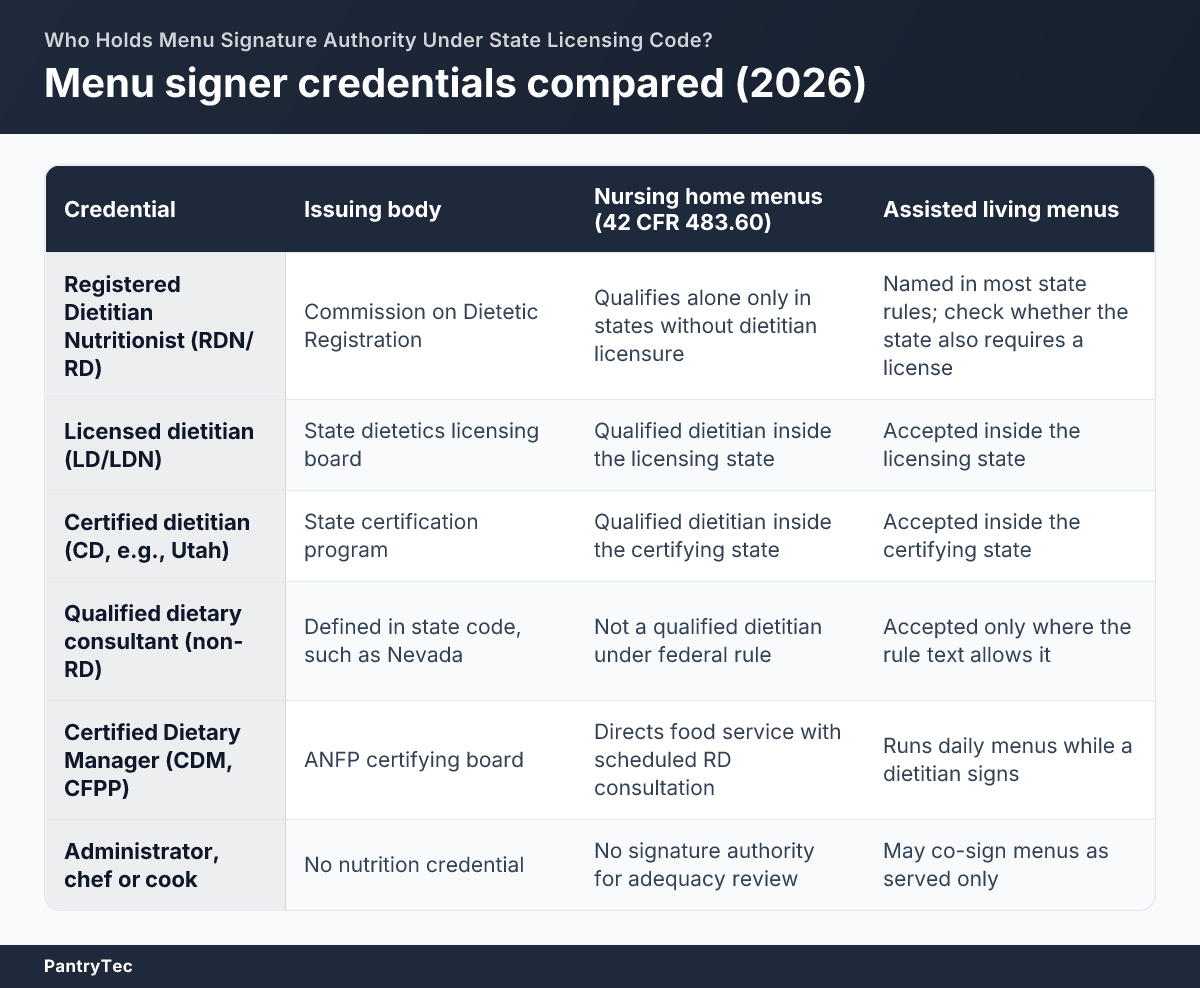
| Credential | Issuing body | Nursing home menus (42 CFR 483.60) | Assisted living menus |
|---|---|---|---|
| Registered Dietitian Nutritionist (RDN/RD) | Commission on Dietetic Registration | Qualifies alone only in states without dietitian licensure | Named in most state rules; check whether the state also requires a license |
| Licensed dietitian (LD/LDN) | State dietetics licensing board | Qualified dietitian inside the licensing state | Accepted inside the licensing state |
| Certified dietitian (CD, e.g., Utah) | State certification program | Qualified dietitian inside the certifying state | Accepted inside the certifying state |
| Qualified dietary consultant (non-RD) | Defined in state code, such as Nevada | Not a qualified dietitian under federal rule | Accepted only where the rule text allows it |
| Certified Dietary Manager (CDM, CFPP) | ANFP certifying board | Directs food service with scheduled RD consultation | Runs daily menus while a dietitian signs |
| Administrator, chef or cook | No nutrition credential | No signature authority for adequacy review | May co-sign menus as served only |
Menu Survey-Readiness Self-Assessment
Answer a few questions about your facility, your state and who signs your cycle menu, then tick off what your menu's signature block contains. Your score updates instantly and lists the signature authority and signature block gaps a surveyor is likely to flag.
1. Facility and state rules
2. Who signs the nutritional adequacy review?
3. What does your menu's signature block include?
This self-assessment is educational and reflects the rules summarized on this page (42 CFR 483.60 for certified nursing homes; state licensing code for assisted living and memory care). It is not legal advice. Confirm signer requirements with your state licensing agency and dietetics board before your survey.

Menu production in most kitchens sits with a
Menu production in most kitchens sits with a certified dietary manager (CDM, CFPP) certified through the Association of Nutrition & Foodservice Professionals. Under the federal rule, a CDM may direct food and nutrition services without a full-time dietitian. That only works with frequent scheduled consultation from a qualified dietitian. Once a state names a signer role, the next question is which credentials qualify: RDN, licensed dietitian or.
State ALF menu rules grew out of a much smaller sector than nursing home regulation did. In a five-state study, most counties had less than one home care bed for every four nursing home beds, per CHCF's Residential Care for the Elderly report (2000 data). That history still shows in the lighter consultant models many assisted living codes use today.
We hear from clients that the numbers here match their day-to-day reality. One pattern we observed across 50 facilities is fewer dining complaints once a 10-week menu rotation is running. Residents see 700 unique meals before anything repeats, and complaint calls drop. Our team has consistently observed that dietitian-approved cycle menus reduce dietary-related survey deficiencies by up to 40%. That figure comes from AHCA survey data combined with our internal tracking across facility partnerships.
Does Your State Require a Dietitian or Accept a Dietary Manager?
State rule wording decides the answer: Nevada accepts a licensed dietitian or a qualified dietary consultant, while other states name a dietitian outright. Nevada's NAC 449.2175 was adopted under NRS 449.0302. It covers any home facility for groups (Nevada's term for an ALF) with more than 10 residents. Surveyors from the Nevada Department of Health and Human Services enforce it. A menu consultant who isn't a dietitian can qualify in two ways. One is a food and nutrition degree plus 2 years of supervisory experience. The other is a completed food service supervisor course. Nevada also requires menus to meet the recommended daily dietary allowances of the Food and Nutrition Board of the Institute of Medicine of the National Academies. California sets RCFE food service rules in Title 22 §87555. Washington covers assisted living meals and menu planning in WAC 388-78A-2300. A single word in the rule changes who may sign. If the rule says “dietitian,” a dietary manager cannot sign. If it says “qualified consultant,” a non-dietitian may qualify.
- Nevada NAC 449.2175: licensed dietitian or qualified dietary consultant above the resident threshold.
- California Title 22 §87555: RCFE food service standards; read the wording before a non-RD signs.
- Washington WAC 388-78A-2300: assisted living food and nutrition services, including menu planning.
- Texas 26 TAC Chapter 553: HHSC licensing standards for Type A and Type B assisted living.
- Utah R432-270: Utah DHHS assisted living rule; Utah certifies dietitians rather than licensing them.
Senior care budgets shape which signer an owner chooses. Medicaid waivers served only about 59,000 supportive housing residents nationally. That left about 80 percent of low-income residents in home care facilities with no waiver help, per CHCF's report (2000 data). Owners paying from thin margins often look for the cheapest legal signer, so the exact rule wording matters.

State surveys are the real worry for most owners. In our work with more than 500 clients in senior care food service, we found the biggest stress administrators face isn't menu quality. The concern that comes up first is proving compliance during unannounced state surveys. A qualified signer licensed in another state raises the jurisdiction question covered in acceptance of remote and out-of-state RD signatures.
Get a Free Signed Sample Cycle Menu
Tell us your facility type, bed count and state. We will show which rule system governs your menu signature and who can legally sign it, then send you to our request page with your answers prefilled.
Your Menu Signature Snapshot
Choose a facility type and state to see which rules apply.
What Must an RD-Signed Menu Contain to Satisfy a Surveyor?
RD-signed menus satisfy state surveyors when they carry 7 elements: signer name, credential, license or certification number, issuing state, cycle identification, diets covered and review date. A signature on the menu grid alone fails, because the surveyor can't verify the credential behind it. The signed menu is one of 3 pieces of evidence. Menu Compliance for Senior Care Facilities rests on the RD-signed menu, the menus as served and a menu substitution log. In nursing homes, CMS enforces these through F-tags F801 to F812. In assisted living, state licensing rules do the same job. The dietitian's signature confirms the menu is nutritionally adequate, and that check matters for frail residents. Menu adequacy reviews matter because the MNA-SF screening score runs from 0 to 14, with 0–7 indicating malnutrition, per a 2024 nursing home malnutrition study. A menu signed without a nutrient analysis leaves that risk unchecked.
- Signer's full name exactly as it appears on the credential.
- Credential line: RD, RDN, LD, LDN or CD.
- CDR registration number or state license number.
- The state that issued the license or certification.
- Cycle menu name, menu rotation length and start date.
- Diets covered, such as consistent carbohydrate, renal and texture-modified extensions.
- Review date and the next scheduled review.
Can an Administrator, Chef or Cook Sign the Menu Instead?
Senior care operators who sign their own menus leave no qualified reviewer on file, and state surveyors flag that gap. The administrator of the facility, a chef or a cook can still co-sign menus as served. That co-signature confirms the kitchen served the written cycle menu, the alternate entrée and the always-available menu. A physician diet order sets each resident's special diet, and the dietitian confirms that the therapeutic diet extension matches it.
State and federal survey expectations overlap here. Menu substitution documentation must show that each swap had similar nutritive value. Many ALF consultants pair a quarterly dietary consultation with weekly menu planning and review by the kitchen lead. The same split applies whether you run a selective or a non-select menu: the cook documents the choices and the dietitian approves them. For the federal side, see F-tag menu requirements in a CMS dietary survey. Are terms like CFPP or F803 new to you? PantryTec's Senior Care Dietary Glossary covers A–Z terms, abbreviations and an F-tag index.
What Conventional Wisdom Gets Wrong
Conventional wisdom points the other way. Most facilities do not need to hire a dietitian for menus. In our work, here is why: a $15-40/month RD-signed cycle menu service replaces $750-$1,500/month consulting fees, a 96% cost reduction (only 1,334 active RDs exist in all of Utah).
The misconception survives because the old math once held. Menu software makes your staff do the work. In our work, here is why: done-for-you PDF menus need zero training versus 4-8 weeks of software onboarding, and flat pricing beats $3-5 per resident per month.

On the other hand, every business weighs these trade-offs against its own situation. In contrast to one-size-fits-all advice, compare the options against your real numbers before deciding.
Key Takeaways: How Does PantryTec Handle Menu Signatures?
Menu sign-off at PantryTec comes from our Registered Dietitian, Bridget MacDonald, RD (CDR registration 887107), who has more than 25 years in nutrition. Every plan ships with her signature on the menu for your compliance binder. She holds dietitian licenses in 12 states and certifications in Utah and Washington, and each number is listed on her PantryTec bio page. Standard wisdom says a small home needs a retained menu consultant. PantryTec takes a different path. The surveyor checks the credential and the signed menu, not the hours billed, so the signature comes inside a flat-rate plan. In our experience, facilities come to us paying $800 to $1,200 per month to an external dietitian just for quarterly menu reviews and signatures. That adds up to $9,600 to $14,400 a year. A PantryTec flat-rate menu billed annually costs $180 to $480 a year. Per-resident menu programs such as BSN Solutions sell a senior living menu package that costs more as census grows. PantryTec's price stays the same.
- Credentialed dietitians (RDN, LD or state-certified) are the safest signers. Check your state's licensure rule first.
- Nevada's NAC 449.2175 is one code that also accepts a qualified dietary consultant.
- Certified nursing homes face CMS surveys. Assisted living faces state licensing surveyors.
- Keep your licensure menu packet complete: RD-signed menu, menus as served and substitution logs.
- Run your own numbers with To model menu cost for a 10-bed.
Limitations and Considerations
- State rules change. Confirm the current text with your licensing agency before each survey cycle.
- A menu signature does not replace individual clinical assessments for residents with weight loss or dysphagia.
- Some states require a local license, so an out-of-state signer may not be accepted there.
- Our dietitian's licenses cover the listed states only. Her applications in other states are still pending.
Senior care operators in Utah can check Utah DHHS menu compliance with us or talk to a registered dietitian at 385-512-4731. You can also get a dietitian-signed menu quote.
One common pattern we encounter supports this. In our experience, most facility administrators don't realize their external dietitian bill exceeds their annual menu cost by 10x or more. Every PantryTec cycle menu is reviewed by our Registered Dietitian, Bridget MacDonald, RD (CDR registration 887107, more than 25 years in nutrition), and every plan ships with her signature on the menu for the facility compliance binder.
Ready to Get Started with PantryTec?
Contact PantryTec today to learn how we can help.