
Colorado requires every assisted living residence to serve at least three meals daily and to make weekly menus available 24 hours before serving. These colorado alr menu rules sit in 6 CCR 1011-1 Chapter 7, Part 17, which the Colorado Department of Public Health and Environment (CDPHE) enforces. PantryTec is a dietitian-approved cycle menu service for senior care facilities. This guide turns each Colorado clause into a menu task you can file. Colorado ALR needs are one row in our state menu regulation citation index, which explains how to find and read any state's rule.
Menu examples help more than rule text. Download Free 4-Week Sample pages to see a Colorado-ready week with alternates, snacks, and diet extensions marked.
TL;DR: Colorado ALRs serve at least 3 meals daily, keep weekly menus viewable a day before service, and offer substitutes of similar nutritive value (Part 17.1, 17.7, 17.2). Therapeutic diets need a practitioner prescription and trained staff (Part 17.10). Part 17 has no dietitian sign-off rule and no fixed retention period, unlike Colorado nursing facilities. Residences must stock food for 3 balanced meals a day for 3 calendar days (Part 17.9).
Last updated: . Rule text checked against the Chapter 7 version effective July 1, 2025.
What Does Colorado Require in an Assisted Living Residence Menu?
Colorado requires assisted living residences to serve three meals daily, vary menus daily, and display weekly menus ahead of service under Chapter 7, Part 17. CDPHE enforces these food and dining rules through its Health Facilities and Emergency Medical Services Division. Meals must offer variety, be nutritionally balanced, and be large enough to satisfy resident appetites. A resident who declines the plated meal must receive an appealing substitute of similar nutritive value. Water and other drinks must be offered with every meal and between meals. Residents also need independent access to drinks at all times. Menus must include seasonal or holiday foods, so a static menu that never changes with the calendar falls short. Residents should be encouraged to help plan menus, and the residence must make reasonable efforts to use their ideas. The table below maps each clause to the record a state surveyor expects to see.
| Part 17 clause | What it requires | Menu record to file |
|---|---|---|
| 17.1 | At least 3 meals daily at regular, community-normal times | Posted meal schedule with service times |
| 17.1(A) | Nourishing substitutes and snacks for residents eating off-schedule | Always-available menu and snack list |
| 17.2(A) | Appealing substitute of similar nutritive value on request | Selective menu with a daily alternate entrée |
| 17.3 | Drinks with and between meals, plus independent access at all times | Hydration station locations and refill schedule |
| 17.6 | Menus vary daily and include seasonal or holiday foods | Cycle menu rotation with seasonal and holiday weeks |
| 17.7 | Weekly menus viewable by residents and the public before serving | Dated weekly menu at a resident-accessible spot |
| 17.8 | Residents encouraged to take part in menu planning | Resident council notes or a menu suggestion log |
| 17.10 | Therapeutic diets only with a practitioner prescription and trained staff | Signed diet orders, diet roster, staff training records |
Written, Dated, and Posted Menu Standards
Menu posting in Colorado sets a one-day floor, not a one-week rule. Part 17.7 asks that the weekly menu be readily available to residents and the public before service. Colorado doesn't mandate a menu rotation length, so a 4-week or 10-week cycle menu both qualify when each day differs. In the selective versus non-select menu debate, a selective menu with a printed alternate entrée meets the substitute rule more cleanly. Date every posted week so a surveyor can match it to the menus as served.
Part 16 Food Safety Tiers by Bed Count
Assisted living kitchens follow two food safety tracks under Chapter 7, Part 16. A residence licensed for 20 beds or more follows the department's retail food regulations. A residence with 19 beds or fewer follows Parts 16.5 through 16.37 and needs no commercial kitchen. For those smaller homes, Part 16.18 bans raw or undercooked meat, poultry, and fish, raw unpasteurized eggs, raw milk, and raw seed sprouts. Food safety in this setting carries real weight. 75% of 7,094 U.S. norovirus outbreaks studied took place in long-term care and assisted living facilities, per the CDC journal Emerging Infectious Diseases (2020).
Colorado Part 17 Menu Survey Readiness Self Assessment
Rate each of the eight menu binder tabs mapped to 6 CCR 1011-1 Chapter 7, Part 17. Your readiness score and a prioritized gap report update as you go. You can then open the report in your own email app or copy it.

Rate each tab to see your gap report.
This page has no server and stores nothing. The email button opens a prefilled draft in your own email program; you review and send it yourself. This is a self check, not legal advice or a CDPHE determination.
How Does C.R.S. § 25-27-104 Shape Colorado ALR Menu Rules?
Colorado Revised Statutes § 25-27-104 is the enabling law, and Chapter 7 is the operative rulebook that tells a residence what to serve and post. Subsection (1) directed the state board to adopt minimum standards by November 1, 2002, covering sanitation, operations, and the adequacy of diet and nutrition. The statute has 2 subsections, and subsection (2) lists 13 required rule topics as paragraphs (a) through (m). Paragraph (2)(b) calls for annual inspection of assisted living residences by the department or its designee. Subsection (1) also says the rules must treat homes of different sizes differently. That clause explains why Part 16 splits kitchens at 20 beds. Chapter 7 cites five statutes as its authority, including §§ 25-1.5-103, 25-27-101, and 25-27-104. The statute itself doesn't mention menus, posting, or substitutes. Those operative details live only in the CDPHE rules, so a survey citation points to a Chapter 7 part number.
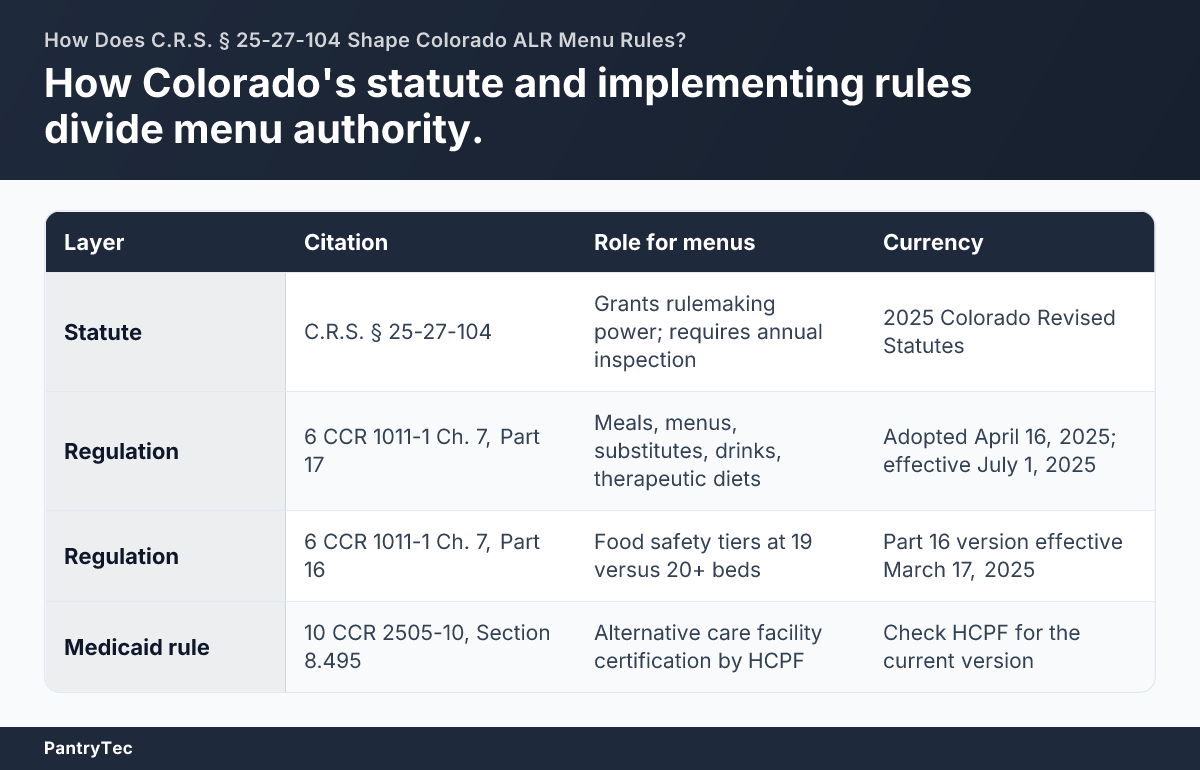
| Layer | Citation | Role for menus | Currency |
|---|---|---|---|
| Statute | C.R.S. § 25-27-104 | Grants rulemaking power; requires annual inspection | 2025 Colorado Revised Statutes |
| Regulation | 6 CCR 1011-1 Ch. 7, Part 17 | Meals, menus, substitutes, drinks, therapeutic diets | Adopted April 16, 2025; effective July 1, 2025 |
| Regulation | 6 CCR 1011-1 Ch. 7, Part 16 | Food safety tiers at 19 versus 20+ beds | Part 16 version effective March 17, 2025 |
| Medicaid rule | 10 CCR 2505-10, Section 8.495 | Alternative care facility certification by HCPF | Check HCPF for the current version |
Residence operators should confirm rule currency before each survey cycle. As of October 2026, the latest Chapter 7 version we verified was adopted April 16, 2025, and took effect July 1, 2025, per the Code of Colorado Regulations. Check the Secretary of State site for later amendments.
Assisted living residences certified by Colorado's Department of Health Care Policy and Financing for Medicaid are called alternative care facilities. Federal home and community-based services (HCBS) settings rules also expect residents in those settings to have access to food at any time. Home care menu budgets have long received little waiver support. Medicaid waivers served only about 59,000 supportive housing residents nationally, leaving about 80 percent of low-income home care residents without that help, per the California HealthCare Foundation report Residential Care for the Elderly (2000 data). Waivers also exclude room and board, so menu costs come from resident payments.

Does Colorado Require a Dietitian to Review ALR Menus?
Colorado does not require a registered dietitian to approve assisted living menus under Part 17, but therapeutic diets need a practitioner prescription and trained staff. Colorado nursing care facilities face a stricter rule. Section 13.8 of 6 CCR 1011-1 Chapter 5 requires menus approved by a registered dietitian, planned at least one week ahead, and kept four weeks after use. Chapter 7 defines a therapeutic diet as one ordered by a practitioner or registered dietitian to treat a condition or change specific nutrients. Its examples include a calorie-counted diet, a specific sodium gram diet, and a cardiac diet. Part 17.14 adds a training rule. Staff who help residents eat must be trained by a qualified professional, such as a registered nurse, speech-language pathologist, or registered dietitian. Dietitian involvement is optional for the general menu and practical for clinical diets. Many operators still choose a dietitian-approved menu as proof of nutritional adequacy.
When Dietitian Review Becomes Necessary in Practice
- A practitioner orders a 2-gram sodium or no-added-salt (NAS) cardiac diet.
- A resident with diabetes needs consistent carbohydrate (CCHO) portions at all 3 meals.
- A renal diet order restricts potassium, phosphorus, and daily protein.
- Dysphagia calls for IDDSI Level 4 pureed, Level 5 minced and moist, or Level 6 soft and bite-sized food.
- Part 17.4 consumption checks flag unplanned weight loss or dehydration.
- A resident repeatedly declines practitioner diet advice, triggering Part 17.5 documentation.
Menu changes for a therapeutic diet start with a signed order in the resident record. Our guide to why therapeutic diets must be physician-ordered covers the federal version of this rule. The therapeutic diet menu extensions show how one base menu branches into each order.
Standard wisdom says a Colorado ALR needs a consulting dietitian on retainer, but PantryTec takes a different path because Part 17 asks for orders and trained staff, not a monthly consultant. In our experience, facilities come to us paying $800 to $1,200 per month to an external dietitian just for quarterly menu reviews and signatures. That is $9,600 to $14,400 a year, against $180 to $480 a year for a PantryTec plan billed annually with the RD Approval Letter included. Every PantryTec cycle menu is reviewed by our Registered Dietitian, Bridget MacDonald, RD (more than 25 years in nutrition). Keep a clinical dietitian for individual resident assessments; the menu signature is the part a subscription replaces.
Colorado Dietitian Licensure Considerations
Colorado Part 17 does not name a required dietitian credential for menu review. Bridget MacDonald holds national CDR registration, and her state licenses, listed on her bio page, do not include Colorado. Confirm current Colorado credential rules with the Department of Regulatory Agencies before relying on any signature for a clinical task.
One common pattern we encounter supports this. In our experience, most facility administrators don't realize their external dietitian bill exceeds their annual menu cost by 10x or more. We deliver a new facility's first menu PDF within 24 to 48 hours of sign-up, and fresh cycle menus then arrive in the facility inbox every week.
How Long Must Colorado Menus and Substitutions Be Retained?
Colorado sets no fixed retention period for menus as served in Part 17, so PantryTec recommends keeping dated menus and substitution notes for 12 months. That window covers the annual inspection called for in C.R.S. § 25-27-104(2)(b). Colorado nursing care facilities have a firm rule: menus are kept at least four weeks after use, and changes are posted as served. Maryland assisted living programs keep menus as served for 6 months under COMAR 10.07.14.30. California home care facilities for the elderly with 16 or more residents keep dated menus as served for at least 30 days, per the California Department of Social Services RCFE regulations. A surveyor in a Colorado ALR still compares the posted week with what residents ate. Missing records turn a simple swap into an unexplained deviation. Retention matters most for substitutions, because a swap is the change nobody sees on the posted menu.
| Setting | Rule | Advance planning | Retention as served | Dietitian review |
|---|---|---|---|---|
| Colorado ALR | 6 CCR 1011-1 Ch. 7, Pt. 17 | Weekly menu viewable before serving | No fixed period stated in Part 17 | Not required for the general menu |
| Colorado nursing care facility | 6 CCR 1011-1 Ch. 5, §13.8 | At least 1 week ahead | At least 4 weeks after use | Registered dietitian approval required |
| Maryland assisted living | COMAR 10.07.14.30 | At least 1 week ahead | 6 months | Dietitian or nutritionist reviews the 4-week menu at least every 3 years |
| California RCFE (16+ residents) | 22 CCR §87555 | At least 1 week ahead | At least 30 days, dated | No RD signature in the menu clause |
Recording Substitutions of Similar Nutritive Value
Menu substitution logs prove that each swap met the similar-nutritive-value standard in Part 17.2(A). One line per change works when it captures these fields:

- Date and meal (breakfast, lunch, dinner, or snack)
- Planned item from the cycle menu
- Item actually served, with portion size
- Reason: supply shortage, resident request, or recipe failure
- Food group or protein match confirming similar nutritive value
- Therapeutic diet orders affected, such as CCHO or 2-gram sodium
- Initials of the cook or person in charge
Assisted living carries different legal names across states, and the name decides which menu rule applies. Oregon regulates home care and assisted living facilities under OAR 411-054. North Carolina licenses adult care homes under 10A NCAC 13F, and New York uses adult homes and assisted living residences under 18 NYCRR. Ohio regulates home care facilities under OAC Chapter 3701-17, Michigan separates homes for the aged from adult foster care, and Texas licenses Type A and Type B assisted living facilities. Colorado's menu retention window is best understood against the state differences in menu signature, posting and retention. Neighboring states differ too, as our Arizona assisted living menu rules guide shows. 3.0 percent of U.S. women aged 65 and over lived in nursing facilities in 2020, compared with 1.8 percent of men, per the U.S. Census Bureau.
What Meal Timing Rules Apply to Colorado Assisted Living Residences?
Colorado requires at least three meals daily at regular, community-normal times, plus nourishing substitutes and snacks for off-schedule eaters, under Part 17.1. Meal times can also flex to resident preferences and plans of care. Part 17 sets no maximum gap between dinner and breakfast. The closest benchmark is federal tag F809 at 42 CFR §483.60(f), written for certified nursing facilities. F809 caps the span between a large evening meal and breakfast at 14 hours. The span may reach 16 hours when a nourishing bedtime snack is served and a resident group agrees. Colorado ALRs are not bound by F809, yet the 14-hour span is a sound scheduling guardrail. Part 17.9 adds a supply rule: keep enough food for three balanced meals per day for three calendar days. Part 17.3 requires drinks with meals, between meals, and within residents' reach at all times.
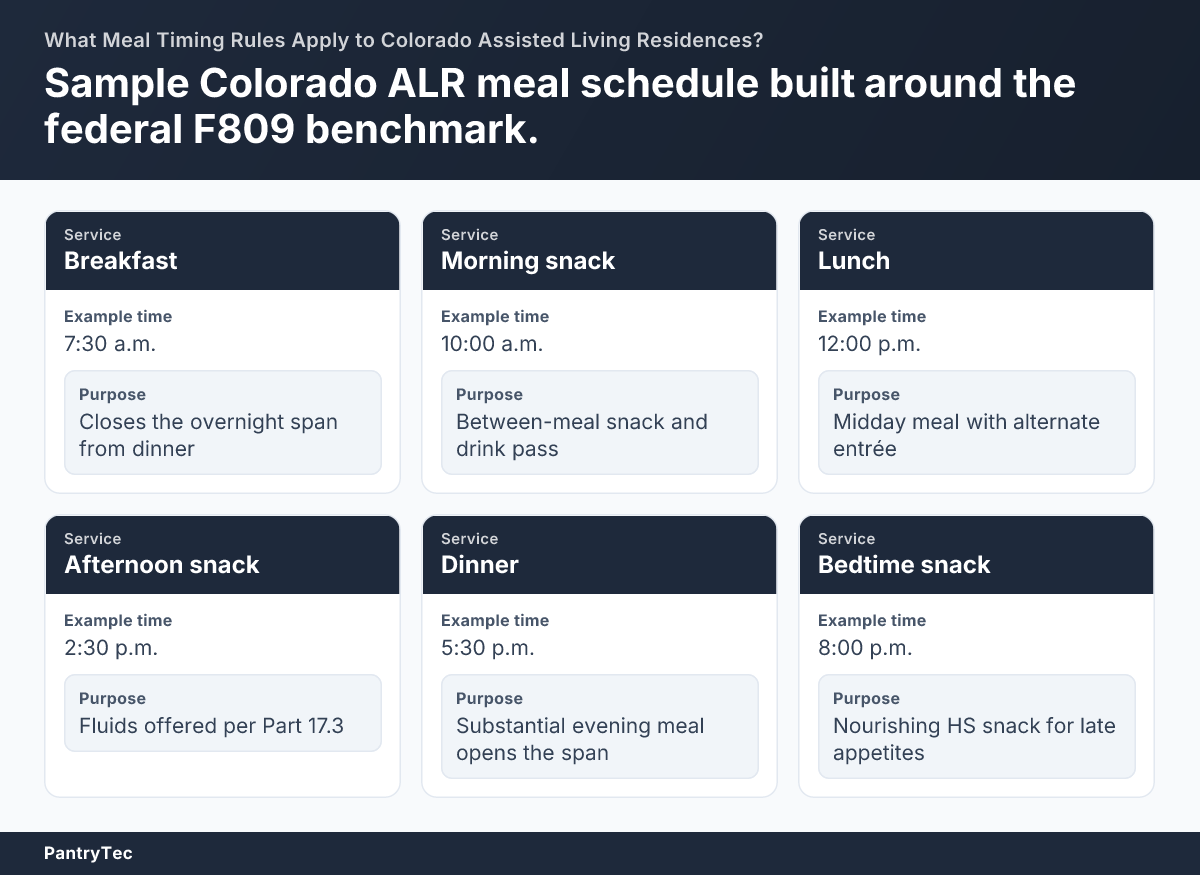
| Service | Example time | Purpose |
|---|---|---|
| Breakfast | 7:30 a.m. | Closes the overnight span from dinner |
| Morning snack | 10:00 a.m. | Between-meal snack and drink pass |
| Lunch | 12:00 p.m. | Midday meal with alternate entrée |
| Afternoon snack | 2:30 p.m. | Fluids offered per Part 17.3 |
| Dinner | 5:30 p.m. | Substantial evening meal opens the span |
| Bedtime snack | 8:00 p.m. | Nourishing HS snack for late appetites |
Maximum Overnight Fasting Interval
Menu schedules that serve dinner at 5:30 p.m. and breakfast at 7:30 a.m. land exactly on the federal cap. Late risers stretch that gap, so the always-available menu matters for residents who sleep in. Surveyor guidance for F809 sits in Appendix PP of the CMS State Operations Manual. That federal benchmark covers most institutionalized seniors. 82.0% of U.S. adults 65 and older living in group quarters were in nursing or skilled nursing facilities during 2014 to 2018, per the U.S. Census Bureau American Community Survey (2018).
Three-Day Food Supply Math
Residence kitchens meet Part 17.9 with simple math. A 10-resident home needs 90 resident-meals on hand: 3 meals times 3 days times 10 residents. PantryTec includes an emergency pantry list with each weekly menu so the stock matches the cycle. For memory care residents who resist utensils, a dementia finger food keeps intake steady between meals.
How Does a Colorado Operator Prepare Menus for a CDPHE Survey?
Colorado operators prepare for CDPHE surveys by filing eight menu records tied to Part 17, since C.R.S. § 25-27-104(2)(b) calls for annual inspections. The records answer the questions a surveyor asks in the dining room and kitchen. Is this week's menu viewable, and was it out a day early? Did today's meal match it, or is the swap logged? Does each therapeutic tray trace back to a practitioner's prescription? Chapter 7 defines a deficiency as any failure to fully comply with a statutory or regulatory requirement. A missing diet order is a deficiency even when the resident ate well. Pairing each record with its Part 17 citation lets a cook or administrator answer in seconds. The numbered list below works as binder tabs, in a simple kitchen-to-office order you can hand to any shift lead.
Survey-Ready Menu Binder Checklist
- Post the current weekly menu where residents and visitors can see it before service (17.7).
- File menus as served for the past 12 months, with substitutions annotated.
- Keep the menu substitution log showing similar nutritive value (17.2(A)).
- File signed practitioner orders for every therapeutic diet, plus a current diet roster (17.10).
- Store staff training records, including food safety and feeding-help training (17.14).
- Count the 3-day food inventory against 3 balanced meals per resident per day (17.9).
- Save resident menu input, such as council minutes or a suggestion log (17.8).
- Record consumption observations and practitioner notices for weight or hydration changes (17.4).
Menu documentation, not menu quality, is the first worry we hear about. In our work, we found the biggest stress administrators face is proving compliance during unannounced state surveys. One pattern our team sees is fewer dining complaints once a 10-week menu rotation is running. New residences can reuse these same tabs as a licensure menu packet, and our survey-ready dining checklist for small assisted living homes gives you a printable version.
Correcting Food Service Deficiencies
Menu deficiencies are fixed with a written plan of correction naming the fix, the person responsible, and the monitoring step. For a missing substitution log, that plan would retrain the cook, start a daily log, and audit it weekly for 4 weeks.

Colorado operators often reach for menu software after a citation, but software makes your staff do the writing. Long-term care technology has its own research base: 14 companies were interviewed and classified by technology type, function, customer, site of use, and workforce impact, per the PMC-published study Emerging Health Technologies in Long-Term. Surveyors still read a dated menu and a signed order. That's why PantryTec delivers ready-to-file PDFs instead of a platform your team has to learn.
Key Takeaways on Colorado ALR Menu Rules
Colorado menu duties fit on one page:
- Serve at least 3 meals daily and keep each weekly menu viewable before service (Part 17.1 and 17.7).
- Offer an alternate entrée of similar nutritive value, plus drinks at all times (Part 17.2(A) and 17.3).
- Prepare therapeutic diets only with a practitioner prescription and trained staff (Part 17.10).
- Keep menus as served and substitution logs for 12 months, since Part 17 sets no period and the statute calls for annual inspections.
- Stock food for 3 balanced meals a day for 3 calendar days (Part 17.9).
Menu compliance questions are easier with a dietitian on call. Talk to a Registered Dietitian at PantryTec, or compare flat-rate RD-signed menu plans from $15/month.
What Conventional Wisdom Gets Wrong
Conventional wisdom points the other way. Most facilities do not need to hire a dietitian for menus. In our work, here is why: a $15-40/month RD-signed cycle menu service replaces the $800-$1,200/month consulting fees on the invoices facilities bring us, a 95% to 99% cost reduction.
The misconception survives because the old math once held. Menu software makes your staff do the work. In our work, here is why: done-for-you PDF menus need zero training versus 4-8 weeks of software onboarding, and flat pricing beats $2-5 per resident per month.
On the other hand, every business weighs these trade-offs against its own situation. In contrast to one-size-fits-all advice, compare the options against your real numbers before deciding.