
IDDSI levels run from 0 to 7. You will find all 8 on this printable iddsi level cheat sheet, with names, color codes, and test methods. Drinks use Levels 0–4 and foods use Levels 3–7, per the University of Hong Kong IDDSI overview. PantryTec, a dietitian-approved cycle menu service for assisted living, memory care, and skilled nursing kitchens, built it for dietary managers who extend one base menu into texture-modified diets. It sits inside our senior care dietary glossary of menu terms, where IDDSI level names are texture-change entries.
Printable references work best beside real menus. Download the Free 10-Week Sample to see how texture levels attach to a dietitian-reviewed cycle, or request a menu demo to review IDDSI extensions with our team.
TL;DR: IDDSI has 8 levels (0–7): drinks 0–4, foods 3–7. Level 5 Minced and Moist particles max out at 4 mm, and Level 6 pieces are about 15 mm. The syringe flow test sorts drinks into Levels 0–3. Legacy pureed maps to Level 4 and honey-thick to Level 3. F805 surveyors trace the order, tray card, and plate.
What Are the Eight IDDSI Levels From 0 to 7?
IDDSI defines 8 levels numbered 0 to 7, with drinks on Levels 0–4 and foods on Levels 3–7, according to the University of Hong Kong IDDSI summary. Each level carries a number, a text label, and a color code, so a cook and a server read the same order the same way. The International Dysphagia Diet Standardisation Initiative was founded in 2013, released its framework in 2016, and published it in 2017, per that same summary. Levels 3 and 4 form the overlap zone. Level 3 is Moderately Thick for drinks and Liquidised for foods. Level 4 is Extremely Thick for drinks and Pureed for foods. That overlap is where tray mix-ups happen, because one number can describe a cup or a bowl. The table below is the core of the cheat sheet. Print it, laminate it, and keep it where plates are built.
| Level | Official name | Applies to | Color code | Kitchen example | Verification test |
|---|---|---|---|---|---|
| 0 | Thin | Drinks | White | Water, coffee, broth | Flow test: under 1 mL left |
| 1 | Slightly Thick | Drinks | Grey | Lightly thickened milk | Flow test: 1–4 mL left |
| 2 | Mildly Thick | Drinks | Pink | Thickened juice (former nectar-thick) | Flow test: 4–8 mL left |
| 3 | Moderately Thick / Liquidised | Drinks and foods | Yellow | Smooth cream soup | Flow test over 8 mL left; fork drip test |
| 4 | Extremely Thick / Pureed | Drinks and foods | Green | Pureed carrots, pureed meatloaf | Spoon tilt and fork drip tests |
| 5 | Minced and Moist | Foods | Orange | Minced chicken in thick gravy | Fork drip, spoon tilt, fork pressure |
| 6 | Soft and Bite-Sized | Foods | Blue | Tender baked fish, flaked | Fork pressure test |
| 7 | Regular / Easy to Chew | Foods | Black | Standard cycle menu entrée | Fork pressure test for Easy to Chew |
Drink Levels 0–4 Defined
Level 0 through Level 4 cover drinks, from thin water to extremely thick liquids eaten by spoon. Thicker drinks move more slowly, which lowers aspiration risk for residents with dysphagia. A speech-language pathologist recommends the level after a swallow check, and the physician diet order makes it binding.
Food Levels 3–7 Defined
Level 5 Minced and Moist limits adult particles to 4 mm, matching the gap between standard fork tines, per a ClinicalTrials.gov IDDSI study record. IDDSI Level 6 soft and bite-sized food uses adult pieces of about 15 mm, per the IDDSI framework descriptors. IDDSI Level 4 pureed food has no lumps and holds its shape on a spoon.
Level 7 Easy to Chew Explained
Level 7 has two forms. Regular is everyday food with no texture limits, while Easy to Chew is soft and tender, without hard or stringy pieces, and it doesn't control bite size. IDDSI also defines transitional foods, which start firm and soften with moisture, like some wafers.

Therapeutic Diet Filter: IDDSI Levels 4, 5 and 6
Pick a texture level to see how one base cycle menu extends into Pureed, Minced and Moist, or Soft and Bite-Sized plates. Narrow by meal or search an ingredient.
Sample dishes are illustrative examples of texture extensions from a base menu, not a prescription. Level definitions, color codes and test methods follow the IDDSI framework as summarized on this cheat sheet: Level 5 particles max out at 4 mm, Level 6 pieces are about 15 mm. Always verify each plate with the listed IDDSI tests and follow the resident's diet order and your dietitian's guidance.
How Do IDDSI Levels Map to Legacy Terms Like Mechanical Soft and Pureed?
Levels in IDDSI replace legacy names: pureed is Level 4, mechanical soft is usually Level 5, nectar-thick is Level 2, and honey-thick is Level 3. Most of those legacy names come from the National Dysphagia Diet and older thickened-liquid labels. Pudding-thick or spoon-thick liquids move to Level 4 Extremely Thick. NDD dysphagia advanced sits closest to Level 6 Soft and Bite-Sized. The fit isn't exact, and that gap matters on survey day. Legacy terms were descriptive, while IDDSI levels are testable. A kitchen's old 'mechanical soft' fails Level 5 when meat is chopped coarsely instead of minced to fork-tine size. Level 1 Slightly Thick has no legacy match, so residents moving to it need a fresh diet order. Use the crosswalk below to retire old labels. Then test every converted standardized recipe before its first service under the new name.
Crosswalk Table of Old and New Names
| Legacy term | IDDSI level and name | Color code |
|---|---|---|
| Thin liquids | Level 0 Thin | White |
| No legacy equivalent | Level 1 Slightly Thick | Grey |
| Nectar-thick | Level 2 Mildly Thick | Pink |
| Honey-thick | Level 3 Moderately Thick | Yellow |
| Pudding-thick or spoon-thick | Level 4 Extremely Thick | Green |
| NDD Level 1 Dysphagia Pureed | Level 4 Pureed | Green |
| NDD Level 2 Mechanically Altered (mechanical soft, ground) | Level 5 Minced and Moist | Orange |
| NDD Level 3 Dysphagia Advanced (chopped) | Level 6 Soft and Bite-Sized | Blue |
| Regular diet | Level 7 Regular or Easy to Chew | Black |
Updating Diet Cards Without Confusing Staff
Level numbers should replace old names on every tray card, diet roster, and menu substitution log in one cutover week. Two vocabularies running side by side is how a 'soft' order becomes the wrong plate. Print the number, name, and color together so a new aide reads all three.
IDDSI conversions also expose a cost problem we see often. In our experience, facilities come to us paying $800 to $1,200 per month to an external dietitian for quarterly menu reviews and signatures. That totals $9,600 to $14,400 a year, against $180 to $480 a year for a PantryTec flat-rate menu billed annually with the RD signature included.
Standard wisdom says each texture level needs its own menu, rebuilt by a consultant. PantryTec extends IDDSI Levels 4, 5, and 6 from the same base cycle menu instead, because one menu keeps entrées and portions aligned across textures. Our guide to building therapeutic diet menus from one cycle shows that spreadsheet logic.
How Do You Test Food and Drink Consistency for IDDSI Compliance?
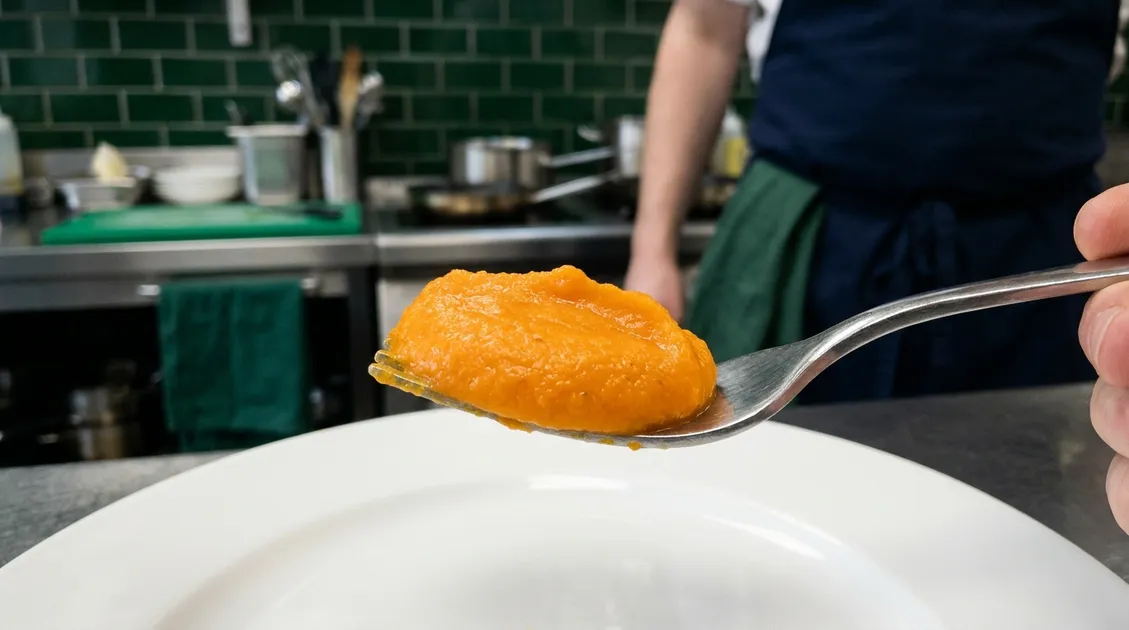
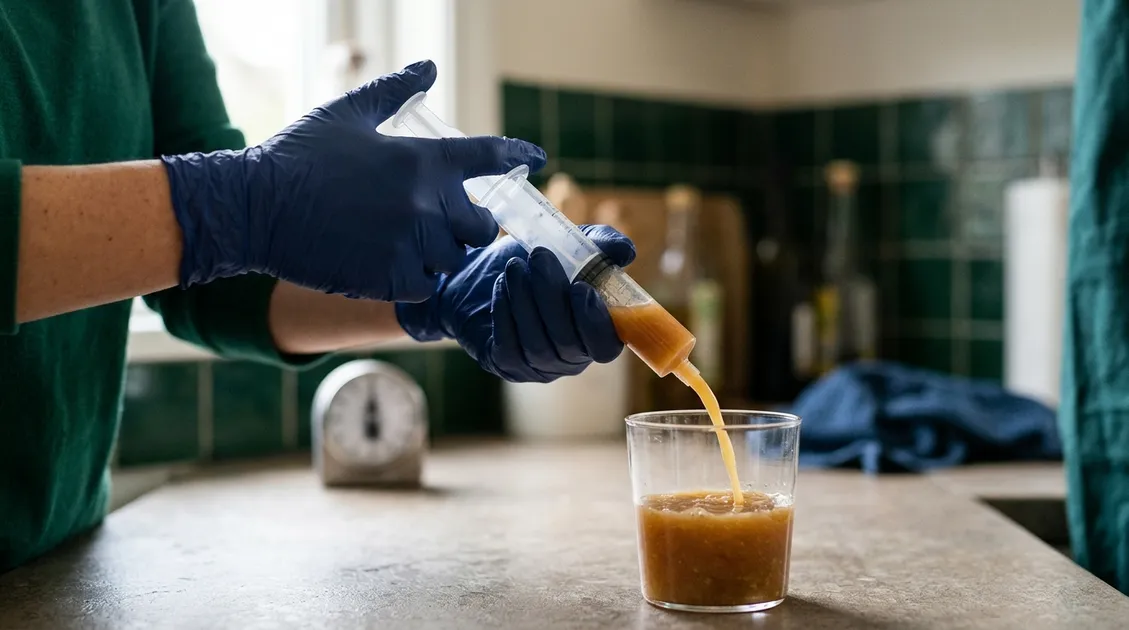
IDDSI flow testing classifies drinks from Level 0 to Level 3 by timing a 10 mL syringe for 10 seconds, per IDDSI's flow test poster. Less than 1 mL remaining is Level 0 Thin, and 1 to 4 mL is Level 1 Slightly Thick. Between 4 and 8 mL is Level 2 Mildly Thick, and more than 8 mL is Level 3 Moderately Thick. The syringe itself is specified: a Luer slip-tip model with a 61.5 mm scale length. Foods use other tools. The fork drip test checks Levels 3 to 5 for thickness and cohesiveness, per the IDDSI testing methods. The spoon tilt test checks Levels 4 and 5. IDDSI Level 4 puree must pass both tests, holding a mound on a fork and sliding cleanly off a tilted spoon. It must show no lumps and no stickiness. A cook or certified dietary manager (CDM) runs these checks on each texture-modified batch before the tray line opens.
The 10 mL Syringe Flow Test
- Cap the syringe tip with a finger and fill it to the 10 mL line.
- Release the tip and start a timer at the same moment.
- Re-cap the tip at exactly the 10-second mark.
- Read the mL left, match it to the Level 0–3 ranges, and log date and initials.
Fork Drip and Spoon Tilt Tests
Level 3 liquidised food drips slowly in dollops through fork tines, while Level 4 pureed food sits in a mound above the fork. On the spoon tilt test, a full spoonful of Level 4 food plops off with very little residue left behind.
Fork Pressure and Chopstick Tests
Level 6 food squashes under a fork pressed until the thumbnail blanches white, and it does not spring back to shape. Chopsticks are an accepted substitute where forks aren't used, and Level 7 Easy to Chew food passes the same pressure check.
How Does IDDSI Documentation Satisfy F805 Food Form Requirements?
IDDSI numbering satisfies F805 evidence checks because 42 CFR §483.60(d)(3) requires food in a form meeting each resident's individual needs, per the eCFR regulation text. Surveyors test that rule during dining observation. They compare the physician diet order, the tray card, and the plated food, following CMS State Operations Manual Appendix. A tray card reading 'mech soft' invites argument. A tray card reading 'Level 5 Minced and Moist, orange' points to a fork-tine standard anyone can check. Therapeutic diet orders fall under F808 and §483.60(e), and our CMS dietary F-tag quick reference index lists the related tags. Federal F-tags bind Medicare- and Medicaid-certified nursing facilities. State-licensed assisted living follows state rules instead, such as Utah's R432-270 assisted living rule. IDDSI labels still help there, because the same tray card works under either license. A CCRC or multi-level campus feeding assisted living and skilled nursing from one kitchen gains the most from one shared vocabulary.
Linking Diet Orders, Tray Cards, and Competency Records
- Physician diet order names food and drink levels separately, such as Level 6 food with Level 2 drinks.
- Diet roster updates in the same shift the order changes.
- Tray card shows the level number, official name, and color code.
- Staff competency records show each cook passed IDDSI testing training.
IDDSI labels address the worry we hear most from administrators. In our work with more than 500 clients in senior care food service, the biggest stress isn't menu quality. The concern that comes up first is proving compliance during unannounced state surveys, and a clean order-to-tray chain answers it.
Level labels also need a signature trail on the menu itself. Every PantryTec cycle menu is reviewed by our Registered Dietitian, Bridget MacDonald, RD (CDR registration 887107, more than 25 years in nutrition). She signs each cycle menu for the facility compliance binder.
We hear from clients that the numbers here match their day-to-day reality. One pattern we observed across 50 facilities is fewer dining complaints once a 10-week menu rotation is running. Residents see 700 unique meals before anything repeats, and complaint calls drop. Our team has consistently observed that dietitian-approved cycle menus reduce dietary-related survey deficiencies by up to 40%. That figure comes from AHCA survey data combined with our internal tracking across facility partnerships.
Where Can Kitchens Get a Printable IDDSI Cheat Sheet?
Printable IDDSI cheat sheets fit all eight levels on one letter-size page (8.5 × 11 inches), and our template library stores a print-ready copy. Find it in the printable dietary forms and template library, alongside other kitchen-ready dietary templates. Post one laminated copy at each tray line station, where plates for texture-modified diets are built. Post another in the nourishment room, where staff thicken drinks between meals. Servers benefit from a pocket card shrunk to a quarter page, about 4.25 × 5.5 inches. IDDSI also offers official framework artwork at no cost on its framework page. For the menus themselves, see our therapeutic diet menus, including IDDSI Level 4, Level 5 and Level 6. Kitchens also need menus that already carry those numbers. PantryTec's Complete Plan, at $20 per month billed annually, includes a therapeutic diet portion and texture guide plus a diet manual.
Pairing the Cheat Sheet With Production Planning
Level counts also belong on the cook-to-census production sheet. Puree only the servings the diet roster calls for, and keep commercial thickener at a set par level in the nourishment room. Extensions such as the IDDSI Level 4 pureed and the IDDSI Level 6 soft and bite-sized keep those counts tied to the base cycle.
Key Takeaways for Using the IDDSI Level Cheat Sheet
IDDSI levels work only when every label, test, and order uses the same number. These points summarize the cheat sheet.
- IDDSI has 8 levels: drinks use 0–4, foods use 3–7, and Levels 3 and 4 overlap.
- Level 5 Minced and Moist and Level 6 Soft and Bite-Sized each carry a measurable size limit checked with a standard fork.
- The syringe flow test sorts drinks into Levels 0–3 by the mL left in the barrel.
- Legacy pureed maps to Level 4 and honey-thick to Level 3, but every converted recipe needs retesting.
- F805 under 42 CFR §483.60(d)(3) is the food-form benchmark surveyors apply in certified nursing facilities.
Limitations and Considerations
- A cheat sheet does not replace a swallow check by a speech-language pathologist.
- Legacy-to-IDDSI mapping is approximate, because facility definitions of 'mechanical soft' differ.
- Test accuracy depends on the specified syringe and a standard metal fork.
- Assisted living texture rules vary by state, so check your licensing agency before relabeling.
Level conversions raise questions in every kitchen. Talk to a Registered Dietitian through PantryTec about texture extensions for your census.
One common pattern we encounter supports this. In our experience, most facility administrators don't realize their external dietitian bill exceeds their annual menu cost by 10x or more. We found that cook-to-census planning alone cuts food cost by about 12% in PantryTec kitchens. Fresh cycle menus arrive in the facility inbox every week.

What Conventional Wisdom Gets Wrong
Conventional wisdom points the other way. Most facilities do not need to hire a dietitian for menus. In our work, here is why: a $15-40/month RD-signed cycle menu service replaces $750-$1,500/month consulting fees, a 96% cost reduction.
The misconception survives because the old math once held. Menu software makes your staff do the work. In our work, here is why: done-for-you PDF menus need zero training versus 4-8 weeks of software onboarding, and flat pricing beats $3-5 per resident per month.
On the other hand, every business weighs these trade-offs against its own situation. In contrast to one-size-fits-all advice, compare the options against your real numbers before deciding.
Ready to Get Started with PantryTec?
Contact PantryTec today to learn how we can help.