
F806 and F807:
Substitutions, Allergies, Preferences and Hydration
Substitutions, allergies, preferences and hydration sit in three short clauses of 42 CFR §483.60(d), and surveyors cite them as F806 and F807.
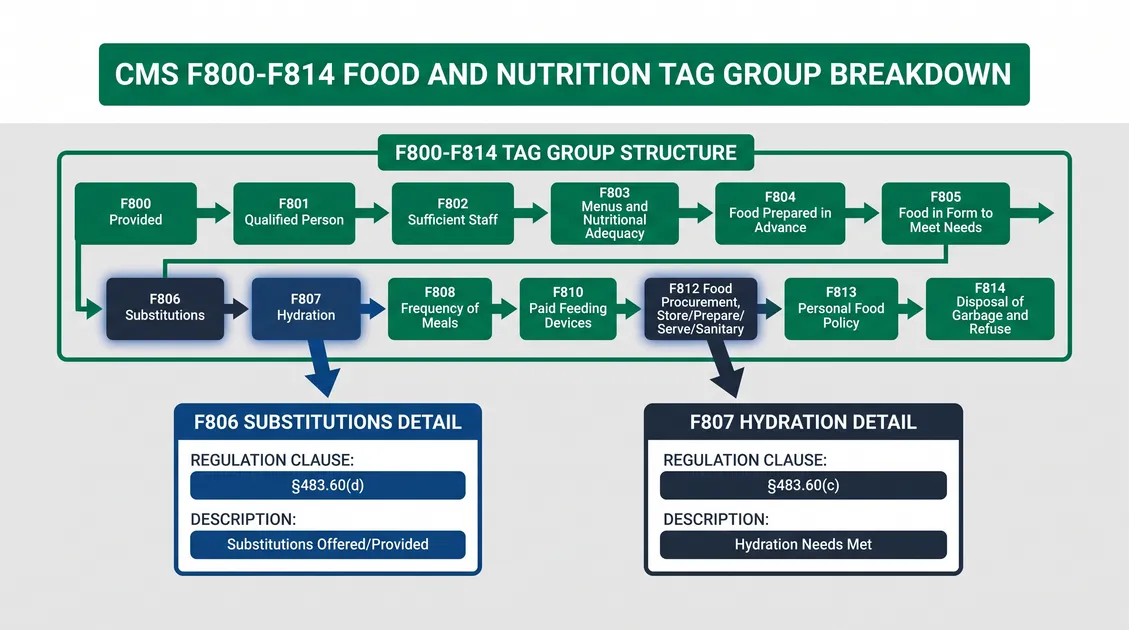
Substitutions, allergies, preferences and hydration sit in three short clauses of 42 CFR §483.60(d), and surveyors cite them as F806 and F807. The f806 f807 substitutions standard requires an alternate of similar nutritive value when a resident declines the served item, while F807 requires drinks at and between meals. Both tags belong to the CMS food and nutrition regulatory group, the 15 tags running F800 through F814 that our guide to passing a CMS dietary survey maps end to end.
TL;DR: F806 covers allergies, intolerances, preferences and nutritive value substitutes. F807 covers drinks at and between meals. Your evidence set is a dated menu substitution log, allergy alerts on the tray card, refusal notes and fluid intake records. A common clinical fluid target in long-term care is 30 mL per kilogram of body weight per day. Nine major allergens now require labeling, not the old FDA Top 8.
What Is the Difference Between F806 and F807?
Substitutions and preferences belong to F806 at §483.60(d)(4) and (d)(5), while drinks and hydration belong to F807 at §483.60(d)(6). F806 asks two things of a kitchen: serve food that fits allergies, intolerances and preferences, and offer an appealing option of similar nutritive value when a resident declines what was served. F807 asks one thing: provide water and other liquids consistent with resident needs and preferences, in amounts enough to maintain hydration. Surveyors reach both tags through the same dining observation rounds, which is why the pair lands together on a CMS-2567 plan of correction. The Centers for Medicare & Medicaid Services publishes the interpretive guidance (IG) for each tag in Appendix PP of the State Operations Manual, and that guidance, not the regulation text, is what the surveyor works from on the unit.
| Element | F806 | F807 |
|---|---|---|
| Citation | §483.60(d)(4)-(5) | §483.60(d)(6) |
| Core duty | Honor allergies, intolerances, preferences; offer equal-value substitutes | Offer drinks at meals and between meals |
| Evidence gathered | Tray cards, diet roster, substitution log, refusal notes | Beverage pass schedule, intake records, hydration cart rounds |
| Typical failure | Resident refuses entrée, gets nothing but broth | Water pitcher out of reach or never refilled |
| Interview target | Resident, family, cook, CDM | Nursing assistant, resident, dietary aide |
Preferences and fluid findings are then scored on the scope and severity (S/S) scale. One missed beverage usually lands at level D with no actual harm. A resident with unplanned weight loss because the alternate was never offered becomes an actual harm (S/S: G) deficiency. Dehydration that ends in a hospital transfer can reach immediate jeopardy at J, K or L. Most facilities face these questions during a recertification survey, which must occur no later than 15 months after the previous one under 42 CFR §488.308.
Menu Substitution Log Builder (F806 Evidence)
Build a dated substitution log with the six fields a surveyor looks for under 42 CFR §483.60(d)(4) and (d)(5). Fill the row, add it to the log, then export the whole log as a CSV file you can open in a spreadsheet or print for the binder.
| Date | Meal | Resident | Item refused | Item offered | Initials | Remove |
|---|
Ask PantryTec about survey ready dietary documentation
What Makes a Substitution "Of Similar Nutritive Value"?
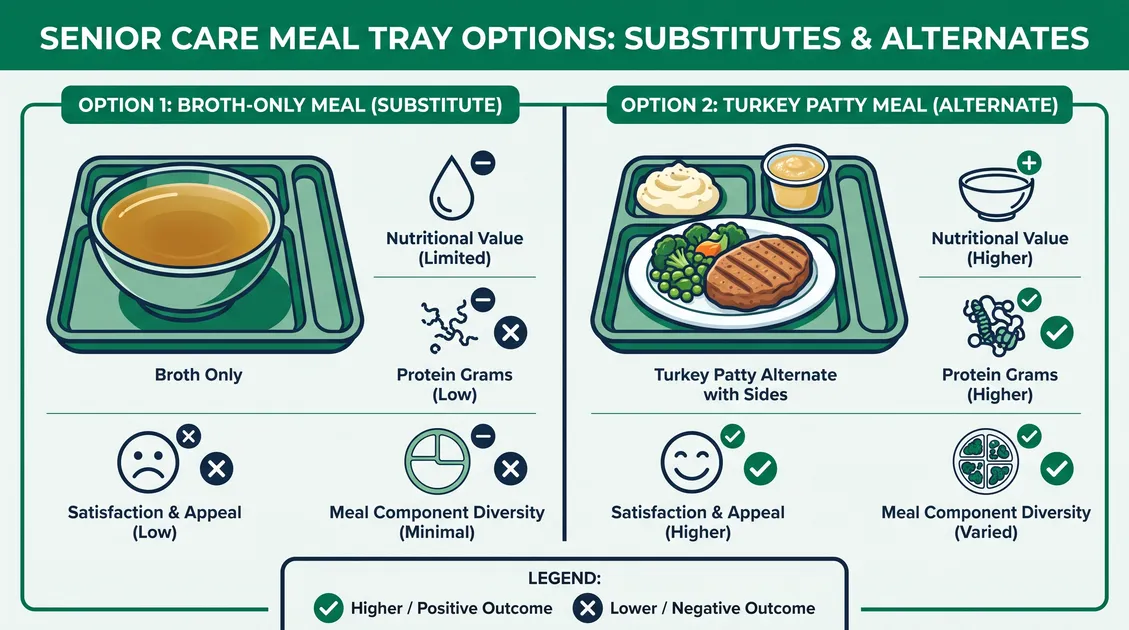
CMS doesn't define "similar nutritive value" in grams, so the facility carries the burden of showing its reasoning. A workable house rule is to keep the alternate close to the planned item on calories and protein, for example within about 10%, and to write that rule into the diet manual. A 3 oz roasted chicken breast carries about 26 g of protein; a cup of clear broth carries under 2 g, and that gap is what gets written up. Texture equivalence matters as much as macros. An alternate handed to a resident on a chopped or mechanically altered diet must arrive at the same texture level, otherwise the swap trades a preference problem for an aspiration risk. Physician-ordered restrictions still govern, which is why F808 therapeutic diet orders limit what any substitution list may offer.
| Served item | Weak substitute | Compliant substitute |
|---|---|---|
| Baked chicken breast, 3 oz | Bowl of broth | Turkey patty, 3 oz, or egg salad, 1/2 cup |
| Beef lasagna | Green salad | Macaroni and cheese with 1 oz added cheese |
| Baked fish fillet | Crackers and jelly | Peanut butter sandwich, 2 tbsp nut butter |
| Milk, 8 oz (lactose intolerance) | Water | Lactose-free milk or fortified soy milk, 8 oz |
How Do You Build a Substitution List Surveyors Accept?
Preferences are easier to honor when the substitution list is written before service, not invented at the tray line. Build a pre-approved list of one alternate entrée and one always-available option per meal, then record each swap in a dated menu substitution log with six fields: date, meal, resident, item refused, item offered, staff initials. That log is also the document that keeps you clean on F803 rule on following the posted menu, since a changed tray without a record reads as a menu the facility ignored.
A 10-week rotation also helps: residents see 70 different daily plans before anything repeats, so fewer reach for the alternate out of boredom.
F807 Daily Fluid Goal and Tray Beverage Calculator
Enter a resident weight to convert it to the common long-term care fluid target of 30 mL per kilogram of body weight per day, then see how that volume splits across meal trays and between-meal beverage passes. F807 at §483.60(d)(6) requires drinks at and between meals in amounts enough to maintain hydration.
68 kg used for the calculation.
Use the actual cup volume your tray line fills, not the cup capacity.
Three meals per day are assumed.
Leave off unless your dietitian documents a food moisture credit in the care plan.
F807 daily fluid goal
Suggested pass schedule to document
| Pass point | Servings | Volume |
|---|
Evidence surveyors collect for F807: the beverage pass schedule, fluid intake records and hydration cart rounds. A pitcher out of reach or never refilled is the typical F807 failure and one missed beverage usually lands at scope and severity level D with no actual harm. For F806, keep the dated menu substitution log, allergy alerts on the tray card and refusal notes with it.
This tool applies the 30 mL per kilogram per day figure cited in the article as a common clinical fluid target in long-term care. It is an educational estimate, not a care plan. Individual targets are set by the resident's physician and registered dietitian, and clinical conditions can raise or lower them.
How Do You Document Allergies and Gluten-Free Accommodation Defensibly?
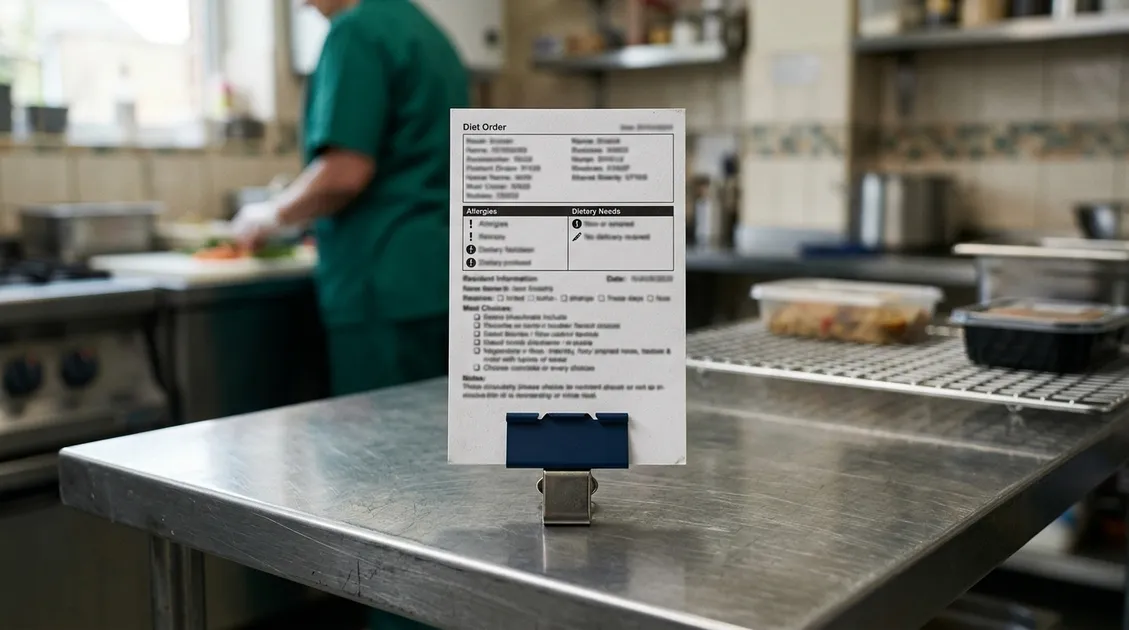
Allergies must appear in three places that match each other: the physician diet order, the care plan, and the tray card. Nine major food allergens require labeling in the United States after sesame joined the list on January 1, 2023, according to the FDA's food allergies guidance, so any kitchen still working from the old FDA Top 8 poster is one allergen short. A food allergy is an immune response and a food intolerance is a digestive one, and the record should say which. Lactose intolerance permits lactose-free milk; a milk allergy doesn't. Surveyors compare the tray card to the diet roster during dining observation rounds, then ask the cook to name the allergen. Mismatched paperwork is the common finding, not a bad recipe.
- Code each entry as allergy, intolerance, or preference: the three carry different kitchen controls.
- Ask the family which foods the resident avoided before admission, then add them to the preference survey.
- Reconfirm ingredient statements quarterly, since manufacturers reformulate products without notice.
- Separate cross-contact controls: dedicated cutting board, clean gloves, first-out production before common allergens.
- Verify certified gluten-free sourcing for celiac disease, including oats, broth bases, and soy sauce.
- Plate gluten-free trays first and cover them before the rest of the tray line runs.
Preferences and allergy accommodations only hold up when dining routines carry them out every shift, which is the practical content of person-centered dining in a small senior facility. For celiac residents, one shared toaster undoes a perfect menu, so our gluten-free menu extension pairs the recipe set with a shared-kitchen cross-contact protocol you can post by the prep table.
How Much Fluid Must Be Offered to Satisfy F807?
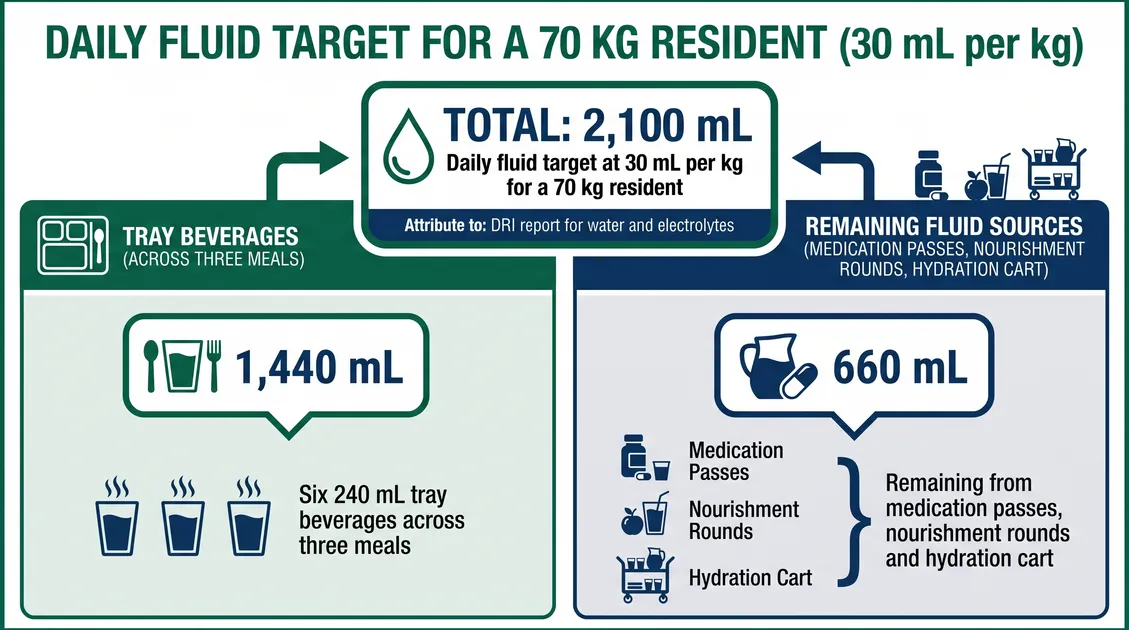
Hydration goals in long-term care commonly start at 30 mL of fluid per kilogram of body weight per day, which puts a 70 kg resident near 2,100 mL. The National Academies set adequate intake for total water at 3.7 liters daily for men and 2.7 liters for women, counting water from food, in the DRI report for water and electrolytes. F807 itself names no number, so the auditable standard is the one your facility writes down and follows. Do the tray math first. Six 240 mL beverages across three meals total 1,440 mL, which leaves roughly 660 mL for a 70 kg resident to gain from medication passes, nourishment rounds, and the hydration cart. Surveyors trace that remainder, and a nursing assistant who cannot describe the between-meal pass is the weak link.
- Set a documented daily fluid goal per resident in the care plan.
- Deliver two beverages per meal on the tray, 240 mL each.
- Run a scheduled hydration pass mid-morning, mid-afternoon, and at bedtime.
- Count 120 mL per medication pass when nursing records intake.
- Track intake for residents with fever, diuretics, or a recent weight change.
Hydration rules bend for dysphagia without disappearing. A speech-language pathologist (SLP) sets the thickened liquid level under the IDDSI framework, where drinks run Level 0 thin through Level 4 extremely thick, and foods continue to Level 5 minced and moist at a 4 mm particle size. Residents keep the right to refuse water and choose another fluid, so preference and safety both belong in the note. A texture upgrade, such as moving from IDDSI Level 4 puree back to Level 6, requires the same SLP documentation as a downgrade.
Key Takeaways for F806 and F807 Compliance
- Substitutions need a written equivalence rule, such as keeping alternates within about 10% of the planned item on calories and protein, reviewed by the dietitian.
- Allergies belong in three matching records, and the list is nine allergens, not eight, per the FDA.
- Hydration needs a documented per-resident goal; 30 mL per kilogram is the common starting point, verified against tray beverage volumes.
- Refusal notes should record what was refused, what was offered instead and how the resident responded; repeated refusals are a reason to revisit the care plan.
- Flat-rate PantryTec menus cost $15, $20 or $40 a month billed annually, the same at any census; see the plan pricing page.
Substitutions and hydration are documentation problems long before they are cooking problems: the same substitution log, allergy alerts and intake records apply at 10 beds or 40.

Limitations and Considerations
- F806 and F807 apply to Medicare and Medicaid certified nursing facilities; state-licensed assisted living follows state rules that often mirror them.
- No cycle menu prevents a citation caused by staffing gaps at the tray line or a missed hydration pass.
- Fluid targets are clinical estimates and must be adjusted by the care team for cardiac and renal residents.
- Ingredient formulations change, so allergen verification is an ongoing task, not a one-time setup.
What is a cycle menu in senior living?
A cycle menu is a fixed set of daily menus that repeats on a schedule, commonly 3 to 5 weeks. PantryTec's 10-week rotation produces 70 unique daily plans covering breakfast, lunch, dinner and snacks.
How many weeks should an assisted living cycle menu be?
No federal rule sets a rotation length; 42 CFR §483.60 only requires menus prepared in advance and followed. State minimums vary (Utah's R432-300-18 sets three weeks for the facilities it covers, for example), and longer rotations reduce repetition complaints.
Do assisted living menus have to be approved by a dietitian?
It varies by state. Utah's R432-270 rules for assisted living, California's Title 22 §87555 and Washington's WAC 388-78A-2300 each address menu planning and dietitian involvement differently, so confirm with your licensing agency. Certified nursing facilities must have menus reviewed by the facility's dietitian or other clinically qualified nutrition professional under 42 CFR §483.60(c)(6), cited as F803.
What does 42 CFR 483.60 require for menus?
Section 483.60(c) requires menus that meet residents' nutritional needs, reflect established national guidelines such as the Dietary Reference Intakes, reflect religious and cultural preferences, are updated periodically, reviewed by a qualified dietitian, and followed as written. F803 is the tag surveyors use for those items.
How far in advance must menus be posted in a care facility?
CMS sets no federal posting deadline; state rules commonly require the current week's menu posted where residents can read it. Keep menus as served, with substitutions annotated and dated, for the retention period your state specifies.
Substitutions, allergy records and hydration documentation take about the same effort whether your census is 8 or 48. To see how a signed 10-week cycle handles them, explore our sample menu downloads.