
By Blake Oldham, COO, PantryTec. Last updated:
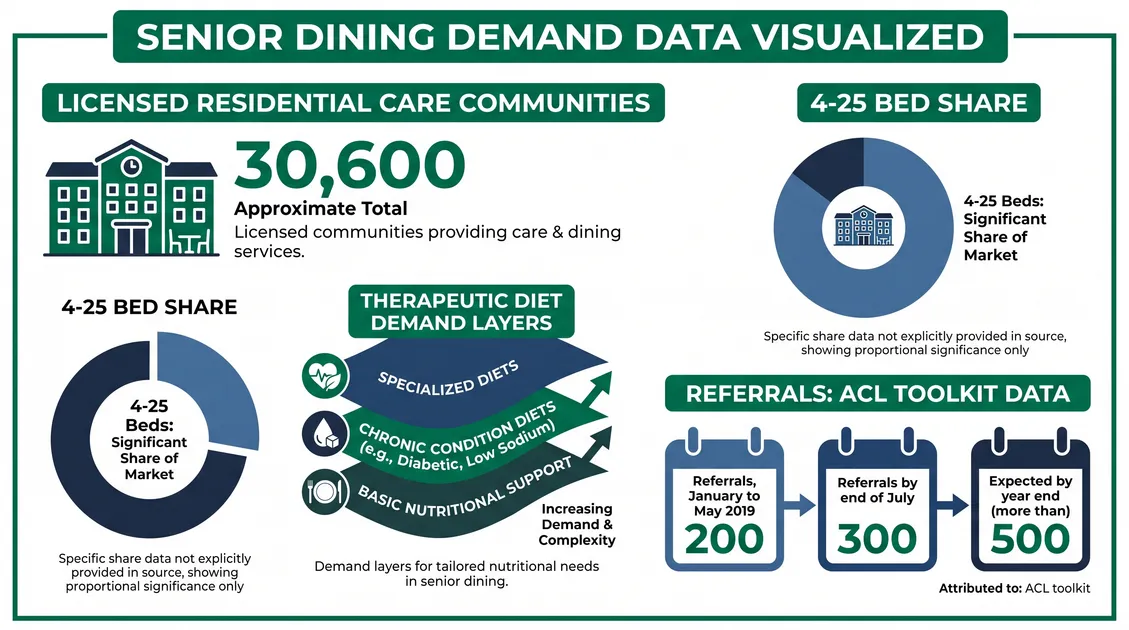
Senior care menu demand starts with roughly 30,600 licensed home care communities in the United States, per the CDC/NCHS National Post-acute and Long-term Care Study. Every other piece of senior dining demand data builds on that count, because most state licensure codes require written, dated menus. Few of those communities employ a registered dietitian. This hub gathers the published figures on who needs menus, which residents need therapeutic diets, why small homes struggle to get RD review, and what surveyors cite.
Menu compliance is PantryTec's field. We build dietitian-approved cycle menus and survey documentation for assisted living, memory care, and skilled nursing kitchens, so this data shapes our daily work. This page sits under our guide to dining as an occupancy driver in senior living. Want a compliant example beside you as you read? Download Free 4-Week Sample.
TL;DR: Most senior care buyers are small: nearly 6 in 10 home care communities have 4 to 25 beds, per NCHS long-term care provider. 14 hours is the most federal rules allow between a large evening meal and breakfast for long-term care residents, per the eCFR (2026), per Electronic Code of Federal Regulations (42 CFR 483.60) (2026). Therapeutic and IDDSI texture orders multiply the menu work for each resident. Many dietary citations come from paperwork gaps, not from the food. No public dataset counts unlicensed homes well.
How Many Senior Care Facilities Need a Written Cycle Menu?
Senior care menu demand leans toward nursing homes: most counties had under one home care bed per four nursing home beds, per Swan and Newcomer. Every licensed kitchen in both settings still needs a written menu. Skilled nursing facilities follow 42 CFR §483.60 and CMS F-Tag F803, which call for menus that meet residents' needs and get dietitian review. Assisted living is licensed by the state rather than certified by CMS, so its menu rules sit in state codes. Utah's code is Utah Administrative Code, enforced by the DHHS Division of Licensing and Background Checks. California uses Title 22 §87555, and Washington uses WAC 388-78A-2300. Demand for assisted living cycle menus follows the number of licensed homes, not bed volume. Small homes carry the same paperwork as large ones.
Which Facility Types Face Written-Menu Rules?
| Facility type | Governing menu rule | Menu obligation |
|---|---|---|
| Skilled nursing facility | 42 CFR §483.60, F800-series tags | Menus meet needs, are prepared in advance, are followed, and get dietitian review |
| Utah assisted living, Type I and Type II | Utah Admin. Code R432-270 | Written menus and food service standards checked at the state licensing survey |
| California RCFE | Title 22 §87555 | State food service and menu standards for elderly residential care |
| Washington assisted living | WAC 388-78A-2300 | State food and nutrition service standards for licensed homes |
| Memory care unit | Host facility's license rules | Finger food menu and texture options inside the licensed cycle |
| Adult day care center | State adult day program rules | Partial-day meal pattern, often one meal plus snacks, still documented |
Care levels shape the menu load in Utah. Type I assisted living admits residents who need limited help, while Type II admits residents with greater care needs. Type II homes usually carry more therapeutic diet orders. New licensees and change-of-ownership (CHOW) buyers often file a licensure menu packet that includes the cycle menu and the RD letter.
Where Does the Uncounted Market Sit?
Dining demand also reaches past the registries. Bed size and ownership structure define the buyer segment, as our page on bed size and ownership mix of small residential care facilities explains. Unlicensed homes are the market's uncounted tail. For more on that group, see the share of the small residential care market that is unlicensed. Those kitchens still cook every day, and no surveyor checks their menus.
Per-Resident Menu Cost Calculator: Consultant Dietitian vs. Flat-Rate Menu Plans
Enter your census and what your consultant dietitian actually charges. The calculator splits each cost across your residents and compares it with $15, $20 and $40 flat-rate menu plans. Nearly 6 in 10 home care communities have 4 to 25 beds (NCHS), so small censuses are where per-resident costs matter most.
Your community
Monthly cost per resident
Plan prices shown are $15, $20 and $40 flat monthly rates for the whole community, divided across your census. Confirm current plan terms with PantryTec before budgeting. Dietitian figures come only from what you enter; this tool does not assume any fee you are not paying. Results are estimates, not a quote.
What Share of Residents Have a Clinical Dietary Need?
There is no national figure for the share of senior care residents with therapeutic diet orders. The ACL toolkit Medical Nutrition Therapy Works for Seniors describes one registered dietitian program whose referrals grew steadily through the year once older adults had easier access to an RD. The lesson for menu planning is plain: when older adults can reach a registered dietitian, diet orders multiply. Each order reaches the kitchen as a therapeutic diet extension. Common orders include a consistent carbohydrate (CCHO) diabetic diet, a renal diet, and a cardiac diet. Cardiac orders usually read 2-gram sodium or no added salt (NAS). Texture orders add another layer, from mechanical soft to pureed. Your diet roster, not your census, sets the real menu workload.
Therapeutic and Texture-Modified Diet Rates
Demand for texture-modified menus follows dysphagia, one of the clinical signals behind this hub's figures. Our review of published dysphagia prevalence studies in long-term collects the ranges. The IDDSI framework then defines what the kitchen must produce:
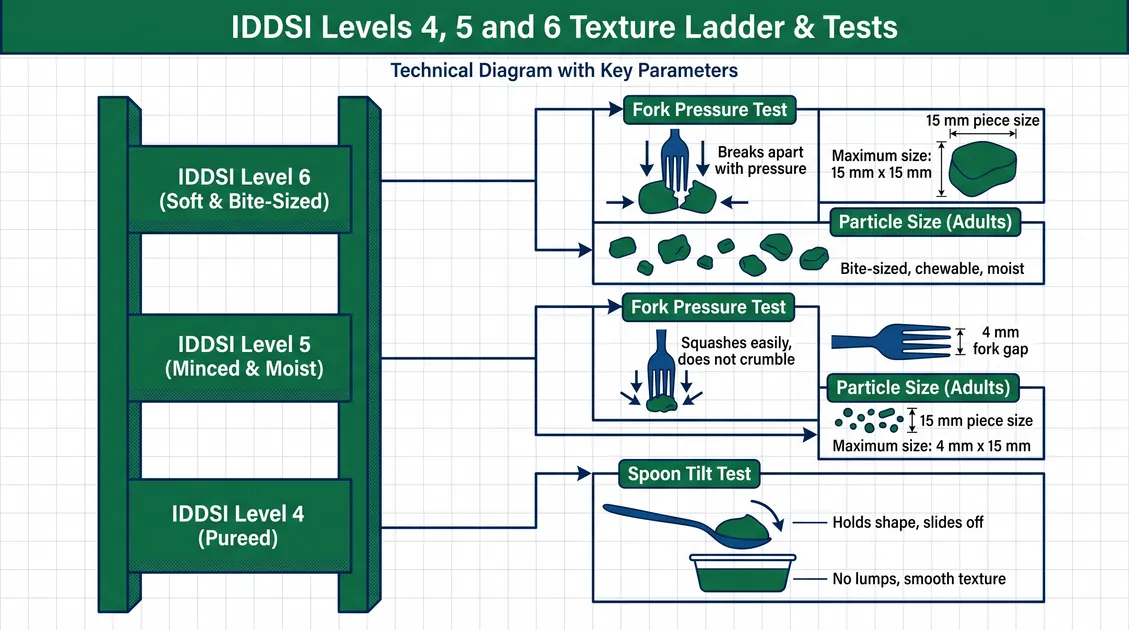
- IDDSI Level 4 pureed: smooth, lump-free food that passes the spoon tilt test.
- IDDSI Level 5 minced and moist: particles no larger than 4 mm, about a fork's tine gap.
- IDDSI Level 6 soft and bite-sized: adult pieces near 15 mm that squash under fork pressure.
- Thickened liquids: mildly and moderately thick drinks, checked with a 10 mL syringe flow test.
- Dementia finger foods: a finger food menu for memory care residents who refuse utensils.
Overlap Between Multiple Diet Restrictions
Menu workload stacks when restrictions overlap. A memory care resident with diabetes and dysphagia needs a CCHO plan at Level 5. That resident also needs fortified high-calorie, high-protein (HCHP) snacks if weight drops. The physician diet order must name every restriction. Malnutrition and unintended weight loss rates show how big that risk is, as our summary of malnutrition findings in long-term care and memory explains. Extensions for each order sit in our therapeutic diet menu library.
What Do Dietary Survey Citations Most Often Involve?
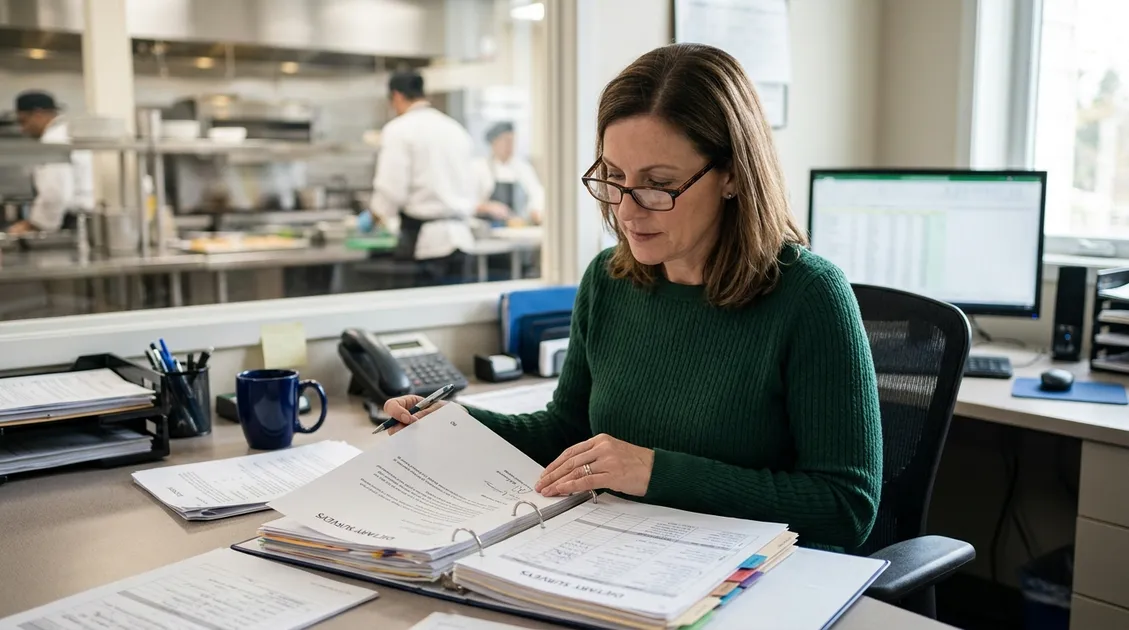
Menu documentation, not food quality, drives many dietary survey citations: undated menus, missing RD approval letters, and blank substitution logs, reviewed under CMS F800-series tags. Surveyors use the Kitchen/Food Service Observation pathway during nursing home inspections. According to Appendix PP of the CMS State Operations Manual, they compare menus as served against the posted cycle menu. They check that each substitute has similar nutritive value and appears in a menu substitution log. Findings are placed on the scope and severity grid, and the facility then files a plan of correction on form CMS-2567. State licensing surveys for assisted living follow the same logic. Senior nutrition programs face similar cost checks. Medicaid-funded meals cannot cost more per meal than meals charged to other fund sources, per the 2011 Washington State Senior Nutrition Program Standards. Auditors treat menus, recipes, and meal costs as linked records. Your survey binder has to hold all of them.
Missing or Undated Menus
Menu sheets without a date or cycle week fail the first check. A surveyor cannot match an undated page to the day's tray line or tray cards. Post the current week where residents can see it, and keep past weeks with notes on what was actually served.
Menus Lacking Documented RD Approval
Menu approval needs proof on paper. An RD approval letter should carry the dietitian's signature, license number, and review date. It should also reference a nutrient analysis against the Dietary Reference Intakes (DRI/RDA). Without that letter, calling a menu dietitian-approved is only a claim.
Substitution and Portion Documentation Gaps
Care kitchens also need a menu substitution log that lists the date, meal, original item, replacement, and approver. Standardized recipes tie each portion to a scoop size. Receiving, Dating and Storage Practices fall under F812. That tag covers checking food at delivery, labeling it with dates, and storing it safely, with a HACCP temperature log as proof. Our guide on To pass a CMS dietary survey with F-Tag menu requirements covers each tag in detail.
The first concern administrators raise is proving compliance during unannounced state surveys. That's why we build each survey binder around the signed letter, the dated cycle, and a substitution log that staff fill in the same day.
Which Sources Publish Senior Dining Demand Data?
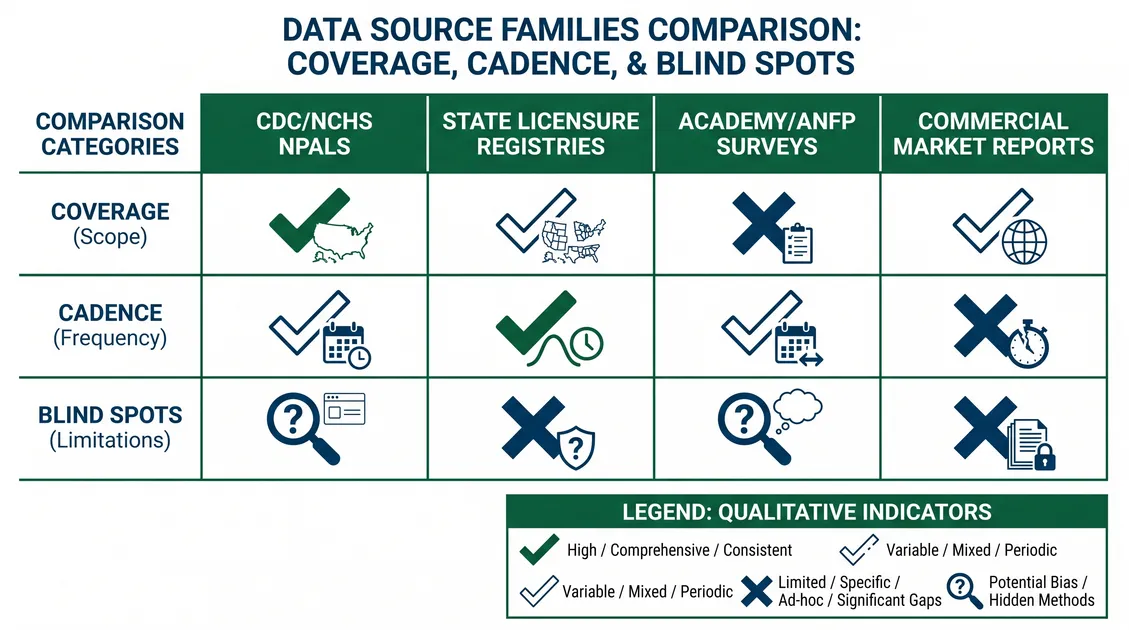
Dining demand figures come from four source families: CDC/NCHS surveys, state licensure registries, dietetics association practice surveys, and paid commercial market reports on long-term care. Commercial reports cost the most: one long-term care software study sells its research suite for $5,000 to $10,000, per Future Market Insights (2023 data). That suite spans 8 regions and a dietary software segment, yet it tells a small operator little about Utah kitchens. NCHS data is free and national, but it counts only licensed communities. State registries list every licensed home by type and bed count, and they update as licenses change. Association surveys from the Academy of Nutrition and Dietetics and ANFP describe how dietitians and dietary managers work. Campus tools look similar but serve a different audience. FoodPro at University of Texas at Austin Housing & Food lists nutrition facts for student dining halls. Daily nutrition goals for students don't match the needs of frail residents.
How Do the Main Sources Compare?
| Source | Coverage | Update cadence | Blind spot |
|---|---|---|---|
| CDC/NCHS NPALS | Licensed residential care communities nationwide | Every two years | Unlicensed homes and diet orders |
| State licensure registries | Each licensed home by type and bed count | Ongoing, as licenses change | Resident clinical data |
| Academy of Nutrition and Dietetics and ANFP surveys | RD and CDM/CFPP practice and pay | Periodic member surveys | Non-member small-home operators |
| Commercial market reports | Vendors, software segments, pricing | Paid subscription updates | Daily small-home kitchen operations |
What Do the Cluster Studies Report?
Data behind this hub's clinical and market points lives on our cluster pages. Each figure below appears on its owner page with full context.
| Published finding | Owner page |
|---|---|
| Simulations suggest nursing facility case mix at admission could drop 1 to 4 percent in absolute terms, or 10 to 30 percent among target RUG-classified cases. | Dietitian workforce and small-facility access to RD review |
| Sarcopenia appeared on only 0.0–0.4% of Medicare claims over five years versus an estimated 41% global nursing home prevalence; frailty appeared on 1.3–1.7% versus 52.3%. | Malnutrition in long-term care: published findings |
| Malnutrition reached 27.6% among French West Indies nursing home residents, versus 13.8% reported by Kaiser et al. with the same MNA-SF tool. | Malnutrition prevalence studies by region |
| French malnutrition prevalence is estimated at 6.4% in rural areas and 18.5% in urban areas, and 15 to 38% in long-term care facilities by MNA-SF. | Malnutrition findings in memory care and |
| Industry officials suggest 10 to 50 percent of supportive facilities are unlicensed, and nearly all of those are small. | How much of the small residential care market is unlicensed |
| As of May 2000, CARF had completed five residential care accreditations and JCAHO one; JCAHO charged $750 to $1,500 and CARF averaged $4,650. | Unlicensed residential care and accreditation |
| Almost 800,000 people in the United States live in licensed supportive housing, and a similar number are thought to live in unlicensed boarding homes. | Licensed versus unlicensed supportive housing counts |
Menu Survey Readiness Self Assessment
Pick your facility type, then answer each item Yes, Partial, or No. Your score and a prioritized gap list update as you go. Many dietary citations come from paperwork gaps, not from the food, so this check focuses on the binder a surveyor will ask for.
Gaps to close first
- Answer the checklist to see your gaps.
This self assessment is an educational aid, not legal or regulatory advice. Your answers stay in your browser and are not saved or sent. Confirm requirements against your current state code or 42 CFR §483.60 and your surveyor's expectations.
Why Do Small Facilities Struggle to Access Dietitian Review?
Care budgets in small homes absorb RD costs poorly: one Area Agency on Aging broke even on Medicare MNT after six years, per ACL's toolkit. That agency reached breakeven only as referrals grew, which shows how much volume RD work needs to pay for itself. A home with a handful of residents rarely has that kind of volume. The registered dietitian still bills for travel, review hours, and signatures, whatever the census. Rural homes face a second problem: few consultant dietitians live nearby, so visits stretch to quarterly or get skipped. Owner-operators in these homes often handle the licensing paperwork themselves. RD availability is the supply-side limit on getting a dietitian-approved cycle menu signed. Our page on dietitian workforce supply and small-facility access to RD review maps that limit by region. Homes with fewer than 25 beds feel it most, since they make up most licensed communities.
Consultant Rates Versus Small-Facility Budgets
Consultant invoices surprise many owners. Most administrators don't realize how far that bill runs above their yearly menu cost.
Sub-25-Bed Economics
PantryTec takes a different view because menu review is repeatable work: one RD-signed cycle fits many homes with similar residents. A consultant's clinical hours are better spent on resident assessments, weight-loss reviews, and diet orders that change. Rescope the contract rather than cancel it, and clinical support stays where residents need it.
How Does Dining Drive Occupancy and Menu Demand?
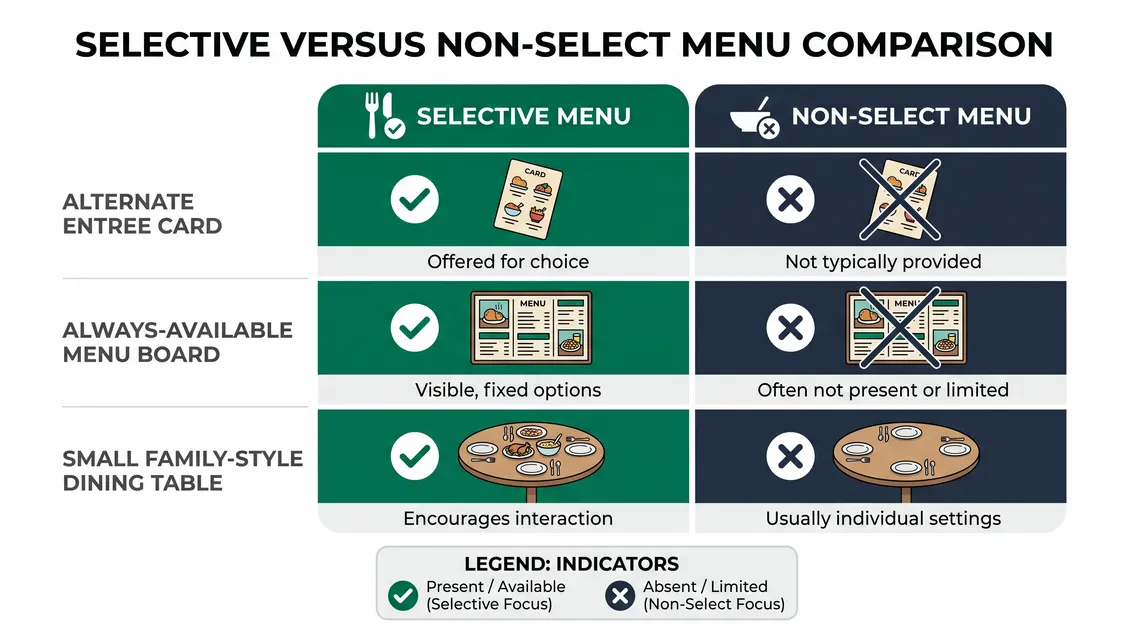
Dining is an occupancy driver in senior living because families judge the dining room on tours, and payment policy shapes who can afford a bed, with flat monthly price at $15 per month. The same report floats moving other aid, such as food stamps, toward monthly RCFE rent. Dining budgets follow those residents into the kitchen. Family-Style and Small-Group Dining suits small homes, where one table seats everyone and staff serve from shared bowls. Person-centered dining adds choice through a selective menu with an alternate entrée, or through an always-available menu of simple items. The choice between a selective and a non-select menu drives cost: a non-select menu posts one entrée, while a selective menu needs two production runs. Seasonal menu updates for spring, summer, fall, and winter keep produce fresh and costs in check.
Contract Dining Management Versus Menu Services
Dining models range from contract dining management, where a firm runs staff, purchasing, and menus, to menu-only services. Contract firms fit large campuses with a steady census. DiningRD sells menu packages and dietitian resources to long-term care operators who keep their own cooks. Per-resident software platforms make staff build the menu inside the tool. For a service comparison, see the PantryTec cycle menu service for senior care operators.
How Long Should a Cycle Menu Rotation Run?
Menu rotation length controls menu fatigue. Short cycles repeat often, and residents notice the repeats quickly. The 10-week rotation PantryTec uses offers 70 daily plans before any day repeats. Our dietitian-approved cycle menus page shows the format.
Key Takeaways: How Should Operators Use Senior Dining Demand Data?
Senior care operators get the most from this data when they match it to their own diet roster and survey history. The national count shows a market made mostly of small homes. The clinical data shows diet orders stacking up on each resident. The access data shows why a signed menu is hard to buy by the hour. Survey patterns show where the paperwork breaks down. Put those together and a plan takes shape. Start with your diet roster and physician diet orders. Memory care units should add texture and finger food counts to that roster. Then check your binder for a dated cycle, an RD approval letter, and a current substitution log. Finally, price menu review separately from clinical nutrition care. The per-resident savings calculator on our flat-rate menu plan pricing page runs that math for your census. Many owners find the menu line is the easiest cost to fix.
- Size demand by the number of licensed homes, using CDC/NCHS data and your state registry, such as Utah DHHS licensing lists.
- Count diet orders and IDDSI texture levels for each resident, because overlapping orders set the menu workload.
- Audit paperwork first: undated menus and unsigned RD approval letters fail F803-style review before anyone tastes the food.
- Price menu signatures apart from clinical RD visits, since the ACL toolkit case studies show RD services need volume to pay off.
PantryTec turns this data into a working menu. The Starter Plan costs $15 per month, the Complete Plan $20, and the Premier Plan $40, at a flat rate regardless of census. Every tier includes an RD Approval Letter for your compliance binder. We usually deliver the first menu PDF within 24 to 48 hours. Weekly menus then arrive every week.
Menu next steps are simple: Get a Dietitian-Signed Menu Quote, Request a Menu Demo, Talk to a Registered Dietitian, or Check Utah DHHS Menu Compliance. You can also call our Springville team at 385-512-4731.
What is a cycle menu in senior living?
Senior living cycle menus are planned daily menus for breakfast, lunch, dinner, and snacks that repeat after a set number of weeks. Kitchens use them to control food cost, simplify ordering, and show surveyors a dated, dietitian-approved plan.
How many weeks should an assisted living cycle menu be?
Menu cycles in assisted living often run 4 or 5 weeks, which keeps ordering simple but repeats dishes quickly. Longer rotations cut menu fatigue. Check your state code for any minimum rotation length.
Do assisted living menus have to be approved by a dietitian?
Menu approval rules for assisted living vary by state, and many state codes require review by a dietitian or another qualified professional. CMS-certified nursing homes must have menus reviewed by a qualified dietitian. The RD model can last: one meals-on-wheels program has provided Medicare MNT with RDNs on staff for about seven years, per the ACL toolkit.
What does 42 CFR 483.60 require for menus?
Menu rules in 42 CFR §483.60 require nursing home menus that meet residents' nutritional needs, are prepared in advance, are followed, and are reviewed by a qualified dietitian. 5 years after November 28, 2016 was the qualification deadline for long-term care dietitians hired earlier, absent other state law, per the eCFR (2026), per Electronic Code of Federal Regulations (eCFR) (2016).
How far in advance must menus be posted in a care facility?
Menu posting deadlines come from state codes, not one federal rule, so confirm yours with your licensing agency. Posting the full 7-day menu before the week begins is a safe practice, and CMS expects nursing home menus to be prepared in advance. PantryTec emails each week's menu ahead of time so staff can post it.
Explore Topics
8 related pages in this section
Annual Dietary Budget Template and Forecast
Independent living menus for 55+ communities: 10-week rotating cycles, 40,000+ recipes, RD approval included. Plans from $15/mo. Get a free sample menu.
Annual Dietary Budget Template and Forecast→PantryTec Cycle Menu Service for Senior Care Operators
Download free sample cycle menus for senior care facilities.
PantryTec Cycle Menu Service for Senior Care Operators→Food Cost Control Guide
Gluten-free menus for senior living communities, dietitian-approved and built into 10-week cycle rotations. Plans from $15/mo. Get a free sample menu.
Food Cost Control Guide→How to Pass a CMS Dietary Survey: F-Tag Menu Requirements
CMS menu compliance in plain English: F-tag menu requirements, the survey walkthrough, the documents surveyors ask for, and RD-signed menu pricing.
How to Pass a CMS Dietary Survey: F-Tag Menu Requirements→Senior Living Cycle Menu Provider Comparison Matrix
Top 10 dietary survey deficiencies ranked: F812, F803, F809 mapped to 42 CFR §483.60, with CMP ranges and plan-of-correction fixes that hold.
Senior Living Cycle Menu Provider Comparison Matrix→How to Plan a Senior Living Cycle Menu: Step-by-Step Guide
Cycle menu planning for senior living, step by step: rotation length, recipes, DRI nutrient analysis, and the dated RD signature surveyors ask to see.
How to Plan a Senior Living Cycle Menu: Step-by-Step Guide→IDDSI Framework Guide for Senior Care Kitchens: All 8 Levels
IDDSI framework guide for senior care kitchens: all 8 levels (0-7), fork drip and spoon tilt tests, F805 survey rules, and cycle menu conversion steps.
IDDSI Framework Guide for Senior Care Kitchens: All 8 Levels→How Do You Find and Read Your State's Menu Rule?
Learn to find and read state menu rule citations for assisted living: who signs, review frequency, retention and survey documents. Get a free sample menu.
How Do You Find and Read Your State's Menu Rule?→