
New York Adult Care Menus:
Facility and ALR Menu Rules Explained
Adult homes in New York must serve three meals a day plus a nutritious evening snack, from menus planned at least three weeks in advance.
Adult homes in New York must serve three meals a day plus a nutritious evening snack, from menus planned at least three weeks in advance. Those duties in 18 NYCRR 487.8 anchor all New York adult care menus, including enriched housing and assisted living residences. PantryTec writes dietitian-approved cycle menus for senior care facilities. This guide applies the rule-search method from our hub on To read a state menu regulation to New York.
Adult care facilities in New York are state-licensed, so federal nursing home rules are a benchmark rather than binding law. 900 hours of supervised dietetics practice is the minimum for a qualified dietitian reviewing nursing home menus, per 42 CFR 483.60 on eCFR (2026). New York facilities with skilled beds must also meet federal F-tag dietary standards. Our guide to CMS dietary survey F-tag menu requirements covers that second audit track.
Menu examples make these rules easier to picture. Use our Download Free 4-Week Sample packet as a reference before you audit your own binder.
TL;DR: New York regulates menus by facility type, not by an assisted living label. Adult homes follow Part 487, enriched housing Part 488, and residences for adults Part 490. ALRs under Part 1001 inherit whichever food service section matches their certification. The Department of Health now expects periodic dietitian review of nutritional adequacy.
What Do New York Adult Care Facility Menu Rules Require?
Adult home menus under New York's Section 487.8 need two cups of milk, two meat servings, four produce servings and four grain servings daily. Those are the milk, meat, vegetables and fruits, and breads and cereals groups. Each meat serving must give an edible portion of at least two ounces, and each produce serving at least one-half cup. Cheese can count as milk or meat, but not both. Citrus or another vitamin C source should appear every day. Menus for regular and modified diets must meet the recommended dietary allowances (RDA), adjusted for age, sex and activity. That standard comes from the Food and Nutrition Board of the National Academy of Sciences, National Research Council. The RDA wording predates today's Dietary Reference Intakes, so we check New York menus against current DRI values too. Many dietitians also schedule a vitamin A source several times a week, although the rule text names only vitamin C. Here's how that works in the kitchen.
18 NYCRR Part 487 Adult Home Food Service
Adult home kitchens follow these working rules in Section 487.8, published by the New York State Department of Health:
- Water, milk, coffee, tea and a hot decaffeinated beverage are offered at each meal.
- Each day's menu includes a hot entree at one meal other than breakfast.
- Planning menus list serving sizes and expected counts of regular and modified meals.
- Menus are served as planned, and occasional substitutions carry like nutritional value.
- Extra foods may be added for personal satisfaction, additional nutrition and calories.
Enriched Housing and ALR Overlay Requirements
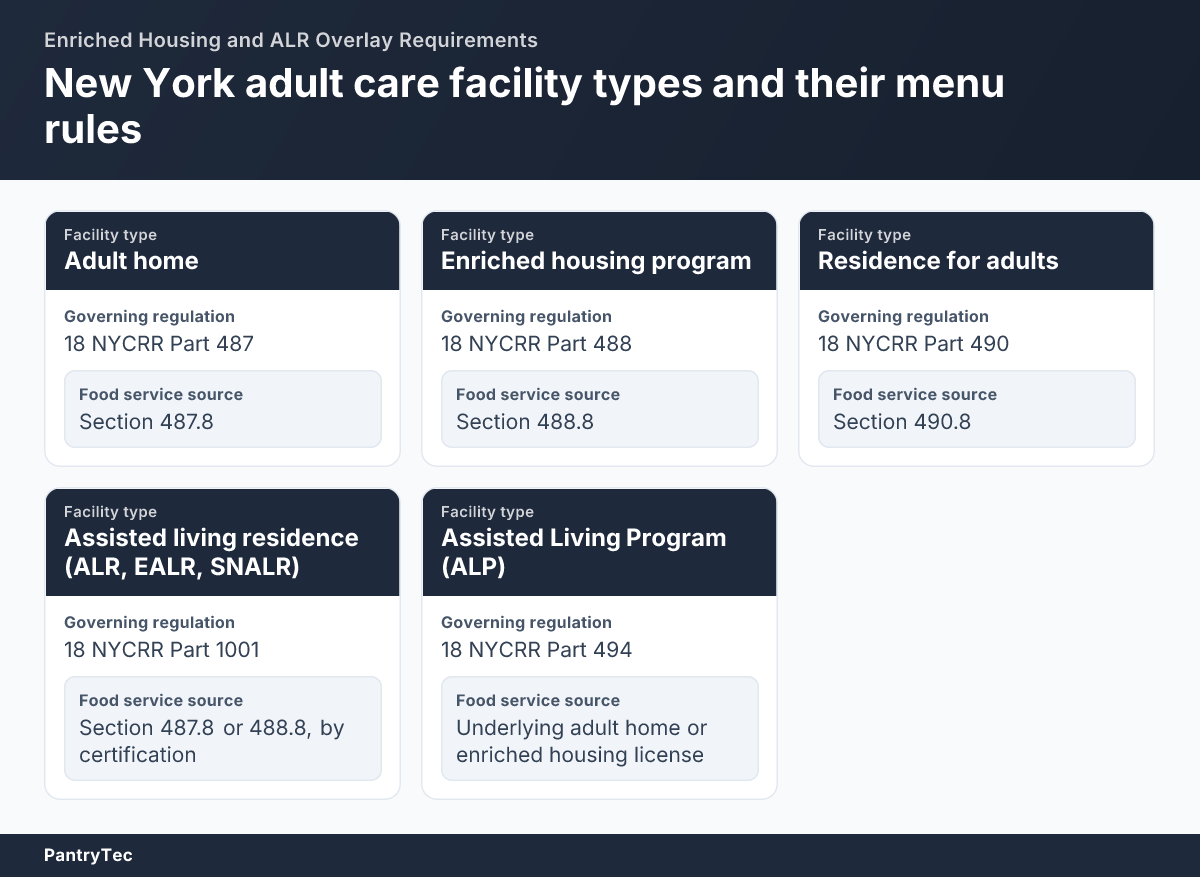
Adult care facilities certified as assisted living residences (ALRs) get no separate menu code. Under 18 NYCRR 1001.10, ALR food service follows Part 487 or Part 488, matching the residence's certification. Enhanced (EALR) and special needs (SNALR) certificates change who may live there, not the meal pattern.
| Facility type | Governing regulation | Food service source |
|---|---|---|
| Adult home | 18 NYCRR Part 487 | Section 487.8 |
| Enriched housing program | 18 NYCRR Part 488 | Section 488.8 |
| Residence for adults | 18 NYCRR Part 490 | Section 490.8 |
| Assisted living residence (ALR, EALR, SNALR) | 18 NYCRR Part 1001 | Section 487.8 or 488.8, by certification |
| Assisted Living Program (ALP) | 18 NYCRR Part 494 | Underlying adult home or enriched housing license |
Care budgets for home settings have historically drawn little waiver support. Medicaid waivers reached only about 59,000 supportive housing residents nationally, per CHCF's Residential Care for the Elderly report (2000 data). That left about 80 percent of low-income RCF residents without waiver help, in the same CHCF analysis. Budget menu review as a fixed operating cost.
New York Menu Survey-Readiness Self-Assessment (18 NYCRR 487.8)
Rate each item for your menu binder: Yes, Partial, or No. Your score updates as you go and highlights documentation gaps in posting, as-served retention, substitution logging, and your diet roster. This is a self-check, not a legal determination.

Answer the checklist to see your readiness level.
Priority fixes
- No gaps flagged yet.
"Email my results report" opens a prefilled draft in your own email app; nothing is sent or stored by this page. Scoring weights critical items double. This tool summarizes duties described in 18 NYCRR 487.8 and does not replace review of the current rule text or a qualified dietitian.
Does New York Require Dietitian Approval of Menus?
Menu review by a qualified dietitian or nutrition consultant is expected under New York's December 30, 2025 guidance, though Section 487.8 text names no signer. The Department of Health issued that guidance as DAL ACF-25-25, covering Sections 487.8 and 488.8. It says nutritional adequacy should be periodically reviewed by a qualified dietitian or nutrition consultant. The regulation itself sets the RDA standard and requires an approved menu planning form. New York nursing homes work differently, because Part 415 ties menus to a diet manual accepted by medical, nursing and dietary services. For adult homes, the practical answer is yes in spirit. An inspector who asks how you know menus meet the RDA expects a credentialed reviewer's dated analysis. A cook's assurance does not count. The usual reviewer is a Registered Dietitian Nutritionist (RDN) or a New York certified dietitian-nutritionist (CDN). Read the DOH interpretive guidance in full before your next cycle refresh.
Qualified Nutritionist Review Standard
Care workforce technology won't fill the reviewer's chair soon. Fourteen LTC technology companies were interviewed for one study, per Emerging Health Technologies in Long-Term. Researchers classified them by technology type, function, customers, sites of use and potential workforce impact. A DOH inspector still wants a human reviewer's name, credential and date on file.
Adult home administrators show a clear pattern in our work. Menu quality is not their biggest stress. The concern that comes up first is proving compliance during an unannounced state survey, so we treat the dated review record as a core deliverable.
We hear from clients that the numbers here match their day-to-day reality. One pattern we see is fewer dining complaints once a 10-week menu rotation is running. Residents get 70 days of menus, 210 breakfasts, lunches and dinners, before any day repeats.
Documenting Approval Signatures and Dates
- Reviewer's full name and credential, such as RDN or CDN.
- Registration or certification number a surveyor can verify online.
- Review date and the menu cycle weeks it covers.
- Diets included, such as consistent carbohydrate, 2-gram sodium and texture-modified.
- Statement that menus meet RDA or DRI targets for older adults.
- Next scheduled review date, set before the cycle refreshes.
How Often Must New York Menus Be Reviewed and Kept on File?
Menu records in New York's food service sections stay on file for six months, dated as planned and as served with every substitution. Section 490.8 spells this out for residences for adults, and the adult home section carries a parallel paragraph. Menus must also be conspicuously posted in a public area residents and visitors can reach, with daily changes shown. Copies of current menus belong in the food preparation area. The regulation text sets no fixed dietitian review interval, so you choose the cadence and must defend it. Annual review is the safer New York calendar, since DOH guidance says periodically without defining the term. Care systems also differ sharply across states. A few states such as Illinois run all-payer systems for long-term care benefits, while most limit gatekeeper roles to Medicaid-eligible persons, per CHCF's report. Menu law shows the same patchwork, as the comparison below makes clear.

Annual Versus Triennial Review Comparison
| Rule | Facility type | Menus written ahead | Dietitian review | As-served retention |
|---|---|---|---|---|
| NY 18 NYCRR 487.8 / 490.8 | Adult home, residence for adults | Three weeks | Periodic, per DAL ACF-25-25 | Six months |
| MD COMAR 10.07.14.30 | Assisted living program | One week | 4-week menu before licensure, after substantive changes, at least every 3 years | Six months |
| FL 59A-36.012 F.A.C. | Assisted living facility | One week | Annual, with original signature, license number and date | Six months |
| NC 10A NCAC 13F .0904 | Adult care home | One week | Licensed dietitian/nutritionist plans or reviews therapeutic menus | 30 days |
| NY 10 NYCRR 415.14 | Nursing home | In advance, per diet manual | Qualified dietitian under federal rules | One year from serving |
Rules in neighboring states add more variation. New York and Ohio both regulate menus under home care terminology rather than assisted living, so our Ohio residential care facility menu rules guide is a useful cross-check. Northeast operators can compare posting and retention terms in our Pennsylvania personal care home menu rules page. Adult day care centers sit outside Parts 487 to 490, and programs in the USDA Child and Adult Care Food Program (CACFP) follow its adult meal pattern. For 18 NYCRR 487.8, daily milk group minimum typically runs about 2 cups in day-to-day operations. 18 NYCRR 487.8 shows meat serving edible portion of at least 2 ounces.
Menu Retention and Posting Timeline
- Plan the next cycle on the approved menu planning form within the required lead time.
- Send new or changed cycles for dietitian review before posting.
- Post the week's menu publicly and note substitutions the same day.
- File dated as-planned and as-served pages together until the retention window closes.
How Are Therapeutic Diets Checked in a New York DOH Inspection?
Adult home inspectors check that each modified diet matches a prescribed dietary regimen and that two-day meal refusals reached the physician. Section 487.8(c) makes each resident's prescribed dietary regimen part of meal planning. The Part 490 version also requires that information, plus food allergies, in the food service area. Section 487.7 adds the refusal rule: the operator calls the physician right away, follows the instruction and notes both in the record. 14 hours is the longest gap 42 CFR 483.60 allows between a large evening meal and breakfast for nursing home residents, per eCFR (2026). The adult home rule covers that overnight stretch with a required nutritious evening snack. Inspections come from the Department of Health's Division of Adult Care Facility and Assisted Living Surveillance. Diet rosters, tray cards and posted menus must tell the same story on the tray line.
Physician Order and Tray Card Alignment
- File the signed diet order in the resident record, naming diet and texture.
- Update the diet roster the same day for every modified or allergy diet.
- Pull the matching therapeutic menu extension built from the regular menu.
- Print the tray card with diet, IDDSI texture level and allergens.
- Annotate the as-served menu whenever a substitution replaces a planned item.
Care teams serving IDDSI Level 4 pureed or 2-gram sodium diets can borrow structure from our therapeutic diet menu extensions. Our explainer on F808 physician-ordered therapeutic diets shows why the order comes first in certified buildings. Software helps less than you'd expect here. Vendors in the same PMC study spanned robots, machine learning, sensors, wearables, online portals, mobile apps, virtual reality and AI, yet the order-to-tray handoff still needs a weekly human check.
Documents Inspectors Request
- Posted menu showing the day's changes and substitutions.
- Dated menus as planned and as served for the full retention period.
- Planning forms listing serving sizes and expected meal counts by diet.
- Tested quantity recipes adjusted to yield the required number of servings.
- Food on hand for at least three days of emergency meals.
Menu deficiencies are cited under the Department's enforcement authority in 18 NYCRR Part 486, and the operator answers with a plan of correction. Fix the system, not the single page: retrain staff on substitution logging and show clean as-served records at follow-up.
One common pattern we encounter supports this. In our experience, most facility administrators don't realize their external dietitian bill exceeds their annual menu cost by 10x or more. In our experience, facilities come to us paying $800 to $1,200 per month to an external dietitian just for quarterly menu reviews and signatures. That is $9,600 to $14,400 a year, against $180 to $480 a year for a PantryTec plan billed annually with the RD Approval Letter included.
Key Takeaways for New York Adult Care Menus
Menu compliance in New York rests on four checkpoints:
- Match each building to its food service section; ALRs inherit 487.8 or 488.8 by certification.
- Build every daily menu around the four food groups and a vitamin C source.
- Schedule dietitian review annually, since DAL ACF-25-25 expects periodic review without a fixed interval.
- Trace every tray card to a prescribed dietary regimen before the inspector does.
Standard wisdom says every New York adult home needs a consulting dietitian on retainer, but PantryTec delivers signed, ready-to-post cycle menus instead. The reason is simple: the rule asks for documented nutritional adequacy, not a standing visit. Facilities come to us paying $800 to $1,200 per month to an external dietitian for quarterly reviews and signatures. That's $9,600 to $14,400 a year, against $180 to $480 a year for a PantryTec plan billed annually.
PantryTec cycle menus are reviewed by Bridget MacDonald, RD (more than 25 years in nutrition), who signs the RD Approval Letter for your compliance binder. Her New York license application is pending, so confirm with your DOH regional office whether your inspector accepts an out-of-state RD signature. First menus arrive within 24-48 hours. Compare tiers on our flat-rate dietitian-approved menu pricing page, or Talk to a Registered Dietitian.

What is a cycle menu in senior living?
Menu cycles are sets of daily menus covering breakfast, lunch, dinner and snacks that repeat after a fixed number of weeks. PantryTec's cycle runs 10 weeks before repeating. New York rules still require each week to be posted and filed as served.
How many weeks should an assisted living cycle menu be?
Adult care rules in New York fix no cycle length. Meat and vegetable-fruit items must differ, or be prepared differently, on each of the 7 days of the week, and meals must reflect seasonal food availability. A cycle long enough to change with the seasons meets both tests.
Do assisted living menus have to be approved by a dietitian?
Rules differ by state. New York requires a licensed dietitian or nutritionist to plan or review therapeutic menus, and Maryland requires review before initial licensure. New York's DAL ACF-25-25 guidance expects periodic review by a qualified dietitian or nutrition consultant.
What is F803 in a nursing home survey?
F803 is the CMS F-tag surveyors cite when a certified nursing home's menus fail to meet residents' needs, are not prepared in advance, or aren't followed. It sits in the F800 food and nutrition series of Appendix PP. Our F803 menu adequacy explainer covers survey evidence.

What does 42 CFR 483.60 require for menus?
Care facilities certified by CMS must follow Section 483.60(c), which requires menus that meet residents' nutritional needs, are prepared in advance, are followed and reflect preferences. A qualified dietitian or nutrition professional reviews them. New York adult homes use the rule only as a benchmark.
In our experience, this holds consistently. Every PantryTec cycle menu is reviewed by our Registered Dietitian, Bridget MacDonald, RD (more than 25 years in nutrition), and every plan ships with the RD Approval Letter she signs for the facility compliance binder. We deliver a new facility's first menu PDF within 24 to 48 hours of sign-up, and fresh cycle menus then arrive in the facility inbox every week.
Get the 4-Week Sample Menu Packet
Tell us your facility type, licensed bed count and state. You will see which New York rule applies to your menus and the minimum meal volume a 4-week cycle covers, then continue to our request page for the packet.