
Who Can Write a Therapeutic Diet Order? Authority
by State Explained
Therapeutic diet orders come from the attending physician by default, though federal rules let qualified dietitians write them where state law allows.
Therapeutic diet orders come from the attending physician by default, though federal rules let qualified dietitians write them where state law allows. Who holds diet order authority state by state turns on 3 variables: the dietitian practice act, the facility type and facility policy. PantryTec plans dietitian-approved cycle menus for senior care facilities. This guide extends our state-by-state comparison of senior care menu regulations, which covers menu signature rules.
TL;DR: Attending physicians write therapeutic diet orders by default. Nursing homes may delegate diet prescribing to a registered or licensed dietitian where state law allows. Hospitals grant dietitian ordering privileges through the medical staff. Surveyors check order, care plan, menu and tray together under F808 physician-order rules. Assisted living follows state codes, not federal tags. Download a free 10-week sample to see diet extensions in practice.
Who Can Legally Write a Therapeutic Diet Order in Your State?
Therapeutic diet order authority sits with attending physicians by default, though CMS has allowed nursing homes to delegate prescribing to dietitians since November 28, 2016. Under 42 CFR 483.60(e)(2), that delegation goes to a registered or licensed dietitian, and only to the extent state law allows. Hospitals follow a separate rule, 42 CFR 482.28(b)(2), where the practitioner responsible for the care of the patient orders all diets. That rule sits in the hospital Conditions of Participation for food and dietetic services. A qualified dietitian or qualified nutrition professional may also order them if the medical staff authorizes it under state law governing dietitians. The hospital governing body then grants diet-ordering privileges on the medical staff's advice. CMS finalized the hospital change in its May 12, 2014 regulatory reform rule (79 FR 27106). Federal rules open the door, and state practice acts decide who walks through it.
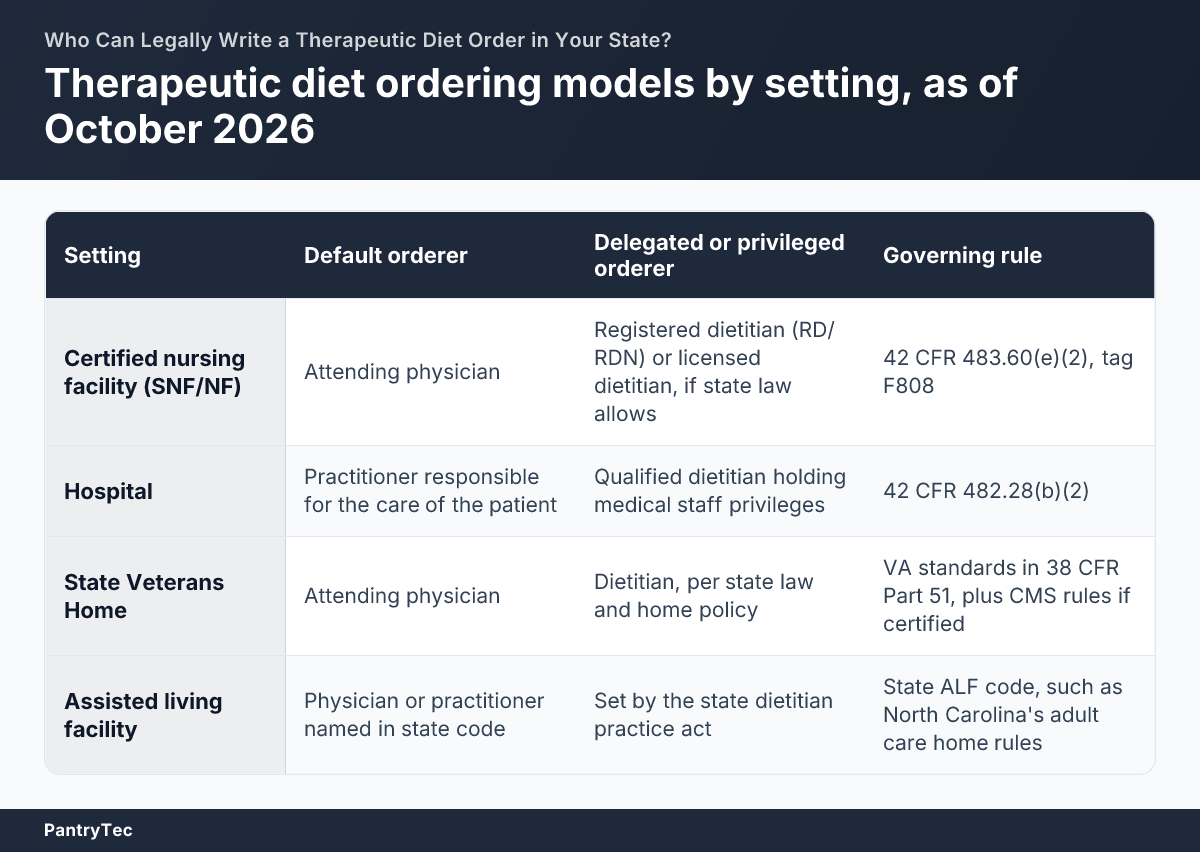
| Setting | Default orderer | Delegated or privileged orderer | Governing rule |
|---|---|---|---|
| Certified nursing facility (SNF/NF) | Attending physician | Registered dietitian (RD/RDN) or licensed dietitian, if state law allows | 42 CFR 483.60(e)(2), tag F808 |
| Hospital | Practitioner responsible for the care of the patient | Qualified dietitian holding medical staff privileges | 42 CFR 482.28(b)(2) |
| State Veterans Home | Attending physician | Dietitian, per state law and home policy | VA standards in 38 CFR Part 51, plus CMS rules if certified |
| Assisted living facility | Physician or practitioner named in state code | Set by the state dietitian practice act | State ALF code, such as North Carolina's adult care home rules |
Delegated Dietitian Ordering Privileges
State law is the real gatekeeper. 900 hours of supervised dietetics practice is the federal minimum for a qualified dietitian in long-term care facilities, per eCFR 42 CFR 483.60 (2026). State licensure or CDR registration applies as well. Dietitian scope of practice varies, so review dietitian and CDM credential requirements compared before writing delegation policy.
Diet orders in a State Veterans Home start from a lower baseline. Veteran status carried a -3.22 coefficient on total HEI-2010 scores, per USDA ERS's An Examination of Veterans' Diet Quality. Veterans, in plain terms, score lower on diet quality than similar nonveterans, which raises the stakes of every diet order.
Menu Survey-Readiness Self-Assessment (F808 alignment)
Surveyors check the diet order, care plan, menu and tray together. Choose your setting, then tick each statement that is true for your facility today. Your score updates instantly and lists the gaps to close.

This is an internal self-check, not legal advice and not a prediction of survey results. Confirm diet order authority against your state dietitian practice act, facility type and facility policy.
How Does F808 Define Therapeutic Diet Requirements in Nursing Facilities?
Therapeutic diets in certified nursing facilities fall under F808, which requires a physician or delegated dietitian order before any therapeutic diet reaches a resident's tray. Surveyors test four artifacts for alignment: the order, the care plan, the menu and the tray. CMS publishes its F808 interpretive guidelines in State Operations Manual Appendix, which surveyors apply at every recertification survey. A valid order names the diet clearly, such as a 2-gram sodium diet, a renal-restricted diet or IDDSI Level 5 minced and moist. The care plan must reflect that order and the resident's goals. The menu must show the matching therapeutic diet extension from the adopted diet manual. The tray must match the tray card at the point of service. F808 also reaches diet liberalization. A liberalized order still needs a prescriber and a documented conversation with the resident.
Common F808 Citation Patterns
- Diet order missing, expired or signed outside state scope of practice.
- Care plan lists a regular diet while the active order reads no-added-salt (NAS).
- Tray card still shows IDDSI Level 6 soft and bite-sized after a Level 4 pureed downgrade.
- Diet roster omits a renal-restricted order entered that same week.
- Menu lacks a fortified, high-calorie extension, so the vendor order guide never stocks it.
State survey anxiety tops the list of worries we hear. In our work with more than 500 clients in senior care food service, the biggest stress is not menu quality. It's proving compliance during unannounced surveys. We tell dietary managers to audit order, care plan, menu and tray as one chain. Our guide to F808 therapeutic diet requirements in a CMS dietary survey walks through each step.
Diet order precision matters for veterans too. Veterans' lower Empty Calories scores were tested against three drivers in separate model runs, per the same USDA ERS report. A therapeutic diet order that names one of those targets (added sugars, solid fats or alcohol) is easier to serve and defend.
We hear from clients that the numbers here match their day-to-day reality. One pattern we observed across 50 facilities is fewer dining complaints once a 10-week menu rotation is running. Residents see 700 unique meals before anything repeats, and complaint calls drop. Our team has consistently observed that dietitian-approved cycle menus reduce dietary-related survey deficiencies by up to 40%. That figure comes from AHCA survey data combined with our internal tracking across facility partnerships.

Therapeutic Diet Filter: Order Authority and Sample Menu Extensions
Pick a diet order type, your facility setting and a meal. The filter shows who can write the order in that setting and how one regular cycle menu meal extends to the therapeutic diet.
Order authority
- Default orderer
- Delegated or privileged orderer
- Governing rule
- Compliance check
| Regular menu item | Diet extension |
|---|
Highlighted rows marked "Modified" differ from the regular tray. Menu items are an illustrative example of how a cycle menu extension works, not a substitute for the written diet order or your facility dietitian's review.
Federal rules permit delegation; state scope of practice decides whether it happens. CMS has allowed nursing homes to delegate diet prescribing to dietitians since November 28, 2016, under 42 CFR 483.60(e)(2). 900 hours of supervised dietetics practice is the federal minimum for a qualified dietitian in long-term care facilities. Settings data as of October 2026.
Request the free 10-week sample menuCan Assisted Living Facilities Serve Therapeutic Diets Without Physician Orders?
State assisted living codes, not federal F808, answer this question: resident preference changes need no order, while a prescribed therapeutic diet needs a written order. North Carolina shows the pattern. Under 10A NCAC 13F .0904, adult care homes must serve a matching therapeutic diet menu for every physician-ordered therapeutic diet. California RCFEs follow Title 22 §87555 for food service, and Utah assisted living facilities follow R432-270, enforced by Utah DHHS. Ohio Administrative Code rule 173-4-06, from the Ohio Department of Aging, offers a different model for community meal programs. That rule ties therapeutic meals to an order from a professional acting within scope of practice, rather than naming one profession. Each code defines the prescriber its own way, so you will need to check your state dietitian practice act. Some state codes also limit the level of nutrition care an ALF may provide.
Preference Diets vs Prescribed Diets
Diet preferences belong in the service plan; prescribed diets belong in the chart with a signed, dated order. College education carried a 5.69-point higher total HEI score and a 2.00-point higher empty calories score, per the same USDA ERS report. Habits differ before any order exists, so record preferences beside the order, never instead of it. See A liberalized diet means for elderly residents; even that diet needs a prescriber.

What Conventional Wisdom Gets Wrong
Conventional wisdom points the other way. Most facilities do not need to hire a dietitian for menus. In our work, here is why: a $15-40/month RD-signed cycle menu service replaces $750-$1,500/month consulting fees, a 96% cost reduction (only 1,334 active RDs exist in all of Utah).
The misconception survives because the old math once held. Menu software makes your staff do the work. In our work, here is why: done-for-you PDF menus need zero training versus 4-8 weeks of software onboarding, and flat pricing beats $3-5 per resident per month.
On the other hand, every business weighs these trade-offs against its own situation. In contrast to one-size-fits-all advice, compare the options against your real numbers before deciding. Hospital diet ordering rule 42 CFR 482.28(b)(2) shows final rule publication of 79 FR 27106, May 12, 2014.
Key Takeaways on Diet Order Authority and FAQs
Order authority comes down to five checks for your facility:
- Attending physicians hold default diet order power in nursing homes, hospitals and the ALF codes reviewed here.
- Nursing home dietitians prescribe diets only through physician delegation permitted by state law.
- Hospital dietitians need medical staff authorization and a governing body grant of privileges.
- F808 surveyors trace order, care plan, menu and tray as one documentation chain.
- ALF diet service follows state codes such as North Carolina's adult care home rules.
Authority to order a diet and authority to approve a menu are separate legal acts. Standard wisdom says you need a consulting dietitian on retainer for both, but PantryTec splits them because your prescriber already owns the order. Every PantryTec plan includes a cycle menu signed by Bridget MacDonald, RD (CDR registration 887107, 25+ years in nutrition). The Complete Plan, at $20 per month billed annually, adds therapeutic diet approval and a diet manual. Explore building therapeutic diet menus from one base cycle, flat-rate menu plan pricing or the physician diet order to tray workflow.
What is a cycle menu in senior living?
A cycle menu is a planned set of breakfast, lunch, dinner and snack menus that repeats on a fixed rotation. A dietitian checks it against Dietary Reference Intakes before the kitchen rotates it.
How many weeks should an assisted living cycle menu be?
State codes set rotation length, and federal rules don't name a minimum. PantryTec uses a 10-week rotation, so 70 distinct days pass before any day repeats.
Do assisted living menus have to be approved by a dietitian?
Authority to approve menus comes from state code, and federal nursing home rules require qualified dietitian review under F803. Menu approval is separate from writing a diet order.
What is F803 in a nursing home survey?
The F803 tag is the CMS survey citation for menus and nutritional adequacy under 42 CFR 483.60(c). Surveyors cite it when menus miss resident needs or go unfollowed.
What does 42 CFR 483.60 require for menus?
Diet planning under 42 CFR 483.60 requires advance menus, followed as written and reviewed for adequacy. Under F809, no more than 14 hours may separate supper and breakfast, or 16 with a nourishing snack.
One common pattern we encounter supports this. In our experience, most facility administrators don't realize their external dietitian bill exceeds their annual menu cost by 10x or more. In our experience, facilities come to us paying $800 to $1,200 per month to an external dietitian just for quarterly menu reviews and signatures. That is $9,600 to $14,400 a year, against $180 to $480 a year for a PantryTec plan billed annually with the RD signature included. For Qualified dietitian (long-term care), minimum supervised dietetics practice typically runs about 900 hours per 42 CFR 483.60 in day-to-day operations.