
Tray line food safety, survey ready
Tray line temperature holding,
from steam table to tray.
Hold hot food at 135°F (57°C) or above, cold food at 41°F (5°C) or below, and deliver every tray fast enough to pass a CMS F804 test tray.
Checked against the FDA Food Code 2022 and CMS Appendix PP
Tray Line Temperature Targets
Per the FDA Food Code 2022

TL;DR: Tray line temperature holding
Preheat the steam table, cover every plate, and keep carts moving, since F804 test trays are judged when the last resident on the unit is served. PantryTec's weekly cycle menus ship with production sheets and cook-to-census instructions, so kitchens cook what the census needs.
Why Is Tray Line Temperature Holding Critical for Dietary Compliance?
Tray line temperature holding is critical because two federal tags meet on every tray: CMS F812 guidance expects hot food held at 135°F (57°C) or above and cold food at 41°F (5°C) or below, and CMS F804 expects a safe, appetizing temperature at service. Both tags sit in 42 CFR §483.60, the food and nutrition services rule covered in the senior care menu compliance guide. F812 also carries weight on surveys: LeadingAge Minnesota's review of CMS QCOR data ranked it third among health deficiencies on the state's recertification surveys. Assisted living communities answer to state rules, and most state food codes build on the FDA Food Code. On the tray line, the steam table sets the starting temperature, while plating speed, dome covers, and cart time decide what reaches the resident. The two risks below show where citations start.
CMS F804 and Palatability Enforcement
F804 sits in §483.60(d), the food and drink paragraph; F812 sits in the food safety paragraph. Appendix PP defines a proper temperature as one that is appetizing to the resident while limiting scald and burn risk. Resident complaints, uneaten meals, and slow tray passes prompt a test tray.
Foodborne Pathogen Growth in the Danger Zone
Clostridium perfringens grows in food held between 40°F and 140°F. The CDC estimates it causes nearly 900,000 U.S. illnesses a year and names nursing homes among the settings where outbreaks happen. The Food Code also treats nursing home residents as a highly susceptible population.
What Are the Regulatory Holding Temperatures for Assembly Tray Lines?
Assembly tray lines hold hot time/temperature control for safety (TCS) food at 135°F (57°C) or above and cold TCS food at 41°F (5°C) or below, per FDA Food Code 2022 §3-501.16, unless the kitchen uses time as a public health control. CMS surveyor guidance calls the range between those numbers the danger zone. Steam tables and bain-maries hold heat, and they aren't built to reheat. Food that was cooked, cooled, and reheated for hot holding has to reach 165°F (74°C) for 15 seconds, within 2 hours, before it enters the well. Cold items like salads, milk, and cut melon sit on an iced or refrigerated rail at 41°F or below. Some state and local codes, including New York State's, still set hot holding at 140°F (60°C), so confirm your state's code before printing new logs. The table below lists each checkpoint.
FDA Food Code Standards for Hot and Cold TCS Foods
| Checkpoint | Standard | Source |
|---|---|---|
| Hot holding (steam table, bain-marie) | 135°F (57°C) or above | Food Code §3-501.16 |
| Cold holding (iced or refrigerated rail) | 41°F (5°C) or below | Food Code §3-501.16 |
| Reheating for hot holding | 165°F (74°C) for 15 seconds, within 2 hours | Food Code §3-403.11 |
| Time without temperature control | 4 hours, with a marked discard time | Food Code §3-501.19 |
| Holding checks | Before service, then every 2 hours | Standard holding SOP |
| Point of service | Safe, appetizing, per resident preference | CMS F804 |
Time as a Public Health Control (TPHC) Parameters
TPHC allows up to 4 hours without temperature control. Hot food leaves holding at 135°F or above, carries a mark showing its 4-hour discard time, and gets served or tossed by then. Written procedures stay on file, and facilities serving a highly susceptible population are barred from using TPHC for raw eggs.
How Does Food Lose Heat Between Plating and Resident Delivery?
Plated food starts losing heat the moment it leaves a 135°F (57°C) steam table, and it cools fastest in the first few minutes, since cooling speed tracks the gap between the food and the room. That gap narrows as food cools, so the curve flattens. Four stages add minutes: plating, staging while the cart fills, transport, and the pass on the unit. At 4 trays a minute, the first tray on a 20-tray cart waits 5 minutes before the cart leaves the kitchen. The only loss rate worth planning around is your own. Take a probe reading at plating and another on a test tray, then divide the drop by the minutes between them: a 30°F drop over 25 minutes works out to 1.2°F per minute. The calculator below turns that rate into a plating floor for your longest route.
The Plating-to-Service Thermal Decay Curve
Straight-line math misjudges the steep early curve, so confirm the result with a test tray, and watch F804's scald risk as plating temperatures climb.
Tray Line Thermal Decay Calculator
Enter your own test tray numbers to find the plating floor for your longest route.
Your estimate
Meets your 135°F target
Why Texture-Modified Diets Cool Faster
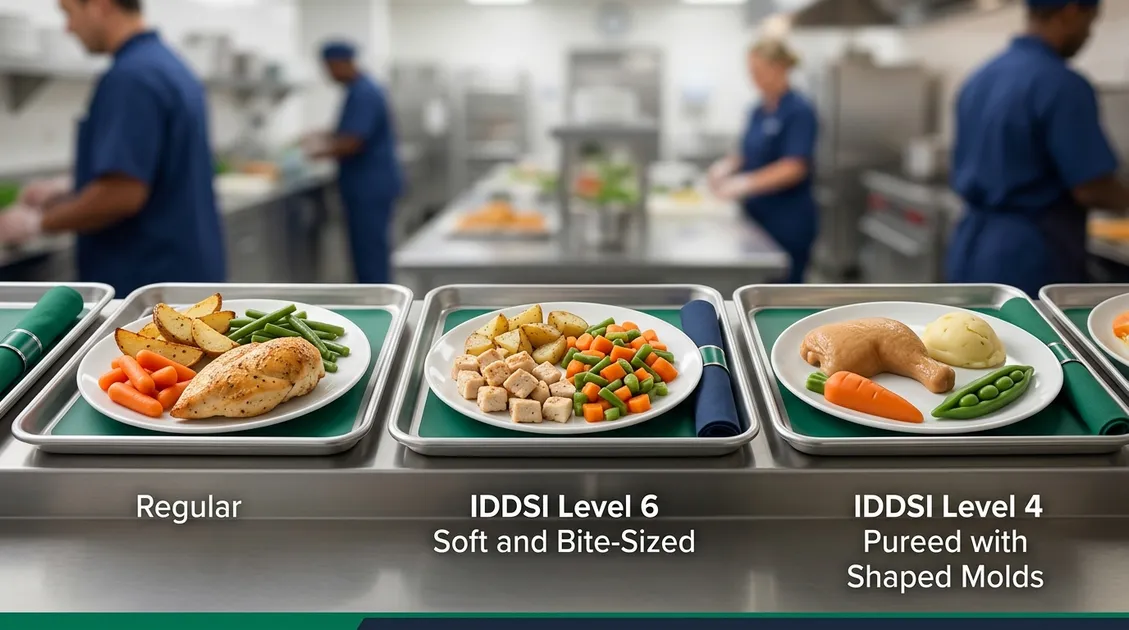
IDDSI Level 4 pureed and Level 5 minced and moist portions are small and shallow, so more surface per ounce meets cool air. Pureeing adds liquid, and cold broth or milk pulls the batch temperature down. Puree close to service, reheat cooked-and-cooled batches to 165°F, keep them covered, and probe them separately.
What Equipment Setup Maintains Compliant Tray Line Temperatures?
A compliant tray line pairs a preheated steam table holding food at 135°F (57°C) or above with something that keeps each plate hot after assembly: a pellet or heated base, an insulated dome, or a heated transport cart. The steam table protects food on the line, and the base, dome, and cart protect it on the route. Passive systems store heat ahead of time in a charged pellet, an induction-heated base, or a preheated plate, then release it slowly. Active systems, like heated transport carts and convection retherm carts, keep adding heat until the tray reaches the unit. Aladdin Temp-Rite rates its Insul-Max heated base at an hour or more of holding once it's heated. Cold plates need the reverse: chilled bases or a refrigerated compartment. The two setups below cover wells, bases, covers, and carts.

Wet-Well Steam Tables vs Dry Induction Plating
Wet wells surround hotel pans with hot water, which spreads heat more evenly than a dry well's air gap. Vollrath's ServeWell manual calls for about 1 inch (2.5 cm) of water and a 60-minute preheat, and it rules out reheating in the well. Probe each pan near the surface and at its thickest point. Induction plating holds heat after the line: a charger heats a metal-core base under each plate.
Insulated Pellets, Plate Covers, and Cart Selection
Plate covers go on the moment food is plated, and CMS F812 guidance calls covering appropriate for meals assembled in the kitchen and delivered to rooms or dining areas. Load carts in delivery order, and keep unheated carts on routes your pellets and domes cover.
PantryTec's position: facilities under 60 beds rarely need heated retherm carts. Pellet bases with a calibrated steam table hold plated entrées about 45 minutes at roughly 10% of the capital cost.
How Do Surveyors Conduct a CMS F804 Test Tray Audit?
Surveyors request a test tray when residents complain about food temperature or taste, meals go uneaten, or tray passes run late, and they pull it from the dining area, floor, or unit of most concern, per CMS Appendix PP F804 guidance. The test tray measures what a resident receives, so every minute between the steam table and the last tray shows up in it. F804 does not set a point-of-service number. Surveyors ask whether hot foods arrive hot and cold foods cold, in line with resident preferences, and Florida's surveyor guidance on food temperatures says delivered hot food isn't expected to meet holding temperature. The riskiest mix is a lukewarm test tray, residents who say the food is cold, and no records showing what happened on the line. The steps below show how the audit unfolds.

The Surveyor's Thermometer Protocol
Trigger
Complaints, uneaten meals, or late tray passes prompt the request.
Route
The tray goes to the unit of concern or the unit farthest from the kitchen.
Timing
Evaluation starts when the last resident on that unit is served and begins eating.
Measure
A clean, sanitized, calibrated thermometer goes into each item's thickest part, and the surveyor tastes it too.
Compare
Findings sit beside resident interviews and your temperature logs.
Steps 2 and 3 follow North Carolina's self-survey module.
Documentation Needed in Your Temperature Logs
Temperature logs record each item before it goes on the steam table and at least every 2 hours after, the interval standard holding SOPs use. Below 135°F, reheat to 165°F if the last good reading came within 2 hours; otherwise, discard the food. The SOP has a manager, ideally your Certified Dietary Manager (CDM) or Certified Food Protection Manager (CFPM), review logs daily and keep them at least 1 year.
PantryTec's view: software doesn't fix temperature problems. Standardized plating, calibrated bi-metallic stem thermometers, and cook-to-census batch timing prevent more F804 citations than sensor dashboards.
F804 Test Tray Logging Template
One row per menu item. Download the blank CSV, print it, and fill it in at every test tray.
| Date | Meal | Unit or cart | Cart left kitchen | Last tray served | Food item | Plated °F | Test tray °F | Taste and look | Corrective action | Initials |
|---|---|---|---|---|---|---|---|---|---|---|
Key Takeaways for Managing Tray Line Temperature and Holding
- Hold hot TCS food at 135°F (57°C) or above and cold at 41°F (5°C) or below, per your state's food code.
- Reheat cooked-and-cooled food to 165°F (74°C) for 15 seconds before it enters the well.
- Measure your own drop rate with paired plating and test tray readings, then set a plating floor.
- Plate purees last, cover every plate, and log temperatures before service and every 2 hours.
- Run your own test tray from the farthest unit before surveyors do.