
Washington ALF Menu Rules Explained:
What WAC 388-78A-2300 Requires
Washington puts its core assisted living food needs in WAC 388-78A-2300, the section most people mean by Washington ALF menu rules.
Washington puts its core assisted living food needs in WAC 388-78A-2300, the section most people mean by Washington ALF menu rules. The section requires at least three meals a day, menus written one week ahead, and menu records kept for six months. PantryTec, a dietitian-approved cycle menu service for senior care facilities, maps this rule for its Washington subscribers. WAC 388-78A-2300 is one of the citations cataloged in our guide on State Menu Rules, and this page reads it clause by clause.
TL;DR: WAC 388-78A-2300 governs meal timing, menu posting, retention, substitutions, alternate entrées and prescribed diets in Washington assisted living. Menus cannot repeat for at least three weeks, and overnight gaps above 14 hours need a nutritious snack. A dietitian must approve the diet manual, with review at least every five years. California keeps menus for a shorter time, so multi-state operators should build to Washington's standard.
Menu records are easier to audit when you have a working example to compare. You can download a free 4-week sample and hold it next to your current cycle.
What Does WAC 388-78A-2300 Require for Assisted Living Menus?
Washington requires every licensed assisted living facility to plan menus in writing, post or deliver them in advance, date them, list every food and snack, and avoid repeating them for at least three weeks, under WAC 388-78A-2300(1)(c). The section has 2 subsections: subsection (1) covers general food service, and subsection (2) covers prescribed diets. Breakfast gets one exception. Facilities offering a variety of hot and cold breakfast choices every day do not need a three-week breakfast cycle. Menus must provide variety and be adjusted for residents' age, gender and activity level, plus individual preferences where reasonably possible. Food can be cooked on-site or bought from a nearby food service business that meets chapter 246-215 WAC, the Washington State Retail Food Code. Each requirement leaves a paper trail, and DSHS licensors read that trail during an inspection. The clause-by-clause table below shows where each obligation lives and what proof satisfies it.
Washington Menu Survey-Readiness Self-Assessment (WAC 388-78A-2300)
Rate your facility on each clause as Met, Partial, or Not met. Where a number or date box appears, enter your actual figure and the status is set for you. Your score and gap report update instantly, and you can send the report from your own email app.
Written Menu and Advance Planning, Clause by Clause
| Clause | Plain-language requirement | Proof licensors look for |
|---|---|---|
| (1)(a) | Minimum daily meals at regular intervals, with an overnight cap | Posted meal times and snack records |
| (1)(b) | Enough time and staff support for residents to eat | Dining room observation |
| (1)(c)(i)-(iii) | Menus written ahead, posted or delivered, fully dated, listing all food and snacks | Current posted menu with snack lines |
| (1)(c)(iv) | Menus kept on file | Past menus in the compliance binder |
| (1)(c)(v)-(vi) | Variety and a minimum cycle length before repeats | Cycle menu calendar |
| (1)(d) | On-site kitchen or nearby contractor meeting chapter 246-215 WAC | Food service contract or kitchen inspection |
| (1)(e) | Meals adjusted for age, gender, activity and preference | Resident interviews |
| (1)(f) | Equal-nutrient substitutions recorded on the original menu | Marked-up menus as served |
| (1)(g) | Alternate entrées at midday and evening meals | Alternates written on the menus |
| (1)(h) | A process residents know about for commenting on food | Comment cards or food committee notes |
| (2)(a) | Prescribed low sodium, diabetic and mechanical soft diets per a diet manual | Dietitian-approved manual in the kitchen |
| (2)(b) | Nutrient concentrates and supplements as prescribed in writing | Written practitioner order |
Nutrition and Resident Preferences
Menu adequacy in Washington is described in plain words: nourishing, palatable and attractively served. The rule never names the Dietary Reference Intakes. California's RCFE rule does, pointing to the Recommended Dietary Allowances. DSHS still checks adequacy, and its assisted living food service observation and interview lists variety and residents' dietary needs as menu checkpoints.
Rules in the same chapter shape who eats at your tables. WAC 388-78A-2020 defines the assisted living facility, the vulnerable adult, and harms such as abuse (sexual, physical, mental), abandonment, personal exploitation and improper use of restraint. It also lists eating as an activity of daily living, which ties meal help to each resident's service plan. Adult day services fall outside chapter 388-78A, so a day program needs its own menu review. For WAC 388-78A-2300, minimum meals per day typically runs about 3 meals in day-to-day operations.
Does Washington Require a Registered Dietitian to Review Menus?
Washington does not require a dietitian to sign every weekly menu, but WAC 388-78A-2300(2) requires a dietitian-approved diet manual, reviewed and updated as needed or at least every five years. That manual governs prescribed general low sodium, general diabetic and mechanical soft food diets, served to each resident as ordered. The manual must be available to and used by the staff who prepare food, so it belongs in the kitchen, not a locked office. Prescribed nutrient concentrates and supplements follow a separate trigger: a health care practitioner's written order. WAC 388-78A-2020 lists puree diets and calorie-controlled diabetic diets as optional health support services, so disclosing them widens your diet workload. Licensors read the dietitian line broadly in practice. A 2023 DSHS complaint investigation cited one home that kept no menus, repeated meals on a two-week cycle and had no registered dietitian approving the meal cycle. The sections below show how that oversight gets documented.
Special Diet and Modified Texture Menus
Rules in Washington still use the term "mechanical soft," while many kitchens now plan to IDDSI levels. Your diet manual is where that translation belongs. If it maps mechanical soft to IDDSI Level 6 soft and bite-sized menus, cooks need that page at the stove. The same goes for consistent carbohydrate diabetic menus and low sodium cardiac menus.
Menu oversight gaps show up in public inspection reports. In an October 2024 DSHS inspection, a community that switched dietary consulting companies never received a new manual. Kitchen staff were using a 2017 edition, and the licensor found all 31 residents at risk of unmet nutritional needs.
Documenting Consultant Sign-Off
Rules for food sanitation sit in WAC 388-78A-2305, the companion section, and DSHS cites that section even more often. One DSHS citation summary lists 37 citations with plans of correction for 2305, against 29 for 2300.

Menu quality is not the biggest stress for administrators, based on our work. The concern that comes up first is proving compliance during unannounced state surveys. A dated diet manual and a signed cycle menu answer that question in seconds.
Standard wisdom says a Washington facility needs a consulting dietitian on retainer. PantryTec takes a different approach: the rule's firm requirement is the approved diet manual, and licensors judge menus on records, variety and resident needs. In our experience, facilities come to us paying $800 to $1,200 per month to an external dietitian only for quarterly menu reviews and signatures. That's $9,600 to $14,400 a year, and residents with complex clinical needs still need a dietitian you hire directly for assessments.
One common pattern we encounter supports this. In our experience, most facility administrators don't realize their external dietitian bill exceeds their annual menu cost by 10x or more. Every PantryTec cycle menu is reviewed by our Registered Dietitian, Bridget MacDonald, RD (more than 25 years in nutrition), and every plan ships with the RD Approval Letter she signs for the facility compliance binder.
Overnight Meal Interval Calculator (WAC 388-78A-2300)
Enter your last evening meal time and the next morning's breakfast time. The calculator measures the overnight gap and shows whether it exceeds 14 hours, the point at which Washington requires a nutritious snack that should appear on your dated menu and snack records.
Planning aid only. The 14 hour threshold reflects WAC 388-78A-2300(1)(a) as summarized on this page. Always confirm against the current rule text and your DSHS licensor's guidance. This tool does not store or send any data.

How Must Washington Facilities Handle Menu Substitutions and Meal Timing?
Washington requires a substitute of equal nutrient value whenever the current day's menu changes, recorded on the original menu, plus a minimum of three meals a day at regular intervals. Clause (1)(a) caps the gap between the evening meal and breakfast at 14 hours unless the facility serves a nutritious snack in between. Clause (1)(g) adds alternate entrées at the midday and evening meals, of comparable quality and nutritional value. Those alternates don't need to appear on the menu posted a week ahead, but the alternates served must be written on the menu. Clause (1)(b) requires enough time and staff support for residents to finish eating. The practical test for a substitution is food group: swap a protein for a protein, a starch for a starch, and produce for produce. A licensor comparing the posted menu with the kitchen should see every change in ink.
Same-Day Substitution Workflow
- Confirm the substitute matches the original item's food group and portion size.
- Check prescribed diets, such as low sodium or mechanical soft, before swapping.
- Write the substitute on the original posted menu before service starts.
- Record each alternate entrée served at lunch and dinner that day.
- File the marked-up menu with its cycle week for the full retention period.
Menu substitutions that use leftovers bring in the food code. Reused cooked food must meet the cooling limits in WAC 246-215-03515, so log cooling times before a leftover becomes tomorrow's swap. A separate menu substitution log helps, but the rule wants the note on the original menu itself.
Overnight Interval and Evening Snack
Rules on overnight gaps are easy to check on paper. A home serving dinner at 5:00 p.m. and breakfast at 7:30 a.m. has a 14.5-hour gap. That schedule needs a documented nutritious evening snack, or breakfast moves to 7:00 a.m. The federal benchmark, 42 CFR §483.60(f) (F809), uses the same overnight concept for nursing homes but doesn't bind Washington assisted living.
Clause (1)(b) support covers ambulatory, semiambulatory and nonambulatory residents alike. Staff who help residents eat fall under long-term care training and home care aide certification rules in chapter 18.88B RCW, and RCW 18.88B.041 lists who is exempt.
How Does Washington's Menu Rule Compare to Oregon and California?
Washington keeps menu records longer than California, where Title 22 §87555 requires RCFEs serving 16 or more residents to keep dated menus as served for at least 30 days. Smaller California RCFEs keep only a sample menu on file, and §87555 allows up to 15 hours between the third meal and the next day's first meal. Oregon's OAR 411-054-0030 takes another route. It requires daily meals with snacks available seven days a week, aligned with USDA recommended dietary allowances and including seasonal fresh fruit and vegetables. Oregon menus must be prepared at least one week ahead, and residents must hear about menu changes in advance. Oregon also expects facilities to involve residents in menu planning. Pacific Northwest operators often hold both Washington and Oregon licenses with differing menu language, so the table below lines the three rules up attribute by attribute.
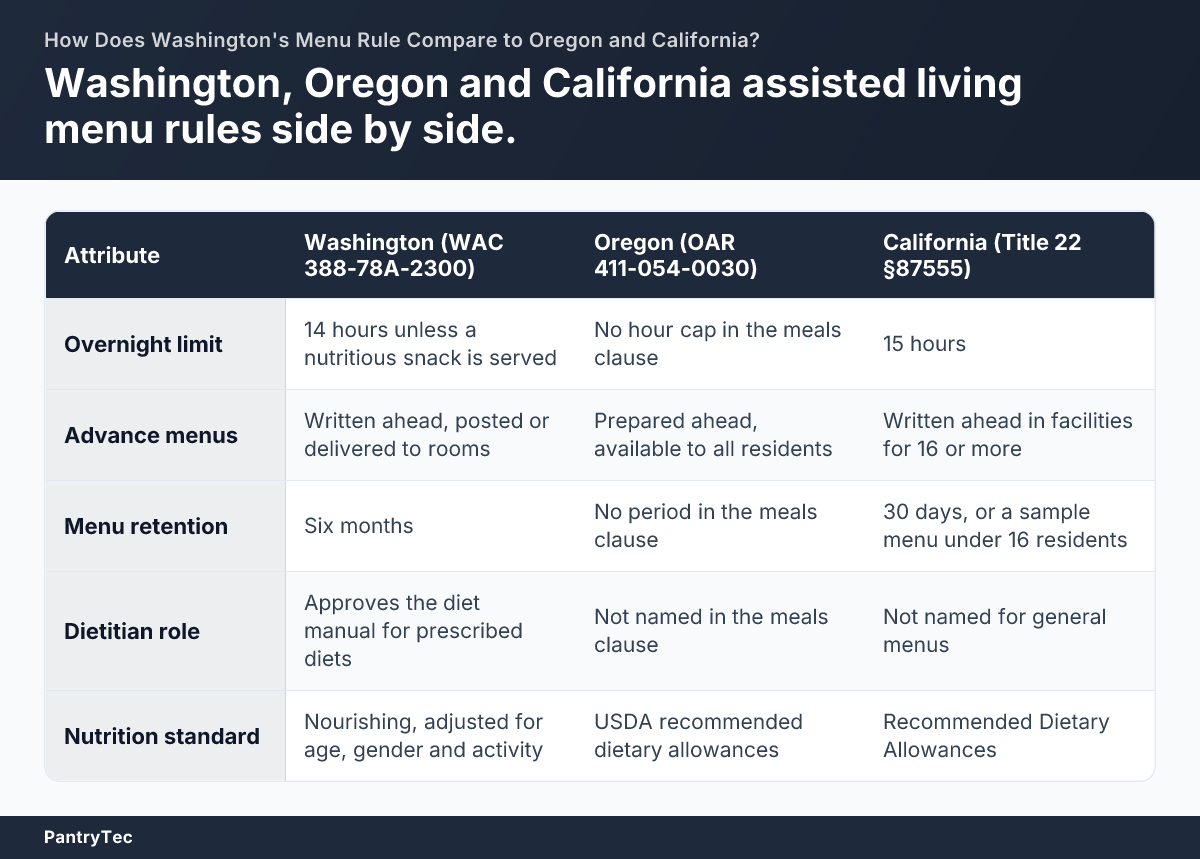
| Attribute | Washington (WAC 388-78A-2300) | Oregon (OAR 411-054-0030) | California (Title 22 §87555) |
|---|---|---|---|
| Overnight limit | 14 hours unless a nutritious snack is served | No hour cap in the meals clause | 15 hours |
| Advance menus | Written ahead, posted or delivered to rooms | Prepared ahead, available to all residents | Written ahead in facilities for 16 or more |
| Menu retention | Six months | No period in the meals clause | 30 days, or a sample menu under 16 residents |
| Dietitian role | Approves the diet manual for prescribed diets | Not named in the meals clause | Not named for general menus |
| Nutrition standard | Nourishing, adjusted for age, gender and activity | USDA recommended dietary allowances | Recommended Dietary Allowances |
Multi-State Operator Strategy
Menu policy across state lines works best when you build to the strictest entry in each row. That means Washington's retention and overnight cap, advance written menus, and Oregon's advance notice of changes. One binder format then holds up in all three states. Compare more states in Menu Regulation By State, or read Oregon assisted living and residential care menu rules and California RCFE menu rules under Title 22.

The menu rotation length is the other lever. One pattern we see is fewer dining complaints once a 10-week menu rotation is running. A cycle that long clears Washington's minimum with room to spare.
We hear from clients that the numbers here match their day-to-day reality. In our work, we found the biggest stress administrators face isn't menu quality. The concern that comes up first is proving compliance during unannounced state surveys.
What Conventional Wisdom Gets Wrong
Conventional wisdom points the other way. Most facilities do not need to hire a dietitian for menus. In our work, here is why: a $15-40/month RD-signed cycle menu service replaces the $800-$1,200/month consulting fees on the invoices facilities bring us, a 95% to 99% cost reduction.
The misconception survives because the old math once held. Menu software makes your staff do the work. In our work, here is why: done-for-you PDF menus need zero training versus 4-8 weeks of software onboarding, and flat pricing beats $2-5 per resident per month.
On the other hand, every business weighs these trade-offs against its own situation. In contrast to one-size-fits-all advice, compare the options against your real numbers before deciding. WAC 388-78A-2300 shows menu retention period of at least 6 months.