
What Ohio Residential Care Menus Must Include Under OAC 3701-16-10
Ohio home care menus must follow OAC 3701-16-10, an Ohio Department of Health rule effective July 12, 2024.
Ohio home care menus must follow OAC 3701-16-10, an Ohio Department of Health rule effective July 12, 2024. Three-meal facilities must meet Dietary Reference Intakes, plan menus one week ahead, and keep dated menus as served for three months. PantryTec writes dietitian-approved cycle menus and survey documentation for senior care facilities. This guide reads the rule the way a dietary manager applies it, as of October 2026. You can find Ohio home care facility rules alongside every other state citation in our state menu rule lookup guide.
TL;DR: Ohio RCFs pick 1 of 4 dietary service levels and state it in resident agreements. Three-meal menus need a diet manual published or approved by a dietitian. The gap between dinner and breakfast cannot exceed 16 hours, and an evening snack is mandatory. Supervising therapeutic diets requires a dietitian. Records must show menus as served plus every substitution.
What Does Ohio Require in a Residential Care Facility Menu?
Ohio requires each home care facility to choose one of four dietary service levels under OAC 3701-16-10 and record that choice in each resident agreement, with advance menu planning at at least 1 week ahead. The four levels are no meals, one to three daily meals, special diets other than therapeutic diets, or supervised therapeutic diets. Rule 3701-16-07 governs resident agreements, so your dietary election and your contract language must match. A facility that promises three daily meals must offer nourishing, palatable, attractive, and appetizing meals at regular community mealtimes. Those meals must provide the Dietary Reference Intakes of the Food and Nutrition Board of the National Academy of Sciences. Each menu must also follow a standard meal planning guide from a diet manual published or approved by a dietitian. Food is served in a form that fits each resident's needs, based on the resident assessment under rule 3701-16-08. The current text replaced older 'shall' wording, so checklists written before 2024 deserve a fresh read.
OAC 3701-16-10 Dietary Service Rules
Home care facility, as defined in rule 3701-16-01, includes homes that house 17 or more unrelated individuals and provide supervision and personal care. A second part of the definition covers smaller homes when at least one resident receives skilled nursing care. Home group homes with 6–16 beds often run on a single cook or an owner-operator kitchen, with no CDM on staff. These homes should confirm their license type before assuming the rule doesn't apply. Binders that still cite OAC 3701-17-60, the former RCF dietary rule, are out of date.
Nutritional Adequacy and Resident Choice
Menu variety is a rule requirement, not an optional extra. Each facility serving meals must offer foods that respect religious restrictions and ethnic and cultural preferences, following its own written policy. The food preferences you record at move-in should show up on the cycle menu.
Ohio also gives a useful picture of how much clinical need residents bring. Maine, Ohio, and Mississippi have different supply levels of nursing homes and RCFs, as the California HealthCare Foundation's Residential Care for the Elderly: Supply report notes. Even so, the three states have similar numbers of nursing home residents per 1,000 aged residents and similar shares of cognitively impaired cases, per that report (p. 41). That pattern is a reason to build texture options and finger foods for residents with dementia into your base plan. 75% of 7,094 U.S. norovirus outbreaks studied took place in long-term care and assisted living facilities, per the CDC journal Emerging Infectious Diseases (2020).
Ohio Menu Survey Readiness Self-Assessment (OAC 3701-16-10)
Set your dietary service level, then answer each item Yes, Partly, or No. Your score updates instantly and lists the documentation gaps to fix before a survey. Items marked Key count double. This is a self-check, not legal advice or a substitute for an ODH survey.
Does Ohio Require a Licensed Dietitian to Approve Menus?
Ohio requires a dietitian at two points: three-meal menus follow a diet manual published or approved by a dietitian, and supervising therapeutic diets requires a dietitian under rule 3701-16-05(G). For regular meals, the rule allows menus based on a published dietitian diet manual. It does not spell out a signature on each weekly menu. Facilities that supervise therapeutic diets must provide or arrange for a dietitian and serve three daily meals. That dietitian oversees, monitors, and helps train food service staff on preparing and serving therapeutic foods. Special diets other than therapeutic diets follow orders from a physician, another licensed health professional working within scope, or a dietitian. Ohio's chapter definitions give examples such as no added salt, no concentrated sweets, portion-adjusted meals, finger foods, and mechanically altered food. Ohio facilities may accept faxed or electronic therapeutic diet orders under rule 3701-16-09. Each order belongs in the resident chart before the kitchen changes a tray.
Dietitian Consultation Requirement
Care settings with federal certification show what a stricter standard looks like. 900 hours of supervised dietetics practice is the minimum for a qualified dietitian reviewing nursing home menus, per 42 CFR 483.60 on eCFR (2026). Ohio's RCF rule does not adopt that definition. A registered dietitian meets both standards, so your file is ready if you add skilled services later.
Facility budgets are where operators feel this requirement most. In our experience, facilities come to us paying $800 to $1,200 per month to an outside dietitian for quarterly menu reviews and signatures. That's $9,600 to $14,400 a year, so it pays to know exactly which tasks Ohio's rule assigns to the dietitian.
Ohio Dietitian Licensure Verification
Ohio licenses dietitians through the State Medical Board of Ohio, which took over from the former Ohio Board of Dietetics. Check any consultant's license in the board's online lookup before you file their approval letter, and note the renewal date.
Care teams should book dietitian time before a new therapeutic diet order arrives. One RDN medical nutrition therapy program received 200 referrals from January to May 2019, per the ACL toolkit Medical Nutrition Therapy Works for Seniors. The program reached 300 by the end of July and expected more than 500 by year end after opening an online referral portal, per the same toolkit. For the federal version of this rule, see our F808 guide to physician-ordered therapeutic diets.

What Meal Spacing and Snack Rules Apply in Ohio?
Ohio limits the gap between the evening meal and breakfast to 16 hours in home care facilities, and every facility that serves meals must offer an evening snack. The snack must include a choice of beverages and a food item from a basic food group. Ohio's limit is two hours longer than the federal nursing home standard. 14 hours is the federal maximum between a large evening meal and breakfast for nursing home residents, per 42 CFR 483.60 (2026). The federal rule allows up to 16 hours only when a nourishing bedtime snack is served and a resident group agrees. Ohio's home care rule has no resident-group condition, and the evening snack is required either way. Here's an example: a facility that serves dinner at 5:00 p.m. reaches the limit at 9:00 a.m. A 9:30 breakfast would break the rule. Serving breakfast by 8:00 a.m. leaves a one-hour cushion.
Ohio's 16-Hour Interval Compared With Other Rules
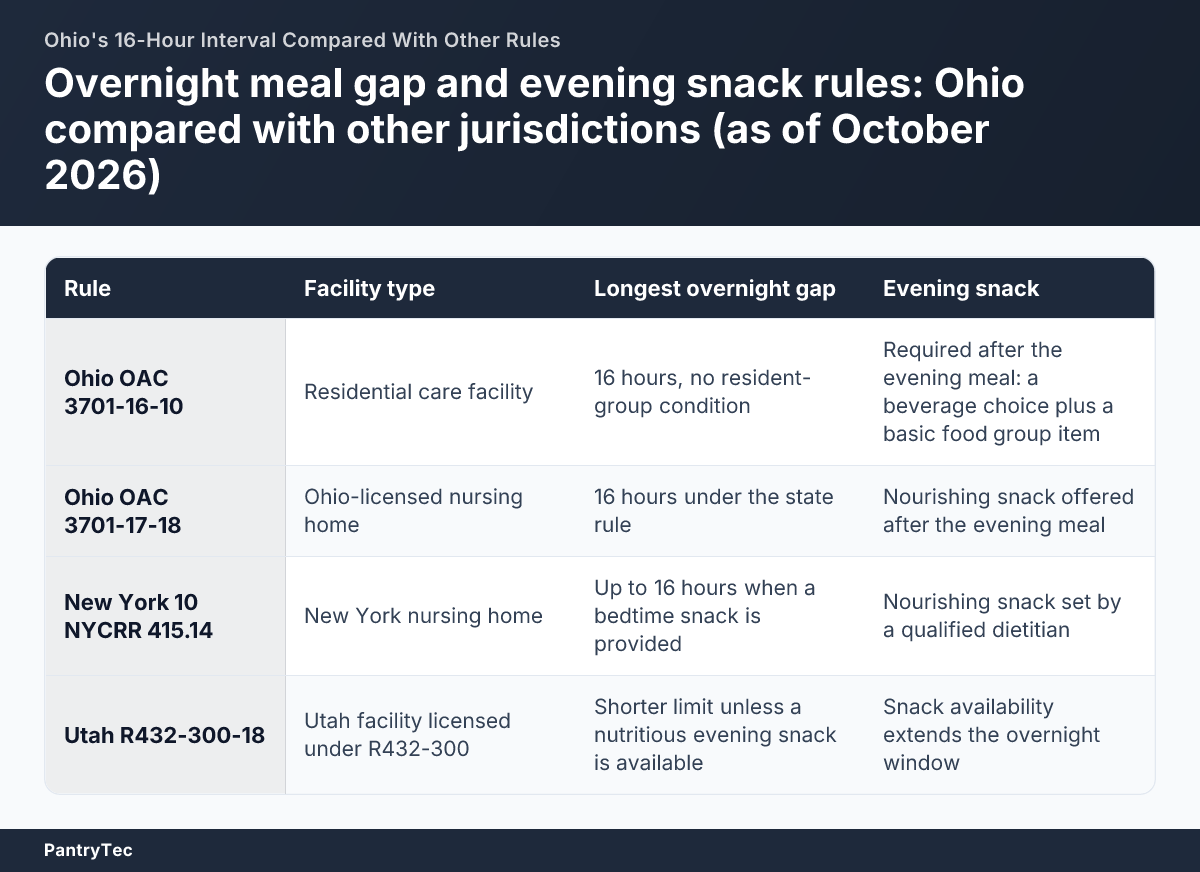
| Rule | Facility type | Longest overnight gap | Evening snack |
|---|---|---|---|
| Ohio OAC 3701-16-10 | Residential care facility | 16 hours, no resident-group condition | Required after the evening meal: a beverage choice plus a basic food group item |
| Ohio OAC 3701-17-18 | Ohio-licensed nursing home | 16 hours under the state rule | Nourishing snack offered after the evening meal |
| New York 10 NYCRR 415.14 | New York nursing home | Up to 16 hours when a bedtime snack is provided | Nourishing snack set by a qualified dietitian |
| Utah R432-300-18 | Utah facility licensed under R432-300 | Shorter limit unless a nutritious evening snack is available | Snack availability extends the overnight window |
Bedtime Snack Documentation
Home care still lives in the shadow of nursing home rules. Small home care market data, from bed-size bands to licensure status, still shows a small sector. A five-state study found fewer than one home care bed for every four nursing home beds in most counties, per Swan and Newcomer (2000) in the CHCF report. No county came close to a 1:1 ratio. If your cook or consultant trained in a nursing home, confirm they are using Ohio's home care limit.
Menu binders should prove that the snack is offered. List the evening snack in every cycle week and note refusals and alternates. Put your snack policy for residents who wake up hungry in the same written policy. Midwest operators can compare these rules with Michigan adult foster care and home for the aged menu rules, which split into two license categories.
How Long Must Ohio Facilities Keep Menus on File for a Survey?
Ohio home care facilities must keep dated menus as served, including therapeutic diets and substitutions, for at least three months and show them to the Director on request. Menus must also be planned at least one week in advance. Substitutions are noted on the menu record itself, so a menu substitution log or as-served notes are the simplest proof. The same paragraph of the rule requires a one-week supply of staple foods and a two-day supply of perishables, sized to your census. Ohio's three-month window falls between two other state benchmarks. California RCFEs licensed for 16 or more residents write menus one week ahead and keep menus as served for 30 days, under 22 CCR 87555. Utah's R432-153-16 keeps substitution records for three months, the same as Ohio. Kitchen staff should initial each as-served change on the day it happens. Store the full retention window on paper or as PDFs, and keep older cycles if your resident agreement or policy promises longer retention.
Pre-Survey Menu Audit Steps
- Pull the dietary election from your policy and compare it with three signed resident agreements.
- Match the diet manual named on your menus to the dietitian approval letter in your compliance binder.
- Check the diet roster against physician, licensed professional, or dietitian orders to ensure every tray matches its order.
- Compare posted meal times with the overnight limit, and confirm the evening snack appears on the menu.
- Review every dated menu as served in the retention window for therapeutic extensions and noted substitutions.
- Check the pantry against the staple and perishable supply standard, and confirm any food service operation license required under Chapter 3701-21.
Home care administrators tell us the survey worries them more than the recipes do. In our work, we found the biggest stress isn't menu quality. The concern that comes up first is proving compliance during unannounced state surveys, which is why this audit starts with paperwork.
Common Dietary Deficiency Patterns
Facility files tend to break down where one document has to match another. These are the gaps we check first:
- Resident agreements that promise three meals while the policy lists a different election.
- Texture-modified trays served without a current order in the resident chart.
- Kitchen substitutions missing from the as-served menu record.
- An evening snack that staff offer verbally but that never appears on the written cycle menu.
Menu cost records get close review in some payer programs, too. Washington's Senior Nutrition Program Standards (2011) say the per-meal cost of Medicaid-funded meals cannot be higher than the cost charged to other funding sources. Ohio RCFs answer to different rules, but keeping menus, substitutions, and food costs linked makes any audit faster. To see signature and retention rules side by side, read our comparison of state menu signature and retention rules.
We hear from clients that the numbers here match their day-to-day reality. One pattern we see is fewer dining complaints once a 10-week menu rotation is running. Residents get 70 days of menus, 210 breakfasts, lunches and dinners, before any day repeats.

Key Takeaways for Ohio Residential Care Menus
Ohio menu compliance depends on four records that match: the dietary election, the diet manual, diet orders, and menus as served.
- OAC 3701-16-10 (current text from 2024) governs Ohio RCF dietary services. Your election must match resident agreements under rule 3701-16-07.
- Three-meal menus must meet Food and Nutrition Board DRIs and follow a diet manual published or approved by a dietitian.
- Ohio's overnight limit is two hours longer than the federal nursing home standard, but the evening snack is required either way.
- Facilities that supervise therapeutic diets must provide or arrange for a dietitian under rule 3701-16-05(G).
- Keep menus as served, with substitutions, for the rule's full retention window plus anything your policy promises.
Standard wisdom says a small Ohio RCF needs a consulting dietitian on a monthly retainer. PantryTec takes a different approach, because the rule ties regular menus to a dietitian-approved diet manual rather than to regular visits. A signed cycle menu covers that part, and you can save paid consultant hours for therapeutic diet work.
Every PantryTec cycle menu is reviewed by Bridget MacDonald, RD (25+ years in nutrition), who holds an Ohio dietitian license. Each plan includes a 10-week rotation and the RD Approval Letter she signs for your compliance binder. Plans cost $180 to $480 a year when billed annually. You can compare tiers on the PantryTec flat-rate menu pricing.
What Conventional Wisdom Gets Wrong
Conventional wisdom points the other way. Most facilities do not need to hire a dietitian for menus. In our work, here is why: a $15-40/month RD-signed cycle menu service replaces the $800-$1,200/month consulting fees on the invoices facilities bring us, a 95% to 99% cost reduction.
The misconception survives because the old math once held. Menu software makes your staff do the work. In our work, here is why: done-for-you PDF menus need zero training versus 4-8 weeks of software onboarding, and flat pricing beats $2-5 per resident per month.
On the other hand, every business weighs these trade-offs against its own situation. In contrast to one-size-fits-all advice, compare the options against your real numbers before deciding.
Limitations and Considerations
- This summary reflects OAC 3701-16-10 as published on codes.ohio.gov. It isn't legal advice, and rules get revised.
- Ohio nursing homes follow Chapter 3701-17 and federal rules, not the home care rule.
- A remote menu service doesn't replace on-site dietitian supervision of therapeutic diets.
What is a cycle menu in senior living?
A cycle menu is a set of planned daily menus that repeats after a fixed number of weeks, such as 4, 5, or 10. Ohio's 3701-16-10 doesn't set a rotation length, but it does require varied, seasonal food and planning ahead.
How many weeks should an assisted living cycle menu be?
Rotation length depends on the state. Utah R432-153-16 requires menus to cycle no less often than every two weeks, while Ohio sets no minimum. PantryTec uses a 10-week rotation to cut down on repetition for long-stay residents.

Do assisted living menus have to be approved by a dietitian?
Ohio requires three-meal menus to follow a diet manual published or approved by a dietitian, and supervising therapeutic diets requires a dietitian. Other states differ: Utah R432-153-16 requires menus approved and signed by a certified dietitian.
What is F803 in a nursing home survey?
F803 is the CMS survey tag for menus and nutritional adequacy in certified nursing homes under 42 CFR 483.60(c). It checks that menus meet residents' needs, are followed, and are reviewed by a qualified dietitian or other clinically qualified nutrition professional. Our F803 menu requirements explainer covers survey details.
What does 42 CFR 483.60 require for menus?
42 CFR 483.60 requires certified nursing facilities to serve at least three meals daily from menus that meet nutritional needs and are reviewed by a qualified dietitian. It applies to Medicare and Medicaid certified facilities. Ohio residential care facilities follow OAC 3701-16-10 instead.
One common pattern we encounter supports this. In our experience, most facility administrators don't realize their external dietitian bill exceeds their annual menu cost by 10x or more. We deliver a new facility's first menu PDF within 24 to 48 hours of sign-up, and fresh cycle menus then arrive in the facility inbox every week.
Get the Free 4-Week Sample Menu Packet
Tell us your facility type, bed count, and state. We will show which Ohio OAC 3701-16-10 points the packet covers for you, then send you to our request page to get your copy.
Your packet preview
This form does not send or store anything. The button opens our request page with your selections filled in so our team can deliver the packet. Rule notes reflect OAC 3701-16-10 (effective July 12, 2024) and are not legal advice; confirm details with the Ohio Department of Health.