
Arizona Assisted Living Menus:
Center and Home Menu Rules Under R9-10-817
Arizona assisted living menus must be written at least one week in advance and posted at least one calendar day before the first meal they cover.
Arizona assisted living menus must be written at least one week in advance and posted at least one calendar day before the first meal they cover. Both duties come from A.A.C. R9-10-817, the food services section of the Arizona Department of Health Services rules for every Arizona assisted living facility (ALF). PantryTec builds dietitian-approved cycle menus and survey documentation for senior care operators, so this guide reads the rule the way a dietary manager applies it. For the method behind every state page, see our guide on To find and read your state's.
TL;DR: Arizona's food rule, A.A.C. R9-10-817, makes the facility manager responsible for the menu. Regular menus need no dietitian signature. Therapeutic diets need a written practitioner order and a current therapeutic diet manual. Assisted living centers also need a food business license. State surveyors compare posted menus, menus as served, and substitution records, so dated paperwork matters more than software.
Menu planners who want a working model can use our Download Free 4-Week Sample page and compare it with the rule below.
What Does Arizona Require in an Assisted Living Menu?
Arizona sets eight menu and meal duties in subsection A of A.A.C, with Arizona food menu (R9-10-817)'s advance planning lead at at least 1 week., and the licensed facility manager owns each one, not a consulting dietitian. The food menu must list the foods served each day and show any food substitution by the morning of that meal. Meals and snacks must then be served according to the posted menu. Daily planning follows the Dietary Guidelines for Americans 2015 named in the rule. Each resident receives a diet matching the nutritional needs written in the resident service plan. Water stays available at all times unless a medical practitioner's order says otherwise. Residents who need help eating get help and adaptive eating equipment, such as a plate guard, rocking fork, or assistive hand device. The kitchen must also be able to store, refrigerate, and reheat food for each resident's dietary needs. Subsection C covers food safety, which is where many small kitchens slip.
Food Safety Temperatures in Subsection C
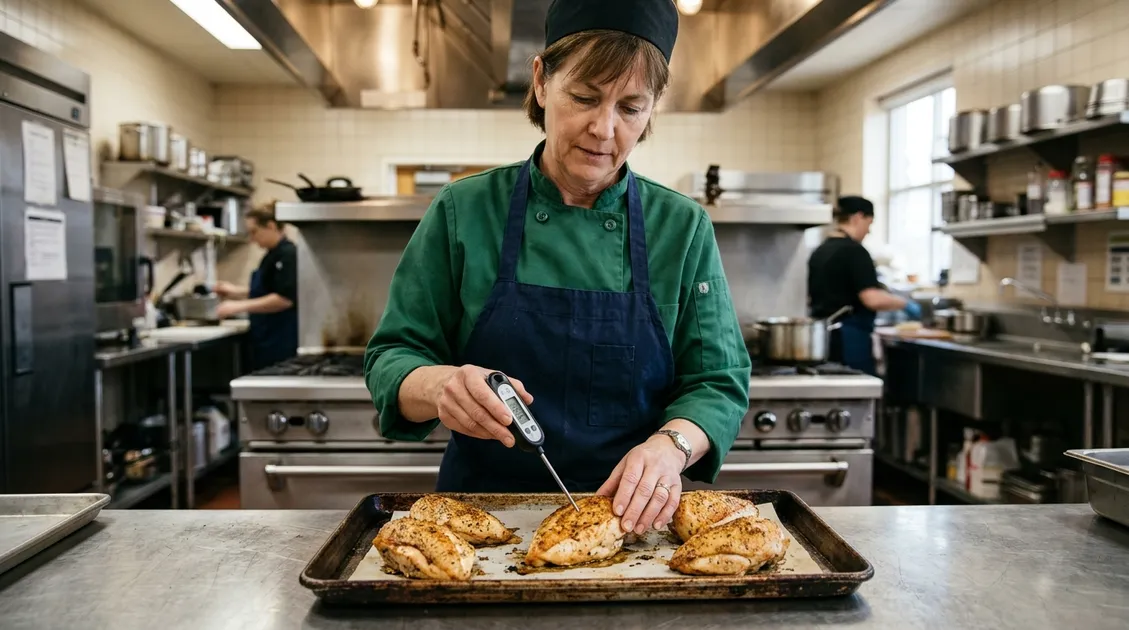
Menu safety also depends on subsection C. 75% of 7,094 U.S. norovirus outbreaks studied took place in long-term care and assisted living facilities, per the CDC journal Emerging Infectious Diseases (2020). Surveyors read your temperature logs with that risk in mind, starting with the cold holding temperature and each minimum internal cooking temperature.
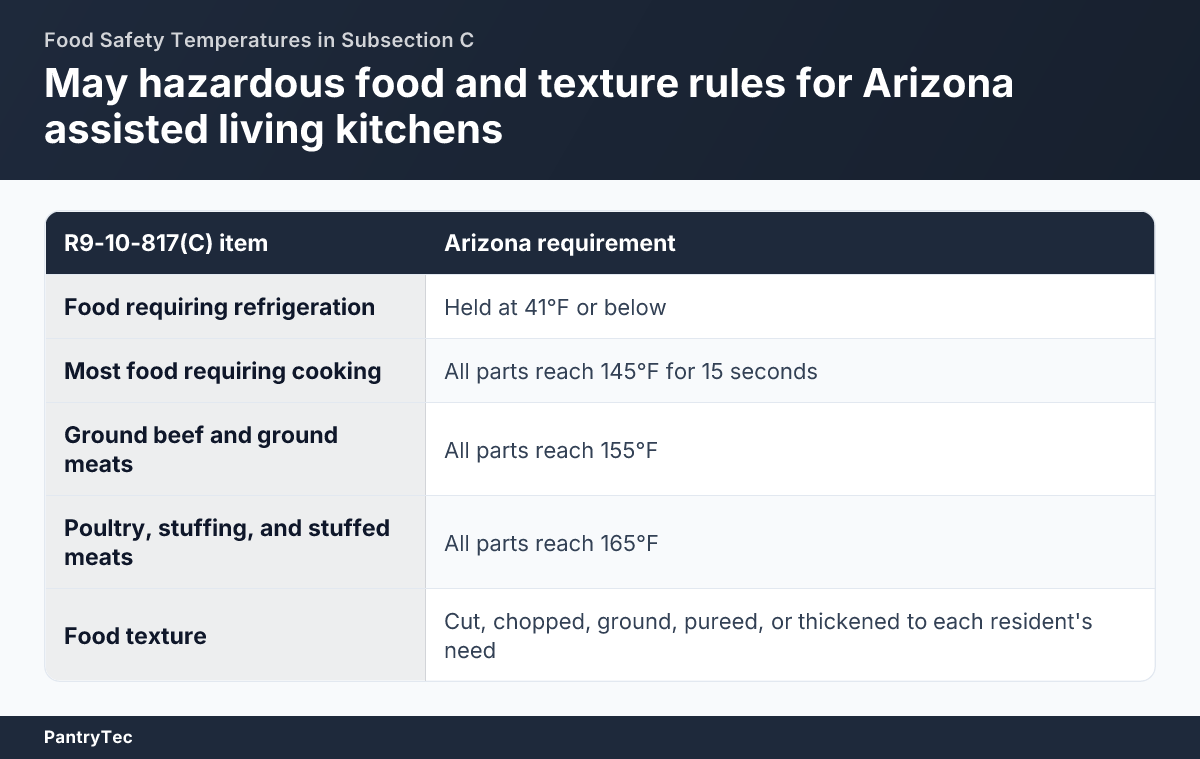
| R9-10-817(C) item | Arizona requirement |
|---|---|
| Food requiring refrigeration | Held at 41°F or below |
| Most food requiring cooking | All parts reach 145°F for 15 seconds |
| Ground beef and ground meats | All parts reach 155°F |
| Poultry, stuffing, and stuffed meats | All parts reach 165°F |
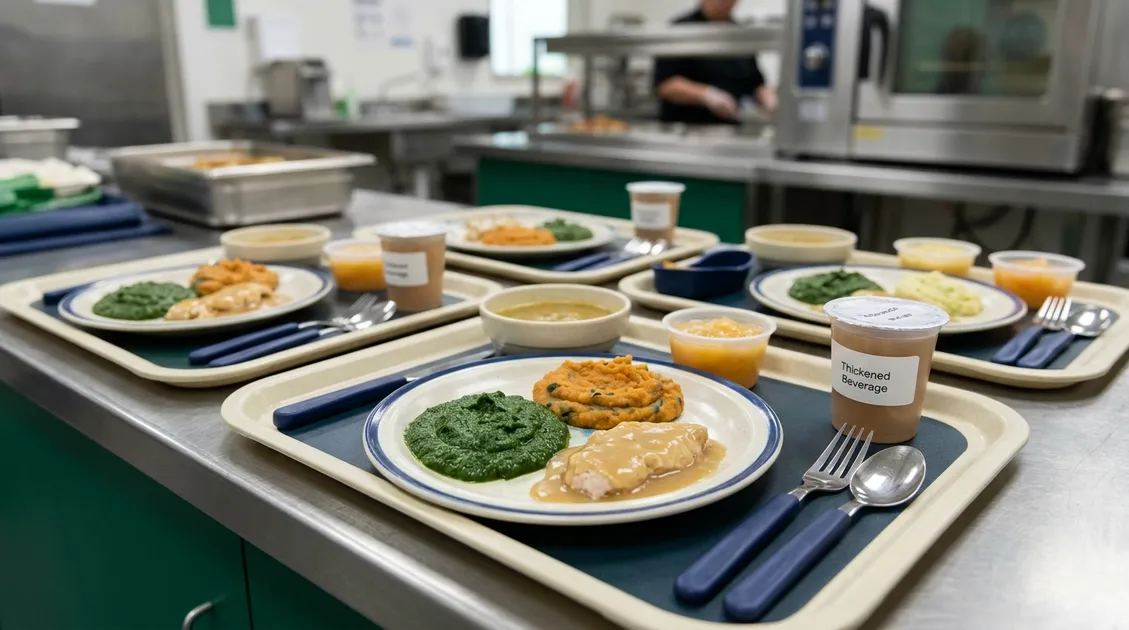
| Food texture | Cut, chopped, ground, pureed, or thickened to each resident's need |
Assisted Living Center vs Assisted Living Home
Assisted living homes serve 10 or fewer residents and centers serve 11 or more, under A.R.S. § 36-401. Both follow the same menu duties. A center must also hold a food business license or permit under 9 A.A.C. 8, Article 1, and keep a copy on file. Any facility that buys prepared meals from a food business keeps that vendor's license copy too.

Home operators watch every compliance dollar, and history explains why. Assisted living company stock fell 70 percent on average by the end of 1999, per CHCF's Residential Care for the Elderly report. Eight of ten publicly traded assisted living firms lost money that year, the same report found.
Arizona Menu Survey-Readiness Self-Assessment (A.A.C. R9-10-817)
Answer each item Yes, Partly, or No based on the paperwork you could hand a surveyor today. Your score and gap list update instantly. Surveyors compare posted menus, menus as served, and substitution records, so dated documentation is what counts.
Your readiness snapshot
Start answering to see your result.
Get your report
This page has no server and does not send, store, or email anything. The email button opens a pre-filled draft in your own email app so you can send the report to yourself or your team.
Self-check only, based on the R9-10-817 duties summarized on this page. It is not legal advice and does not predict a survey outcome. Confirm details against the current Arizona Department of Health Services rule.
Who Must Approve Menus for an Arizona Assisted Living Facility?
Arizona requires no registered dietitian signature on regular assisted living menus; R9-10-817 makes the manager accountable, with clinical oversight entering only through ordered therapeutic diets. If a facility offers therapeutic diets, subsection B adds two duties. A current therapeutic diet manual must be available to employees. Each therapeutic diet must follow a written order from the resident's primary care provider or another medical practitioner. That order triggers texture-modified diets, such as pureed foods or thickened liquids. It also triggers restrictions like a 2-gram sodium or consistent carbohydrate (CCHO) plan. Federal nursing home rules set a higher bar. Under 42 CFR §483.60(c)(6), menus in certified nursing facilities must be reviewed for nutritional adequacy by a dietitian or other clinically qualified nutrition professional. North Carolina sits between the two, because 10A NCAC 13F .0904 requires therapeutic diet menus to be planned or reviewed by a licensed dietitian/nutritionist. Arizona's lighter text does not mean lighter scrutiny at survey time.
Who Signs What Under Arizona's Rule
- The manager plans, posts, and keeps regular menus without a required signature.
- A primary care provider or other medical practitioner writes each therapeutic diet order.
- Employees work from a current therapeutic diet manual kept in the kitchen.
- Each resident service plan records the diet needs the plate must match.
Assisted living menu costs are private costs: Medicaid waivers reached only about 59,000 supportive housing residents nationally, per CHCF's Home Care for the Elderly (2000 data). Facility rates, not public programs, cover most food and menu spending. About 80 percent of low-income residents in home care got no help from those programs, the report adds.
Menu sign-off is where we see budgets leak. In our experience, facilities come to us paying $800 to $1,200 per month to an external dietitian solely for quarterly menu reviews and signatures. That's $9,600 to $14,400 a year. Therapeutic menus still deserve RD review, so the fix is scope, not elimination. Our guide explains Therapeutic diets must be physician-ordered under.
In our experience, most facility administrators don't realize their external dietitian bill exceeds their annual menu cost by 10x or more.
How Long Must Arizona Facilities Keep Menu Records, and How Do Other States Compare?
Arizona requires food menus to be kept at least 60 calendar days after their last day, with every food substitution recorded by that meal's morning, with menus-as-served retention at 30 days. That menu retention period applies to menus as served, not menus as planned. Kitchen staff mark changes on the posted copy or a menu substitution log, then file it. A substitute should carry similar nutritive value, such as baked chicken replacing pork loin. Meal spacing is a separate question. R9-10-817 sets no hour limit between supper and breakfast, so the federal benchmark is the safest guide. Under 42 CFR §483.60(f), certified nursing facilities serve at least three meals daily. No more than 14 hours may pass between a large evening meal and breakfast. A nourishing bedtime snack stretches that to 16 hours if the resident group agrees. A 5:30 p.m. supper and 7:30 a.m. breakfast lands right at that federal limit.

Arizona vs North Carolina vs Federal Menu Rules
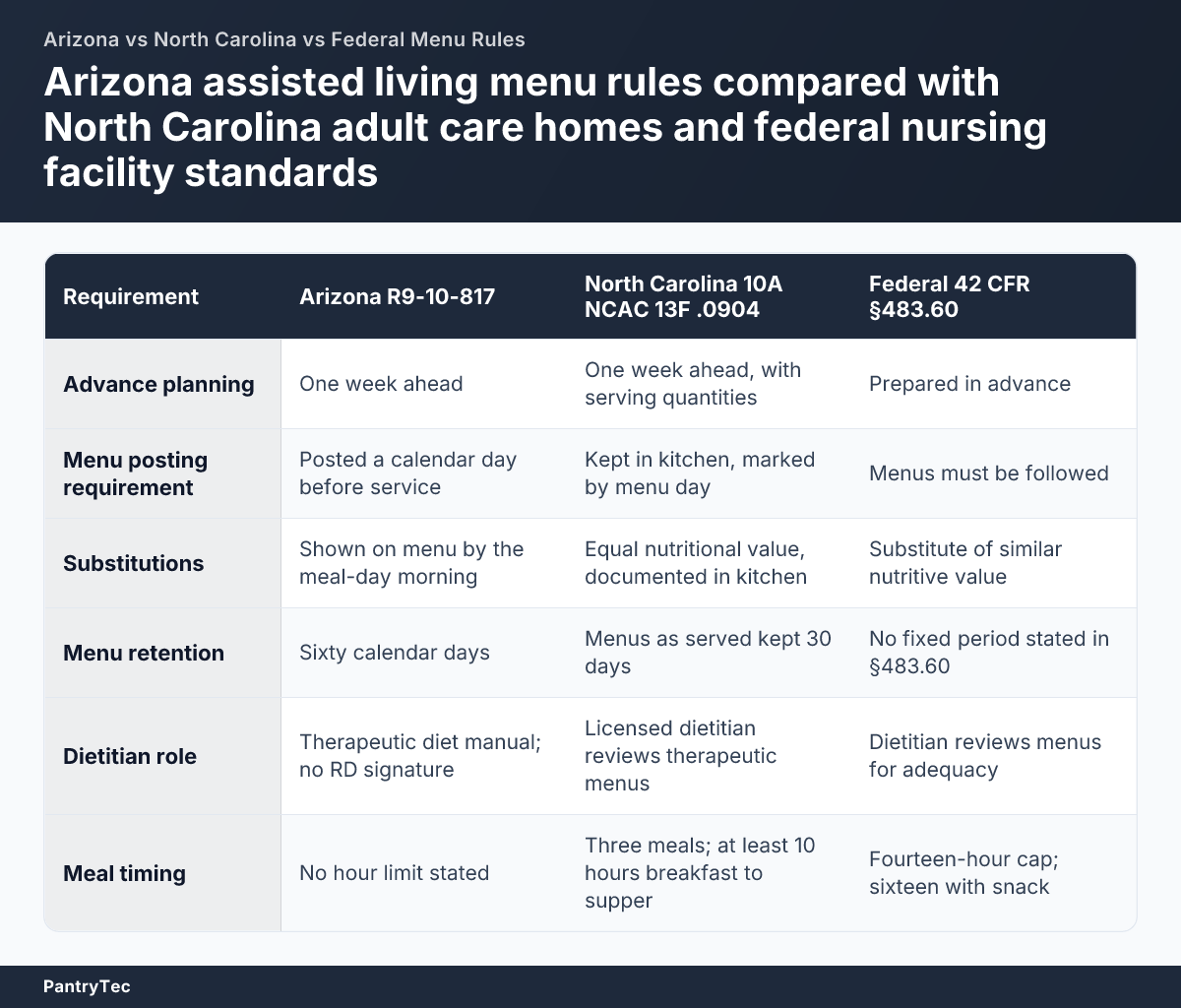
| Requirement | Arizona R9-10-817 | North Carolina 10A NCAC 13F .0904 | Federal 42 CFR §483.60 |
|---|---|---|---|
| Advance planning | One week ahead | One week ahead, with serving quantities | Prepared in advance |
| Menu posting requirement | Posted a calendar day before service | Kept in kitchen, marked by menu day | Menus must be followed |
| Substitutions | Shown on menu by the meal-day morning | Equal nutritional value, documented in kitchen | Substitute of similar nutritive value |
| Menu retention | Sixty calendar days | Menus as served kept 30 days | No fixed period stated in §483.60 |
| Dietitian role | Therapeutic diet manual; no RD signature | Licensed dietitian reviews therapeutic menus | Dietitian reviews menus for adequacy |
| Meal timing | No hour limit stated | Three meals; at least 10 hours breakfast to supper | Fourteen-hour cap; sixteen with snack |
Assisted living rules grew up beside a much larger nursing home system. 82.0% of U.S. adults 65+ in group quarters lived in nursing or skilled nursing facilities in 2014-2018, per the U.S. Census Bureau American Community Survey (2018). That helps explain why federal F-tags became the default vocabulary for dietary staff. Home care bed supply ran below one bed per four nursing home beds in most counties of a five-state study, per CHCF's report (2000 data). Each state draws its own lines, from the Texas assisted living menu rule to Colorado assisted living residence menu rules.
What Do ADHS Surveyors Check During an Arizona Menu Review?
Arizona Department of Health Services surveyors test menu compliance against four record sets: posted menus, menus as served, therapeutic diet orders, and food safety logs. Inspections can arrive without notice, so your binder has to be current every day. Surveyors work for the ADHS Bureau of Assisted Living Facilities Licensing, which older ADHS documents list under home facilities licensing. Most reviews start in the kitchen. The surveyor compares the posted food menu with the steam table and the plates leaving the line. A mismatch with no recorded substitution reads as a menu that wasn't followed. Next, the surveyor picks a resident on a therapeutic diet and traces the written order to the tray. The therapeutic diet manual, the refrigerator thermometer, and recent temperature logs get checked along the way. Centers show their food business license. Homes that buy catered meals show the caterer's license or permit instead. Each unexplained gap gives the surveyor grounds for a deficiency citation.
Documents to Stage Before the Survey
- Your licensure menu packet, with the current dated food menu posted where residents see it.
- Archived menus as served, with changes marked in a menu substitution log.
- Written diet orders matched to each resident service plan.
- The current therapeutic diet manual at the kitchen station.
- Temperature logs plus the food business or vendor license copy.
Menu quality is rarely the first worry. We have worked. The concern that comes up first is proving compliance during unannounced state surveys. Our survey-ready dining checklist for small assisted living homes turns the list above into a binder index.
Assisted living technology choices are wide: 14 long-term care technology companies were interviewed and classified for Emerging Health Technologies in Long-Term, published in PMC. Their products ranged across robots, sensors, wearables, online portals, mobile apps, and virtual reality. Arizona's R9-10-817 requires none of them, and a dated, complete binder meets the rule.
We hear from clients that the numbers here match their day-to-day reality. In our work, we found the biggest stress administrators face isn't menu quality. The concern that comes up first is proving compliance during unannounced state surveys. One pattern we see is fewer dining complaints once a 10-week menu rotation is running. Residents get 70 days of menus, 210 breakfasts, lunches and dinners, before any day repeats. 3.0 percent of U.S. women aged 65 and over lived in nursing facilities in 2020, compared with 1.8 percent of men, per the U.S. Census Bureau.

What Conventional Wisdom Gets Wrong
Conventional wisdom points the other way. Most facilities do not need to hire a dietitian for menus. In our work, here is why: a $15-40/month RD-signed cycle menu service replaces the $800-$1,200/month consulting fees on the invoices facilities bring us, a 95% to 99% cost reduction.
The misconception survives because the old math once held. Menu software makes your staff do the work. In our work, here is why: done-for-you PDF menus need zero training versus 4-8 weeks of software onboarding, and flat pricing beats $2-5 per resident per month.
On the other hand, every business weighs these trade-offs against its own situation. In contrast to one-size-fits-all advice, compare the options against your real numbers before deciding.
Key Takeaways on Arizona Assisted Living Menu Rules
Arizona operators can meet R9-10-817 with three tools: a written cycle menu, a substitution log, and a therapeutic diet manual. Standard wisdom says every assisted living home needs a consulting dietitian on retainer, but PantryTec delivers RD-signed cycle menus for senior care operators at a flat rate instead. The reason is the rule itself: Arizona asks the manager to plan, post, and keep menus, not to buy monthly RD hours. PantryTec's flat-rate menu plans run $15, $20, or $40 per month billed annually, with no per-resident or setup fees. Every plan includes a 10-week rotating cycle menu delivered weekly by PDF. Each plan also ships with an RD Approval Letter signed by Bridget MacDonald, RD (more than 25 years in nutrition). The Complete plan adds a diet manual and a food temperature log, two items surveyors ask to see. First menus arrive within 24-48 hours of sign-up.
- Arizona's R9-10-817 puts menu planning, posting, and retention on the manager, with no RD signature rule for regular menus.
- Therapeutic diets need a written practitioner order plus a current therapeutic diet manual on site.
- Federal 42 CFR §483.60(f) meal spacing is the best scheduling benchmark because Arizona's rule sets no hour limit.
- ADHS surveyors compare posted menus with menus as served, so log each substitution the morning it happens.
Limitations and Considerations
- Arizona amends its rules, so confirm the current R9-10-817 text with ADHS before relying on any summary.
- Federal §483.60 benchmarks guide scheduling but don't bind state-licensed assisted living.
- Independent living and 55+ communities without care licenses fall outside Article 8, and no menu replaces a written diet order.
What is a cycle menu in senior living?
Assisted living cycle menus are planned menus that repeat after a set rotation length, covering breakfast, lunch, dinner, snacks, and extensions like a finger food menu. PantryTec's 10-week rotation gives residents 70 distinct days before a repeat.
How many weeks should an assisted living cycle menu be?
Arizona sets no minimum menu rotation length in R9-10-817. A selective menu with an always-available alternate entrée cuts formal substitutions, and selective versus non-select menu design is your call.
Do assisted living menus have to be approved by a dietitian?
Assisted living menus in Arizona need no dietitian signature for regular diets, though therapeutic diets need a written practitioner order. Certified nursing facilities, by contrast, need dietitian review of menus under 42 CFR §483.60(c)(6).
What is F803 in a nursing home survey?
Menu adequacy in certified nursing homes is the subject of F-Tag F803, which enforces 42 CFR §483.60(c) through Appendix PP of the State Operations Manual. Arizona assisted living is surveyed under state rules instead; our F803 nutritional adequacy explainer covers the federal tag.
What does 42 CFR 483.60 require for menus?
Menu standards in 42 CFR §483.60(c) require menus that meet national guidelines, are prepared in advance, are followed, and are reviewed for nutritional adequacy. Section (f) adds at least three meals daily.
Get the Free 4-Week Sample Menu Packet
Tell us your facility type, bed count, and state. You will see a preview of what the packet covers for Arizona's A.A.C. R9-10-817, then continue to our request page to receive it.
Packet preview
| Food | Requirement |
|---|---|
| Food requiring refrigeration | 41°F or below |
| Most food requiring cooking | 145°F, 15 sec |
| Ground beef and ground meats | 155°F |
| Poultry, stuffing, stuffed meats | 165°F |