
How Often Must Menus Be Re-Approved? Annual vs Every Three Years
Menus in senior care facilities should be re-approved by a dietitian at least every 12 months, even where a state allows longer.
Menus in senior care facilities should be re-approved by a dietitian at least every 12 months, even where a state allows longer. Menu reapproval frequency is set by license type: Florida assisted living rules require annual review, while federal nursing home rules say only “periodically.” No state code compared on this page sets a three-year cycle, so consultants default to annual review when a code is silent. PantryTec, a dietitian-approved cycle menu service for senior care, maps this timing rule in our hub on State menu rules differ on approval.
TL;DR: Annual dietitian review is the safest default. Florida writes it into code, CMS ties “periodically” to resident needs, and California's RCFE rule sets no interval. A three-year letter fails outright in annual-review states. Re-approve early whenever diets, recipes, vendors or residents change.
Approved menus are easier to defend when you know what a dated sign-off looks like. Download free dietitian-approved sample menus and compare them with the approval record in your binder.
How Often Must a Dietitian Re-Approve a Cycle Menu?
Annual re-approval is the most common fixed interval in the codes compared below, while federal rules require periodic updates and California's RCFE rule names none. Florida is the clearest annual example. Its assisted living rule, Rule 59A-36.012, requires all regular and therapeutic menus to be reviewed annually by a qualified dietetics professional. Washington sits at the long end, with a multi-year review clock for the dietitian-approved diet manual under WAC 388-78A-2300. The federal benchmark, 42 CFR §483.60(c), says menus must be updated periodically and reviewed by a dietitian for nutritional adequacy. CMS guidance for F-Tag F803 in Appendix ties “periodically” to changing resident needs, not to a calendar date. Assisted living homes are not bound by that federal rule. Many state surveyors still read it as the benchmark, which is why the table below includes it.
| Jurisdiction and rule | Facility type | Re-approval interval | Who signs |
|---|---|---|---|
| Federal, 42 CFR §483.60(c)(5)-(6) | Medicare- and Medicaid-certified nursing facilities | “Updated periodically” plus a nutritional adequacy review; no fixed calendar | Facility dietitian or clinically qualified nutrition professional |
| Florida, Rule 59A-36.012 | Assisted living facilities | Annually, with original signature, license or registration number and review date on file | Licensed or registered dietitian, licensed nutritionist, or supervised dietetic technician |
| California, Title 22 §72341 | Skilled nursing facilities | All menus dietitian-approved and revised quarterly | Facility dietitian |
| California, Title 22 §87555 | RCFEs (assisted living) | No stated interval; homes licensed for 16 or more keep menus as served 30 days | Consultant required in larger homes when the food lead is not a dietitian, nutritionist or home economist |
| Washington, WAC 388-78A-2300 | Assisted living facilities | Diet manual reviewed at least every 5 years; menus kept at least 6 months | Dietitian (diet manual approval) |
| Texas HHSC, Policy F-1720 | Area Agency on Aging meal providers | Written approval of each meal and allowable substitution before service | Dietitian with Texas license or CDR registration number |
Menus for Older Americans Act meal programs run on the tightest clock. Texas Health and Human Services Commission (HHSC) policy requires Area Agencies on Aging (AAAs) to secure written dietitian menu approval before a meal is served. Menu monitoring for compliance then confirms that served meals match the approved menu. The Texas Department of Licensing and Regulation licenses dietitians under Texas Occupations Code, Chapter 701, so only license holders may use the title “licensed dietitian.”
Approved menus in Washington's senior nutrition programs carry a cost rule too. Medicaid-funded meals can't cost more per meal than other-funded meals, per the Washington State Senior Nutrition Program Standards (2011 federal citation).

Menu Survey-Readiness Self-Assessment
Choose your jurisdiction, enter the date of your last dietitian menu approval, and tick each item you can prove from your binder. The tool flags an approval older than the rule's interval (or the 12-month best-practice default when a code is silent) and builds a gap report you can email to yourself or your team.
1. Your rule and dates
2. Binder checklist
- No gaps calculated yet.
"Email this gap report" opens your own email app with the report pre-filled; you choose the recipient and send it yourself. PantryTec does not receive or store anything you enter here. This self-check summarizes the rules compared on this page and is not legal advice; confirm requirements with your state licensing agency and your dietitian.
Annual vs Every Three Years: Which Re-Approval Cycle Holds Up at Survey?
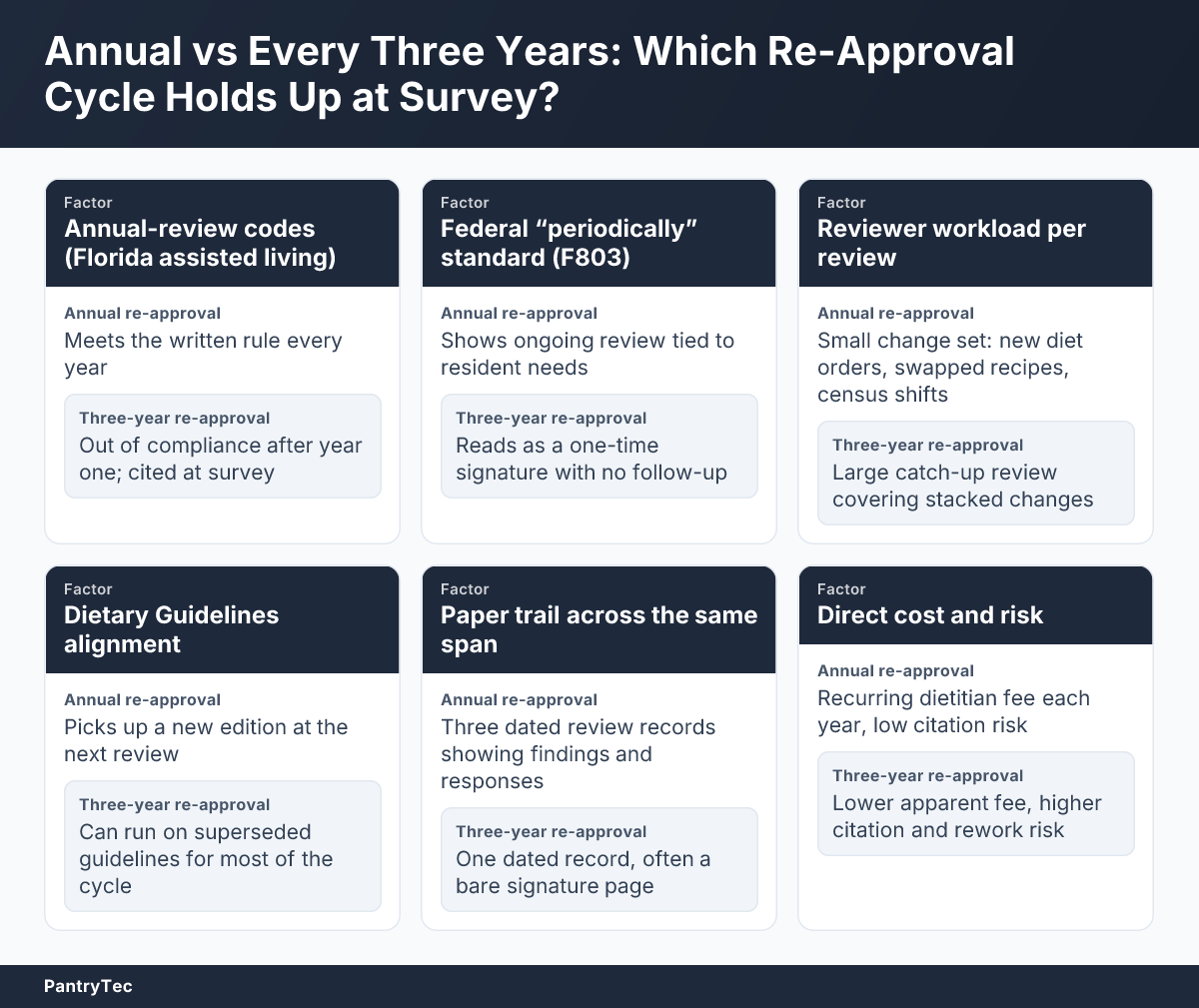
Annual re-approval holds up in every jurisdiction compared here, while a three-year cycle breaks annual-review rules and reads as a bare one-time signature everywhere else. Three-year re-approval doesn't appear in any state code on this page. Operators usually inherit it from an old consultant contract or a binder habit. Picture a Florida assisted living home whose menu was signed 26 months before survey. That approval is 14 months past its annual deadline, so the surveyor treats it as expired. National guidelines move as well. The 2025–2030 Dietary Guidelines for Americans now succeed the 2020–2025 edition that Florida's rule still includes. A menu signed under the older edition invites a fair nutritional adequacy question. An annual cycle catches that shift at the next review, and a triennial cycle can miss it entirely. The table weighs both options factor by factor.
| Factor | Annual re-approval | Three-year re-approval |
|---|---|---|
| Annual-review codes (Florida assisted living) | Meets the written rule every year | Out of compliance after year one; cited at survey |
| Federal “periodically” standard (F803) | Shows ongoing review tied to resident needs | Reads as a one-time signature with no follow-up |
| Reviewer workload per review | Small change set: new diet orders, swapped recipes, census shifts | Large catch-up review covering stacked changes |
| Dietary Guidelines alignment | Picks up a new edition at the next review | Can run on superseded guidelines for most of the cycle |
| Paper trail across the same span | Three dated review records showing findings and responses | One dated record, often a bare signature page |
| Direct cost and risk | Recurring dietitian fee each year, low citation risk | Lower apparent fee, higher citation and rework risk |
Which Re-Approval Cycle Is Right for Your Facility?
Must you re-approve every year if your state code says nothing? The law may not demand it, but these decision rules keep your file defensible.

- Choose annual review when your state code sets it, as Florida does for assisted living.
- Choose annual review when you serve modified/therapeutic diets, IDDSI textures or a finger food menu for dementia.
- Choose annual review when you hold CMS certification, because F803 surveyors look for ongoing dietitian involvement.
- Consider a longer cycle only when your code is silent or multi-year and your roster is stable.
- Skip the three-year option whenever residents, recipes or vendors changed since the last signature.
Approved menus also solve a problem that isn't on paper. In our work with more than 500 clients in senior care food service, we found the biggest stress administrators face is not menu quality. The concern that comes up first is proving compliance during unannounced state surveys. A current annual record is the document that settles that concern.
We hear from clients that the numbers here match their day-to-day reality. One pattern we observed across 50 facilities is fewer dining complaints once a 10-week menu rotation is running. Residents see 700 unique meals before anything repeats, and complaint calls drop. Our team has consistently observed that dietitian-approved cycle menus reduce dietary-related survey deficiencies by up to 40%. That figure comes from AHCA survey data combined with our internal tracking across facility partnerships.
What Should an Annual Menu Review Record Contain?
Annual review records need six elements: review date, scope, findings, corrective advice, the facility's response, and dietitian's signature with a license or CDR registration number. Florida's assisted living rule sets the legal floor: original signature, registration or license number, and review date, kept in facility files. Texas HHSC's menu documentation policy adds service dates, computer nutrient analysis or Texas Model for Menu Planning compliance, and approved substitutions. The Commission on Dietetic Registration (CDR), the credentialing agency of the Academy of Nutrition and Dietetics, issues the registration number many states accept. Findings compare the cycle against the Dietary Reference Intakes (DRIs) and the Recommended Dietary Allowances (RDA) that California's RCFE rule still references. Menu check evidence belongs here too: plate waste survey results, food preference surveys and menu committee minutes. Advice plus a dated facility response prove the review changed something. Surveyors weigh that record as ongoing oversight, not a one-time signature.
- Review date and the date the approved cycle menu took effect.
- Scope covering cycle weeks, meals, snacks and each therapeutic diet extension.
- Findings from nutrient analysis against DRI targets and standardized recipe yields.
- Corrective advice, such as portion changes or a new alternate entrée.
- Facility response showing when and how each advice was adopted.
- Dietitian signature, credential line and license or CDR registration number.
Menus as served complete the evidence set: each posted menu is dated and annotated with every substitution, matching your menu substitution log. Review cycles and retention windows together define how many dated records you must hold. Compare how long menus must be retained in each state, then check how long you must keep menus as served. File everything using our guide to building a survey-ready dietary binder with dated approval records.
What Events Trigger an Off-Cycle Re-Approval?
Often the calendar isn't the trigger at all. These changes void the scope of a prior approval and call for a fresh nutritional adequacy review:

- Adding a therapeutic diet, such as a renal diet or 2-gram sodium extension, under a new F808 order.
- Adopting IDDSI textures for dysphagia, including an IDDSI Level 4 pureed.
- Replacing cycle entrées or standardized recipes, or switching broadline vendors with different portions.
- Moving from a non-select menu to a selective menu with an always-available alternate entrée.
- Census or acuity shifts, such as opening a new memory care wing.
- Change of ownership (CHOW) or a new license needing a licensure menu packet and kitchen plan review.
- Menu substitutions outside the approved list, which Texas HHSC requires to be comparable in nutrient content.
What Happens When an Approval Expires Before Survey?
Approved menus that lapse before survey draw citations under the state food service rule or, in certified nursing homes, under F803. A 2023 Washington DSHS complaint investigation shows the pattern. The cited home kept no menus and had no Registered Dietitian approving its cycle. Meals repeated on a two-week loop.
Menus with a lapsed approval are fixed fastest with a fresh dietitian review letter dated before your plan of correction is due. Start a trigger log at the same time so the gap doesn't recur. Federal surveyors also test whether the current menu carries a valid approval date. See passing a CMS dietary survey on menu documentation F-tags and F803 explained: menus must meet resident needs.
Menu Re-Approval Annual Savings Calculator
Compare what you pay a consultant dietitian to review and sign your menus against a flat-rate RD-signed menu plan. Pick your rule set, then replace the sample fees with the quotes you actually have.
1. Your re-approval schedule
2. Your costs (sample inputs, enter your own quotes)
Estimate only. Fees are your inputs; review intervals reflect the rules summarized on this page. Confirm current requirements with your state licensing agency. A three-year approval letter fails outright in annual-review states.
Key Takeaways: Menu Re-Approval Timing, Cost and FAQs
Menus stay survey-ready when the dietitian signature is a recurring event rather than a one-time purchase. Standard wisdom says you need a retained consultant dietitian to keep re-approvals current. PantryTec has its Registered Dietitian sign every cycle menu instead, because the signature should travel with the menu, not with a billable visit. In our experience, facilities come to us paying $800 to $1,200 per month to an external dietitian for quarterly menu reviews and signatures. That is $9,600 to $14,400 a year, against $180 to $480 a year for a PantryTec plan billed annually. Every cycle menu is reviewed by our Registered Dietitian, Bridget MacDonald, RD (CDR registration 887107, more than 25 years in nutrition). Premier subscribers also get menus customized to the facility's preferences and resident specifics, with dietitian re-verification as needed.
One common pattern we encounter supports this. In our experience, most facility administrators don't realize their external dietitian bill exceeds their annual menu cost by 10x or more. We found that cook-to-census planning alone cuts food cost by about 12% in PantryTec kitchens. Every PantryTec cycle menu is reviewed by our Registered Dietitian, Bridget MacDonald, RD (CDR registration 887107, more than 25 years in nutrition), and she signs each cycle menu for the facility compliance binder.
What Conventional Wisdom Gets Wrong
Conventional wisdom points the other way. Most facilities do not need to hire a dietitian for menus. In our work, here is why: a $15-40/month RD-signed cycle menu service replaces $750-$1,500/month consulting fees, a 96% cost reduction.

The misconception survives because the old math once held. Menu software makes your staff do the work. In our work, here is why: done-for-you PDF menus need zero training versus 4-8 weeks of software onboarding, and flat pricing beats $3-5 per resident per month.
On the other hand, every business weighs these trade-offs against its own situation. In contrast to one-size-fits-all advice, compare the options against your real numbers before deciding.
- Florida's Rule 59A-36.012 makes annual review the legal minimum for assisted living menus.
- Federal 42 CFR §483.60 says “periodically,” which CMS ties to resident needs, not dates.
- Re-approve off-cycle after a new CCHO, renal or IDDSI diet, a vendor switch or a census shift.
- Keep the full review record and annotated menus as served together in your dietary binder.
What is a cycle menu in senior living?
Menus in a cycle menu rotation are planned day by day and repeat after a set number of weeks. Each day covers at least three meals plus snacks, so the dietitian can analyze the whole rotation at once. That single review is what the dietitian's re-approval covers.
How many weeks should an assisted living cycle menu be?
Every state sets its own menu rotation length, and no federal rule fixes one. Longer rotations reduce the menu fatigue CMS guidance warns about. PantryTec uses a 10-week cycle, giving 70 distinct days before any repeat.
Do assisted living menus have to be approved by a dietitian?
Approved menus are required in many states, though the wording varies. Florida requires annual review by a licensed or registered dietitian or licensed nutritionist, and Washington requires a dietitian-approved diet manual. California RCFEs licensed for 50 or more residents need regular consultation when the food service lead isn't a dietitian, nutritionist or home economist.
What does 42 CFR 483.60 require for menus?
Menus under 42 CFR §483.60(c) must meet national guidelines, be prepared in advance, be followed, reflect residents' cultural needs, be updated periodically and be reviewed by a dietitian. The rule binds Medicare- and Medicaid-certified nursing facilities surveyed under F803. State-licensed assisted living facilities use it as a benchmark only.
How far in advance must menus be posted in a care facility?
Every assisted living code sets its own posting rule, and Florida requires menus planned at least one week in advance, posted or easily available to residents. California requires larger RCFEs to write menus a week ahead and keep them available for review. The federal rule requires menus prepared in advance without naming a lead time.
Menus coming due for re-approval this year need a plan now. Talk to a Registered Dietitian, get a dietitian-signed menu quote, or request a menu demo of how the weekly service works. You can also weigh menu service vs hiring a consultant dietitian before your next budget cycle.
Ready to Get Started with PantryTec?
Contact PantryTec today to learn how we can help.