
Florida ALF Dietary Rules Under 58A-5 and 59A-36.012:
Menus, Therapeutic Diets and Records
Florida ALF dietary rules now sit in Rule 59A-36.012 of the Florida Administrative Code, which replaced former Rule 58A-5.020.
Florida ALF dietary rules now sit in Rule 59A-36.012 of the Florida Administrative Code, which replaced former Rule 58A-5.020. Menus must be dated, planned at least 1 week in advance and reviewed every year by a qualified dietitian. The Agency for Health Care Administration (AHCA) checks these duties during licensure surveys. PantryTec is a dietitian-approved cycle menu service for senior care facilities. This guide is one entry in our state menu rule reading guide.
TL;DR: Florida's ALF food service rule moved from 58A-5.020 to 59A-36.012 on July 1, 2019. An October 4, 2022 amendment adopted the 2020-2025 Dietary Guidelines and the 2019 DRI tables. Therapeutic diets follow the order written by the resident's health care provider. Menus as served, with substitutions noted, stay on file for 6 months. Homes licensed for 16 or fewer residents do not need standardized recipes.
What Does Florida Rule 59A-36.012 Require for ALF Menus?
Florida Rule 58A-5.020 required menus that were dated, planned in advance, showed portion sizes and got a yearly dietitian review. Rule 59A-36.012 carries those same duties today. The chapter was first written by the Department of Elder Affairs (DOEA). On July 1, 2019, the rules moved to AHCA as Chapter, according to the history notes in the Florida Administrative Code. Menus must cover both regular and therapeutic diets. You must post planned menus where residents can see them or make them easy to get, and you should invite residents to help plan them. Portion sizes go on the menu or on a separate sheet. Facilities licensed for more than 16 residents must cook from standardized recipes. The legal authority for the rule is section 429.41 of the Assisted Living Facilities Act, which is Part I of Chapter 429, Florida Statutes. Older guides that cite Florida Statutes Chapter 400 were written before ALF law moved to Chapter 429 in 2006. Section 429.02 holds the definitions. List both rule numbers in your binder index, because older inspection reports still use the 58A-5 numbers.
Where Did Each 58A-5 Rule Land in Chapter 59A-36?
| Former DOEA rule | Current AHCA rule | What it governs for dining |
|---|---|---|
| 58A-5.0181 | 59A-36.006 | Admission and the Form 1823 health assessment, which includes diet instructions |
| 58A-5.0182 | 59A-36.007 | Resident care standards, including monitoring how much and how well residents eat |
| 58A-5.020 | 59A-36.012 | Menus, portions, therapeutic diets, record keeping and emergency food |
| 58A-5.031 | 59A-36.022 | Limited nursing services license |
Which Nutrition Standards Do Florida Menus Use?
Dietary standards changed on October 4, 2022, when AHCA amended Rule 59A-36.012. Menus now follow the USDA Dietary Guidelines for Americans, 2020-2025, and the 2019 Dietary Reference Intakes (DRIs). As of October 2026, the rule text still names those two editions. Unless a resident chooses to eat less, the facility must serve at least the standard portions set by the DRIs. For adults 51 and older, the recommended daily protein (RDA) is 0.8 g per kilogram of body weight, counted across each menu day.
Florida menu planning should also account for veterans. Veterans make up about 7 to 8 percent of U.S. adults, per the USDA Economic Research Service report An Examination of Veterans' Diet Quality (2019). That report found veterans had lower overall Healthy Eating Index (HEI) scores than nonveterans with similar backgrounds.
Menu Survey-Readiness Self-Assessment (Rule 59A-36.012)
Check each item your Florida ALF can show a surveyor today. Your score updates instantly across four areas: diet orders, posted menus, saved menus as served, and the yearly dietitian review. When you finish, open a prefilled email of your results in your own mail app.

The email button opens your own mail app with the report filled in; this page does not send, store or collect anything. This is an informal self-check based on Rule 59A-36.012 (formerly 58A-5.020), not an official AHCA scoring tool or legal advice. Confirm details against the current Florida Administrative Code.
Who Must Approve Therapeutic Diets in a Florida ALF?
Therapeutic diets in a Florida ALF need two approvals: a written diet order from the resident's health care provider and a yearly dietitian review of every therapeutic menu. Rule 59A-36.012 says therapeutic diets must be prepared and served as the health care provider ordered. The order decides what one resident eats. The yearly review checks whether the menus meet nutrition standards. Three kinds of reviewers qualify: a licensed or registered dietitian, a licensed nutritionist, or a registered dietetic technician supervised by one of them. The review record shows the reviewer's signature, registration or license number, and date, per the original 58A-5.020 text. Menus must also list the foods that let residents stick to each therapeutic diet. Buffet, family-style and select-menu facilities don't have to record what residents eat unless a provider order asks for it. A new diet order often shows up first on AHCA Form 1823, the health assessment done at admission under Rule 59A-36.006.
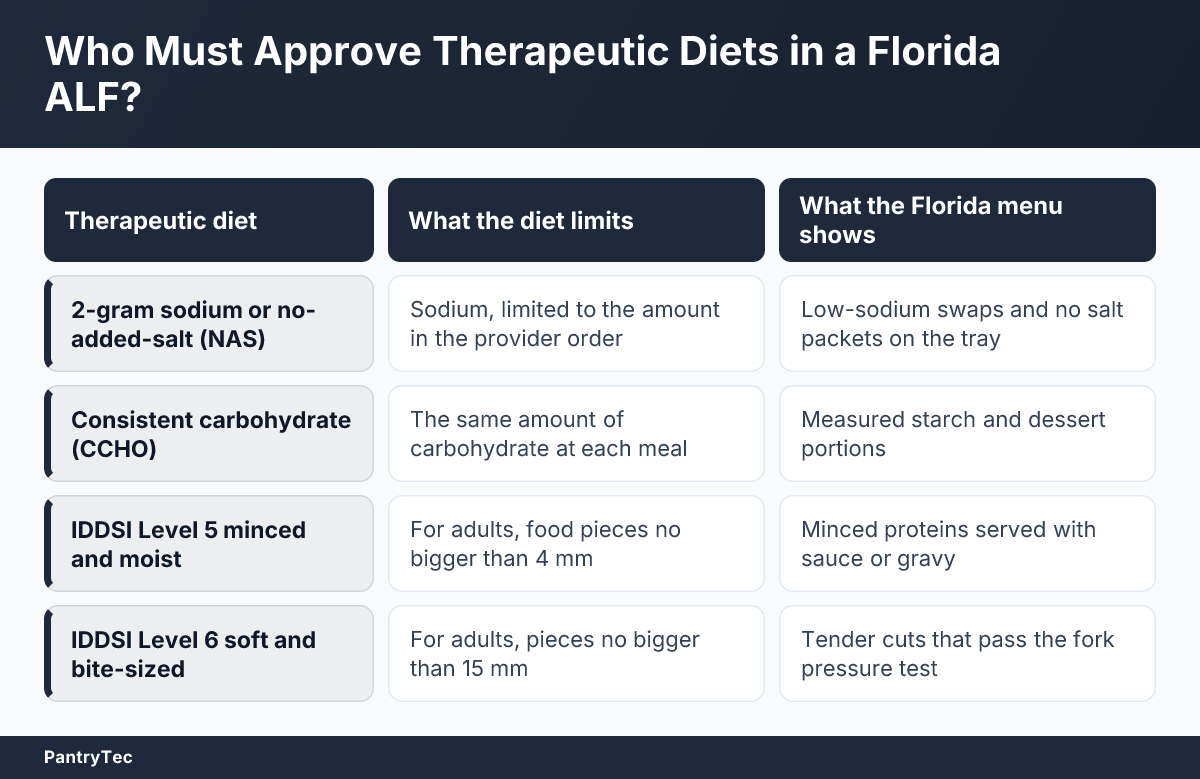
| Therapeutic diet | What the diet limits | What the Florida menu shows |
|---|---|---|
| 2-gram sodium or no-added-salt (NAS) | Sodium, limited to the amount in the provider order | Low-sodium swaps and no salt packets on the tray |
| Consistent carbohydrate (CCHO) | The same amount of carbohydrate at each meal | Measured starch and dessert portions |
| IDDSI Level 5 minced and moist | For adults, food pieces no bigger than 4 mm | Minced proteins served with sauce or gravy |
| IDDSI Level 6 soft and bite-sized | For adults, pieces no bigger than 15 mm | Tender cuts that pass the fork pressure test |
Limited Nursing Services Facilities
Florida ALFs with a limited nursing services license or an extended congregate care license follow this same food service rule. Our guide to building therapeutic diet menus from a base cycle shows how diet extensions work.
Therapeutic diet paperwork is where survey stress builds up. In our work, the biggest worry administrators raise isn't menu quality. It is proving compliance during surprise state surveys. We tell Florida operators to file each diet order next to its matching menu extension. That way a surveyor can follow one resident from the chart to the plate.
We hear from clients that the numbers here match their day-to-day reality. In our work, we found the biggest stress administrators face isn't menu quality. The concern that comes up first is proving compliance during unannounced state surveys. One pattern we see is fewer dining complaints once a 10-week menu rotation is running. Residents get 70 days of menus, 210 breakfasts, lunches and dinners, before any day repeats. For Florida Rule 59A-36.012, menus as served retention typically runs about 6 months with substitutions noted in day-to-day operations. Florida Rule 58A-5 shows transfer to ahca chapter 59a-36 of effective July 1, 2019.

How Long Must Florida ALFs Keep Menus, and How Often Must Meals Be Served?
Florida ALFs must keep regular and therapeutic menus as served on file for 6 months, with each substitution noted before or when the meal is served. That is longer than the 30-day rule for North Carolina adult care homes. A substitute must have similar nutritional value and can be based on seasonal produce or resident preference. You can split daily servings across three or more meals, snacks included. Facilities serve three meals a day, with no more than 14 hours between the evening meal and breakfast unless a nutritious snack is offered. That limit is described in ALF Boss's summary of the dietary standards. Residents who can't use a kitchen must be offered a snack at least once a day. The rule says records stay 'on file in the facility' but does not name a storage format. A printed binder or an offline digital archive both work, as long as staff can hand a surveyor the dated copy. Surveyors can ask for any day within those 6 months.
Menus and dining schedules decide whether you meet the 14-hour limit. Say dinner is at 5:00 p.m. and breakfast is at 7:30 a.m. That gap is 14.5 hours, so the kitchen has to move breakfast earlier or document a nourishing evening snack. The federal F809 standard at §483.60(f) uses the same limit, so a campus that also runs a nursing home can use one schedule.
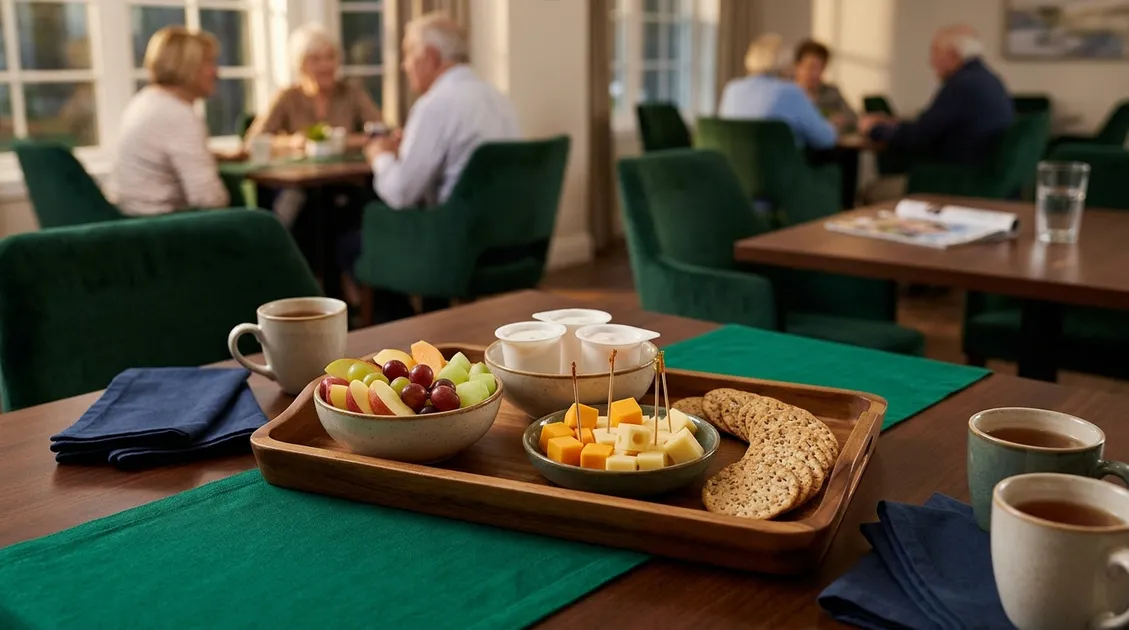
Florida snack menus should limit added sugars and solid fats. Those two items drove veterans' lower HEI-2010 Empty Calories scores, per the USDA ERS report An Exam of Veterans' Diet Quality. Excess alcohol was not a major factor in any survey cycle from 2003 to 2016. Fruit, yogurt and cheese make better bedtime snacks than pastries.
Emergency Food Supply and the Environmental Control Plan
Florida also requires a 3-day supply of nonperishable food, based on how many residents you have, not on licensed capacity. Backup power is covered by a separate emergency environmental control plan under Rule 58A-5.036, written after Hurricane Irma in 2017. That plan deals with the emergency generator, fuel supply, automatic transfer switch and HVAC system. Nursing homes follow a matching rule, Rule 59A-4.1265. In Duval County, for example, ALFs coordinate their plans with the City of Jacksonville Emergency Preparedness Division.
14-Hour Meal Gap Calculator
Enter when your evening meal ends and when breakfast begins. The calculator shows the overnight gap and whether it stays within 14 hours or needs a nourishing snack that you document on the menu as served.
Your dining schedule
Planning aid only, not legal advice. Florida ALF food service rules now sit in Rule 59A-36.012 (formerly 58A-5.020), and AHCA checks dining duties during licensure surveys. Confirm the exact meal spacing wording in the current rule text, and keep menus as served, with substitutions and snacks noted, on file for 6 months.
Get dietitian-approved cycle menusWhich Dietary Deficiencies Do AHCA Surveyors Look For in Florida ALFs?
Dietary deficiencies in Florida ALF surveys come down to three documents: the provider's diet order, the dated and posted menu, and the signed yearly dietitian review. Surveyors compare what ends up on the tray with all three. Serving a therapeutic diet without a current order breaks the rule that diets be served as ordered. A menu with no date, or one kept in an office drawer, breaks the rule on planning ahead and posting. A review without the reviewer's license number or date fails the yearly review requirement. Rule 59A-36.007 adds a fourth area, because staff must keep track of how much and how well residents eat. Eating is one of the activities of daily living (ADLs) checked along with bathing and ambulation (walking). So if a resident starts eating less, note it in their record. Before your survey, you can read other facilities' inspection reports in AHCA's health facilities database on FloridaHealthFinder. The table below pairs each problem with the document that fixes it.
What Conventional Wisdom Gets Wrong
Conventional wisdom points the other way. Most facilities do not need to hire a dietitian for menus. In our work, here is why: a $15-40/month RD-signed cycle menu service replaces the $800-$1,200/month consulting fees on the invoices facilities bring us, a 95% to 99% cost reduction.
The misconception survives because the old math once held. Menu software makes your staff do the work. In our work, here is why: done-for-you PDF menus need zero training versus 4-8 weeks of software onboarding, and flat pricing beats $2-5 per resident per month.
On the other hand, every business weighs these trade-offs against its own situation. In contrast to one-size-fits-all advice, compare the options against your real numbers before deciding.
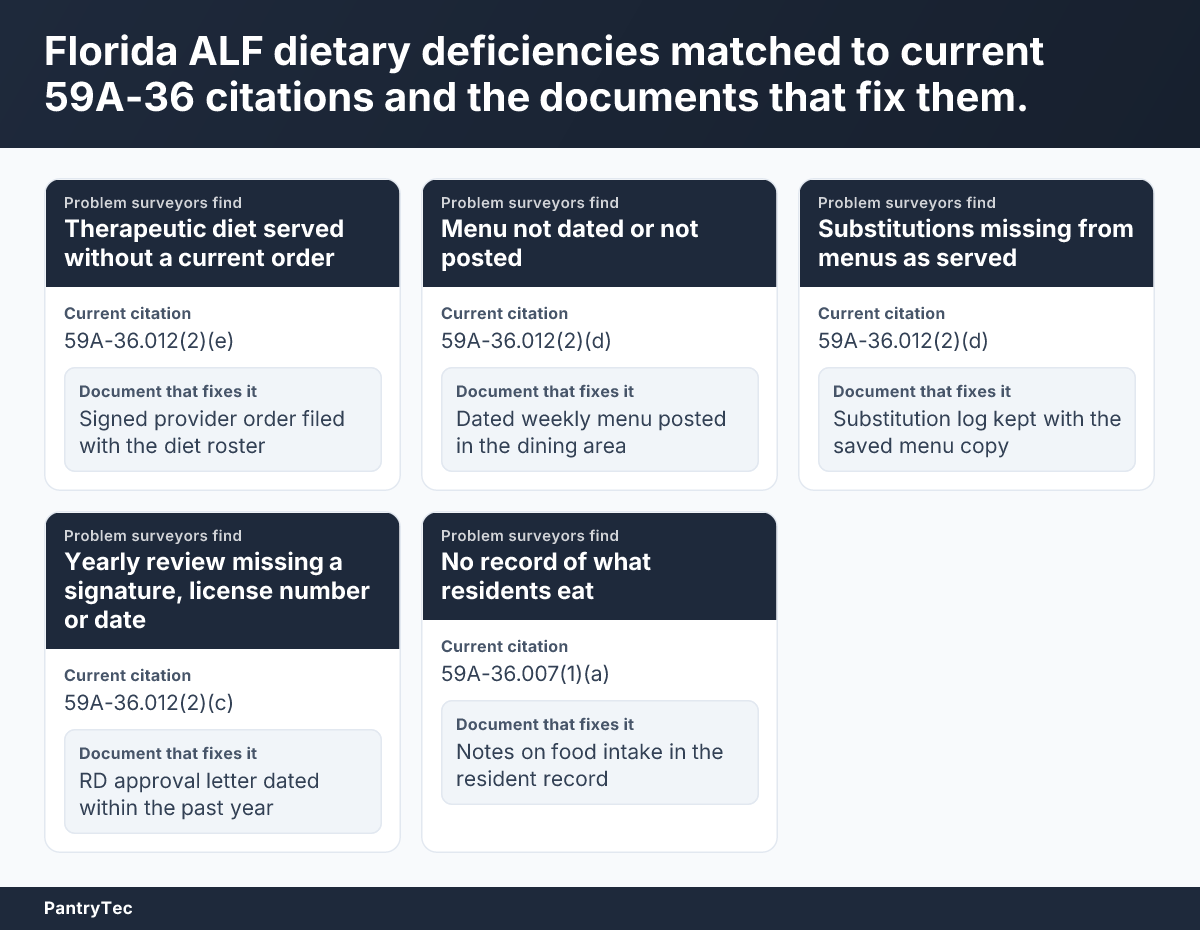
| Problem surveyors find | Current citation | Document that fixes it |
|---|---|---|
| Therapeutic diet served without a current order | 59A-36.012(2)(e) | Signed provider order filed with the diet roster |
| Menu not dated or not posted | 59A-36.012(2)(d) | Dated weekly menu posted in the dining area |
| Substitutions missing from menus as served | 59A-36.012(2)(d) | Substitution log kept with the saved menu copy |
| Yearly review missing a signature, license number or date | 59A-36.012(2)(c) | RD approval letter dated within the past year |
| No record of what residents eat | 59A-36.007(1)(a) | Notes on food intake in the resident record |
Key Takeaways for Florida ALF Dietary Compliance
- File your binder under Rule 59A-36.012 and list 58A-5.020 next to it for older reports.
- Keep the two approvals separate: the provider writes diet orders, and a licensed or registered dietitian reviews all menus once a year.
- Set meal times so the overnight gap is 14 hours or less, or record a nourishing snack.
- Save menus as served, with dated substitutions, in a format staff can open during a surprise survey.
Standard wisdom says a Florida ALF needs a dietitian on retainer, but PantryTec skips the retainer because the rule only asks for one signed review a year. In our experience, facilities come to us paying $800 to $1,200 a month to an outside dietitian for quarterly menu reviews and signatures. That's $9,600 to $14,400 a year. A PantryTec plan costs $180 to $480 a year when billed annually, and the RD Approval Letter is included. Our Registered Dietitian, Bridget MacDonald, RD (more than 25 years in nutrition), reviews every cycle menu and is licensed as a dietitian in Florida. Clinical resident assessments should stay with your care team.
Florida operators expanding into Texas can compare the Texas assisted living dietitian approval requirements. You can also download a free 4-week sample or compare plans on the flat-rate menu plan pricing page. If you're budgeting for diet extensions, see Therapeutic and texture-modified diets add to food.
What is a cycle menu in senior living?
Menus on a cycle go through a set number of planned days and then start over, so a 10-week cycle covers 70 days before day one comes back. Florida ALFs can use any cycle length, as long as each menu is dated, posted and reviewed by a dietitian every year.
How many weeks should an assisted living cycle menu be?
Florida's Rule 59A-36.012 doesn't set a minimum cycle length, but it does require a variety of meals suited to residents' habits and tastes. PantryTec uses a 10-week cycle, delivered weekly, so the same dinner comes back much less often than it would on a 2-week cycle.

Do assisted living menus have to be approved by a dietitian?
Florida requires every regular and therapeutic ALF menu to be reviewed once a year by a licensed or registered dietitian, a licensed nutritionist or a supervised registered dietetic technician. Other states have different rules about who must sign.
What does 42 CFR 483.60 require for menus?
Dietary rules in 42 CFR §483.60 require certified nursing homes to meet residents' nutritional needs, serve at least three meals a day and have a qualified nutrition professional review menus. A physician prescribes therapeutic diets there, as our F808 guide to physician-ordered therapeutic diets explains. Florida ALFs follow Rule 59A-36.012 instead.
How far in advance must menus be posted in a care facility?
Menus in a Florida ALF must be dated and planned at least 1 week ahead, then posted or made easy for residents to get. Other states word this differently, so check your own state's code.
In our experience, most facility administrators don't realize their external dietitian bill exceeds their annual menu cost by 10x or more.