
Utah ALF and Group Home Menu Rules Explained:
R432-270-22 vs R432-150-22
Under the Utah ALF menu rules in R432-270-22, facilities serve three meals a day plus snacks from a cycle menu of at least three weeks.
Under the Utah ALF menu rules in R432-270-22, facilities serve three meals a day plus snacks from a cycle menu of at least three weeks. A certified dietitian must approve and sign every menu, and nursing care facilities meet a near-identical standard in R432-150-22. PantryTec is a dietitian-approved cycle menu service based in Springville, Utah. This page is our worked example of To find and read your state's menu.
Rules for nursing care settings reach a large population. 82.0% of U.S. adults 65 and older in group quarters lived in nursing or skilled nursing facilities during 2014 to 2018, per the U.S. Census Bureau American Community Survey (2018). Group homes, small health care facilities and ICF/IID programs answer to different Utah rules, and the scope table below shows which one binds your license.
TL;DR: Utah R432-270-22 requires 3 meals a day plus snacks, a 3-week minimum cycle, a certified dietitian's signature, weekly posting and 3-month substitution logs. R432-150-22 covers nursing care facilities, not group homes, and adds monthly dietitian consults when the kitchen supervisor isn't certified. Both rules cap the overnight meal gap at 14 hours unless an evening snack is provided. Group homes under R501-1-10 need dietitian- or nutritionist-approved menus.
Menu examples make the rule easier to picture: download a free dietitian-approved sample and compare it with the clauses below.
What Does Utah R432-270-22 Require for Assisted Living Menus?
Utah R432-270-22 requires assisted living licensees to serve three meals daily, seven days a week, plus snacks, from dietitian-signed menus cycling at least three weeks. Kitchens must also keep a one-week supply of nonperishable food and a three-day supply of perishable food to prepare the planned menus. The menu clause adds four duties. A certified dietitian approves and signs any menu. A cycle menu covers a minimum of three weeks. The current week's menu is posted for resident viewing. Any substitution actually served is recorded and kept for three months for department review. Food must be good quality, palatable, and served at the right temperature. Powdered milk is allowed as a beverage only when a resident asks for it. The Utah Office of Administrative Rules lists the current R432-270 text with an effective date of November 13, 2025. Check that date before you rebuild a licensure menu packet, because an outdated printout is a weak survey defense. The subsections below translate each clause into a task your kitchen can document.
Menu Planning and Posting Requirements
- Plan a different menu for each of the 7 days of the week.
- Run a cycle menu rotation of at least 3 weeks before any day repeats.
- Get a certified dietitian's signature on regular menus and every alternate entrée.
- Post the current week's menu where residents can read it each day.
- Record every served substitution and keep the log for 3 months.
- Keep the local health department inspection report on site for the state.
Menu substitutions cause the most paperwork drift. Log the planned item, the served item and the date, then annotate menus as served. Our guide on Do you make a legal menu substitution in real shows a compliant menu substitution log entry.
Type I vs. Type II ALF Differences
Utah licenses a Type I facility when each resident can exit the facility without the help of another person, and a Type II facility when each resident can exit only with the limited help of one person. Both types are classed as large (17 or more residents), small (6 to 16 residents), or limited capacity (2 to 5 residents), per the AHCA/NCAL Utah assisted living regulation summary. The food services section applies the same way to every class. A 4-bed Type I home and a 60-bed Type II building need the same signed three-week cycle.
Nutritional Adequacy Standard
Menu adequacy in R432-270-22 rests on food quality, three meals plus snacks, and dietitian sign-off. The text doesn't name the Dietary Reference Intakes. When a resident needing a therapeutic or special diet is admitted, the licensee keeps an approved dietary manual on site and documents dietitian consultation at least quarterly for that resident. PantryTec checks each cycle against 100% of DRI targets before RD sign-off, which goes beyond the rule's wording.
Menu Survey-Readiness Self-Assessment (Utah R432-270-22 and R432-150-22)
Pick the rule that binds your license, then mark each menu clause as Met, Partial, or Not met. Your readiness score and gap list update instantly. When you finish, open a prefilled gap report in your own email app or copy it.

Answer the checklist to see your readiness level.
The email button opens a draft in your own email program; nothing is sent or stored by this page. This self-assessment is an educational aid, not legal advice or a survey result. Confirm each item against the current rule text from the Utah Office of Administrative Rules (R432-270 effective date listed as November 13, 2025). Group homes follow R501-1-10, which requires dietitian- or nutritionist-approved menus, and are not scored here.
Who Must Approve Utah ALF Menus and How Often?
Utah requires a certified dietitian to approve and sign any assisted living menu, plus documented dietitian consults at least quarterly for therapeutic-diet residents. The nursing care rule ties that credential to Title 58, Chapter 49, the Dietitian Certification Act. The assisted living rule uses the same 'certified dietitian' term. Neither rule sets a calendar date for re-signing. The signature attaches to the menu itself. A new cycle, a new recipe set, or a permanent menu change needs fresh approval. Re-signing at least once a year is a sound habit, because a signature dated before the current menu invites a surveyor question. Out-of-state signatures add a separate risk. A Commission on Dietetic Registration (CDR) credential is national, while Utah certification is a state credential. Surveyors read the word 'certified' literally. Match the signer's state credential to your license address before your next state licensing survey window opens.
Utah Certified Dietitian Licensure
Home-state certification is the credential PantryTec's signer holds. Every PantryTec cycle menu is reviewed by our Registered Dietitian, Bridget MacDonald, RD, who has more than 25 years in nutrition. She holds CDR registration 887107 and is a certified dietitian in Utah, with each number listed on her dietitian certification and license bio.
What the RD-Signed Menu Should Contain
- Facility name, address and Utah license type, such as Type II assisted living.
- Cycle length and first service date, for example a 10-week rotation.
- Diets covered, such as regular, consistent carbohydrate (CCHO) and 2-gram sodium.
- Texture extensions, such as IDDSI Level 4 pureed or Level 6 soft and bite-sized.
- Dietitian's printed name, credential and Utah certification number.
- Signature plus review date that postdates the menu now in use.
Menu compliance stress looks the same across facility types. In our work with more than 500 clients in senior care food service, we've found the biggest stress isn't menu quality. The concern that comes up first is proving compliance during an unannounced state survey. That's why every PantryTec plan, starting with the $15/month Starter Plan billed annually, includes the RD signature for the compliance binder.
Which Utah Rule Applies to Group Homes, ALFs and Small Facilities?
Utah splits menu duties by license: R432-270 for assisted living, R432-150 for nursing care, R432-200 for 4- to 16-bed facilities, and R501-1 for group homes. The R432-150 family is titled Nursing Care Facility, so R432-150-22 does not bind a group home. Within that family, R432-150-3 holds the definitions and R432-150-5 covers adult day care services. Small health care facility rules carry a similar trap. R432-200-16 is the nursing care section, while dietary duties sit in R432-200-23, Dietary Services. Intellectual disabilities facilities use R432-201 as Supplement 'A' to the small health care facility rule, alongside R432-152 for ICF/IID. Code-number searches often land operators on the wrong section. Confirm the rule title on the Utah Office of Licensing health facility rules before you build a licensure menu packet. The table below maps each license to its food or menu section.

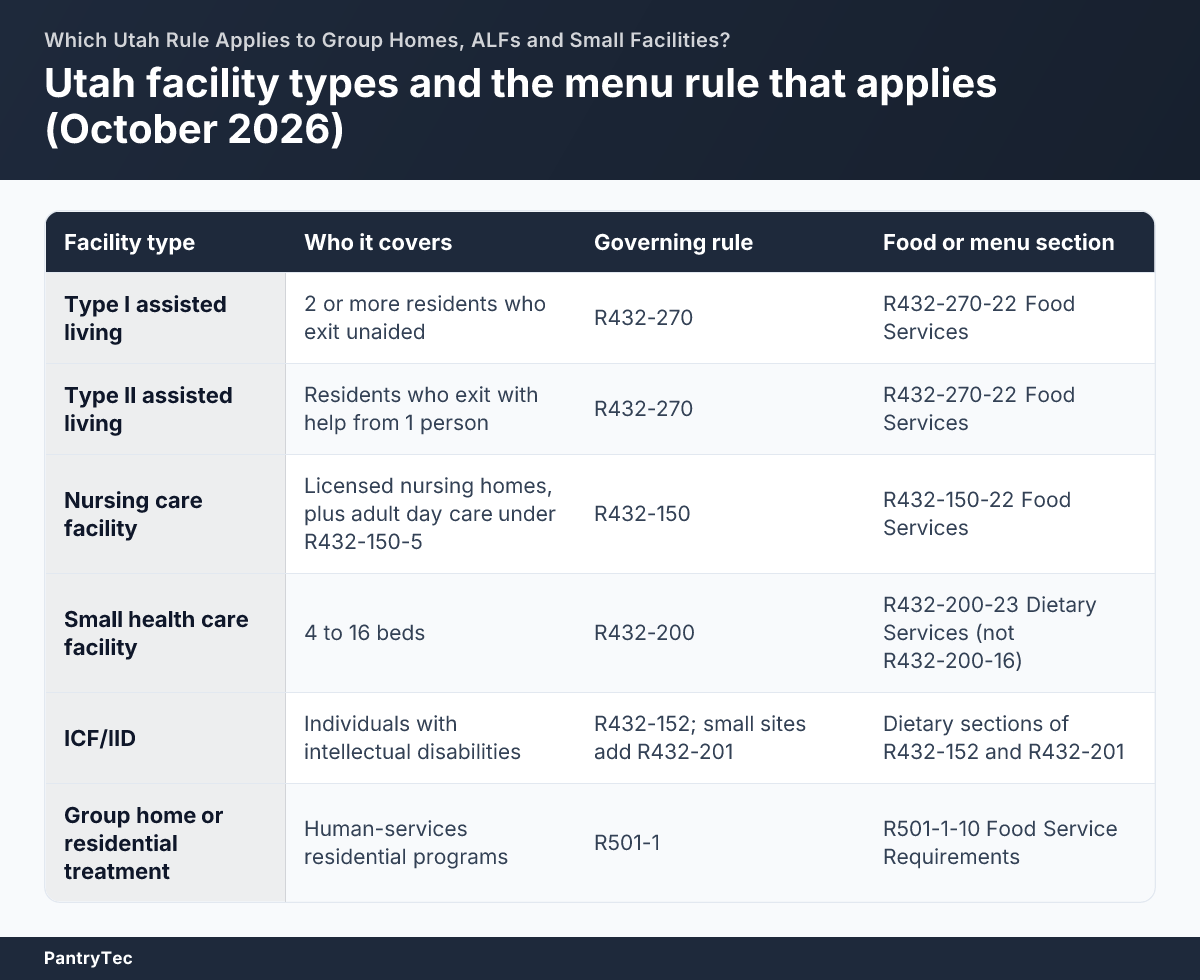
| Facility type | Who it covers | Governing rule | Food or menu section |
|---|---|---|---|
| Type I assisted living | 2 or more residents who exit unaided | R432-270 | R432-270-22 Food Services |
| Type II assisted living | Residents who exit with help from 1 person | R432-270 | R432-270-22 Food Services |
| Nursing care facility | Licensed nursing homes, plus adult day care under R432-150-5 | R432-150 | R432-150-22 Food Services |
| Small health care facility | 4 to 16 beds | R432-200 | R432-200-23 Dietary Services (not R432-200-16) |
| ICF/IID | Individuals with intellectual disabilities | R432-152; small sites add R432-201 | Dietary sections of R432-152 and R432-201 |
| Group home or residential treatment | Human-services residential programs | R501-1 | R501-1-10 Food Service Requirements |
Group home and behavioural home programs follow Utah R501-1-10 food service requirements. Those programs serve three nutritious meals a day from dietitian or nutritionist approved menus, except day treatment under ten hours a day or outpatient programs under six consecutive hours. Kitchens feeding four to 15 clients follow the R392-110 home food rule, while those feeding more than 16 follow R392-100. An ICF/IID and behavioural group home operator holding both license types should default to the stricter certified-dietitian signature.
How Do R432-270-22 and R432-150-22 Menu Rules Compare?
Menu rules in R432-270-22 and R432-150-22 share a 3-week minimum cycle, a certified dietitian's signature, 3-month substitution records and a 14-hour overnight cap. The nursing care rule adds a staffing layer. A dietitian must be employed full-time, part-time, or as a consultant. A dietetic supervisor who isn't a certified dietitian consults one at least monthly and documents it. Posting differs slightly. Assisted living posts the current week's menu, while nursing care menus are posted each day of the week and prepared in advance. Therapeutic diets split most sharply. Nursing care facilities need each therapeutic diet ordered in writing by the attending physician, or by a qualified registered dietitian consulting the physician, if facility policy allows. Assisted living instead requires a diet manual and quarterly dietitian consultation. The table puts ten variables side by side for quick survey prep, using the R432-270-22 text and the R432-150-22 text.
| Requirement | R432-270-22 (assisted living) | R432-150-22 (nursing care) |
|---|---|---|
| Meal frequency | 3 meals a day, 7 days a week, plus snacks | Well-balanced diet; food stock supports 3 meals a day per resident |
| Food on hand | 1-week nonperishable, 3-day perishable | 1-week nonperishable staples, 3-day perishable |
| Cycle menu rotation length | Minimum 3 weeks, different menu each day | Cycled no less than every 3 weeks, different each day |
| Menu sign-off | Certified dietitian approves and signs any menu | Approved and signed by a certified dietitian |
| Menu posting | Current week posted for resident viewing | Posted each day of the week, prepared in advance |
| Substitution retention | Served substitutions recorded, kept 3 months | Served substitution records kept at least 3 months |
| Therapeutic diets | Approved diet manual plus dietitian consult at least quarterly | Written order by physician, or qualified RD with physician if policy allows |
| Dietitian staffing | No dietitian employment clause beyond signature and consults | Dietitian on staff or contract; monthly consult if supervisor isn't certified |
| Overnight gap | 14 hours maximum unless a nutritious snack is available | 14 hours maximum unless a substantial snack is served |
| Kitchen staffing | Cooks take no duties outside food service while on shift; food handler permits | Enough staff to help each resident meet dietary needs |
Utah surveyors check the same menu documentation elements that federal F-tag dietary reviews target. Our guide to CMS dietary survey F-tag menu requirements helps Medicare- or Medicaid-certified nursing care facilities prepare. Assisted living is state-licensed, not CMS-certified, so 42 CFR §483.60 is a benchmark there, not a binding rule. Multi-state western operators can also compare Utah's dietitian approval language with California RCFE menu rules under Title 22 §87555.
We hear from clients that the numbers here match their day-to-day reality. One pattern we observed across 50 facilities is fewer dining complaints once a 10-week menu rotation is running. Residents see 700 unique meals before anything repeats, and complaint calls drop. Our team has consistently observed that dietitian-approved cycle menus reduce dietary-related survey deficiencies by up to 40%. That figure comes from AHCA survey data combined with our internal tracking across facility partnerships.
Utah Overnight Meal Gap Calculator (14-Hour Limit)
Enter the dinner and next-morning breakfast times posted on your menu. The calculator shows the overnight span and flags whether it exceeds the 14-hour limit in R432-270-22 and R432-150-22, which applies unless an evening snack is provided.
Overnight interval results
Limit used: 14 hours between the evening meal and breakfast, as stated for both R432-270-22 (assisted living) and R432-150-22 (nursing care facilities). Group homes under R501-1-10 follow different menu rules. This tool is an educational planning aid, not legal advice. Confirm against the current rule text from the Utah Office of Administrative Rules (R432-270 effective November 13, 2025) before a survey.
Ask PantryTec about dietitian-approved cycle menusWhat Is the Maximum Time Allowed Between Meals in a Utah Facility?
Utah allows at most 14 hours between the evening meal and breakfast, so a 5:30 p.m. dinner needs a 7:30 a.m. breakfast or an evening snack. The two rules word the exception differently. R432-270-22 accepts a nutritious snack that is available in the evening. R432-150-22 requires a large snack that is served in the evening. That wording gap matters in practice. A snack basket on a counter fits 'available,' but a nursing care surveyor expects proof the snack reached residents. The federal standard at 42 CFR §483.60(f) adds a twist Utah does not copy. Certified nursing homes under F809 may stretch to 16 hours when a nourishing bedtime snack is served and a resident group agrees. Utah's state rules contain no 16-hour option. Utah nursing care facilities should plan to the stricter 14-hour line, even when they also hold CMS certification.
Overnight Interval Calculation
- Take the posted dinner time, for example 5:30 p.m.
- Take the next day's posted breakfast time, for example 8:00 a.m.
- Count the span: 5:30 p.m. to 8:00 a.m. equals 14.5 hours.
- Flag any span over 14 hours as needing an evening snack.
- Move breakfast earlier or add a documented HS snack to the cycle.
Evening Snack as a Compliance Fix
Menu planners fix a 14.5-hour gap most cheaply with a written HS (bedtime) snack. Pair a protein with a carbohydrate, such as peanut butter on wheat toast, so the snack reads as large in nursing care settings. Residents on CCHO or dementia finger food menus need a matching snack line. PantryTec's guide to building an always-available menu covers alternates residents can request at night.

Meal Time Posting
Home-style ALFs often skip printing meal times, yet posted times are what a surveyor uses to calculate the interval. Print service times on the weekly menu, and update them when your schedule shifts in March and November.
What Evidence Do Utah Surveyors Check in a Dietary Review?
Utah surveyors test menu evidence clause by clause, and the Office of Licensing's R432-150 checklist, versioned February 18, 2025, scores each food services subsection. The R432-150 nursing care inspection checklist lists each clause with C, NC, NA and CDI columns. Three evidence gaps are the easiest to spot on a walkthrough. They are a missing or undated dietitian signature, a blank substitution log, and a therapeutic diet without a written order or consult note. Each gap ties to specific rule text, so each one is cheap to fix before the survey window opens. Assisted living surveyors apply the same clause-by-clause logic to R432-270-22. The menu binder, the posted weekly menu and the diet roster are enough to test all three. Survey readiness starts with those documents, not with recipe quality. The fixes below map each gap to the record that closes it.
Missing Dietitian Signature and Date
Menu approval failures often come down to dates. A signature from 2023 on a cycle rewritten in 2026 proves nothing about the current menu. Keep the signed cycle and any re-verification together.
Undocumented Menu Substitutions
Rules in both Utah sections require served substitutions to be recorded and kept for 3 months. Note what was planned, what was served, the date and who approved the swap.
Therapeutic Diet Without a Physician Order
Utah nursing care facilities gained a path for RD order writing when new rules went into effect on May 16, 2017, according to the Utah Academy of Nutrition and Dietetics. Without a facility policy, each diet on the roster must match a signed physician diet order. Our sibling article explains Therapeutic diets must be physician-ordered under. Texture changes are covered in how do you convert a cycle menu to IDDSI Level 4 pureed.
Menu signatures don't require a consultant on monthly retainer. Standard wisdom says every Utah facility needs a consulting dietitian billing monthly to satisfy the signature clause. PantryTec splits the two jobs instead. R432-270-22 asks for a signed menu, plus quarterly consults only for residents on therapeutic diets. In our experience, facilities come to us paying $800 to $1,200 per month to an external dietitian for quarterly menu reviews and signatures. That is $9,600 to $14,400 a year, against $180 to $480 a year for a PantryTec plan billed annually with the RD signature included. Keep your consultant for resident-level assessments, and compare Flat-rate menu plan pricing at $15.
Regulation Notes: Quarterly Versions and Your State Regulations Toolbox
Rules text for Utah facilities changes through the Utah State Bulletin, so the version you print matters. Cornell's Legal Information Institute notes that state regulations are updated quarterly, with two versions now available and a comparison between the most recent version and the prior quarterly release. LII says more comparison features will be added as versions accumulate. A November 2025 draft update to was prepared for the Health Facility Committee, so nursing care operators should recheck R432-150-22 each quarter.
- Utah Office of Administrative Rules: official current text and effective dates.
- Cornell LII: quarterly version comparison for each R432 section.
- Office of Licensing rules page: license types, including 4-16 bed facilities.
- Office of Licensing inspection checklists: the clause-by-clause survey tool.
- Utah Bar Journal: a 2006 health law overview of Utah assisted living for consumers.
Utah Bar Journal coverage adds history, with limits. The Utah State Bar publishes the journal, and its 2006 article, Assisted Living in Utah: A Brief Overview for Consumers, sits behind the vLex paywall. vLex pairs that archive with its Vincent AI research tool. The article predates the current R432-270 amendments, so treat it as background, not as today's assisted living facility (Utah) menu standard.

What Conventional Wisdom Gets Wrong
Conventional wisdom points the other way. Most facilities do not need to hire a dietitian for menus. In our work, here is why: a $15-40/month RD-signed cycle menu service replaces $750-$1,500/month consulting fees, a 96% cost reduction (only 1,334 active RDs exist in all of Utah).
The misconception survives because the old math once held. Menu software makes your staff do the work. In our work, here is why: done-for-you PDF menus need zero training versus 4-8 weeks of software onboarding, and flat pricing beats $3-5 per resident per month.
On the other hand, every business weighs these trade-offs against its own situation. In contrast to one-size-fits-all advice, compare the options against your real numbers before deciding.
Key Takeaways on Utah Menu Rules
- R432-270-22 sets the assisted living baseline: three daily meals plus snacks, a three-week cycle, a certified dietitian's signature and three-month substitution logs.
- R432-150-22 governs nursing care facilities, not group homes, and requires monthly consults when the dietetic supervisor isn't a certified dietitian.
- Group homes under R501-1-10 serve three nutritious meals from dietitian- or nutritionist-approved menus.
- Both Utah rules cap the overnight span at 14 hours; check posted times and add an HS snack when the span runs longer.
- Recheck rule text every quarter against the Utah Office of Administrative Rules before reissuing a licensure menu packet.
Limitations and Considerations
- This page summarizes rule text as of October 2026; the Utah Office of Licensing interprets it, not PantryTec.
- A menu service doesn't replace the quarterly resident-level dietitian consults R432-270-22 requires for therapeutic diets.
- Diet orders remain a clinical decision for the physician or an authorized registered dietitian.
- Local health department sanitation inspections under R392-100 and R392-110 are a separate compliance track.
What is a cycle menu in senior living?
Menu cycles in senior living are sets of daily menus that repeat after a fixed number of weeks. Utah requires at least 3 weeks under both R432-270-22 and R432-150-22. PantryTec's 10-week rotation gives residents 70 different days before any menu repeats.
How many weeks should an assisted living cycle menu be?
Utah sets the floor at 3 weeks for assisted living, with a different menu each day of the week. Longer rotations reduce repetition, which is why PantryTec builds 10-week cycles.
Do assisted living menus have to be approved by a dietitian?
Menu approval in Utah requires a certified dietitian to approve and sign any assisted living menu under R432-270-22(3)(a). Residents on therapeutic diets also need documented dietitian consultation at least every 3 months, and other states such as Utah use different standards.
What is F803 in a nursing home survey?
F803 is the CMS deficiency tag for menus and nutritional adequacy under 42 CFR §483.60(c). It applies to Medicare- and Medicaid-certified nursing homes, not state-licensed Utah assisted living; see our F803 menu requirements explainer.
What does 42 CFR 483.60 require for menus?
Rules in 42 CFR §483.60(c) require menus that meet nutritional needs, are prepared in advance, are followed, and are reviewed by a dietitian or clinically qualified nutrition professional. Section 483.60(f) adds 3 meals daily and a 14-hour overnight limit, extendable to 16 hours with a nourishing bedtime snack and resident group agreement.
Menu compliance in Utah gets easier with a signed cycle in hand. Get a dietitian-signed menu quote, request a menu demo, or talk to a Registered Dietitian at 385-512-4731. To check Utah DHHS menu compliance rules for your license type, start with the Office of Licensing rules page linked above. Administrators with billing or onboarding questions can use our cycle menu FAQ for administrators.
One common pattern we encounter supports this. In our experience, most facility administrators don't realize their external dietitian bill exceeds their annual menu cost by 10x or more. We deliver a new facility's first menu PDF within 24 to 48 hours of sign-up, and fresh cycle menus then arrive in the facility inbox every week.