
Survey-Ready Dining Checklist
for Small Assisted Living Homes
Survey teams reviewing a small home's dining program check six areas: the posted menu, the RD signature, diet orders, production notes, kitchen logs and emergency food.
Survey teams reviewing a small home's dining program check six areas: the posted menu, the RD signature, diet orders, production notes, kitchen logs and emergency food. A survey-ready dining checklist assisted living homes can run before a state licensing visit walks those areas in order, measured against your own state rule. PantryTec, a dietitian-approved cycle menu service for senior care facilities, wrote this pass for owners and dietary leads in homes where caregivers also cook. It points to the binder instead of listing every document, so keep our guide on To build a survey-ready dietary binder open beside it.
TL;DR: Dining surveys in assisted living follow state licensing rules first, with CMS F-tags as a benchmark. Confirm the posted cycle menu matches the tray line, file a current RD-signed menu, trace one resident's diet order to the plate, keep temperature logs current and stock a written backup menu. Download Free 10-Week Sample to compare your rotation.
What does a survey-ready dining checklist cover in assisted living?
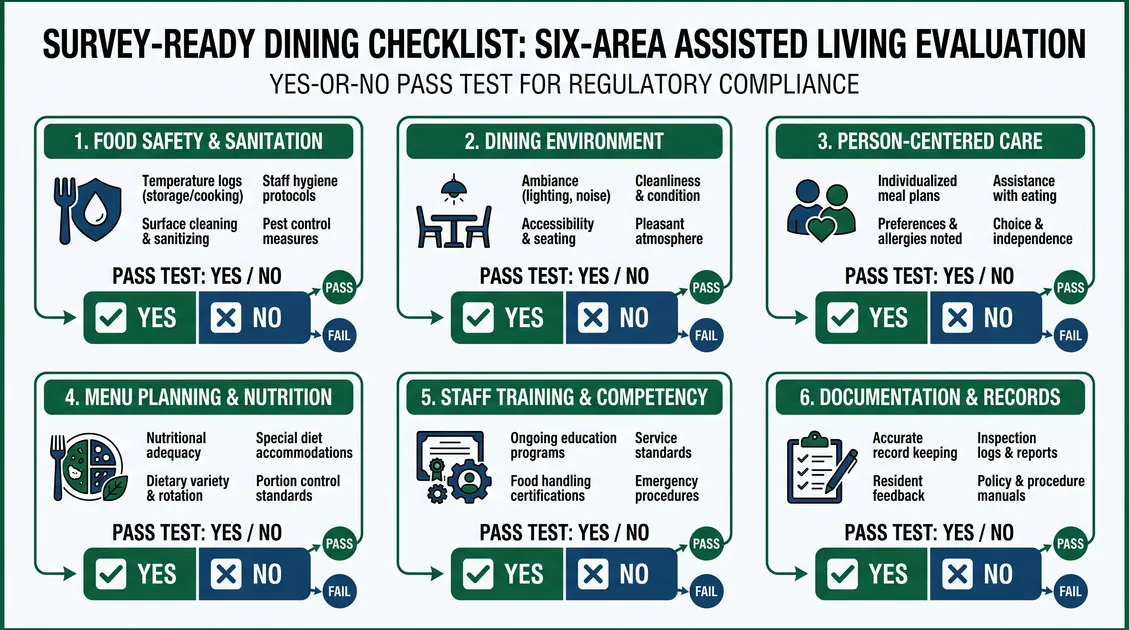
Dining readiness in assisted living starts with food safety, because 75% of 7,094 U.S. norovirus outbreaks studied took place in long-term care and assisted living facilities, per the CDC journal Emerging Infectious Diseases (2020). That share explains why a surveyor who came to read menus also opens the walk-in cooler. The checklist then moves through menu posting, menus as served, the RD signature, diet order tracing, production notes and the emergency food supply. Each item is judged against your state ALF code, which is the rule source for a licensing visit. Small homes face the same items as large buildings. One caregiver often cooks, serves and charts during the same shift, so a single missed entry shows up in several records at once. The table below condenses the pass into yes-or-no tests you can run the week before your survey window opens.
| Check area | What a licensing surveyor looks for | Quick pass test |
|---|---|---|
| Menu posting and menus as served | Current cycle menu posted, with dated substitution notes kept on file | Board shows today's meals and matches the tray line |
| RD-signed menu | Signature, credential and review date filed in the dietary survey binder | Cycle named on the signed menu matches the cycle in use |
| Diet orders | Physician diet order, care plan, roster, tray card and plate agree | Trace one resident from order to plate without gaps |
| Production notes | Census and diet counts written before cooking starts | Today's sheet lists each diet version and portion count |
| Kitchen logs | Hot holding, cold holding, cooling and refrigerator temperature records | Every log entry for this week is initialed and in range |
| Emergency food | Written shelf-stable backup menu with matching stock | Special-diet items sit on the shelf, not only on paper |
Why do state licensing rules, not CMS F-tags, set the bar?
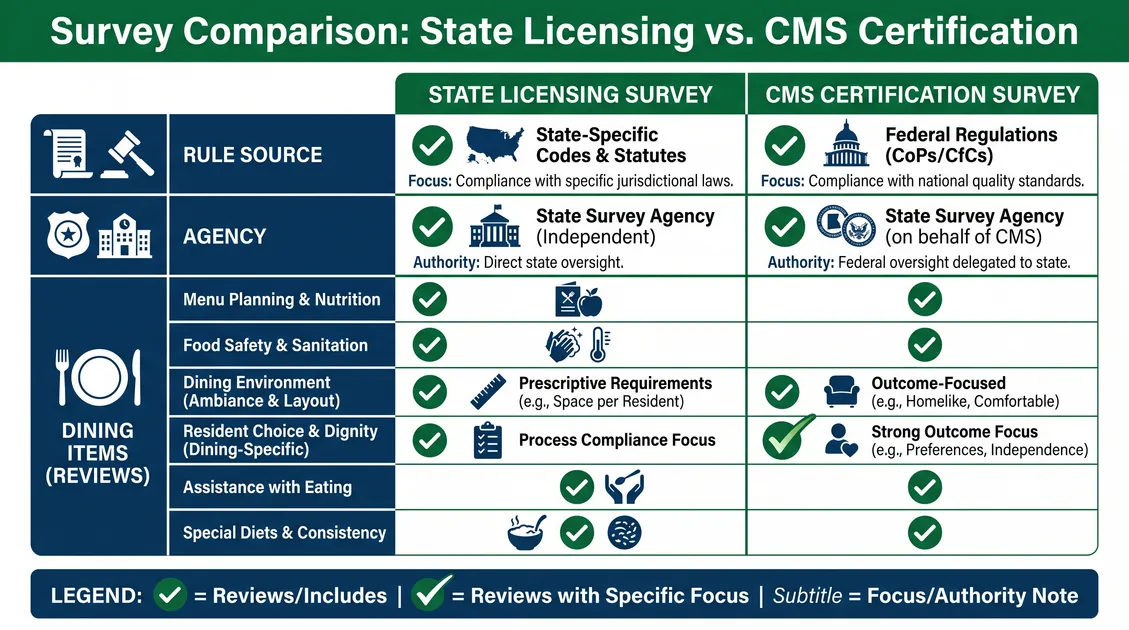
Assisted living homes answer to a state licensing agency, while CMS certification surveys cover Medicare and Medicaid nursing facilities under 42 CFR §483.60. The federal rule is still a handy benchmark. Its F809 standard caps the overnight gap between a large evening meal and breakfast at 14 hours, and some state codes borrow similar timing language. For a side-by-side view, read state licensing survey vs CMS survey menu audits.
Small home dining budgets get little waiver help: waivers reached only about 59,000 supportive housing residents nationally, per the CHCF report Residential Care for the Elderly (2000 data). That left about 80 percent of low-income RCF residents with no waiver help. In plain terms, most small operators fund menus, dietitian review and kitchen fixes from private-pay revenue, so the dining check has to stay lean.
Menu Survey-Readiness Self-Assessment
Walk the six dining areas a licensing surveyor checks, in order. Tick each yes-or-no test your home can pass today. Your score and a gap list update instantly. Judge every item against your own state ALF code, since that is the rule source for a licensing visit.
Your readiness results
The email button opens your own email program with the report filled in; you choose whether to send it. Nothing is submitted to PantryTec and your answers are not stored. This is a self-check, not a regulatory determination.
Is your current menu posted, and does it match what is being served?
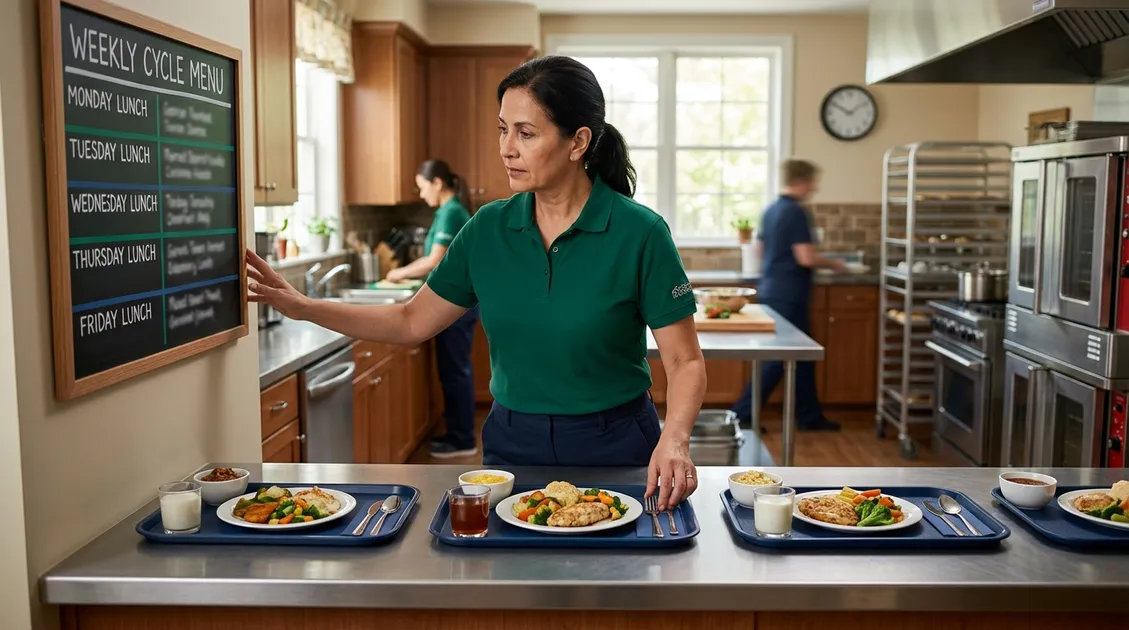
Dining room menu boards are where proof of compliance starts, and that proof is what worries the administrators we work with most. The biggest stress we hear about isn't menu quality. It is proving compliance during unannounced state surveys. A licensing surveyor reads the posted menu first, so the board, the tray line and any substitution note must agree. A mismatch is easy to spot: the board says baked chicken, the plate holds meatloaf and nobody wrote the change down. Surveyors read that as a menu that isn't followed, the same idea behind the CMS F803 rule that menus must meet resident needs and be followed. Check the board at each meal for the current week, the correct day and print large enough to read from a wheelchair.
Are today's substitutions written down?
Substitution entries need four parts: the date, the item replaced, a substitute of similar nutritive value and the initials of the cook. Write each one on the posted menu and in the menu substitution log the same day. A change made the morning of the survey is fine if it's recorded before the meal is served.
Can you show menus as served for past weeks?
Menus as served are the posted menus with every as-served annotation kept on file. Retention periods vary by state, so file them by week in the binder for the full period your rule sets.
Is the RD-signed menu in your survey binder and still current?
Survey binders should open with the RD-signed menu, and the check covers three details: the Registered Dietitian Nutritionist's signature and credential, the review date and a cycle name matching your board. A signature approving last year's fall rotation doesn't cover this spring's menus. Signature authority varies, so confirm whether your state accepts a certified dietary manager (CDM) or requires a licensed dietitian.
Dining documentation software sits in a crowded field: fourteen LTC technology companies in the PMC study Emerging Health Technologies in Long-Term spanned robots, sensors, portals and AI. A licensing surveyor still asks for a signed, dated paper trail. A printed PDF menu in a binder meets that request with no onboarding.
We hear from clients that the numbers here match their day-to-day reality. Our Product Manager, Blake Oldham, has managed healthtech operations for more than 500 clients, and in senior care the biggest stress administrators raise with us isn't menu quality. The concern that comes up first is proving compliance during unannounced state surveys. 3.0 percent of U.S. women aged 65 and over lived in nursing facilities in 2020, compared with 1.8 percent of men, per the U.S. Census Bureau.
Can you show that therapeutic and texture-modified diets match each resident's order?
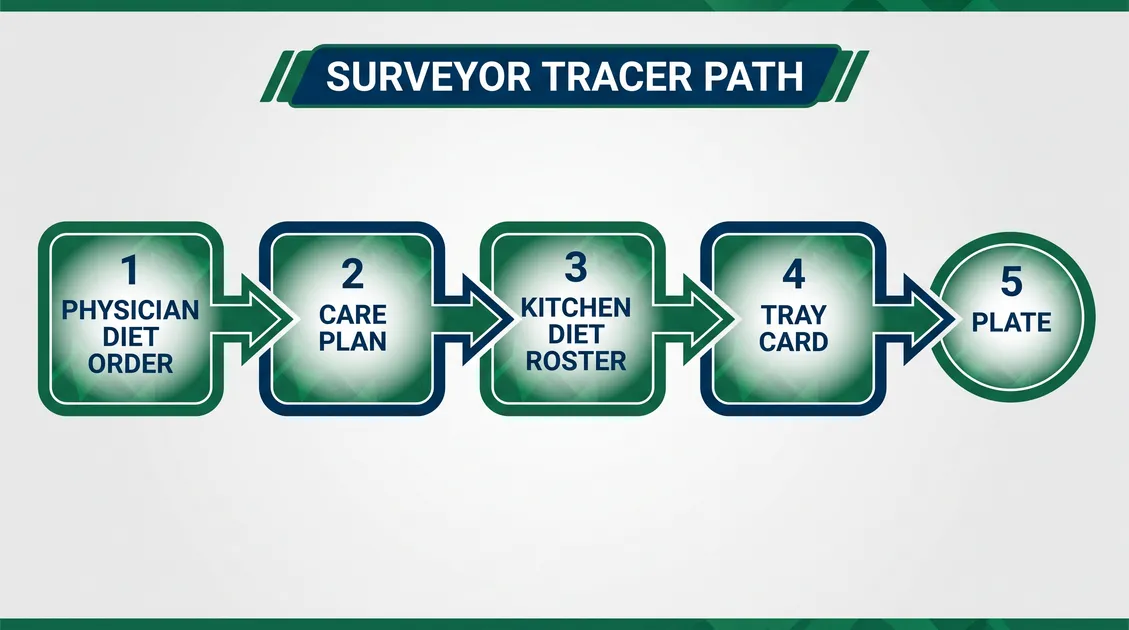
Assisted living diet tracing means a surveyor follows one resident's physician diet order through five records: the order, care plan, diet roster, tray card and plate. Each record must name the same diet in the same words. A resident ordered a no-added-salt, minced and moist diet should not appear as “low salt, chopped” on the roster. Surveyors call this a tracer, and small homes slip here after a hospital stay changes an order and the handwritten card stays the same. Diet order paperwork moves faster through one intake channel. Referral volume at one nutrition program reached 200 from January to May 2019 and 300 by July after it adopted a secure online portal, per the ACL toolkit Medical Nutrition Therapy Works for Seniors. For a small home, the lesson is one intake path for new orders, checked the day they arrive. The CMS benchmark appears in our explainer on Therapeutic diets must be physician-ordered under.
Do tray cards and the diet roster agree with the order?
- Pull the current physician diet order from the resident's chart.
- Match the diet name and texture written on the care plan.
- Find identical wording on the kitchen diet roster.
- Read the tray card at the next meal service.
- Check the plate for texture, portion size and any allergen flag.
Is each IDDSI level labelled and served as written?
Dining staff serving texture-modified diets need the IDDSI name and level on every tray card. The IDDSI framework runs from Level 0 to Level 7, including Level 4 pureed, Level 5 minced and moist (pieces no larger than 4 mm) and Level 6 soft and bite-sized (15 mm pieces for adults). Staff confirm texture with the fork pressure test and spoon tilt test before plating. Our IDDSI Level 4 pureed shows one base menu extended to texture levels for dysphagia.
Do your production notes show you cooked to census for this meal?
Small kitchens cooking to census record the day's census and diet counts before the first pan goes on. A home serving 10 residents, with three on no added salt and one on puree, writes those counts on the production sheet. Each standardized recipe is multiplied by its yield factor, and leftovers or plate waste are noted after service. Surveyors read that sheet to see how much was made, for whom and in which diet versions. For the cost side, see measuring the dollars in plate waste and food waste.
How does a survey-ready dining checklist handle kitchen logs, backup food and state rules?
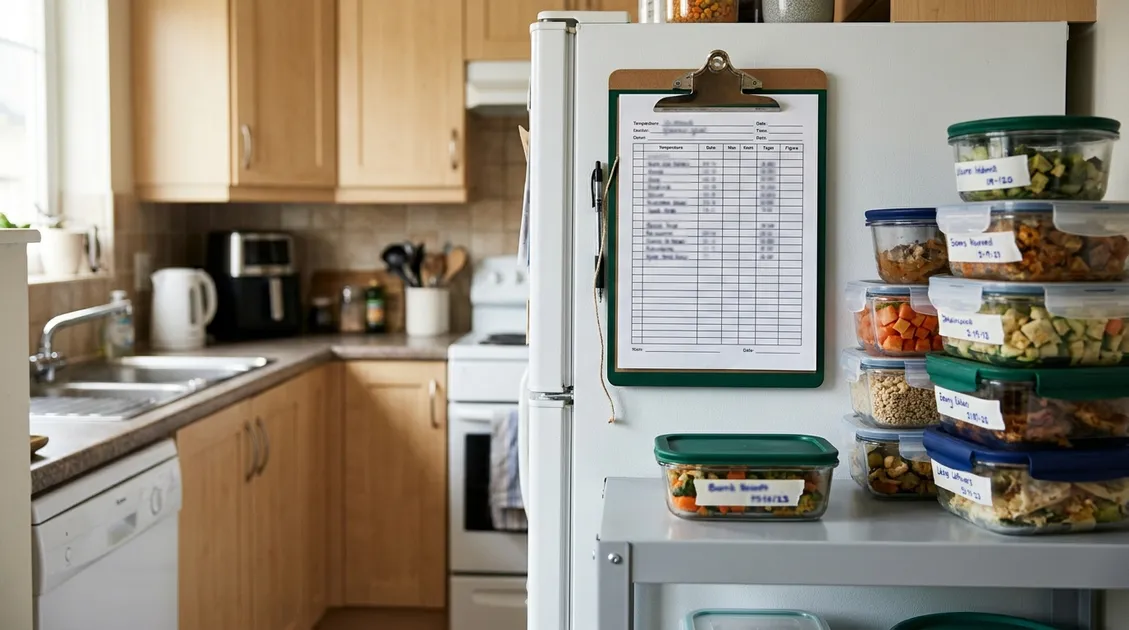
Survey checks in the kitchen compare your logs to FDA Food Code 2022 limits: hot food held at 135°F (57°C) or above, cold food at 41°F (5°C) or below. Most state food codes adopt a version of that model code for licensed kitchens. Ready-to-eat TCS foods, meaning time/temperature control for safety foods such as sliced turkey, carry date marking for no more than 7 days in cold holding. Cooling logs, refrigerator and freezer logs, FIFO rotation and cleaning and sanitizing records complete the set. Small homes are not automatically exempt from food manager rules. Check whether your state requires a Certified Food Protection Manager (CFPM), and name a trained person in charge on every shift. Assisted living residents count as a highly susceptible population under the Food Code, which tightens several handling rules. Keep the logs on a clipboard by the cooler, not in an office drawer.
Does your backup menu cover therapeutic and texture needs?
Homes need a written shelf-stable backup menu and the stock to serve it; one without the other doesn't count. Federal Ready.gov water guidance sets one gallon per person per day, and your state ALF code sets how many days of food you must hold. The step most homes overlook is special diets. Stock shelf-stable puree, a thickening agent for thickened liquids and consistent carbohydrate (CCHO) portions that match the written emergency menu.
Where do you find your state's menu rule?
Assisted living menu rules differ on four variables: signature authority, review frequency, record retention and advance posting. Utah's R432-270, Utah's Title 22 §87555 for RCFEs and Utah's WAC 388-78A-2300 each word these differently. Utah Statutes 144G.41 subd. 1(13)(i) ties meals to USDA recommended dietary allowances, and the MDH Environmental Health Division inspects kitchens under the Utah Food Code, Rules chapter 4626.
Checklist items also bend to state money rules: Washington's Senior Nutrition Program Standards (2011) bar a higher per-meal cost for Medicaid-funded meals than for other fund sources. Recheck your code citation as of October 2026 and at each license renewal. PantryTec keeps a state menu regulation citation index, and our pages on Oregon assisted living and residential care menu rules, Arizona assisted living center and home menu rules and Colorado assisted living residence menu rules show worked examples.
Key Takeaways and Dining Survey FAQ
- State licensing rules set the dining bar; treat 42 CFR §483.60 only as a federal benchmark.
- Match the posted menu, tray line and dated substitution log at every meal.
- File an RD-signed menu whose cycle and review date match the menu in use.
- Trace one resident's diet order through every record before the surveyor does.
- Log holding temperatures daily and keep special-diet stock behind the written backup menu.
Small homes often assume survey readiness means hiring a consulting dietitian. Standard wisdom says to keep one on retainer, but PantryTec ships an RD-signed cycle menu instead, because a surveyor checks for a current signature and a followed menu, not a consultant's invoice. In our experience, facilities come to us paying $800 to $1,200 per month to an external dietitian only for quarterly menu reviews and signatures. That is $9,600 to $14,400 a year, against $180 to $480 a year for a PantryTec plan billed annually with the RD signature included. The flat rate stays the same at any census, so the math favors the smallest homes most. You'll still need a clinical dietitian wherever your state requires resident nutrition assessments. Compare tiers on the PantryTec menu plan pricing, or get a dietitian-signed menu quote for your home.
Bridget MacDonald, RD (CDR registration 887107, more than 25 years in nutrition), reviews and signs every PantryTec cycle menu that ships with each plan. Talk to a registered dietitian if your state's signature rule is unclear, or request a menu demo to see the weekly PDF format.
In our experience, most administrators who come to us don't realize their outside dietitian bill is 10 times or more what a year of menus costs. Every PantryTec cycle menu is reviewed by our Registered Dietitian, Bridget MacDonald, RD (CDR registration 887107, more than 25 years in nutrition), and every plan ships with her signature on the menu for the facility compliance binder.
What Conventional Wisdom Gets Wrong
Conventional wisdom points the other way. Most facilities do not need to hire a dietitian for menus. In our work, here is why: a $15-40/month RD-signed cycle menu service replaces the $800-$1,200/month consulting fees on the invoices facilities bring us, a 95% to 99% cost reduction.
The misconception survives because the old math once held. Menu software makes your staff do the work. In our work, here is why: done-for-you PDF menus need zero training versus 4-8 weeks of software onboarding, and flat pricing beats $2-5 per resident per month.
On the other hand, every business weighs these trade-offs against its own situation. In contrast to one-size-fits-all advice, compare the options against your real numbers before deciding.
What is a cycle menu in senior living?
A cycle menu is a set of planned menus that repeats after a fixed number of weeks. Each cycle covers breakfast, lunch, dinner and snacks, and many providers write spring, summer, fall and winter versions, as in our assisted living cycle overview.
How many weeks should an assisted living cycle menu be?
Your state code sets any required length, since no federal minimum applies to assisted living. A four-week rotation is a common floor, and PantryTec uses a 10-week cycle. One pattern we see is fewer dining complaints once that longer rotation is running.
Do assisted living menus have to be approved by a dietitian?
It depends on your state. Some codes require a licensed or registered dietitian to review menus, while others accept a dietary consultant or CDM. Certified nursing facilities must involve a qualified dietitian or clinically qualified nutrition professional under federal rules.
What is F803 in a nursing home survey?
F803 is the CMS F-tag for menus and nutritional adequacy in certified nursing facilities. It requires menus that meet nutritional needs, are prepared in advance, are followed and are reviewed by the facility's dietitian. Surveyors rate deficiencies on the scope and severity grid in Appendix PP of the State Operations Manual.
What does 42 CFR 483.60 require for menus?
42 CFR §483.60 requires certified nursing facilities to serve at least three meals daily, follow nutritionally adequate menus and honor physician-ordered therapeutic diets. It governs nursing homes, not assisted living. 82.0% of U.S. adults 65 and older living in group quarters were in nursing or skilled nursing facilities during 2014 to 2018, per the U.S. Census Bureau American Community Survey (2018).
Get the Free 10-Week Sample Menu Packet
Tell us about your home: facility type, licensed bed count and state. We will preview what to compare in your rotation, then send you to PantryTec's request page with your details filled in.
Your packet preview
This form does not submit or store anything. The button opens PantryTec's request page with your answers in the link so you can complete the request there. Always measure your program against your own state licensing rule; CMS F-tags are a benchmark only.
Ready to Get Started with PantryTec?
Contact PantryTec today to learn how we can help.