
Small-facility kitchen guide
Senior care kitchen operations, run from one RD-signed cycle menu.
A working guide for 6 to 16 bed homes and small assisted living kitchens: daily production, the survey binder, weekend coverage and what inspectors check. Plans from $15/mo.
- RD-approved
- Utah R432-270-22
- CMS F-Tag F803
- 100% DRI
Senior care kitchen operations in a small facility run on one document: a dietitian-approved cycle menu. Utah's assisted living rule requires the menu to cover at least three weeks and carry a certified dietitian's signature, per Utah Admin. Code R432-270-22. PantryTec is a dietitian-approved cycle menu service based in Springville, Utah. We deliver 10-week rotations as print-ready PDFs with an RD Approval Letter for your compliance binder. You can preview the format in our dietitian-approved assisted living cycle menus.
TL;DR: A small senior care kitchen runs on six records: signed menu, recipes, production sheet, substitution log, temperature logs and diet roster. Utah requires a cycle of at least three weeks, and served substitutions stay on file for three months. Cold food holds at 41°F or below and hot food at 135°F or above. PantryTec covers the menu, recipes and RD signature from $15 per month, flat-rate.
Menu Basics
What Is a Dietitian-Approved Cycle Menu and Why Does a Small Home Need One?
A dietitian-approved cycle menu is a repeating 3- to 10-week senior care meal plan that a registered dietitian has reviewed and signed for nutritional adequacy. Utah's assisted living rule, R432-270-22, sets a three-week minimum cycle and requires a certified dietitian to approve and sign any menu. Federal nursing home rules are the benchmark many states model. Under 42 CFR §483.60(c), menus must meet national nutrition guidelines, be prepared in advance, be followed and be reviewed by a dietitian. In a small home, one cook often plans, shops, preps and serves, so a written rotation removes daily guesswork. The menu also sets portion sizes, texture versions and snacks for every resident on the roster. PantryTec's 10-week rotation gives your kitchen 70 unique daily plans before any day repeats. Your cook works from the same printed plan every day, and surveyors compare it against the plate.
3-Week vs 5-Week vs 10-Week Cycle Rotations
| Rotation | Unique daily menus | Times a dish repeats per year | Where it fits |
|---|---|---|---|
| 3-week | 21 | About 17 | Utah's legal minimum for assisted living menus |
| 5-week | 35 | About 10 | Homes that rewrite their menus each season |
| 10-week | 70 | About 5 | PantryTec's rotation, written and RD-signed for you |
What the Dietitian Signature Certifies
An RD Approval Letter certifies that the menu, as written, meets nutritional targets on the review date. PantryTec checks each menu against 100% of DRI targets before a Registered Dietitian signs. Utah's nursing care rule, R432-150-22, ties the term certified dietitian to Utah's Dietitian Certification Act, so ask any vendor which credential its signer holds.

Seasonal Spring/Summer and Fall/Winter Versions
Seasonal versions swap produce, such as root vegetables in winter and fresh fruit in summer, at similar nutritive value. PantryTec also includes Thanksgiving and Christmas menus.
Daily Workflow
How Do Senior Care Kitchen Operations Run Day to Day?
Senior care kitchen operations run on a daily loop: count census, cook to that count, check temperatures, serve by diet order and log every change. The loop repeats for every meal, every day, because R432-270-22 requires three meals a day, seven days a week, plus snacks. The cook-to-census production sheet is the control document. It converts the cycle menu into today's quantities for the residents in the building. A 12-bed home with two residents in the hospital cooks for 10, not 12. Standardized recipes carry the yield and portion size, so the cook scales without guessing. The tray line then matches each plate to the diet roster and tray card. Any change gets written down before the shift ends, including a refused entrée and the alternate served. PantryTec's cook-to-census instructions come with every menu, so the scaling math is already on the page.
- Check census and the diet roster, including hospital leaves and new diet orders.
- Write planned portions on the production sheet by item, diet and texture.
- Thaw proteins in the refrigerator, never at room temperature.
- Cook from standardized recipes scaled to census, probing each final temperature.
- Hold hot and cold food in safe ranges, and log every reading.
- Plate each tray against its tray card, then record served portions and substitutions.
What Goes on a Cook-to-Census Production Sheet?
A production sheet lists each menu item, planned portions by diet and texture, and portions served. Scale each recipe by dividing census by yield: a 50-serving recipe cooked for 9 residents uses a 0.18 factor. Therapeutic columns keep consistent carbohydrate (CCHO) diabetic menus and IDDSI Level 4 pureed menus on the same page as the regular menu. Small-census kitchens do this math daily, which is why our cycle menus for 6 to 16 bed group homes come with cook-to-census instructions.
Survey Readiness
Which Documents Must Live in the Kitchen Binder Every Day?
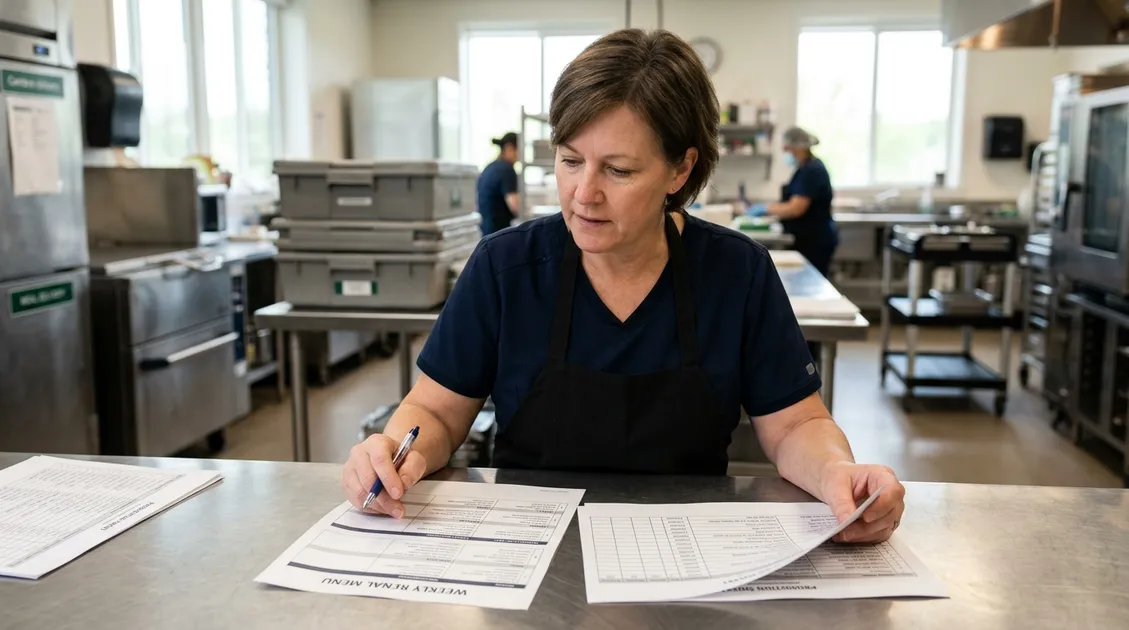
The kitchen binder holds six working records: the signed cycle menu, standardized recipes, production sheets, the substitution log, temperature logs and the diet roster. Together they show that the menu you posted is the menu you served. CMS's Kitchen/Food Service Observation pathway, form CMS-20055, directs nursing home surveyors to confirm staff follow the menus. Utah adds its own paper trail for assisted living. R432-270-22 requires the current week's menu posted for residents and a record of every substitution served. The same rule requires an approved dietary manual once any resident needs a therapeutic diet. Keep the binder in the kitchen, since the cook is the person who updates it. An office binder misses weekend updates, because the weekend cook cannot reach it. PantryTec's RD Approval Letter and weekly menu PDF go straight into the first tab.
The Six-Document Minimum Set
| Record | Proves | Location | Retention |
|---|---|---|---|
| Signed menu and RD letter | Menus were planned and approved | Binder tab 1; current week posted | No Utah period; keep the prior version |
| Standardized recipes | Yield and portions match the menu | At the prep station | Every recipe in the cycle |
| Production sheet | Planned and served portions | Prep station clipboard | Set in your policy manual |
| Substitution log | What changed and what replaced it | Beside the posted menu | 3 months (R432-270-22) |
| Temperature logs | Food stayed in safe ranges | Each cold unit and steam table | Set in your policy manual |
| Diet roster and tray cards | Trays match diet orders | At the tray line | Updated when an order changes |
What surprises many small operators is that a signed menu can still draw a citation when the plate does not match it. Our team's fix is one clipboard for the substitution log and production sheet, so the cook fills in both at once.
Retention Timelines by Document Type
Served substitutions carry the only retention clock in Utah's assisted living rule, and R432-150-22 matches it for nursing care. Set periods for other records in your dietary policies and procedures manual, then follow them.
Utah Rules
What Does Utah Require From an Assisted Living Kitchen?
Utah's assisted living food service rule, R432-270-22, requires three daily meals plus snacks, a signed menu cycle of three weeks or more, and substitution records. The Utah Department of Health and Human Services licenses these facilities and reviews those records. The rule also sets supply levels: one week of nonperishable food and three days of perishables for the planned menu. No more than 14 hours may pass between the evening meal and breakfast unless a nutritious evening snack is available. Anyone who prepares or serves food needs a current food handler's permit. A cook on food service duty may not be assigned concurrent duties outside the food service area. That line matters in a 6-bed home, where one employee can hold both jobs across a day. Staff who also work care or housekeeping shifts need hygiene and infection control measures the facility has developed and implemented.
- Any menu approved and signed by a certified dietitian, on a cycle of at least three weeks.
- The current week's menu posted for residents to read.
- Served substitutions recorded and kept for three months.
- An approved dietary manual once any resident needs a therapeutic diet.
- Documented dietitian consultation at least quarterly for therapeutic diets.
- Food service sanitation that meets Utah Rule R392-100.
Nursing care facilities under R432-150-22 follow a parallel rule with the same minimum cycle. A dietetic supervisor who is not a certified dietitian consults one at least monthly. Outside Utah, check your state's administrative code for its assisted living food service section.
Kitchen Roles
Who Is Qualified to Run the Kitchen Under F801?
F801 requires a qualified dietitian, or a designated director of food and nutrition services with a CDM or another listed qualification, under 42 CFR §483.60(a). The tag applies to Medicare- and Medicaid-certified nursing facilities, not state-licensed assisted living. A qualified dietitian holds a bachelor's in nutrition or dietetics, completes 900 supervised practice hours and holds state licensure or certification. If the dietitian is not full-time, the facility designates a director of food and nutrition services. That director needs one of five qualifications, such as a certified dietary manager credential or a food service management degree. The fifth path requires two or more years as a director plus a food safety course completed by October 1, 2023. The director must also receive frequently scheduled consultations from a qualified dietitian. A Utah assisted living home needs a certified dietitian's menu signature and quarterly consultation for therapeutic diet residents.
CDM, CFPP and RD Consultant Roles
| Role | Credential | Kitchen job | Named in |
|---|---|---|---|
| Qualified dietitian (RDN) | Bachelor's degree, 900 supervised hours, state license or certification | Reviews menus, consults on residents | §483.60(a)(1); Utah menu signature |
| Food and nutrition director | CDM or another listed qualification | Runs daily kitchen operations | §483.60(a)(2) |
| CDM, CFPP | Certified Dietary Manager, Certified Food Protection Professional | Supervises production and sanitation | Meets the F801 director path |
| Cook or kitchen aide | Current food handler's permit | Cooks to census, keeps logs | Utah R432-270-22(8) |
Consultant Dietitian Hour Requirements
Federal rules set no minimum consultant hours; §483.60(a)(2)(iii) calls for frequently scheduled consultations. Utah sets frequencies. Nursing care facilities with a non-dietitian supervisor consult at least monthly under R432-150-22. Assisted living homes document dietitian consultation at least quarterly for each therapeutic diet resident.

What a Cook Can and Cannot Decide
Within a cook's authority
- Scale portions to today's census.
- Serve an approved substitute of similar value, then log it.
- Offer an always-available alternate when a meal is refused.
Outside a cook's authority
- Change a therapeutic diet, which a physician or delegated dietitian orders.
- Change an IDDSI texture or liquid thickness without an order.
- Skip a posted item without logging the substitution.
Coverage Planning
How Do You Cover Weekends and Call-Outs Without Breaking the Menu?
Weekend kitchen coverage holds up when Friday-through-Sunday menu days rely on batch-cooked or premade components an untrained cover cook can heat, serve and log safely. Utah requires three meals a day, seven days a week, so Saturday carries the same legal weight as Tuesday. Coverage breaks in predictable places: an unrecorded swap, a skipped temperature log or a regular plate sent to a pureed diet. PantryTec's Weekend Hybrid menu style is designed around this staffing gap, with simpler weekend production. Every PantryTec menu also includes a safety-net alternative menu and an emergency pantry list. The alternative menu covers a missed delivery or a cook who calls out before breakfast. Utah already requires a one-week nonperishable and three-day perishable supply, so plan the backup menu around that stock. Log any swap during the same shift, while the details are fresh.
Pre-Prepped Weekend Menu Days
Prep weekend components late in the week, labeled and dated. CMS-20055 checks that opened containers and leftovers are dated or used within 7 days. Cooked food must cool from 135°F to 70°F within 2 hours, and to 41°F within 6 hours total, per the FDA Food Code 2022.
The Backup Cook Call List
Keep a two-deep call list: two trained backups for each regular cook, each with a current food handler's permit. A caregiver who covers the kitchen hands off care duties first, since R432-270-22 bars concurrent duties outside food service.
A scenario our team hears from small homes: the weekend cover cook swaps the posted entrée for a freezer meal, and nobody logs it. The swap is fixable; the missing record is what gets cited. The fix is an approved swap list printed on the back of the substitution log.
Simplified Recipes for Untrained Coverage
Cover cooks need fewer steps, not different food. Write weekend recipe cards with five steps or fewer, a scoop size and a final temperature. Keep texture versions on the same card. Level 5 minced and moist food is 4 mm or smaller, and IDDSI Level 6 soft and bite-sized pieces are 15 mm or smaller.
Inspection Day
What Does a Surveyor Check During a Dietary Kitchen Tour?
Nursing home surveyors start with a brief kitchen tour on arrival, checking thawing, date labels, hand sinks and hair restraints, according to CMS form CMS-20055. Food safety tag F812 ranked second among the most cited nursing home deficiencies in CASPER data current as of April 2025, per CMS Compliance Group. Surveyors return later to check storage temperatures, cooking temperatures and dish sanitation. Refrigerators must read 41°F or below, and steam table food must hold at 135°F or above. Poultry must reach 165°F, and reheated leftovers must reach 165°F for 15 seconds before hot holding. The menu check comes near the end, under F803: staff follow the posted menu, and it meets residents' needs. Staffing questions close the pathway with F801 qualifications and F802 staffing sufficiency. Utah assisted living kitchens follow the state food service sanitation rule, R392-100, for the same storage and temperature habits.
The Kitchen Walk-Through Sequence
- Arrival check of thawing, date labels, raw meat storage, hand sinks and hair restraints.
- Refrigerator and freezer readings, plus food stored 6 inches off the floor.
- Final cooking temperatures, steam table holding and cooling practice.
- Dish machines reaching a 180°F final rinse, or 50 ppm chlorine at low temperature.
- Staff following the posted menu, and the menu meeting residents' needs (F803).
The Dietary F-Tags Surveyors Check
F812 sits second on that national list, the highest of any dietary tag.
| F-tag | What it covers | Record to keep ready |
|---|---|---|
| F803 | Menus planned ahead and followed | Posted menu, production sheets, substitution log |
| F804 | Palatable food at a safe temperature | Holding logs and test tray checks |
| F805 | Food in the form each resident needs | Tray cards with IDDSI levels |
| F806 | Allergies, preferences, similar-value substitutes | Always-available list and substitution log |
| F808 | Therapeutic diets prescribed by a physician | Diet orders matching the diet roster |
| F812 | Sanitary storage, preparation and service | Temperature logs, date labels, sanitizer strips |
Resident Interview Questions About Food
Surveyors also interview residents about taste, temperature, choices and evening snacks. Your always-available list and bedtime snack record answer the last two before anyone asks.

Flat-Rate Pricing
What Does Menu Compliance Cost Small Senior Care Kitchen Operations?
PantryTec's dietitian-approved cycle menus cost $15, $20 or $40 per month in 2026 when billed annually, at any census, and therapeutic diet add-ons cost $5 per month each. The Starter Plan includes a 10-week rotating cycle, weekly PDF delivery and full dietitian approval. The Complete Plan adds cooking adjustment guidelines for common therapeutic diets. The Premier Plan adds customizable menus and expanded therapeutic coverage, including renal diet menus and dementia finger food menus. Per-resident menu programs, which PantryTec tracks at $3 to $5 per resident per month, work differently. A 16-bed home on that model pays $48 to $80 monthly, and the bill rises with every admission. At the low $3 rate, the $15 Starter Plan costs less once a home passes five residents. No PantryTec tier carries a long-term contract or setup fee.
| Plan | Monthly | Yearly | What's included | Built for |
|---|---|---|---|---|
| Starter | $15 | $180 | 10-week cycle, weekly PDF, RD approval | Small homes, adult day cares |
| Complete Recommended | $20 | $240 | Common therapeutic diet guidelines | Mid-sized assisted living, memory care |
| Premier | $40 | $480 | Custom menus, RD re-verification as needed, expanded therapeutic support | Medically complex residents |
| Therapeutic add-on | $5 each | $60 each | One diet, such as diabetic, renal or IDDSI | Adding a single diet |
Menu software is the other route, though your staff still build the menus inside it. Compare both in our senior living menu provider comparison and PantryTec vs BSN Solutions.
Get a quote for dietitian-signed menus
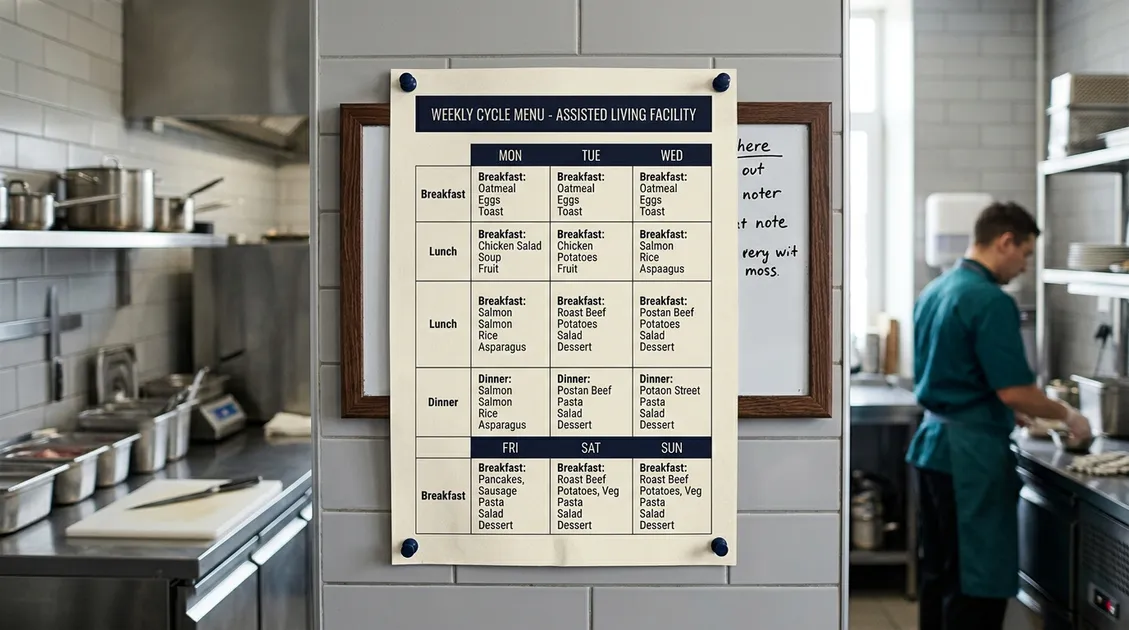
Share your bed count and diet mix, or first see how PantryTec's weekly PDF delivery works.
Quick Recap
Key Takeaways for Running a Small Cycle Menu Kitchen
- Utah assisted living menus need a certified dietitian's signature and a cycle of at least three weeks (R432-270-22).
- Cook to census from standardized recipes, and record planned and served portions on the production sheet.
- Post the current week's menu, and keep served substitutions on file for three months.
- Log cold and hot holding temperatures every shift against the 41°F and 135°F limits.
- PantryTec's flat-rate plans cost $15 to $40 per month billed annually, with $5 therapeutic add-ons and an RD Approval Letter.
Limitations and Considerations
- A signed menu does not replace clinical nutrition assessments or Utah's quarterly consultation for therapeutic diet residents.
- State rules differ, so confirm your license type's cycle, signature and posting rules first.
- At the $3 per-resident rate, flat pricing costs more for homes with fewer than five residents.
Common Questions
Frequently Asked Questions About Cycle Menu Kitchens
What is a cycle menu in senior living?
A cycle menu in senior living is a set of daily menus that repeats after a fixed number of weeks. Utah assisted living homes need at least a three-week cycle signed by a certified dietitian. PantryTec's cycle runs 10 weeks.
How many weeks should an assisted living cycle menu be?
An assisted living cycle menu in Utah must cover at least three weeks under R432-270-22. A dish repeats about 17 times a year on a 3-week cycle and about 5 times on a 10-week cycle. Other states set their own minimums.
Do assisted living menus have to be approved by a dietitian?
Assisted living menus in Utah must be approved and signed by a certified dietitian under R432-270-22. Nursing homes follow 42 CFR §483.60(c)(6), which requires dietitian review for nutritional adequacy. Rules in other states vary.
What does 42 CFR 483.60 require for menus?
42 CFR §483.60(c) sets six menu requirements for nursing homes. Menus must meet national nutrition guidelines, be prepared in advance, be followed, reflect residents' needs, be updated periodically and be reviewed by a dietitian.
How far in advance must menus be posted in a care facility?
Utah assisted living homes must post the current week's menu for residents under R432-270-22. Federal nursing home rules require menus prepared in advance but set no posting lead time. A week posted before Monday breakfast meets Utah's rule.
Run a survey-ready kitchen from one signed menu.
RD-approved cycle menus arrive weekly from $15/month, with no per-bed fees and an RD Approval Letter included.
Want to see a week of menus first?