
Wound-Healing and Protein-Boost Menu Adjustments
Food cost management in senior care controls how many dollars a facility spends feeding each resident daily, measured as a cost per resident day (PPD).
Food cost management in senior care controls how many dollars a facility spends feeding each resident daily, measured as a cost per resident day (PPD). Strong food cost management senior care programs keep it in check through cycle menus and cook-to-census production. PantryTec, a Springville, Utah menu service, builds both into one flat-rate subscription that starts at $15 per month, and every menu carries a Registered Dietitian signature. This guide breaks down PPD math, waste reduction, inventory tools, and when outsourcing beats hiring a consultant.
TL;DR: Track food cost per resident day (PPD); ANFP's skilled nursing median was $6.25 (2017 data). Cook-to-census production cuts waste 20-30%. Inventory tracking trims spending up to 15%. Outsourcing menu planning runs $15-$40/month versus the $800-$1,200/month consulting dietitian invoices facilities bring us, a 95% to 99% cost cut.
What Is Food Cost Management in Senior Care Facilities?
Food cost management in senior care is the practice of planning, buying, and portioning meals so total food spending stays inside a set Per Resident Day (PPD) budget. Facilities find PPD by dividing total food dollars by resident days in a period. Cost drivers include raw food price, plate waste, therapeutic diet complexity, and vendor markups. Federal rules under CMS §483.60 require menus that meet each resident's needs, so budgets can't come at the cost of nutrition. A Registered Dietitian Nutritionist reviews menus to confirm adequacy before any cut. Good programs treat food cost as a weekly KPI, not a number checked once a year at survey time.
Defining Per Resident Day Costs
Per Resident Day cost divides total food spending by total resident days. A 20-bed home spending $4,200 a month on food across 600 resident days runs a $7.00 PPD. PantryTec displays an estimated PPD on every sample menu, so you can budget before the first grocery order lands. Dig deeper with our walkthrough on PPD Food Cost Calculator, because PPD is the primary metric tracked under food cost management.
Key Cost Drivers in Senior Dining
Cost pressure comes from four levers: overproduction, weak inventory control, therapeutic diet premiums, and single-vendor pricing. Renal and cardiac plates cost more because they need specialty ingredients. Springville, Utah operators we serve often overspend on emergency grocery runs that carry mileage and labor no invoice ever captures.
What Is the Average Food Cost Per Resident Day in Senior Living?
One published benchmark comes from skilled nursing: ANFP's benchmarking survey (2017 data, published 2018) found a median food cost of $6.25 per resident day, with the middle half of facilities between $5.35 and $7.41. Higher resident acuity in skilled nursing drives more therapeutic diets. Skilled nursing facilities, governed directly by CMS §483.60, feed medically complex residents, so per-plate cost runs higher than a small assisted living home. Regional swings track local grocery prices and labor markets. The California Healthcare Foundation found home care supply is thin, with less than one home care bed for every four nursing home beds in most counties studied. That scarcity keeps occupancy high and makes tight budgeting essential. Almost 800,000 people live in licensed supportive housing nationwide, per the same California Healthcare Foundation report, so small PPD differences scale into large dollars sector-wide. The National Center for Assisted Living counts more than 28,900 assisted living communities in the U.S., each managing its own food budget.
| Skilled nursing facilities | Food cost per resident day |
|---|---|
| 25th percentile | $5.35 |
| Median | $6.25 |
| 75th percentile | $7.41 |
Skilled Nursing vs Assisted Living Costs
Skilled nursing plates cost more because more residents need renal, cardiac, or IDDSI texture-modified meals. Assisted living carries a lighter clinical load, so a well-planned ALF menu can keep food cost down while still meeting the Dietary Guidelines for Americans.
Regional Cost Variations
Regional grocery prices move PPD by a dollar or more between Utah and coastal states.
How Does Cook-to-Census Reduce Food Waste in Senior Living?
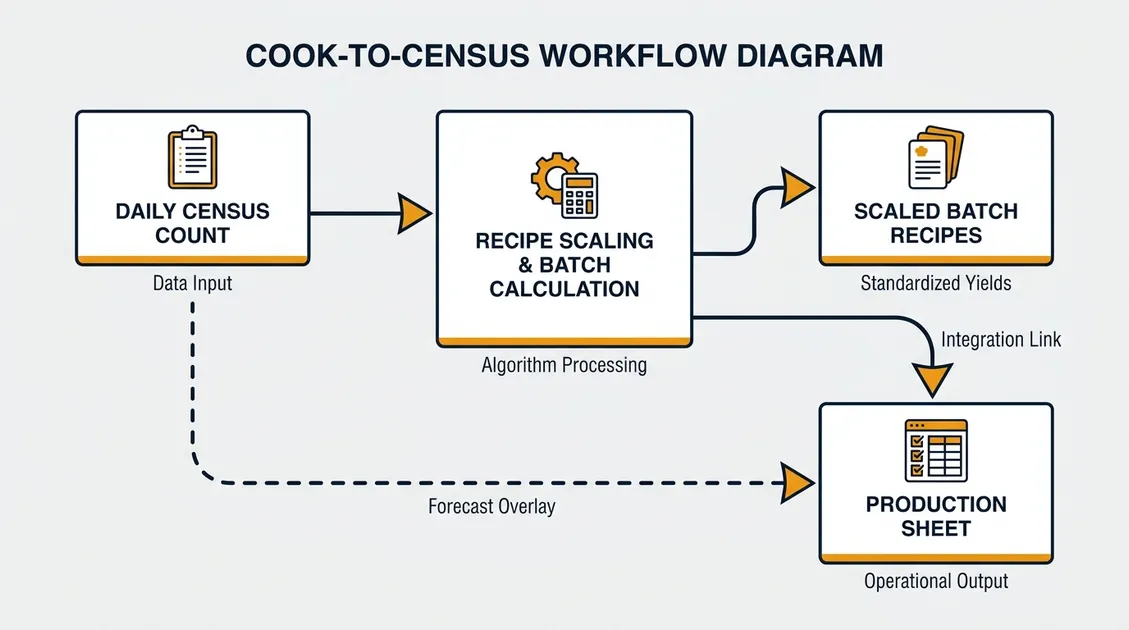
Food waste in senior living drops 20% to 30% when kitchens cook to the verified daily resident census instead of a full house, according to ENERGY STAR food service data. Staff count today's occupied beds, then scale batch recipes to that headcount. Overproduction is the biggest hidden expense in senior dining, because leftovers that cannot be safely reheld go straight to the trash. A 30-bed home running at 24 occupied beds wastes roughly a fifth of every batch cooked for 30. Cook-to-census forecasting converts that waste into savings without touching menu quality or resident choice. According to the EPA, institutional kitchens send large volumes of edible food to landfill, so forecasting is where the fastest budget wins live.
Matching Production to Resident Count
Production sheets scale each recipe to the morning census number.
Daily Census-Based Forecasting
Forecasting works best when the cook checks census before prep and adjusts portions using the scaling formula on the production sheet. Waste reduction ties directly to how well outsourcing quantifies these gains, which we cover in our ROI of outsourcing menu planning analysis.
Which Tools Track Inventory and Control Food Spending?
Food spending falls up to 15% a year when facilities adopt an inventory tracking system that curbs spoilage and flags supplier price swings, according to the National Restaurant Association. The long-term care software market is crowded and expensive: the Long-term Care Software Market Report prices its Full Research Suite at $5,000, $7,500, or $10,000 across 8 regions and 60-plus country-level data splits. Most small homes never need enterprise tooling that costly. A separate study of emerging long-term care technology interviewed 14 companies spanning sensors, machine learning, and mobile apps, showing how much software now targets this sector. Tools help only when staff actually use them, which is where simplicity beats feature bloat.
Inventory Tracking Systems
Inventory systems set par levels, catch shrinkage, and reconcile vendor invoices against the order. Tracking par levels stops the panic reorder that pushes PPD past budget.
Comparing Supplier Prices
Procurement cost comparison is a core lever of overall food cost management. Compare case prices across your distributors and order to census, so you never over-order to fill a truck.
Cost Model Comparison Matrix
Compare PantryTec flat-rate menu service against per resident menu software and a consulting dietitian. Enter your census to see estimated monthly cost for each option.
| Feature | PantryTec Flat Rate | Per Resident Menu Software | Consulting Dietitian |
|---|---|---|---|
| Pricing model | Flat rate from $15 per month | Charged per resident, per month | $800 to $1,200 per month |
| Scales with census | No, price stays flat | Yes, cost rises per bed | Varies, often hourly add ons |
| Registered Dietitian signature | Yes, on every menu | Usually not included | Yes |
| 10 week cycle menus | Included | Build your own | Custom, billed separately |
| Estimated PPD on menus | Shown per sample menu | Depends on data entry | Manual analysis |
| Cook to census production | Not included | Add on module | Advisory only |
| CMS 483.60 nutrition adequacy | Reviewed by RD | Facility responsibility | Reviewed by RD |
Estimated monthly cost by option
Figures are illustrative estimates. PantryTec starts at $15 per month (flat rate). Consulting dietitian range of $800 to $1,200 per month reflects the invoices facilities bring us. Per resident software cost uses the rate you enter above, since pricing varies by vendor. Confirm actual pricing with each provider before deciding.
How Do Dietitian-Approved Cycle Menus Lower Food Costs?
Dietitian-approved cycle menus lower food costs through standardized portions and consolidated purchasing: the kitchen orders against a known menu instead of planning meal by meal. A 10-week rotating cycle menu spreads 70 unique daily menus before anything repeats, so buyers order core ingredients in larger, cheaper lots. Standardized recipes lock portion sizes, which stops the accidental over-plating that inflates raw food cost. PantryTec menus carry a Registered Dietitian signature for the survey binder, satisfying CMS F-tags F803, F804, and F809. Therapeutic diet extensions for diabetic, renal, cardiac, and IDDSI texture-modified meals build off one base menu, so a facility skips separate ingredient lists. IDDSI compliance for pureed and minced textures follows the same recipe spine, keeping cost predictable even for medically complex residents.
Standardized Recipes and Portion Control
Standardized recipes drive the shopping list, the portion, and the cost. PantryTec's recipe library scales each dish to serving size, which removes guesswork and keeps carb loading in check on diabetic menus.
Therapeutic Diet Integration
Therapeutic diets add cost only when they run on separate menus. One base cycle extends to the common therapeutic diets on the Complete plan, and our high calorie intake cycle and other therapeutic diet menus reuse the same fortified ingredients to hold the budget.
Emergency Pantry and Disaster Menus
CMS requires senior care facilities to keep a 72-hour emergency food supply under the 2017 Emergency Preparedness. An emergency pantry list for senior care facilities stocks shelf-stable proteins and grains scaled to census, and our holiday menu planning for Thanksgiving and Christmas guide keeps seasonal spikes budgeted too.
Should Senior Care Facilities Outsource Menu Planning to Dietitians?
Senior care facilities that outsource menu planning pay $15 to $40 per month, versus the $800 to $1,200 on an external consulting dietitian's invoices, a cost cut of 95% to 99%. An in-house Registered Dietitian makes sense for large or high-acuity communities that need daily clinical oversight. Most assisted living homes under 50 beds don't. A subscription delivers dietitian-signed cycle menus without the retainer. The California Healthcare Foundation reports accreditation is already costly, with JCAHO charging $5,500 and CARF averaging $750 to $1,500 per home care program, so operators face heavy compliance bills before food even enters the picture. Outsourcing the menu function removes one recurring expense. It's proving compliance during unannounced state surveys. But, some clinical experts argue on-site dietitian assessment still matters for residents with unstable weight or complex swallowing needs.
| Factor | PantryTec Subscription | Consulting RD |
|---|---|---|
| Monthly cost | $15-$40 flat | $800-$1,200 retainer |
| RD signature | Included | Extra visits |
| Staff training | None, print and post | Not applicable |
| Therapeutic diets | Common therapeutic diets from one base menu | Custom, billed hourly |
| Contract | None | Often annual |
In-House RD vs Subscription Models
Subscription models fit small and mid-size homes; in-house RDs fit large SNFs. Compare full options in our best cycle menu providers 2026 rankings before you commit.
Compliance Risk Reduction
State rules, not just federal ones, govern assisted living dining. Utah's Bureau of Health Facility Licensing rule R432-270 sets ALF dietary standards, while California's Title 22 §87555 governs RCFEs. Federal CMS F-tags F800 through F809 apply to Medicare and Medicaid nursing facilities and serve as the benchmark most states model. Confirm your own state's rule with its licensing agency before survey season.
Limitations and Considerations
- A menu service does not replace an on-site RD assessment for residents with rapid, unintended weight loss.
- Complex dysphagia cases still need a Speech-Language Pathologist to set swallow-safe textures.
- CCRCs and multi-level communities may need layered clinical review beyond a cycle menu.
- State survey acceptance of a national remote RD signature varies, so verify your state accepts it.
- Flat-rate savings shrink at very large facilities where an on-staff dietitian spreads across more beds.
Key Takeaways for Senior Care Food Cost Management
Food cost management in senior care rewards facilities that track PPD weekly and act on the numbers. Here are the points worth pinning to the office wall.
- One published benchmark is ANFP's skilled nursing survey (2017 data): a median food cost of $6.25 per resident day.
- Cooking to census cuts waste 20-30% per ENERGY STAR data.
- Inventory tracking trims spending up to 15% a year, according to the National Restaurant Association.
- Dietitian-approved 10-week cycle menus steady purchasing while satisfying CMS §483.60 and F-tags F803/F804/F809.
- Outsourcing menu planning at $15-$40/month beats an $800-$1,200/month consulting dietitian by 95% to 99%.
Cost control starts with one menu. Get a free sample menu or calculate your per-resident savings at PantryTec's flat-rate plans from $15 per month, then call 385-512-4731 to schedule a dietitian consultation.
How do assisted living facilities plan menus?
Assisted living facilities plan menus using rotating cycle menus, usually 4 to 10 weeks long, reviewed by a Registered Dietitian for nutritional adequacy. Most states model CMS §483.60, requiring menus prepared in advance and followed. PantryTec delivers a 10-week rotation with 70 unique daily menus as weekly PDFs.
What is a cycle menu in senior living?
A cycle menu is a set meal schedule that rotates over a fixed period, then repeats. A 10-week rotating cycle offers 70 unique daily menus before any dish returns. Cycle menus stabilize purchasing, because the kitchen orders against a known menu instead of planning day by day.
Do assisted living menus need to be approved by a dietitian?
Most states require assisted living menus to be reviewed and signed by a Registered Dietitian, and simply listing restrictions does not satisfy that rule. PantryTec includes the RD signature with every plan for the compliance binder, matching CMS F-tag F803 expectations.
How much does a dietitian cost for assisted living?
The retainer invoices facilities bring us for a consulting dietitian run $800 to $1,200 per month. A subscription menu service with RD approval runs $15 to $40 per month, a 95% to 99% reduction.
How often should assisted living menus be reviewed?
Assisted living menus should be reviewed with each cycle change and at least quarterly, with a full annual review by a Registered Dietitian. Seasonal updates and new therapeutic diet admissions trigger extra reviews. PantryTec re-verifies menus as diets or regulations change.
Ready to Get Started with PantryTec?
Contact PantryTec today to learn how we can help.