
How to Build a Survey-Ready Dietary Binder:
Document Checklist
Build your dietary survey binder around 12 core document sets, led by the signed RD approval letter, menus as served, substitution logs and production records.
Build your dietary survey binder around 12 core document sets, led by the signed RD approval letter, menus as served, substitution logs and production records. Each set answers one question a state surveyor asks under 42 CFR §483.60 or your state licensing rule. PantryTec, a dietitian-approved menu company for senior living, built this checklist from the records its cycle menu service for senior care operators supplies.
TL;DR: File every document set in survey-pathway order behind one index. Get dietitian signatures with credential lines and dates. Reconcile logs quarterly. Rehearse before your recertification survey window opens, starting from a free 4-week sample menu download.
What Documents Belong in a Survey-Ready Dietary Binder?
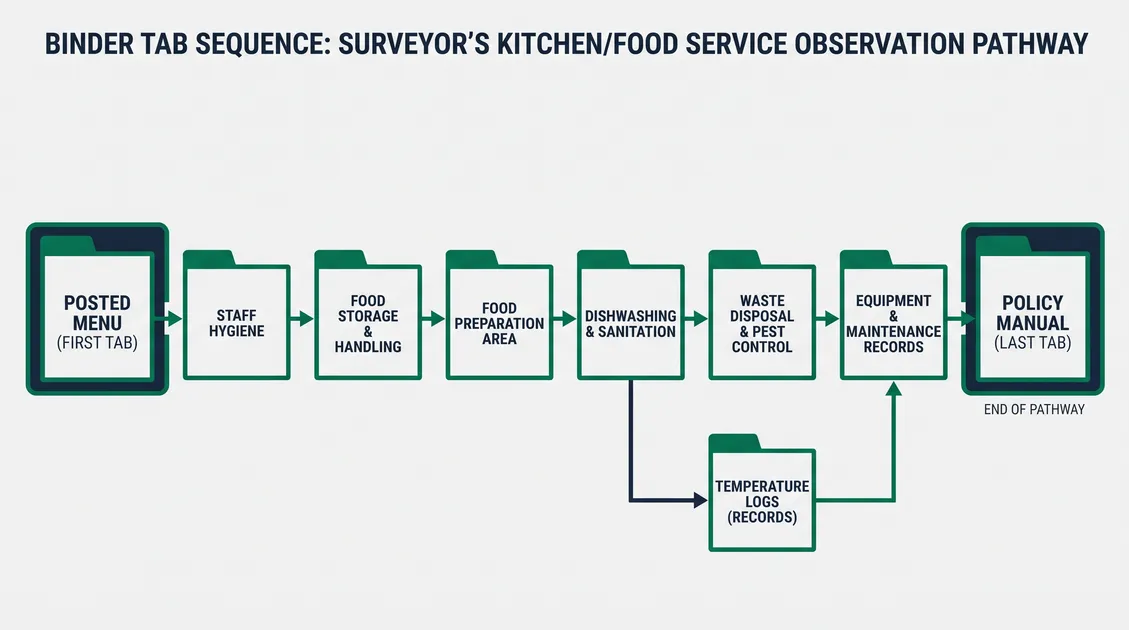
Dietary binders ready for survey prove three facts: a dietitian approved the menu, the kitchen followed it, and each diet order got its extension. The core record is the cycle menu: daily menus rotating on a fixed multi-week schedule instead of one static week repeated. A 9-step cycle menu build workflow ends in two outputs: standardized recipes and a nutrient analysis checked against the Dietary Reference Intakes. Menus as served, substitution logs and production sheets then show what left the kitchen. Diet spines extend the regular menu to consistent carbohydrate (CCHO), renal, 2-gram sodium and texture-modified orders. Each texture line names its IDDSI framework level: Level 4 pureed, Level 5 minced and moist, or Level 6 soft and bite-sized. Surveyors on the Kitchen/Food Service Observation pathway, described in CMS State Operations Manual Appendix, check the posted menu against the tray line. They then ask for these papers. A gap anywhere becomes a dietary deficiency citation.
Document meal times on their own tab. 14 hours is the longest gap allowed between a large evening meal and next breakfast for nursing home residents, per eCFR, 42 CFR 483.60 (2026). State rules govern assisted living. File HACCP temperature logs behind the production sheets, and keep hood fire-suppression records for the separate Life Safety Code survey.
| Document set | What it proves |
|---|---|
| RD approval letter contents | A qualified dietitian approved the menu |
| Cycle menu, standardized recipes, nutrient analysis | Portions meet DRI targets |
| Menu posting location and format | Residents see choices and meal times |
| Menus as served retention rules | What the kitchen actually served |
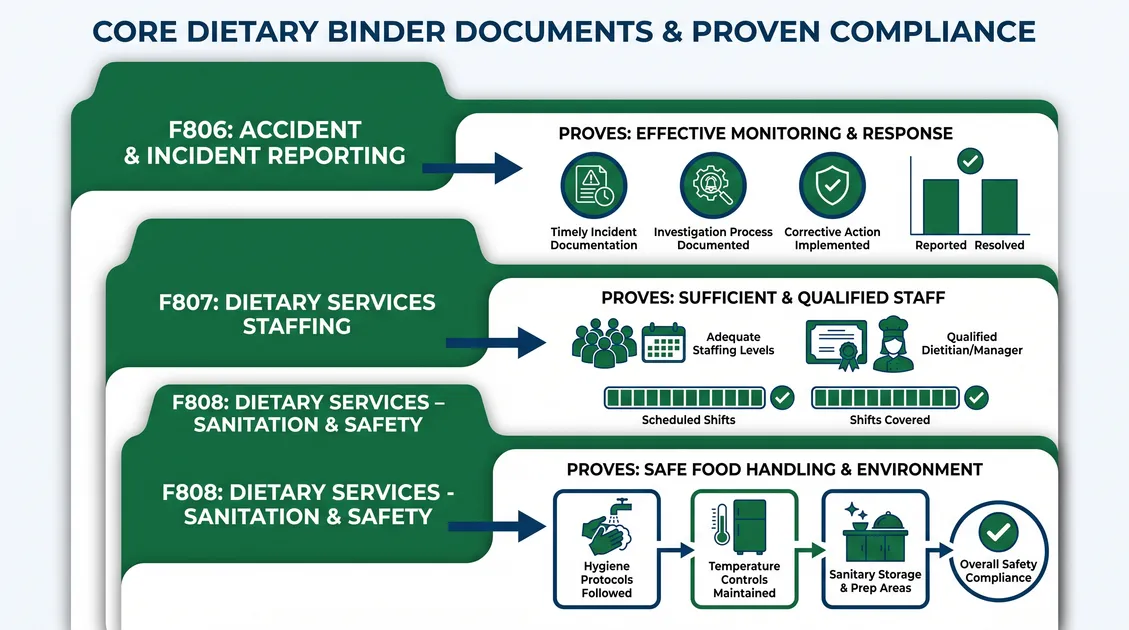
| Menu substitution logs that pass survey | Equal-value substitutes (F806) |
| Completed production sheets as evidence | Cook-to-census quantities and temperatures |
| Therapeutic diet spines and IDDSI sheets | Every diet order has a menu |
| Tray cards and diet rosters | Match to physician diet order (F808) |
| Preference and refusal records | Choice and always-available alternates |
| Weight, intake and hydration records | Fluids and outcomes (F807) |
| Annual menu review documentation | Menus remain current |
| Dietary policies and procedures manual plus diet manual | Who maintains each record |
Menu Survey-Readiness Self-Assessment
Rate each of the 12 core document sets in your dietary binder as Complete, Partial or Missing. Your readiness score and gap list update instantly, and you can email the gap report to yourself or your team from your own email app.

Your setting
Core document sets
Binder best practices
These are tracked separately and do not change your 12-set score.
Meal times tab: overnight gap check
Document meal times on their own tab. For nursing home residents, 14 hours is the longest gap allowed between a large evening meal and next breakfast (eCFR, 42 CFR 483.60). State rules govern assisted living.
Your readiness score
Gap report
Scoring: Complete counts as 1, Partial as 0.5, Missing as 0, out of 12 sets. This is a self-check, not a prediction of survey outcome. Nothing is sent or stored by this page.
How Should You Organize and Sign the Dietary Binder?
Binder tabs work best in survey-pathway order, not alphabetical, behind a one-page index, so staff can hand a surveyor any record in under two minutes. The index lists each tab, its record owner and the last review date. Pathway order follows the questions as they come: posted menu, menus as served, substitutions, production sheets, diet orders, tray cards, intake records and policies. Paper binders suit most small homes, and digital binders work when a printed index sits on top. Signatures follow the same discipline. A Registered Dietitian Nutritionist (RDN), credentialed by the Commission on Dietetic Registration, signs menus, nutrient analysis and the diet manual. 900 hours of supervised dietetics practice is the minimum for a qualified dietitian reviewing nursing home menus, per eCFR's 42 CFR 483.60 (2026). A certified dietary manager (CDM, CFPP) signs daily logs and production sheets, and a physician orders each therapeutic diet under F808. Every dietitian signature carries a credential line, license number and review date.
Survey anxiety, not menu quality, is the stress administrators raise with us first. Their worry is proving compliance during an unannounced state survey, and we have found a pathway-ordered index is the quickest fix.
We hear from clients that the numbers here match their day-to-day reality. Our Product Manager, Blake Oldham, has managed healthtech operations for more than 500 clients, and in senior care the biggest stress administrators raise with us isn't menu quality. The concern that comes up first is proving compliance during unannounced state surveys. One pattern we see is fewer dining complaints once a 10-week menu rotation is running. Residents get 70 days of menus, 210 breakfasts, lunches and dinners, before any day repeats.
Dietary Binder Tab Index and Cover Sheet Builder
Fill in your facility details, mark the status of each of the 12 core document sets, and download a printable tab index and cover sheet filed in survey pathway order. Start your rehearsal with the free 4-week sample menu.
Cover sheet details
12 core document sets: status
Binder readiness
The download is an HTML file built in your browser from what you entered. Open it and use your browser's print option to print or save as PDF. Nothing is sent or stored. This checklist is an organizing aid, not legal or regulatory advice; confirm requirements with your state survey agency.
Which Binder Gaps Trigger F806 and F807 Citations, and How Do You Test for Them?
Dietary citations under F806 and F807 start with predictable binder gaps: unlogged substitutions, preferences not tied to care plans, and hydration logs ending at mealtime. F806 covers allergies, preferences and substitutes of similar nutritive value, while F807 covers drinks that keep residents hydrated. Picture a cook who swaps baked cod for chicken and writes nothing down. The surveyor sees cod on the posted menu, chicken on the tray and no log entry. That one gap supports both an F803 menu-followed finding and an F806 substitute finding. Federal rule sets no fixed interval for dietitian menu review, so PantryTec recommends an annual review plus quarterly log reconciliation. A diet manual revision, a change of ownership (CHOW) or a census jump forces an earlier review. Book that review early, because binder sign-offs compete for busy dietitians. 200 referrals reached one MNT program from January to May 2019 and 300 by July, per the ACL's Medical Nutrition Therapy Works for Seniors toolkit.
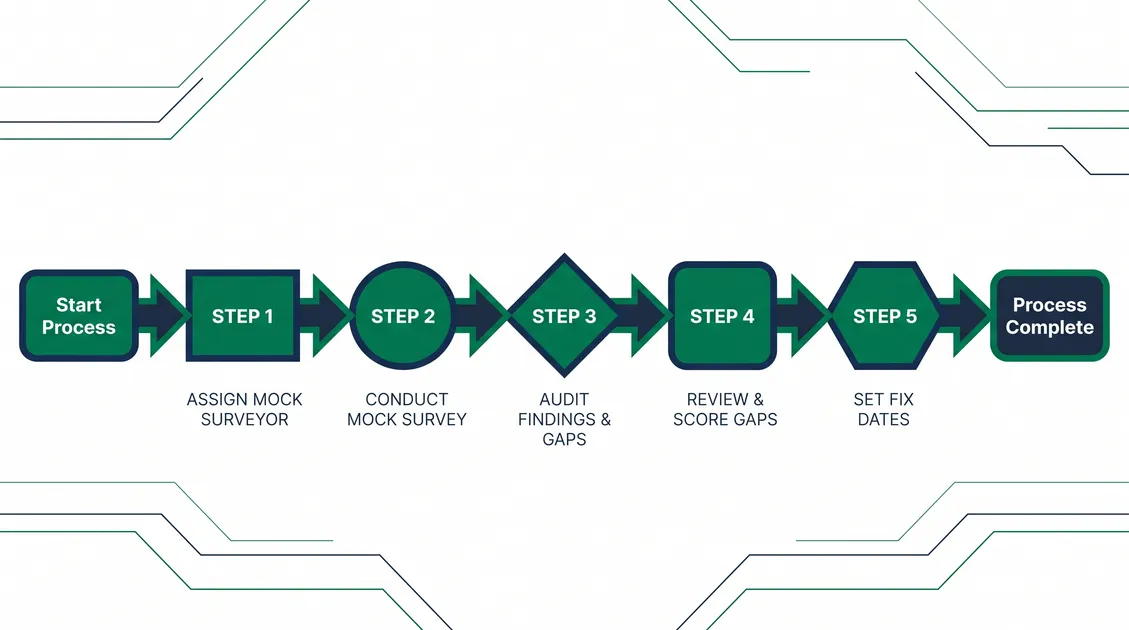
Survey rehearsal works best as a two-hour Mock Dietary Survey Audit modeled on the questions surveyors ask during a dietary survey walkthrough.
What Conventional Wisdom Gets Wrong
Conventional wisdom points the other way. Most facilities do not need to hire a dietitian for menus. In our work, here is why: a $15-40/month RD-signed cycle menu service replaces the $800-$1,200/month consulting fees on the invoices facilities bring us, a 95% to 99% cost reduction.
The misconception survives because the old math once held. Menu software makes your staff do the work. In our work, here is why: done-for-you PDF menus need zero training versus 4-8 weeks of software onboarding, and flat pricing beats $2-5 per resident per month.
On the other hand, every business weighs these trade-offs against its own situation. In contrast to one-size-fits-all advice, compare the options against your real numbers before deciding.
- Assign a staffer outside dietary to play surveyor.
- Request records cold and time each retrieval.
- Compare one day's posted menu, tray line and menus as served.
- Run a test tray audit and a plate waste audit.
- Score gaps with the 30-point mock dietary audit for survey readiness and set fix dates.
Key Takeaways: When Does Outsourcing Binder Documents Make Sense?
Dietary binder upkeep is worth outsourcing when no dietitian is on staff: PantryTec plans start at $15 per month billed annually, RD approval letter included. The Starter Plan delivers a 10-week rotating cycle menu as a PDF to your inbox every week. The Complete Plan, $20 per month billed annually, adds common therapeutic diets, a diet manual and recipes. It also adds a portion and texture guide and a food temperature log. The Premier Plan, $40 per month billed annually, adds menus customized to your residents once per rotation. Standard wisdom says every facility needs a consulting dietitian for menus, but PantryTec ships RD-signed menus because surveyors check signatures, not billed hours. Bridget MacDonald, RD (CDR registration 887107, 25+ years in nutrition), signs every approval letter for your compliance binder. First menus arrive within 24-48 hours of sign-up, with no setup fee or per-resident charge.
| Option | Cost per year |
|---|---|
| PantryTec Starter | $180 |
| PantryTec Complete | $240 |
| PantryTec Premier | $480 |
| Per-resident software, 30 beds | $720 to $1,800 |
| Outside dietitian | $9,600 to $14,400 |
- File every core document set in survey-pathway order behind a single index sheet.
- Put a credential line, license number and date on every dietitian signature.
- Reconcile substitution and hydration logs quarterly, because F806 and F807 findings start there.
- Rehearse with a cold mock audit before your recertification survey window opens.
Binder sign-off bills surprise most administrators. Facilities come to us paying $800 to $1,200 per month to an external dietitian for quarterly menu reviews and signatures. That's $9,600 to $14,400 a year, against $180 to $480 for a plan billed annually.
Limitations and Considerations
- Menu approval letters do not replace clinical dietitian assessments for individual residents.
- Menu signature authority varies by state, and Bridget MacDonald's license applications are pending in eight states.
- Binder records prove compliance only when cooks follow the menu and log every change.
Document gaps close fastest before a surveyor calls. Compare flat-rate menu plan pricing, get a dietitian-signed menu quote, or talk to a registered dietitian. For F-tag detail, see Menu Compliance.
What is a cycle menu in senior living?
A dietary cycle menu is a planned rotation of 3 daily meals plus snacks that repeats after a set number of weeks, approved by a dietitian in advance.
How many weeks should an assisted living cycle menu be?
Survey and licensing rules for cycle length come from each state, since 42 CFR 483.60 sets no minimum. Rotations of 4 weeks or longer limit repetition.
Do assisted living menus have to be approved by a dietitian?
Dietary approval for assisted living depends on state licensing, not federal rule. Utah's R432-270 and Utah's COMAR 10.07.14 each set their own menu rules.
What is F803 in a nursing home survey?
Survey tag F803 cites menus that miss nutritional needs, aren't prepared in advance, aren't followed or lack dietitian review under 42 CFR 483.60(c). See F803 menu requirements explained.
What does 42 CFR 483.60 require for menus?
Document rules in 42 CFR 483.60(c) require planned, followed, preference-based menus with dietitian review, while paragraphs (e) and (f) cover therapeutic diets and meal frequency. See the 42 CFR §483.60 requirements guide.
In our experience, most administrators who come to us don't realize their outside dietitian bill is 10 times or more what a year of menus costs. In kitchens our team has worked in, cooking to census cut food cost by about 12%. For Nursing home meal schedule, maximum gap between evening meal and breakfast typically runs about 14 hours (42 CFR 483.60, 2026) in day-to-day operations.
Explore Topics
8 related pages in this section
What Is in the PantryTec Compliance Documentation Package?
Diabetic consistent carb menus for senior care facilities deliver 45–60g carbs per meal. Cycle menus start at $15/mo (Starter); common therapeutic diets come with the Complete plan, $20/mo billed annually.
What Is in the PantryTec Compliance Documentation Package?→What Does 42 CFR §483.60 Require? Food and Nutrition Services Explained
RCFE cycle menus in California must meet Title 22 dietitian review standards. PantryTec delivers compliant 10-week rotating menus from $15/mo flat.
What Does 42 CFR §483.60 Require? Food and Nutrition Services Explained→F803 Explained: Menus Must Meet Resident Needs and Be Followed
Board and care home cycle menus from $15/mo. Dietitian-approved, 10-week rotation, common therapeutic diets, weekly PDF delivery. No contracts. Get a free sample.
F803 Explained: Menus Must Meet Resident Needs and Be Followed→F808: Why Therapeutic Diets Must Be Physician-Ordered
CCRC multi-level cycle menus from PantryTec serve every care tier, from IL through SNF, with dietitian-approved 10-week rotations starting at $15/mo.
F808: Why Therapeutic Diets Must Be Physician-Ordered→How Do You Correct an F803 Menu Citation? Plan of Correction Walkthrough
Hospice care cycle menus designed for comfort dining with dietitian approval, phosphorus management, and IDDSI texture modifications.
How Do You Correct an F803 Menu Citation? Plan of Correction Walkthrough→What Do Surveyors Ask During a Dietary Walkthrough?
Complete 2026 guide to senior care menu compliance: CMS 42 CFR §483.60, F-tag requirements, dietitian approval, and documentation checklists. Save $750+/mo.
What Do Surveyors Ask During a Dietary Walkthrough?→What Do Dietary Scope and Severity Levels 1–4 Mean?
Dietary scope and severity explained: the CMS A–L grid, four severity levels, three scope levels, and what each dietary citation really costs.
What Do Dietary Scope and Severity Levels 1–4 Mean?→Menu Service vs Spreadsheet Menus: What Breaks at Survey
Side-by-side comparison of PantryTec vs Grove Menus (Aline) for senior care facilities.
Menu Service vs Spreadsheet Menus: What Breaks at Survey→