
Food offered in a form that meets individual needs is the whole point of F805, the tag surveyors cite when texture doesn't match a resident's chewing or swallowing ability. The F805 food form standard comes from 42 CFR §483.60(d)(3), one rule inside the F800 to F814 food and nutrition group. Appendix PP tells surveyors to watch meal service and ask a blunt question: is the food cut, chopped, ground, or pureed for that resident's needs? Our dietary survey F-tag requirements overview maps the full series. This article stays on food form.
TL;DR: F805 requires food prepared in a form designed to meet individual needs. IDDSI supplies 8 texture levels and bedside tests that make the rule measurable. Severity letters J, K and L mean immediate jeopardy. Pureed cycles need their own nutrient analysis, and every tray ticket must match a dated diet order.
What Does F805 Require for Modified Texture and Food Form?
Food prepared under F805 must match three clinical facts about the resident: dentition, swallowing safety, and the ability to handle utensils. Appendix PP of the State Operations Manual directs surveyors to observe meals, look for residents struggling to chew or swallow, and confirm food arrives cut, chopped, ground, or pureed as the care plan states, per the CMS surveyor guidance. A modified texture diet is not the same thing as a therapeutic diet. Texture and altered fluid consistency address mechanical safety; a therapeutic diet controls nutrients such as sodium or carbohydrate. About 1 in 25 adults reports a swallowing problem in a given year, according to the NIDCD, and dysphagia is far more common in long-term care. Missing molars alone can justify a ground meat order. Adaptive dining equipment, including scoop plates, built-up handles, and nosey cups, counts as part of the food form answer.
Cut, Chopped, Ground and Pureed: Terms Your Diet Manual Must Define
- Cut: standard food sized down at the tray line by a dietary aide.
- Chopped: uniform small pieces for partial dentition or slow chewing.
- Ground: moist, cohesive protein, the classic dysphagia mechanically altered diet.
- Pureed: smooth, lump free, holds its shape, no chewing required.
- Altered fluid consistency: thickened drinks ordered at one named IDDSI level.
Food form rules reach past certified nursing homes. F805 binds Medicare and Medicaid certified skilled nursing facilities, and assisted living is licensed by states instead. Utah R432-270, California Title 22 §87555 and Washington WAC 388-78A-2300 all set food service standards for assisted living, and state surveyors apply similar tray line logic. Allergies and intolerances sit next door under F806.
F805 Menu Survey-Readiness Self-Assessment
Check every statement that is true of your facility today. The tool scores your diet order, care plan, and tray card documentation against the food form expectations in 42 CFR §483.60(d)(3) and Appendix PP, then lists your open gaps. Items marked critical are the ones tied to severity letters J, K and L (immediate jeopardy).

Nothing you type here is sent, stored, or emailed by this page. The copy button puts the report on your clipboard and the email button opens a draft in your own mail program, addressed to whoever you choose. This self-assessment is an educational aid, not a substitute for your state survey agency guidance, your diet manual, or clinical judgment.
How Should the IDDSI Framework Map to Your Cycle Menu?
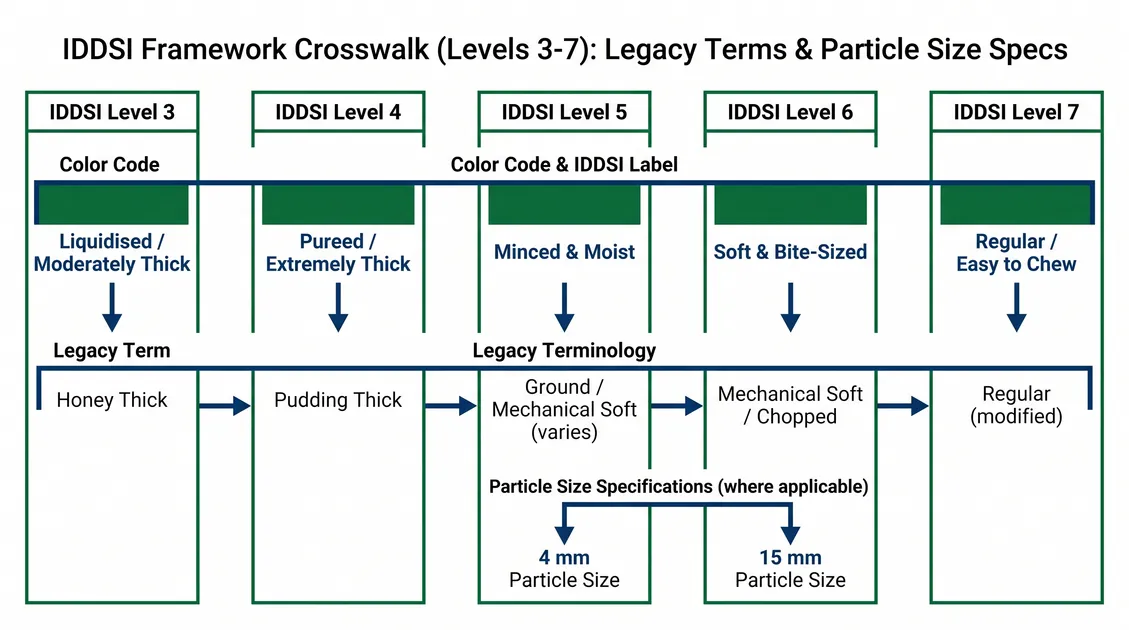
Food textures become measurable when the menu names an IDDSI level instead of a legacy word. The International Dysphagia Diet Standardisation Initiative defines 8 levels, numbered 0 through 7, with drinks covering levels 0 to 4 and foods covering levels 3 to 7, per the IDDSI framework. Level 5 minced and moist allows lumps no larger than 4 mm, which is the gap between the tines of a standard fork. Level 6 soft and bite-sized allows pieces up to 15 mm that squash under fork pressure. Legacy terms cause most of the confusion surveyors find, because mechanical soft, dysphagia advanced, and chopped mean different things in different kitchens. Your diet manual needs one crosswalk table, and the tray ticket should print the same level the speech-language pathologist recommended. Transitional foods, which change texture with moisture or heat, need a separate note.
| IDDSI level | Name | Color | Legacy term | Kitchen spec or test |
|---|---|---|---|---|
| 3 | Liquidised | Yellow | Thick pureed | Drips slowly through fork prongs |
| 4 | Pureed | Green | Pureed, extremely thick | Holds shape; spoon tilt test |
| 5 | Minced and moist | Orange | Ground, mechanical soft | 4 mm lumps; fork drip test |
| 6 | Soft and bite-sized | Blue | Chopped, dysphagia advanced | 15 mm pieces; fork pressure test |
| 7 | Regular or easy to chew | Black | Regular | No size limit; chew tolerance only |
Form and fluid tests each take under a minute. The 10 mL syringe flow test grades thin through moderately thick drinks by how much liquid is left after 10 seconds. Our IDDSI framework guide covering all 8 texture levels walks through every test, and the IDDSI Level 4 pureed shows how one base cycle extends downward. Whatever level prints on the ticket must trace back to an authorized order, which is why therapeutic and texture diets need a physician order.
Why Do Pureed Menus Fail Nutrient Analysis So Often?
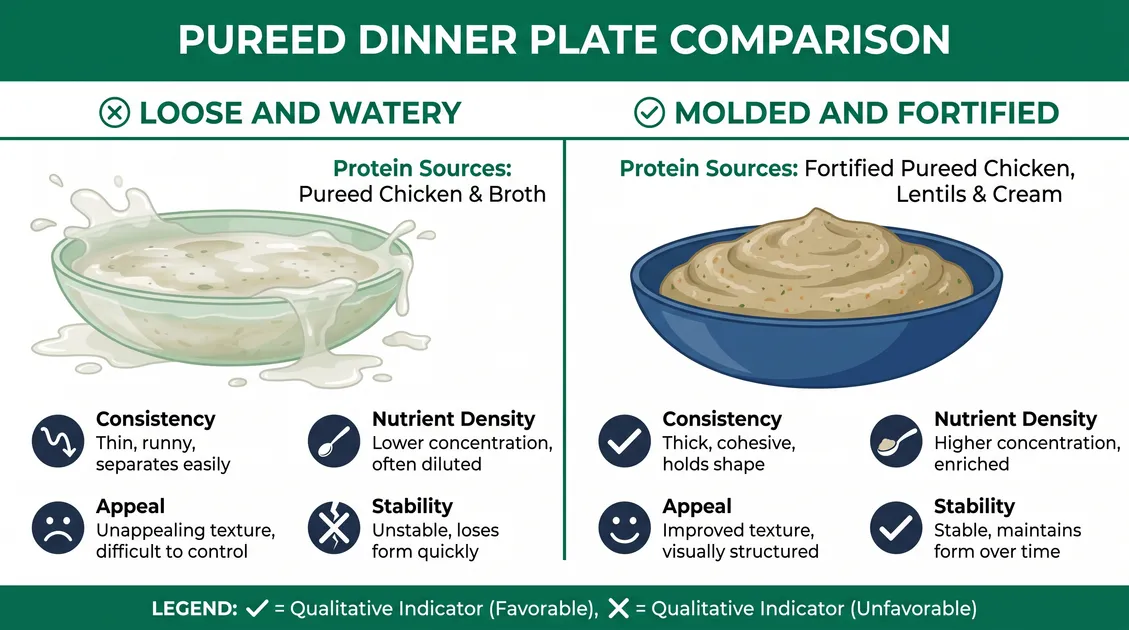
Food loses energy density the moment liquid goes into the blender. Broth, milk or gravy adds volume without adding much protein, so a scoop of pureed chicken delivers less than the whole portion it replaced. Run the pureed cycle's nutrient analysis against the Dietary Reference Intakes for adults 51 and older, and a diluted pureed cycle usually fails on protein first. Residents on texture-modified diets rarely close that gap with volume, since pureed portions fill the stomach faster. Food-first fortification fixes the math before supplements enter the conversation.
- Nonfat dry milk powder stirred into potatoes, soups, and hot cereal.
- Molded puree shaped into recognizable forms to lift intake and dignity.
- Whole milk, butter, or cheese as the thinning liquid instead of water.
- Fortified gravy on every pureed entree, portioned with a #8 scoop.
- High-calorie high-protein snacks twice daily, listed on the production sheet.
Food variety matters as much as density. Run a separate nutrient analysis for the pureed cycle rather than assuming the regular analysis carries over. Plate waste audits and test tray audits then tell you whether the fortified recipes are actually being eaten.
F805 Texture-Modified Sample Packet Builder
Pick your facility type, bed count, and state to size a 4-week texture-modified cycle. The tool builds a request summary you can carry straight to the PantryTec quote form. Nothing is sent from this page.
Your 4-week packet sizing
What the 4-week texture-modified sample packet covers
- Cut, chopped, ground, and pureed spreadsheets for every day of the 28 day cycle
- Altered fluid consistency plan tied to one named IDDSI level per order
- Pureed cycle nutrient analysis run separately from the regular menu
- Tray ticket template that matches a dated diet order, the document surveyors compare at the tray line
- Diet manual definitions page for cut, chopped, ground, pureed, and thickened drinks
- Adaptive dining checklist covering scoop plates, built-up handles, and nosey cups
| Level | IDDSI name | Kitchen term in your diet manual |
|---|---|---|
| 0 | Thin | Unthickened drinks |
| 1 | Slightly Thick | Altered fluid consistency |
| 2 | Mildly Thick | Altered fluid consistency |
| 3 | Liquidised or Moderately Thick | Altered fluid consistency |
| 4 | Pureed or Extremely Thick | Pureed, smooth, lump free, holds shape |
| 5 | Minced and Moist | Ground, moist cohesive protein |
| 6 | Soft and Bite-Sized | Chopped |
| 7 | Regular or Easy to Chew | Cut at the tray line |
Nothing on this page emails, stores, or generates a file. The button opens the PantryTec request page, where a person handles your packet.
What Documentation Links the Diet Order to the Tray Card?
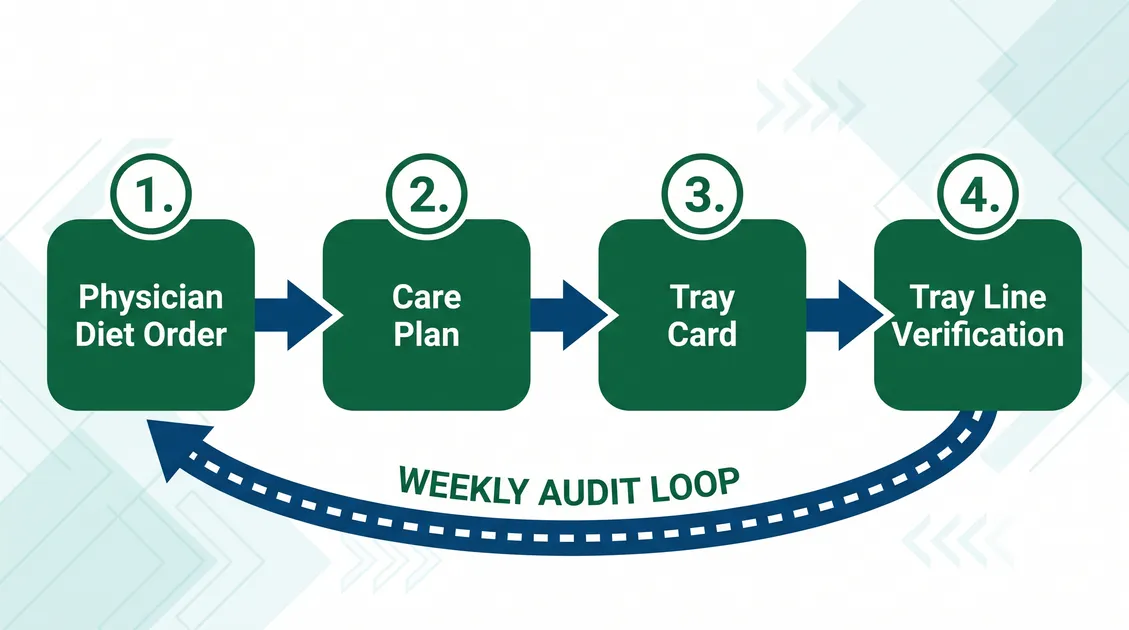
Food form documentation is a three-point chain: the physician diet order, the care plan, and the tray card or meal ticket the cook and dietary aide read. Surveyors start with resident record review on sampled residents, then stand at tray line observation and compare each plate against that paperwork. A mismatch becomes a survey citation even when no resident is harmed. Tray accuracy verification catches errors first, and it works only when one named person checks every tray against the diet roster before it leaves the kitchen. Keep dated sign-in sheets for texture training so you can show who was trained and when. Color-coded tickets, dated substitution logs and change-of-condition updates close the loop.
- Print the diet roster and compare it against physician orders dated this week.
- Pull 5 resident records and confirm the care plan names the same IDDSI level.
- Watch 10 trays leave the line against their meal tickets.
- Log every substitution the day it happens, noting equal nutritive value.
- File the speech therapy advice and the RD approval letter in the binder.
A signed dietitian-approved menu plus a dated substitution log answers the paperwork half of F805, and documented staff competency checks answer the rest.
When Does a Wrong Texture Become Immediate Jeopardy?
Food served at the wrong texture climbs the scope and severity grid as soon as a resident is harmed. The grid runs from letter A to letter L, pairing scope (isolated, pattern or widespread) with severity, and letters J, K and L signal immediate jeopardy, per the CMS scope and severity grid. Letters G through I mean actual harm short of jeopardy. A choking event that required the Heimlich maneuver, or aspiration pneumonia traced to thin liquids served against the order, is the classic path to an immediate jeopardy (IJ) citation. Per-day civil money penalties under 42 CFR §488.438 are adjusted for inflation every year; CMS's 2025 figures run $8,351 to $27,378 per day in the upper range used for immediate jeopardy and $136 to $8,211 per day in the lower range.
- A to C: no actual harm, minimal potential, no penalty in most cases.
- D to F: potential for more than minimal harm; correction required.
- G to I: actual harm, with pattern or widespread scope raising the letter.
- J to L: immediate jeopardy, removal plan due at once, denial of payment possible.
Form errors cost far less to prevent than to correct. A plan of correction on Form CMS-2567 is due within 10 calendar days, and it must show systemic change rather than retraining one aide. Weekly tray audits, documented competency checks, and a speech-language pathologist review after every change of condition block most escalation. Palatability and temperature standards under F804 apply to modified textures too, so a pureed plate still has to look and taste acceptable.
Key Takeaways on F805 Food Form Compliance
- F805 is judged at the tray line, not on paper: food form must match dentition and swallowing ability.
- Name an IDDSI level on every ticket instead of a legacy term such as mechanical soft.
- Run a distinct nutrient analysis for the pureed cycle, and fortify with milk powder, butter, and cheese.
- Reconcile order, care plan, and meal ticket weekly, logging substitutions the day they occur.
- Treat severity letters J, K and L as your cost ceiling, since daily penalties start there.
PantryTec menus arrive as facility-ready PDFs with an RD Approval Letter, and the texture-modified versions extend the same base cycle. Plans are flat at $15, $20 or $40 a month billed annually rather than per resident; the pricing page lists each tier, and you can download a free sample menu before deciding.
What is a cycle menu in senior living?
A cycle menu is a fixed set of daily menus that repeats on a schedule, often 3 to 5 weeks in senior care; PantryTec uses a 10-week rotation. Each day covers breakfast, lunch, dinner and snacks, plus an alternate for residents who decline the main item.
How many weeks should an assisted living cycle menu be?
Rotation length is set by your state licensing rule, and longer cycles cut repetition complaints. PantryTec builds 10-week rotations, so 70 daily plans run before anything repeats, with seasonal variants for spring, summer, fall, and winter.
Do assisted living menus have to be approved by a dietitian?
It depends on the license. Certified nursing facilities must have menus reviewed by the facility's dietitian or other clinically qualified nutrition professional under 42 CFR §483.60(c)(6). Assisted living follows state rules, and some states, such as Utah under R432-270-22, require a certified dietitian to approve menus. Keep the signed approval letter, with credential and review date, in the compliance binder.
What does 42 CFR 483.60 require for menus?
42 CFR §483.60 requires nourishing, palatable, well-balanced meals meeting each resident's nutritional needs, with menus prepared in advance and followed. It also caps the span between a substantial evening meal and breakfast at 14 hours (16 hours when a nourishing snack is served and a resident group agrees), and covers food form under F805.
How far in advance must menus be posted in a care facility?
Posting timing is a state licensing matter, and the common standard is the current week's menu displayed where residents can read it. Retain menus as served, with substitutions annotated and dated, for the retention period your state requires.