
How to Find
and Read State Menu Rule Citations for Your Facility
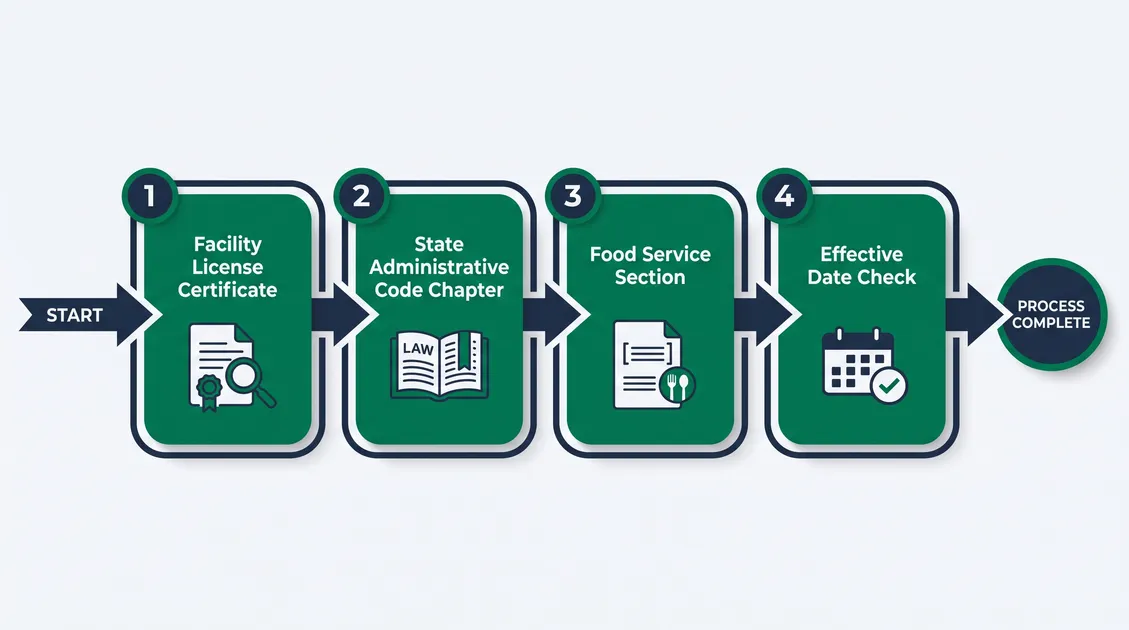
State menu rules sit in each state's administrative code, and you find yours in four steps: license type, code chapter, food service section, effective date.
State menu rules sit in each state's administrative code, and you find yours in four steps: license type, code chapter, food service section, effective date. Reading state menu rule citations means pulling out who signs the menu, how often it is reviewed, what gets posted, and how long records stay. PantryTec writes dietitian-approved cycle menus for senior care facilities against these rules, and this hub follows the same lookup our menu reviewers use. For signature, posting and retention differences side by side, see State ALF menu rules differ. For citation numbers, open the State Menu Regulation Citation Index; this guide teaches you to read the text behind each number.
TL;DR: All 50 states license assisted living under state law, and certified nursing homes add federal 42 CFR §483.60. Read each food service section for five elements: signer, daily meals, overnight gap, posting with substitutions, and retention. Review frequency ranges from annual to triennial to unstated. Utah names a state-certified dietitian as signer. Surveyors ask for the approval letter, dated menu and substitution log first.
Which State Agency Publishes the Menu Rule That Applies to Your Facility?
State licensing agencies publish assisted living menu rules, while certified nursing homes also follow federal 42 CFR §483.60 and its F800-series food and nutrition tags. The agency name changes by state. In Utah, the Department of Health and Human Services' Division of Licensing and Background Checks enforces R432-270. Florida's assisted living food standards sit in Chapter 58A-5, written by the Department of Elder Affairs and enforced by the Agency for Health Care Administration. California's Community Care Licensing Division inspects RCFEs under Title 22. Each agency runs its own state licensing survey, separate from the CMS certification survey a skilled nursing facility receives. That split matters because a surveyor cites the rule their own agency owns. Find the agency first, and the correct citation follows. Use the four-step lookup below, then read the subsections on jurisdiction, license type and online rule text.
- Identify your license type on the certificate, such as Type I ALF, RCFE or personal care home.
- Open the state administrative code chapter that matches that license.
- Find the food service, dietary or nutrition section inside that chapter.
- Confirm the effective date and any pending amendments before relying on the text.
Licensing Agency vs. Health Department Jurisdiction
Menu needs and kitchen sanitation often come from two different offices. The licensing agency writes the menu, meal and dietitian rules. A state or local health department enforces the food code, including HACCP temperature logs, the person in charge (PIC) and food handler permits. Check the letterhead on any deficiency before you open a rule book.
Facility License Type Determines the Citation
Rule citations attach to the license, not the building. Utah divides assisted living into Type I and Type II by resident care needs. Arizona separates assisted living centers from smaller assisted living homes, a split our Arizona assisted living center and home menu rules page walks through. Pennsylvania licenses personal care homes under a different chapter than assisted living residences. Our Pennsylvania personal care home and ALR menu rules guide flags this as a frequent lookup error.
Menu standards follow the same line between home and nursing care. 3.0 percent of U.S. women aged 65 and over lived in nursing facilities, compared with 1.8 percent of men, per the U.S. Census Bureau (2020). That group lives under federal menu standards plus state licensure. Assisted living, board and care and RCFE residents fall under state code alone.
Where the Rule Text Lives Online
Read the rule on the official state publisher, not a vendor summary. Utah posts R432-270 on the Utah Office of Administrative Rules, and Washington posts WAC 388-78A-2300 on the Legislature's site. Search results mislead: a query for Texas menus can surface the University of Texas at Austin Housing &. Food FoodPro app, a campus dining tool with no licensing force. Don't skip the effective date, and confirm it as of September 2026. The Utah ALF and group home menu rules under page is our worked example of this lookup.
Menu Survey-Readiness Self-Assessment
Choose your state and license setting, then rate each item as Yes, Partial, No or N/A. Your score and gap list update instantly. Items surveyors usually ask for first (approval letter, dated menu, substitution log) are marked Priority.
Your readiness results
Answer the items above to see your readiness level.
The email button opens your own email app with the report prefilled so you can send it yourself. This page does not send, store or collect anything. This self-assessment is a study aid, not legal advice: always confirm against the current text and effective date of your state's food service section.
What Five Requirements Appear in Almost Every State Menu Rule?
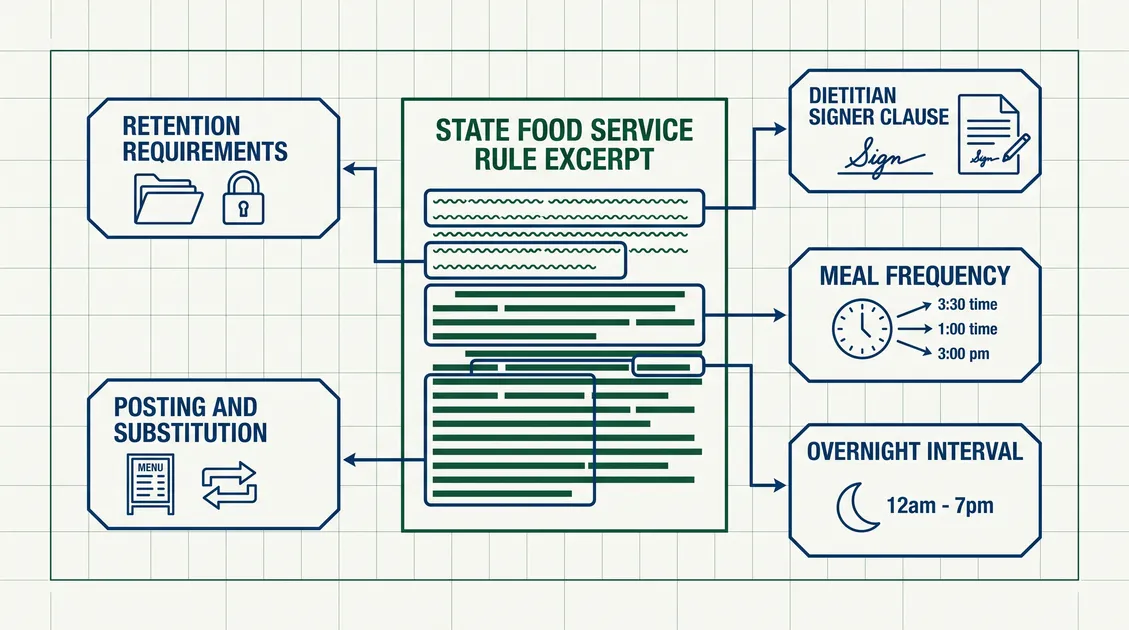
Menu rules in most state codes repeat five testable needs: a dietitian signer, daily meals, overnight gap, posting with substitutions, and retention of served menus. The wording changes far more than the substance. Utah's R432-270-22 has a certified dietitian approve and sign menus. Florida's Chapter 58A-5 names a registered dietitian or licensed dietitian/nutritionist as reviewer. California's Title 22 §87555 wants menus written in advance and posted where residents can see them. Each version tests the same two ideas. A qualified person checked nutritional adequacy against the Dietary Reference Intakes (DRI), and residents know what they will eat. Read each food service section with these five items as a checklist. You'll catch gaps before a state surveyor does, and you'll know which binder document proves each one. The table below lines up the anatomy with real citations.
| Requirement | What the rule tests | Example citation and wording | Proof a surveyor checks |
|---|---|---|---|
| Dietitian approval | Qualified review of nutrient adequacy | Utah R432-270-22: certified dietitian approves and signs menus | Signed RD approval letter with credential and date |
| Daily meals | Three meals every day, plus snacks | 42 CFR §483.60(f), the benchmark many state codes echo | Posted meal times and tray line records |
| Overnight gap | Limit between supper and breakfast | Washington WAC 388-78A-2300 meal spacing clause | Meal service time log |
| Posting and substitutions | Residents see the menu; changes are recorded | California 22 CCR §87555: menus written one week ahead and posted | Current week posted plus a menu substitution log |
| Retention | Proof of menus as served | Florida 58A-5.020: 6 months; Utah substitutions: 3 months; California: 30 days | Menus-as-served file with as-served annotations |
Dietitian Review and Approval
Rule language names the signer in different ways: registered dietitian, certified dietitian, licensed dietitian/nutritionist, or qualified consultant. Match the exact title your code uses. A signature from the wrong credential creates citation risk even when the menu is sound.
Meal Frequency and Overnight Interval
State codes pair the meal count with meal timing. Surveyors compare posted meal times with the tray line, so an early supper can break the rule with a perfect menu. Our complete Washington ALF menu rules resource shows one state's meal-spacing wording.
Menu Posting, Substitution, and Retention
Read the posting clause next to the substitution clause. Most codes expect an always-available alternate entrée and a logged substitute of similar nutritive value. Selective menus (a choice of entrées) and non-select menus (one plate) both need as-served notes. RCFE operators should keep the California RCFE menu rules in Title 22 §87555 page close, since retention there is the shortest in the table.
How Often Must a Dietitian Review Your Cycle Menu?
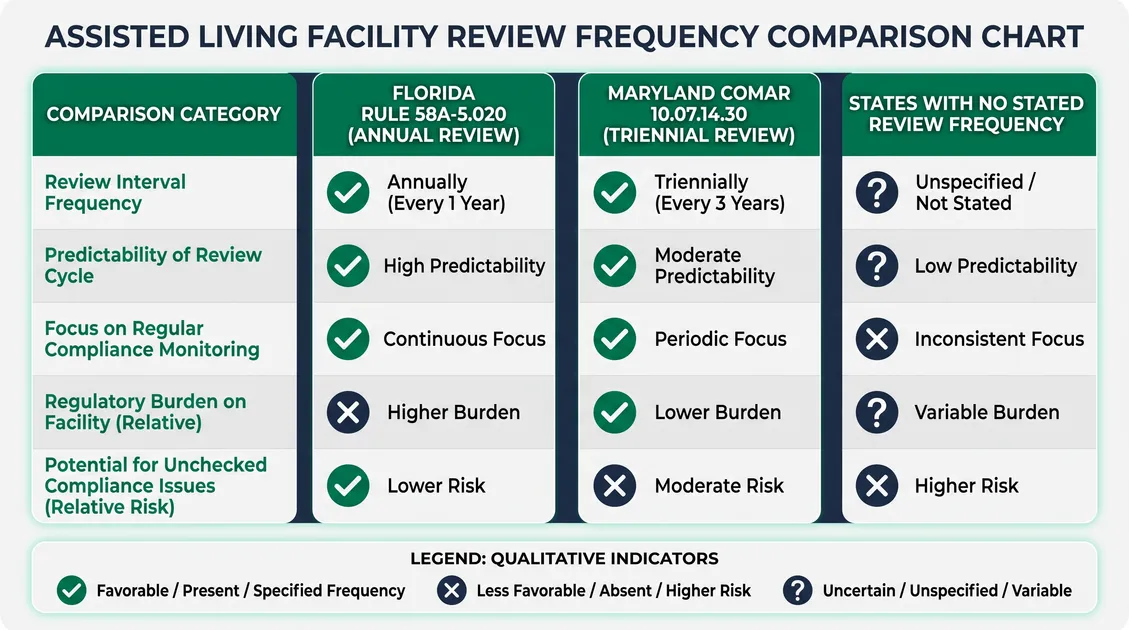
Menu review frequency follows three patterns: annual review in Florida, a three-year cycle for Maryland's four-week menu, and no stated interval in several other codes. Florida's Rule 58A-5.020 expects the reviewer to sign, date and add a license number. Maryland's COMAR 10.07.14.30 ties the review to the menu cycle itself. Silent codes carry the most risk. Surveyors in those states compare the date on your last approval with the menu in use. A cycle revised after the signature date is, in practice, an unapproved menu. Treat any change to recipes, portions or diet extensions as a trigger for a new review. A dated annual menu review record in the survey binder answers the frequency question in any state. Assisted living cycle menus that rotate over many weeks still need one signature covering the entire rotation and every diet it extends.
Annual Review States
Florida is the clearest annual example. A registered dietitian or licensed dietitian/nutritionist reviews menus each year and signs with credential details, even when nothing on the menu changed.
The concern administrators raise first is proving compliance during an unannounced state survey. A dated annual letter at the front of the binder settles that concern before the surveyor asks twice.
Triennial Review States
Rule text in Maryland gives assisted living programs a longer window between reviews. The served menu still has to match the cycle the dietitian reviewed, substitutions included. Our Maryland COMAR 10.07.14.30 four-week menu review requirement page shows the review record Maryland surveyors expect.
States With No Stated Frequency
State silence isn't permission to skip review. Use annual review as your default, because it is the shortest interval among the states in this guide. It also keeps your approval letter newer than your last menu change.
Who Is Qualified to Approve Menus in Your State?
Menu approval belongs to the exact credential your state code names: a CDR-credentialed registered dietitian (RD), a state-certified dietitian, or a qualified nutrition consultant. Utah shows why the exact title matters. R432-270 calls for a certified dietitian, and Utah certifies dietitians under the Dietitian Certification. The Division of Professional Licensing (DOPL) administers that certification. A national RD registration alone doesn't make someone a Utah certified dietitian. An out-of-state reviewer who signs Utah menus remotely should hold Utah certification, or the letter invites questions at survey. Texas answers the same question with its own wording, covered in our Texas assisted living menu and dietitian approval rules page. Read the definitions section of your code before you hire anyone. Definitions decide whether the word dietitian means registered, licensed, certified, or all three in your state.
Registered Dietitian vs. State-Licensed Certified Dietitian
State licensure or certification is legal permission to practice in one state, while registered dietitian nutritionist (RDN) is a national credential. A certified dietary manager (CDM, CFPP) runs the kitchen and often keeps the diet roster. That signature does not replace a dietitian where the code names one.
Consultant Dietitian Contract Requirements
Rule text in some states asks for a written consultant agreement listing duties and visit frequency. Community dietitian access is growing: one RDN program logged 200 referrals from January to May 2019 and 300 by July, per an ACL toolkit. The toolkit, Medical Nutrition Therapy Works for Seniors, reports that the program expected 500+ referrals by year end. For a small home, that means credentialed reviewers are reachable outside hospital systems.
Therapeutic Diet Order Authority
Therapeutic diets start with an order, not a menu. Most assisted living codes keep diet orders physician-driven, while federal F808 lets nursing homes delegate diet ordering to a dietitian where state law allows. The menu then extends that order: a consistent carbohydrate (CCHO) diabetic diet, a renal diet, or a 2-gram sodium cardiac diet. Texture orders add a mechanical soft diet or a pureed diet. The IDDSI framework numbers its texture levels from 0 to 7, so orders should name the level. See our therapeutic diet menu extensions, and read how Florida pairs menus with diet authority in Florida ALF dietary rules under.
What Menu Documents Will a Surveyor Ask For First?
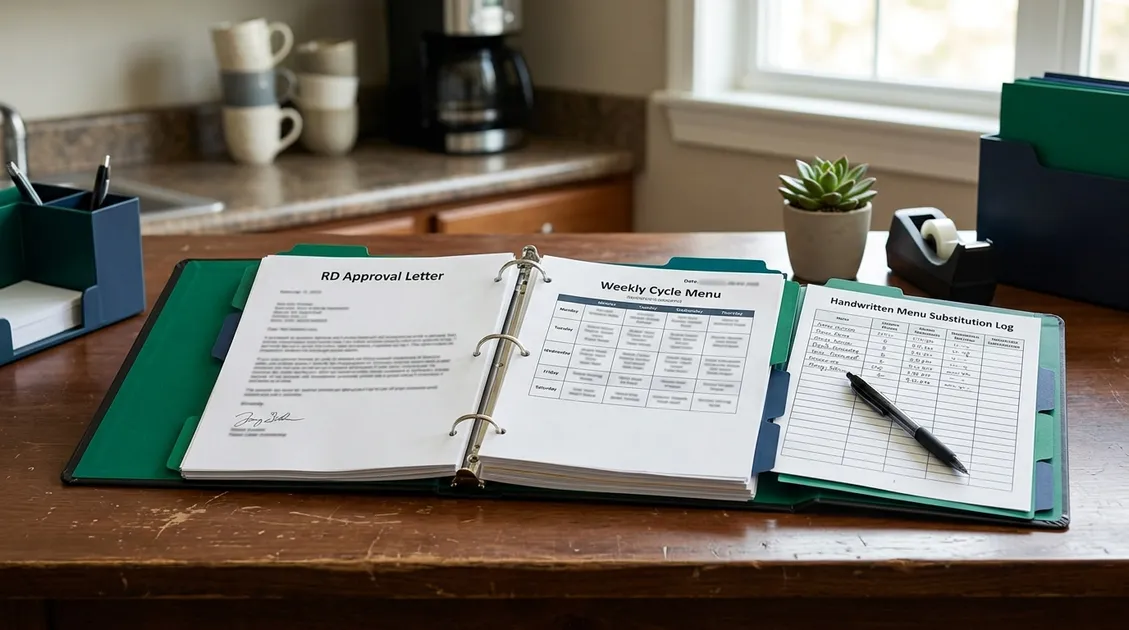
Menu documentation requests start with three items: the signed RD approval letter, the dated cycle menu for the current week, and the menu substitution log, with menus-as-served retention period at 6 months. Those items prove the rule anatomy described above: a qualified person approved the menu, the kitchen follows it, and changes were recorded. Next come menus as served, physician diet orders matched to the diet roster, and standardized recipes with portion sizes. A new license or a change of ownership (CHOW) often adds a licensure menu packet to the application. Keep everything in one survey binder, sometimes called a compliance binder, ordered the way surveyors ask. Nursing homes follow a similar order under the Kitchen/Food Service Observation pathway, so mixed campuses can share one binder layout. A defensible file is plain on purpose. Every page is dated, signed where required, and easy to find.
The Signed Menu Review Letter
The menu review letter should show five elements a surveyor can verify quickly:
- Reviewer name and credential, such as RDN, LD or state-certified dietitian.
- License or certification number wherever your state code requires one.
- Review date and the period the approval covers.
- The cycle and every therapeutic diet extension included in the review.
- A statement that nutrient analysis met Dietary Reference Intakes targets.
Dated Substitution Log
Menu substitution logs record the date, meal, planned item, substitute, reason and the staff member who approved the change. Log substitutes of similar nutritive value, such as baked fish for baked chicken, rather than a sandwich for a hot entrée.
Retained Served Menus
State retention clocks differ, as the five-needs table shows. Keep menus as served until your next survey, even if the minimum is shorter, because surveyors ask about the months since their last visit. Our complete Colorado ALR menu rules resource shows how one state words its retention citation.
How Do Federal Nursing Home Standards Differ From State ALF Menu Rules?
Menu timing in nursing homes follows F809: at most 14 hours from the evening meal to breakfast, or 16 hours with a nourishing bedtime snack. The longer window also needs agreement from a resident group, under 42 CFR §483.60(f). Assisted living has no federal menu rule. State code alone sets the signer, timing and retention, even where a state copies federal language. Nursing home surveyors work from the CMS State Operations Manual, Appendix PP, which explains how CMS F-tag F803 and its neighbors apply. Findings land on the CMS-2567 statement of deficiencies and are placed on the scope and severity grid, up to immediate jeopardy. A plan of correction follows, and serious findings can bring a civil monetary penalty. Read state ALF rules on their own terms, since the state licensing survey uses the state's forms and enforcement steps.
F809 Frequency of Meals in Skilled Nursing
The menu clock matters as much as the menu under F809. A cycle that serves a large evening meal early needs a documented bedtime snack with nutritional value, such as half a sandwich and milk. Skilled nursing facilities also answer to F803, which expects menus prepared in advance, followed, and reviewed by a clinically qualified nutrition professional.
Why ALF Rules Are State-Only
State control of assisted living menus exists because CMS certification covers nursing facilities, not assisted living. 82.0% of adults 65 and older in group quarters lived in nursing or skilled nursing facilities in 2014-2018, per the U.S, per U.S. Census Bureau American Community Survey (2018). Census Bureau (2018). Most institutional seniors sit under federal rules, which is why F-tag content crowds search results for assisted living questions.
Facilities Operating Both License Types
Menu design on mixed campuses and CCRCs should follow the stricter rule for each variable: federal meal timing, the state's signer title, and the longer retention period. Our guide on To pass a CMS dietary survey with F-tag menu requirements covers the nursing side. The page on what 42 CFR §483.60 requires explains the federal floor that state licensure rules build on.
Research Notes From Our State Rule Pages
State rule pages in this hub also carry research on home care supply, resident needs and funding. Each finding below lives on its owner page.
| Finding | Owner page |
|---|---|
| Between 50 and 64 percent of RCFE residents needing help with walking or wheeling reported needing more help than they received. | California RCFE menu rules and complete Oregon assisted living menus resource |
| Veterans are about 7 to 8 percent of U.S. adults and, after demographic controls, score lower on total HEI diet quality than nonveterans. | Florida ALF dietary rules |
| At most 10 to 20 percent of nursing home residents with only physical or cognitive impairments are likely assisted living transfer candidates under current policy. | Oregon assisted living and residential care menu rules |
| As of 2000, Medicaid waivers served about 59,000 supportive housing residents nationally, leaving about 80 percent of low-income RCF residents without that assistance. | Oregon residential care menu rules |
| The average assisted living company's common stock fell 70 percent by the end of 1999, and eight of ten publicly traded firms lost money that year. | Arizona assisted living menu rules |
| Maine, Ohio and Mississippi have similar nursing home residents per 1,000 aged residents despite different nursing home and RCF supply. | Ohio residential care facility menu rules |
Key Takeaways: How Do You Turn Your State's Menu Rule Into a Survey-Ready File?
- Find the rule through your license type first, because Type I, Type II, RCFE and personal care home chapters carry different citations.
- Read each food service section for five elements: signer, daily meals, overnight gap, posting with substitutions, and retention.
- Match the signer to your code's exact title, such as a Utah certified dietitian under Title 58, Chapter 49.
- File the dated approval letter, current cycle menu and substitution log together, since surveyors request those three first.
- Apply F809 and Appendix PP only under a nursing facility license; assisted living answers to state code alone.
Menu compliance is what PantryTec builds from this same lookup. PantryTec delivers a 10-week rotating cycle menu with an RD approval letter included for your compliance binder. Flat menu plan pricing at $15, $20 and $40 per month covers the Starter, Complete and Premier tiers, with no per-resident charge. Starter gives small assisted living homes, group homes and adult day cares one menu style of their choice. Complete adds all three menu styles and common therapeutic diets. Premier adds renal, cardiac, pureed IDDSI Level 4, dysphagia and a dementia finger food menu for memory, re-verified by a registered dietitian as needed. Run your bed count through the per-resident savings calculator on the pricing page before you renew a consultant contract.
That deliverable is nutrient analysis, a signature and a dated letter. The facility keeps a clinical dietitian for resident assessments where its code requires one. Our consultant versus PantryTec cost model for a small works through the math.
Dietitian fees are where operators see the gap first. We usually deliver the first menu PDF within 24 to 48 hours of signup.
Explore Topics
8 related pages in this section
What Does 42 CFR §483.60 Require? Food and Nutrition Services Explained
RCFE cycle menus in California must meet Title 22 dietitian review standards. PantryTec delivers compliant 10-week rotating menus from $15/mo flat.
What Does 42 CFR §483.60 Require? Food and Nutrition Services Explained→How State ALF Menu Rules Differ: Signature, Posting and Retention
Compare ALF menu requirements by state: who must sign cycle menus, when menus must be posted, and how long menus as served stay on file. Free sample menu.
How State ALF Menu Rules Differ: Signature, Posting and Retention→How to Pass a CMS Dietary Survey: F-Tag Menu Requirements
CMS menu compliance in plain English: F-tag menu requirements, the survey walkthrough, the documents surveyors ask for, and RD-signed menu pricing.
How to Pass a CMS Dietary Survey: F-Tag Menu Requirements→PantryTec Cycle Menu Service for Senior Care Operators
Download free sample cycle menus for senior care facilities.
PantryTec Cycle Menu Service for Senior Care Operators→Food Cost Control Guide
Gluten-free menus for senior living communities, dietitian-approved and built into 10-week cycle rotations. Plans from $15/mo. Get a free sample menu.
Food Cost Control Guide→Senior Living Cycle Menu Provider Comparison Matrix
Top 10 dietary survey deficiencies ranked: F812, F803, F809 mapped to 42 CFR §483.60, with CMP ranges and plan-of-correction fixes that hold.
Senior Living Cycle Menu Provider Comparison Matrix→How to Plan a Senior Living Cycle Menu: Step-by-Step Guide
Cycle menu planning for senior living, step by step: rotation length, recipes, DRI nutrient analysis, and the dated RD signature surveyors ask to see.
How to Plan a Senior Living Cycle Menu: Step-by-Step Guide→IDDSI Framework Guide for Senior Care Kitchens: All 8 Levels
IDDSI framework guide for senior care kitchens: all 8 levels (0-7), fork drip and spoon tilt tests, F805 survey rules, and cycle menu conversion steps.
IDDSI Framework Guide for Senior Care Kitchens: All 8 Levels→