
Menus for Assisted Living Facilities
Providing exceptional menus for assisted living facilities is one of the most effective ways to improve resident satisfaction and is a meaningful factor in move-in decisions. But a menu is more than just a list of food—it's an operational document that controls your budget, compliance, and kitchen workflow.
Explore Registered Dietitian (RD)–Approved Samples
One Week Menu Sample (Regular Diet)
This is what a typical Dietitian-Approved week looks like in our system. Balanced nutrition, vibrant variety, and cost-controlled.
Bacon
Toast
Berries
Boiled Egg
Sausage
Syrup
Muffin
Fruit
Turkey Bacon
Hashbrowns
Fruit Compote
Yogurt
Mashed Potato
Gravy
Rice Pilaf
Asparagus
Sweet Potato
Green Beans
Biscuit
Garden Salad
Brown Rice
Egg Roll
Roasted Potato
Coleslaw
Noodles
Peas
Soup of Day
Croissant
Chips
Tomato Soup
Roll
Cookie
Garlic Bread
Tartar Sauce
Caesar Salad
What Makes a Superior Senior Living Menu?
Seasonal Rotation
Residents love choices that reflect the time of year. Our Spring/Summer and Fall/Winter cycles ensure produce is fresh, affordable, and festive for holidays.
Operational Flexibility
An independent living facility shouldn't use the same menu as a skilled nursing home. Our system adapts recipes for "liberalized" diets or strict therapeutic needs instantly.
Cost-Effective Health
Healthy doesn't mean expensive. By using cross-over ingredients and precise portioning, we create heart-healthy, RDA-compliant menus that stay within a strict PPD budget.
Enjoyability First
Compliance matters, but flavor wins. We rely on herbs, spices, and visual appeal to ensure residents actually eat—and enjoy—the food we deliver.
Beyond the Menu: Your Operational Toolkit
A PDF menu isn't enough. PantryTec provides the complete ecosystem your Food Service Director needs to run a compliant, stress-free kitchen.
Automated Tray Cards
Stop hand-writing diet cards. Our system generates tray cards linked to the daily menu, automatically flagging allergies and dislikes for every resident.
Census-Based Prep Guidance
Staff knows exactly *how much* to cook based on your current census. "Cook 5lbs of carrots," not "Cook a bunch of carrots." This is key to waste reduction.
Ingredient Delivery
The biggest difference? We deliver the food. See how our logistics model saves you time compared to traditional shopping.
View Delivery Process →Budget Control
Know your PPD (Per Resident Day) cost before the month starts. Our buying power typically lowers food bills by ~12% (Source: Aline).
Calculate Your ROI →One Menu, Twelve Ways: Adaptation Matrix
Managing therapeutic diets is complex. We simplify it. Below is a real-world example of how a single day's menu is automatically modified for every resident in your care.
Eggs, Toast, Fruit
Roast Chicken, Mash, Beans
Turkey Sandwich, Veg Soup
Consistent Carb
Low K+ / Phos
Low Sodium/Fat
Restriction
No salt shaker
Gallbladder/Liver
GF Ingredients
IDDSI Level 6
IDDSI Level 5
IDDSI Level 4 (Smooth)
Memory Care
Fortified
Assisted Living Menu Examples
1. Basic, one-day assisted living menu with all diets covered
Below we have a comprehensive one-day menu view showing how one planned set of meals can be safely adjusted for different resident needs without running separate menus. This “all-diets” view helps managers and staff stay consistent, reduce errors, and keep service moving smoothly.
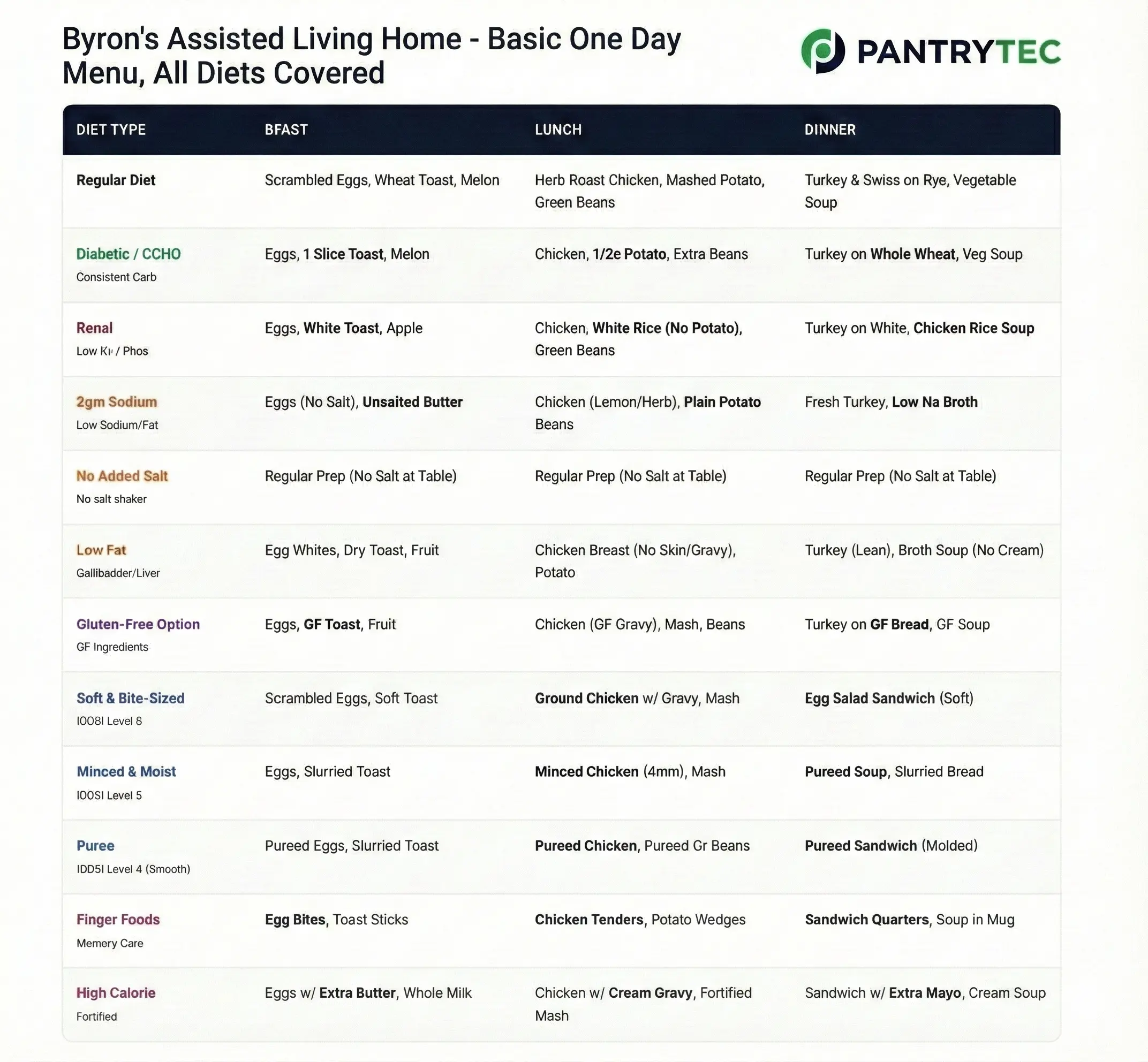
One core menu, clear modifications:
Portions are controlled (like toast or starchy sides) to help keep carbohydrates steady.
Higher potassium/phosphorus items are replaced with more appropriate choices (example: rice instead of potatoes).
Includes 2g sodium and no added salt approaches to support cardiac and blood pressure needs.
Provides easy-to-chew and swallow textures (soft & bite-sized, minced & moist, purée) to reduce choking risk.
Shows how meals can be served without gluten-containing bread products when needed.
Finger foods encourage independence and easier eating.
Adds calorie boosts (like whole milk, extra butter, cream gravy) for residents who need weight support.
2. Basic, one-week assisted living menu
Below is a one-week menu view (Breakfast, Lunch, and Dinner) showing exactly what’s being served each day—and the tools staff use to run service smoothly.
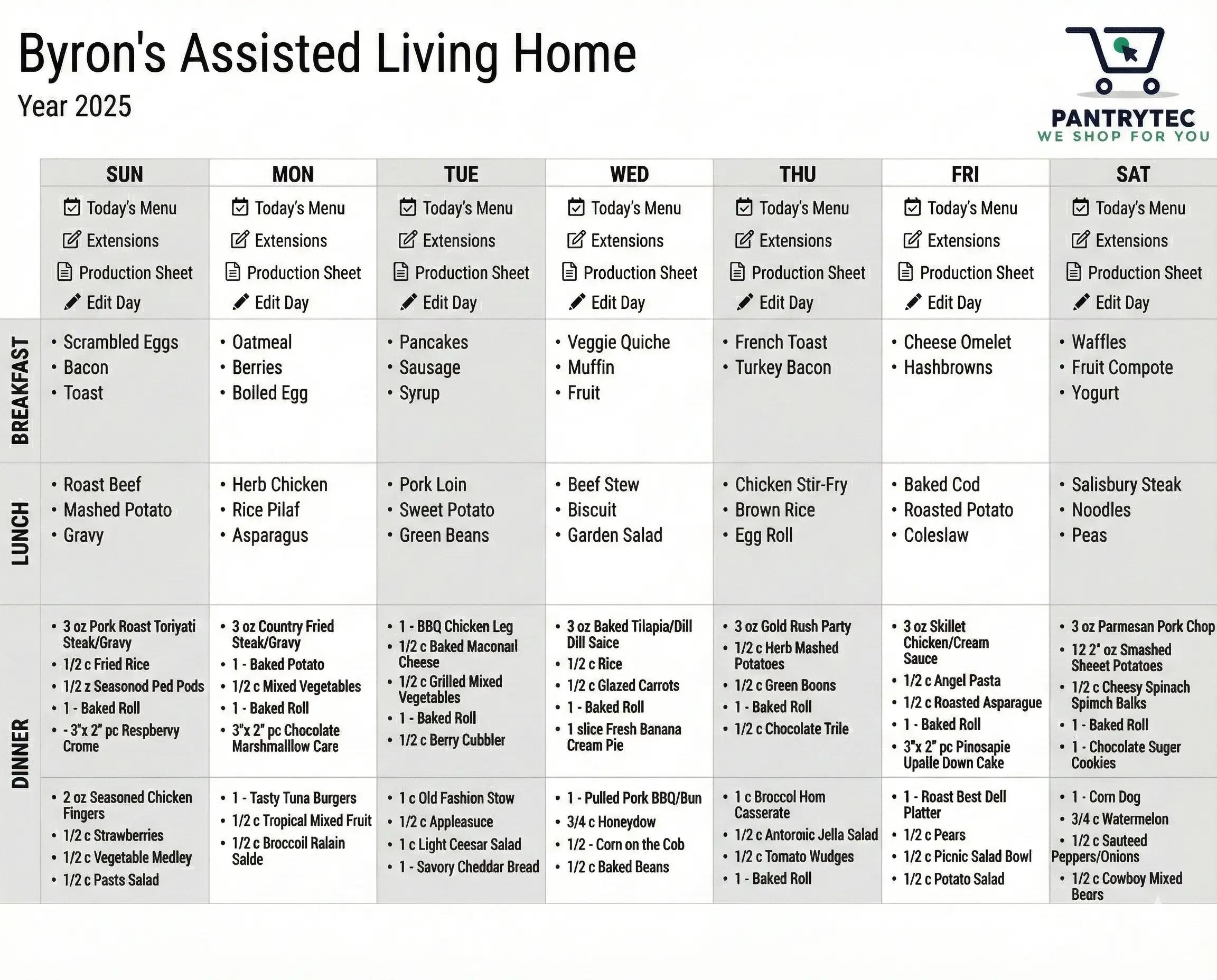
- A full 7-day snapshot: The grid lays out Sunday–Saturday so managers can quickly confirm variety, balance, and rotation across the week.
- Three meals, clearly separated: Breakfast and lunch list the main components for each day, while dinner includes detailed portions and sides.
- Built for daily execution: Each day includes quick links for Today’s Menu, Extensions, Production Sheet, and Edit Day.
- Production-ready details: Dinner lines show portion sizes (like 3 oz proteins) and measured sides, which supports accurate plating and predictable food cost.
- Simplifies training: New cooks and servers can follow the same playbook, and supervisors can spot issues fast.
- Helps reduce waste: When menus are planned with consistent portions and a production sheet, the kitchen can prep closer to the census instead of overcooking.
- Supports better communication: This format gives dietary, nursing, and kitchen teams one shared reference for what’s being served.
Frequently Asked Questions
Are the menus approved for my state?
Yes. All our menus are signed by a Registered Dietitian and meet CMS and state licensing requirements for assisted living facilities nationwide.
Can I customize the menu cycle?
Absolutely. Our platform allows you to swap entrees easily. The system automatically updates your shopping list and nutritional analysis instantly.
How do you handle allergies?
Our automated tray cards flag specific allergens based on individual resident profiles, ensuring kitchen staff provide safe, pre-approved alternatives.
What if I have a low census?
Our procurement logic scales down to your exact resident count. You won't be forced to buy bulk cases for empty beds, significantly reducing waste.
References & Data Sources:
- "Dining as a key driver of resident satisfaction." Source: FoodService Director / Senior Housing News.
- "12% reduction in food expenses via standardization." Source: Aline / Entegra Procurement Data.
- "IDDSI Framework and Testing Methods." Source: International Dysphagia Diet Standardisation Initiative (IDDSI.org).
- "Average PPD ($7.15) vs Retail." Source: PantryTec internal purchasing data vs. National Retail Averages (BLS).