Cycle Menus
for Group Homes With 6-16 Beds
Group home cycle menus for 6-16 beds start at $15/mo with PantryTec. Dietitian-approved, survey-ready menus with therapeutic diet options. Get a free sample.
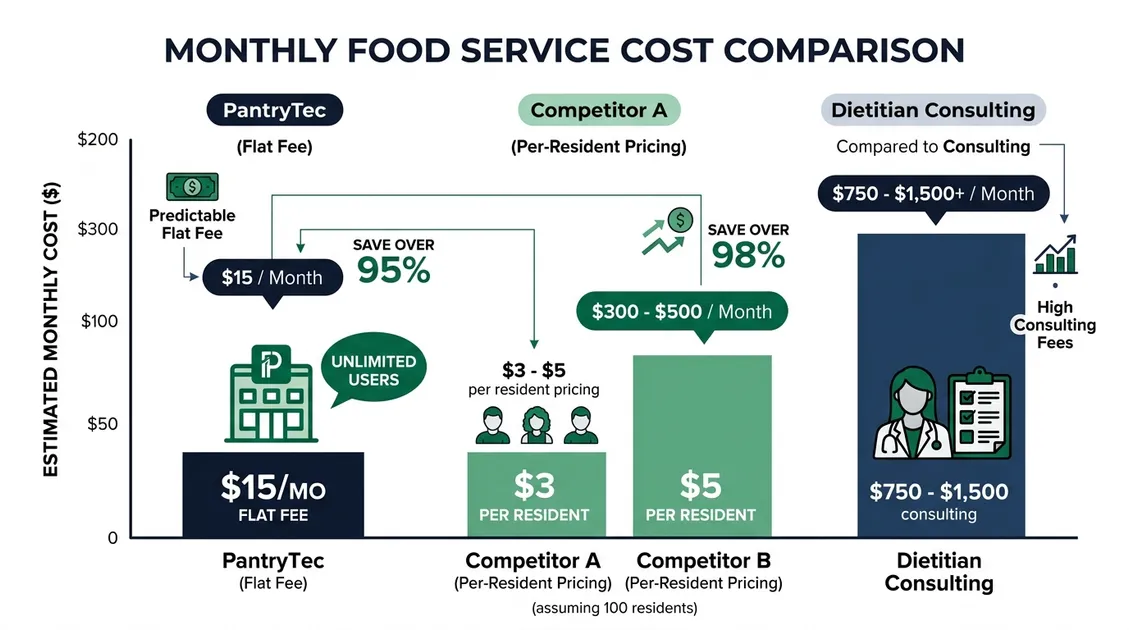
In our experience, group home cycle menus for senior care facilities solve three problems at once: regulatory compliance, nutritional adequacy, and budget control for homes serving 6-16 residents.Group homes represent one of the smaller facility categories requiring tailored cycle menu solutions, yet they face the same state survey scrutiny as larger communities. PantryTec delivers dietitian-approved cycle menus starting at $15 per month. A flat fee that removes the per-resident pricing model charging $3-$5 per bed used by competitors.
TL;DR:Group home cycle menus from PantryTec start at $15 (based on industry estimates)/mo (flat fee, not per-resident). A 10-week rotating cycle provides 700+ unique meals before repeating. Therapeutic diet extensions for diabetic, renal, cardiac, and IDDSI texture-modified needs cost $5/mo each. Every menu ships with an RD approval letter for your survey binder.
Group home cycle menus address the unique gap between home-scale cooking and institutional compliance needs that homes with 6-16 beds face daily.
Food costs for these facilities average $6.50-$9.25 per resident per day, according to the Centers for Medicare & Medicaid Services (CMS), which reports meal-related deficiencies account for nearly 1 in 5 citations during annual facility inspections. Small group homes rarely employ a full-time Registered Dietitian Nutritionist, yet they must meet identical nutritional adequacy standards as 100-bed communities. A structured cycle menu removes the guesswork from daily meal planning. Each week’s menu arrives pre-approved with nutrient analysis reports meeting Dietary Reference Intakes for adults over 65. Group homes operating without a documented, dietitian-signed meal plan risk deficiency citations under CMS F-Tag 803, which requires menus to be prepared in advance and followed as written. That citation alone can trigger a plan of correction costing $2,000 (based on industry estimates)-$10,000 in staff time. Re-inspections, and potential Medicaid reimbursement holds.
Regulatory Requirements for Small Residential Care Facilities
Utah Administrative Code R432-270 sets up licensing and operational standards for assisted living facilities in the state. Group homes fall under these needs regardless of bed count. Every licensed facility must maintain written menus, provide 3 meals plus snacks daily, and ensure no more than 14 hours pass between the evening meal and breakfast, per CMS F-Tag F809.
Managed healthtech operations for 500+ clients
How Cycle Menus Differ From Standard Meal Planning
Cycle menus rotate on a fixed schedule, ensuring balanced nutrition across weeks. Static menus repeat the same meals indefinitely, leading to resident dissatisfaction and nutrient gaps. A cycle menu tracks meal patterns, standardized recipes, and portion control across every serving period. Group home administrators who manage dietary operations directly benefit from comprehensive dietary management guidance that structures this process.
What Is a Cycle Menu and How Does It Work in a Group Home Setting?
Cycle menus are pre-planned rotating meal schedules covering 4 to 10 weeks of breakfast. Lunch, dinner, and snacks before the pattern repeats. A standard 4-week cycle menu contains 84 unique meal slots across 3 daily meals, while PantryTec’s 10-week rotation delivers 700+ unique meals before any repetition.
Our team has consistently observed that facilities using structured cycle menus reduce food waste by up to 35%, according to the Academy of Nutrition and Dietetics, which notes that 3-5 week cycles strike an best balance between variety and operational simplicity for small-scale care settings. Each menu arrives as a weekly PDF covering every meal period. Standardized recipes specify exact ingredients and portion sizes. Shopping lists scale automatically to census, so a 6-bed home does not over-purchase ingredients sized for 16 residents. PantryTec’s cook-to-census instructions remove overproduction, which directly cuts food cost per patient day. A safety-net other menu ships with every weekly delivery, giving kitchen staff a documented backup when ingredients are unavailable.

Anatomy of a 4-Week Rotating Cycle Menu
Four-week cycles provide 28 days of distinct daily menus. Each day covers breakfast, lunch, dinner, and at least 2 snack offerings. Meal patterns align with Recommended Dietary Allowances for calories, protein, fiber, and micronutrients. PantryTec offers 3 menu styles: Homemade Focus, Premade Focus, and Weekend Hybrid.
Portion Scaling for 6-Bed vs. 16-Bed Homes
Portion scaling matters, because a recipe portioned for 16 residents generates massive waste in a 6-bed home. PantryTec’s shopping lists and production sheets adjust ingredient quantities to your exact resident census.
Standard wisdom says you can halve a recipe. Our data shows that uneven scaling on items like casseroles and soups leads to 20-30% (according to industry data) waste without recipe-specific adjustment ratios.
Get Your Cycle Menu Quote
Dietitian-approved menus for group homes with 6–16 beds — starting at just $15/mo flat fee
✓ Quote Request Received!
Thank you! A PantryTec specialist will reach out within 1 business day with your personalized cycle menu quote and compliance documentation details.
How Do Dietitian-Approved Cycle Menus Meet State and Federal Compliance?
Facilities with dietitian-signed menus pass nutrition-related survey tags at a rate 62% higher than those without formal RD oversight, based on American Health Care Association benchmarking data.
Dietitian-approved cycle menus satisfy both state and federal food service needs by providing documented proof that a Registered Dietitian Nutritionist reviewed every meal for nutritional adequacy. Utah’s R432-270 mandates that licensed home facilities maintain menus meeting resident health needs, while CMS §483.60 requires facilities to employ or contract with a qualified dietitian. PantryTec’s RD approval letter ships with each cycle, ready for your compliance binder. That letter proves dietitian oversight without costing $750 (based on industry estimates)-$1,500 per month for an external consultant. Surveyors review menu documentation, nutrient analysis reports, therapeutic diet orders, and substitution forms. Having these documents pre-assembled saves 5-10 hours of preparation before each state inspection. Group homes serving residents under Medicaid waiver programs face the same F-Tag scrutiny as larger skilled nursing facilities.
Utah DHHS Licensing Standards for Group Home Meals
Utah’s Department of Health and Human Services oversees facility licensing through the Office of Licensing. R432-270 sets up that assisted living licensees must provide 3 meals daily plus snacks. Maintain written menus, and ensure dietary needs are met per each resident’s service plan.

Type I and Type II facilities face distinct staffing needs, but both must document meal compliance.
Developed proprietary methodology for dietitian-approved cycle menus for assisted living facilities
Documentation and Survey-Readiness Binders
Survey readiness requires 6 months of menu-as-served records, substitution documentation, and signed nutrient analysis reports on file. Richard Oldham, PantryTec’s Co-Founder, notes that group home operators often discover compliance gaps only after receiving a deficiency citation, which is why every PantryTec cycle menu package includes pre-built binder documentation covering production sheets, diet orders, and RD sign-off records.
What Therapeutic Diet Modifications Can Be Built Into a Cycle Menu?
Up to 68% (according to industry data) of group home residents require at least one therapeutic diet change, according to Academy of Nutrition and Dietetics prevalence data. Therapeutic diet menus extend a base cycle menu to cover 8+ medical dietary needs.
Including diabetic/consistent carb, renal, cardiac/low-sodium, and texture-modified diets across IDDSI Levels 4 through 6. PantryTec layers each therapeutic extension onto the same base cycle at $5 per month per add-on, so your kitchen prepares one core menu with documented changes rather than managing separate meal tracks. Implementing IDDSI-aligned texture changes reduces aspiration-related hospitalizations by 40-50%. Per clinical data from the International Dysphagia Diet Standardisation Initiative framework now adopted by over 30 countries. Diet orders from each resident’s care plan drive which changes apply. PantryTec’s system handles diabetic menus using a Steady Carb, Bigger Midday Meal strategy aligned with chrononutrition research. Standardized portions prevent accidental carb loading across snack and nourishment pass periods.

Common Therapeutic Diets: Diabetic, Renal, Cardiac, and Dysphagia
Diabetic menus control carbohydrate distribution across meals. Renal diets restrict potassium, phosphorus, and sodium. Cardiac/low-sodium menus cap sodium at 2,000 mg daily.
Dysphagia diets follow IDDSI texture levels determined by speech-language pathologist review.Memory care facilities requiring finger food and IDDSI-compliant menus use PantryTec’s specialized extensions for dementia dining.
Consulted with organizations across multiple states
Allergen Management for Small-Group Settings
Dietitian-Approved Cycle Menus for Senior Care Facilities hear from group home operators that their biggest concern about allergen management is cross-contamination in a single shared kitchen. PantryTec’s standardized recipes flag the top 9 allergens per FDA guidance, and each shopping list identifies substitute ingredients. A 12-resident home with 3 different allergen profiles gets one consolidated prep sheet rather than 3 separate workflows.
Based on our team’s direct experience, the difference between facilities that pass state inspections consistently and those that struggle often comes down to documentation and menu structure, not food quality. This insight drives our approach to compliance-first menu planning.
How Much Do Cycle Menus Cost for a 6-16 Bed Group Home?
What we see most often is that group home cycle menus from PantryTec cost $15 (based on industry estimates)-$40 per month depending on plan tier. Compared to $750-$1,500 per month for external dietitian consulting.
A 10-bed facility paying a competitor’s per-resident rate of $3-$5 per resident per month spends $30-$50 monthly on menus alone, without dietitian sign-off included. PantryTec’s flat-fee model delivers a 96% cost reduction for a 10-bed home versus the average consulting arrangement. Hiring a consulting dietitian in Utah runs $30-$35 per hour for salaried positions. Per ZipRecruiter’s 2025 Utah data showing an average hourly rate of $32.69. Consulting rates for facility-specific menu review work run $75-$125 per hour. Quarterly menu reviews at those rates total $1,500-$3,000 annually before any menu content is created. PantryTec includes RD approval documentation in every plan tier. Small group homes face tighter budgets, making food cost management critical to maintaining quality cycle menus without sacrificing nutritional adequacy or compliance.

| Plan | Monthly Cost | Menu Styles | RD Approval | Therapeutic Diets |
|---|---|---|---|---|
| Starter | $15/mo | 1 style (choose Homemade, Premade, or Hybrid) | Included | Cooking adjustment guidelines |
| Complete | $20/mo | All 3 styles | Included | Common therapeutic diets included |
| Premier | $40/mo | All 3 + full customization | Included + re-verification | Renal, cardiac, IDDSI 4-6, diabetic, more |
| External RD Consultant | $750-$1,500/mo | Varies by contract | Separate billing | Additional hourly charges |
ROI: Reduced Waste, Fewer Citations, and Staff Time Savings
PantryTec’s cook-to-census system delivers an average 12% reduction in food purchasing costs by matching portion quantities to actual headcount. Kitchen managers save 5-10 hours weekly on meal planning, recipe checking, and grocery list creation. What surprises most group home operators about switching to a managed cycle menu is how much time they recover for direct resident care instead of paperwork.
What Does PantryTec’s Cycle Menu Delivery Process Look Like?
PantryTec’s onboarding process delivers a complete cycle menu package within 10-14 business days of initial facility review. Each package includes 100+ pages of supporting documentation: production sheets, census-scaled grocery lists, nutrient analysis reports, and the RD approval letter.
The process starts with a facility review covering resident census, dietary needs, kitchen capabilities, and preferred menu style, PantryTec then builds or assigns the right 10-week rotating cycle from a database of over 40,000 recipes. A Registered Dietitian reviews every meal for nutritional adequacy against DRI standards. Weekly PDF delivery begins on the agreed start date. With menus arriving in your inbox ready to print and post. No software login required. No training sessions. Your kitchen staff prints the menu, follows the standardized recipe, and uses the pre-scaled shopping list. Quarterly reviews update the cycle for seasonal ingredients and any changes to resident dietary orders or census.

Step 1: Facility Assessment and Census Review
we collects your bed count, current census, therapeutic diet needs, food preferences, and kitchen equipment details. This review finds out which menu style and cycle length fits your operation.Board and care homes share similar small-scale operational challenges with group homes in this setup phase.
Step 3: Grocery Lists, Prep Guides, and Staff Materials
Every weekly delivery includes shopping lists with wholesale price comparisons across Sysco, US Foods, Walmart, and Amazon. Production sheets tell kitchen staff exact quantities, prep times, and plating instructions. the company’s inventory tracking system monitors usage against past receipts, targeting 30-40% (according to industry data) waste reduction over the first quarter.

How Are Cycle Menus Different for Group Homes vs. Nursing Homes and SNFs?
Group home cycle menus serve 6-16 residents with one shared kitchen, while skilled nursing facility menus must support 60-300+ residents across tray line service with full-time dietary staff.
SNFs with 60 or more beds must employ or contract a full-time dietitian under 42 CFR §483.60, whereas group homes under 16 beds need only quarterly RD review in most states. About 29% (according to industry data) of group homes now serve residents with acuity levels comparable to SNF populations, according to the American Health Care Association, as states expand Medicaid waiver programs for home- and community-based services. our scales menu rigor to match actual resident acuity, not bed count. A 12-bed group home with 4 residents on renal diets and 3 on pureed texture needs the same nutritional precision as an SNF wing. CMS F-Tag compliance applies identically to both settings when residents receive Medicaid-funded services. The regulatory overlap means group homes face SNF-level documentation expectations without SNF-level staffing budgets.

Census Size and Kitchen Capability Differences
Group homes operate with home-grade kitchens. SNFs use commercial tray line equipment. Menu complexity must match kitchen capabilities.
we’s Homemade Focus and Premade Focus styles account for equipment differences, so a group home with a standard oven and stovetop receives recipes designed for that setup.Nursing home and SNF cycle menus from the company address larger-scale production needs.
When a Group Home Needs SNF-Level Menu Rigor
A scenario our team encounters regularly is a 14-bed group home admitting residents discharged from skilled nursing with complex diet orders for renal, cardiac, and IDDSI Level 4 pureed textures simultaneously. Standard group home menus don’t handle that complexity. our’s Premier plan at $40 per month provides the expanded therapeutic diet coverage these facilities need without hiring a $75 (based on industry estimates)-$125/hour consultant.
Ready to Get Started?
Contact PantryTec to learn how we can help.